
CreaX for Supplement Brands: Ads and Pages From a Product Link
by the CreaX team
In this guide
- AudienceWho this is for: supplement and wellness sellers
- Why it mattersThe problem this solves
- The outputWhat CreaX produces from one product link or image
- IdeasSupplement ad angles that work without health claims
- Read this firstCompliance: what Meta and TikTok restrict for supplement ads
- Meta (Facebook and Instagram)
- TikTok
- The law behind the platforms
- How toStep-by-step workflow for a supplement brand
- ExampleWorked example: a small wellness brand
- PricingWhich CreaX plan fits a supplement brand?
- Do thisTips for better supplement ads
- Honest takeLimits and when to use other tools
- FAQFrequently asked questions
- Q.Can I advertise supplements on Facebook and Instagram?
- Q.Can I advertise supplements on TikTok?
- Q.Can I use before-and-after photos for a supplement?
- Q.Does CreaX write compliant copy automatically?
- Q.Can CreaX make ads in other languages?
- Q.How much does it cost?
Use case · Supplement and wellness brands
Supplement ads live under tighter rules than almost any other product, and they still need a steady flow of fresh creatives. CreaX helps supplement and wellness sellers turn a product link or photo into studio ads, UGC-style video ads and a landing page in about 60–120 seconds, so you can spend your time on the part that matters most here: making sure every claim is one you can stand behind.
By the CreaX team
Key takeaways
- ✓Who it is for: supplement, vitamin, protein, greens and wellness brands, plus dropshippers and media buyers who run ads for them.
- ✓What you get from one link or photo: studio ad creatives in five styles (Classic, Humble Orbit, Punch, Luxe, Meta Feed) and four sizes (1:1, 3:4, 4:5, 9:16), UGC-style video ads of 18, 30 or 45 seconds, and a landing page.
- ✓Angles that work without health claims: routine, taste and format, the ingredients exactly as listed on your label, convenience, and bundle or subscription offers.
- ✓The non-negotiable step: Meta and TikTok restrict health claims, body-image messages and wording about the viewer's health. Review every line of AI copy against your label and evidence before you run it.
In this guide
AudienceWho this is for: supplement and wellness sellers
This guide is for anyone selling ingestible wellness products online: vitamin and gummy brands, protein and sports nutrition stores, greens powders, herbal teas and collagen drinks, plus the dropshippers, affiliates, media buyers and agencies who advertise them.
If you are still comparing tools for the whole category, our list of the best AI tools for health and fitness brands covers the wider landscape. This article shows how CreaX fits into a supplement workflow and where the policy lines are.
Why it mattersThe problem this solves
Supplement brands face two problems at once. First, creative fatigue: winning ads slow down, and you need new angles, formats and sizes to keep testing. Second, compliance: the most persuasive-sounding copy (big promises about energy, weight or health) is exactly what gets ads rejected, accounts flagged, or a brand into legal trouble.
- Photoshoots and creators take time and money, and every new flavor or bundle needs its own set of ads.
- Generic AI copy tends to drift toward claims your product can't support, because that is how a lot of supplement marketing online is written.
- Rejections cost time. Each disapproval means rewriting, resubmitting and waiting while your test sits idle.
If your ads are already being disapproved, start with our explainer on why Meta and TikTok reject ads, then come back to build a cleaner set of creatives.
The outputWhat CreaX produces from one product link or image
Paste a product link (from your store, Alibaba, AliExpress, Amazon, Etsy or any product page) or upload a product photo, and CreaX gives you:
| Output | What it is | Supplement use |
|---|---|---|
| Studio ad creatives | Product ads in five styles: Classic, Humble Orbit, Punch, Luxe, Meta Feed | Clean product ads, flavor launches, premium looks for higher-priced blends |
| Four ad sizes | 1:1, 3:4, 4:5 and 9:16 | Feeds, portrait feeds, stories and Reels without manual resizing |
| UGC-style video ads | Videos of 18, 30 or 45 seconds | Routine, taste-test, unboxing and how-to-use angles |
| Landing page | Simple, Detailed or Advanced | A page per product, flavor or bundle offer |
| Multi-tenant store | Separate stores for brands or niches | Agencies or sellers running several wellness brands |
CreaX outputs as described on creax.io. You still decide which claims appear in the final ads and pages.
Our guide to studio ad creatives from one product photo shows how to get the cleanest product ads, which matters for supplements because a sharp, honest shot of the jar or pouch is often the strongest creative you have. For the page side, the CreaX landing page generator explainer walks through the Simple, Detailed and Advanced levels.
Turn your supplement into a full ad kit
Paste a product link or upload a photo and get studio ads, UGC-style video ads and a landing page in about 60–120 seconds.
IdeasSupplement ad angles that work without health claims
The good news: you don't need health promises to sell a supplement. Shoppers also buy on habit, taste, convenience, trust in the ingredients list and a good offer. These angles give each ad a real reason to exist while staying away from the claims platforms restrict:
- The routine angle: where the product fits in the day. "Part of my morning: one scoop in my smoothie." It shows use, not results.
- The taste and format angle: flavor, texture, how it mixes, gummy vs capsule vs powder. Taste-test videos work well as UGC-style ads.
- The ingredients angle: what is in the product, stated exactly as it appears on your label, plus what isn't (for example no added sugar, if that is true and on the label).
- The convenience angle: travel sachets, a jar that lasts a month, easy to take at work or the gym.
- The offer angle: bundles, multi-packs, a starter kit or a subscription with a real discount, explained clearly with the terms.
Offers deserve extra attention in this category because the product itself is hard to differentiate. Our FAQ on what makes a good ecommerce offer explains how to build one that doesn't rely on fake urgency, and the guide on ads for subscription products covers how to present a subscribe-and-save deal honestly.
★One angle per ad
Read this firstCompliance: what Meta and TikTok restrict for supplement ads
This is the most important section. Rules differ by platform and country and they change, so treat this as a summary of the official policy pages, not legal advice, and read the current versions before launching.
Meta (Facebook and Instagram)
Meta's Health and Wellness policy says ads for dietary, health, weight loss or weight gain products must be targeted to people aged 18 or older. It also prohibits statements of inferiority about physical appearance (negative terms, descriptions or questions that attack someone's appearance, body parts or hygiene), and for weight products it bans close-ups of pinched fat on a body area.
Separately, Meta's personal attributes policy says ads must not assert or imply personal attributes, including physical or mental health and medical conditions. In practice that means copy like "Are you tired all the time?" or "Struggling with your weight?" is risky, because it implies the advertiser knows something about the viewer's health. Describe the product instead: "A morning drink with B vitamins, as listed on the label."
TikTok
TikTok's Weight Management and Body Image policy says weight loss or muscle gain claims must be restricted to people aged 18 or older and framed around a healthy lifestyle. Its examples of what is not allowed include claims that a product alone, without diet or exercise, leads to weight loss or muscle gain, and suggestions that results are easy or guaranteed. Ads also must not shame people about their bodies, suggest there is an ideal body, or claim that looking a certain way brings confidence or success.
TikTok's Healthcare and Pharmaceuticals policy varies by market. In some countries supplements may be advertised with 18+ targeting, in some only with proof of local approval, and in some they are not allowed at all. Several market sections list claims to treat, cure, heal or prevent conditions, "miracle" claims, and before-and-after comparisons for food supplements as not allowed. Check the section for every country you target.
The law behind the platforms
Platform approval doesn't make a claim legal. In the US, the FTC's Health Products Compliance Guidance explains that health claims need competent and reliable scientific evidence. In the EU, health claims on foods, including food supplements, generally have to come from an authorized list. Other countries have their own regulators and rules. The safe default everywhere: only say what your label and your evidence support.
| Avoid | Why | Write instead |
|---|---|---|
| "Cures", "treats", "heals", "prevents" | Medical claims are restricted on both platforms and regulated by law | What the product is and how you take it |
| "Guaranteed weight loss", "lose 10 lbs fast" | Guaranteed or easy results are listed as not allowed | Routine, taste and format angles |
| "Are you tired?", "Hate your belly?" | Implies health attributes or attacks appearance | "One scoop in your morning smoothie" |
| Side-by-side body before-and-after | Restricted for supplements in many markets | Product, routine and unboxing shots |
| Ingredient benefits you can't prove | Needs evidence; label rules apply | Ingredients exactly as on the label |
Simplified examples based on Meta and TikTok policy pages. Rules vary by country; check the current pages and your local regulations.
Policy wording checked on Meta's Transparency Center and TikTok's advertising policy pages, October 2026.
If you plan to use AI presenters, read whether AI UGC ads are allowed on Meta and TikTok first, and see how to make before-and-after ads that don't get rejected for why body transformations are the wrong format for supplements.
!Always review AI copy before running it
How toStep-by-step workflow for a supplement brand
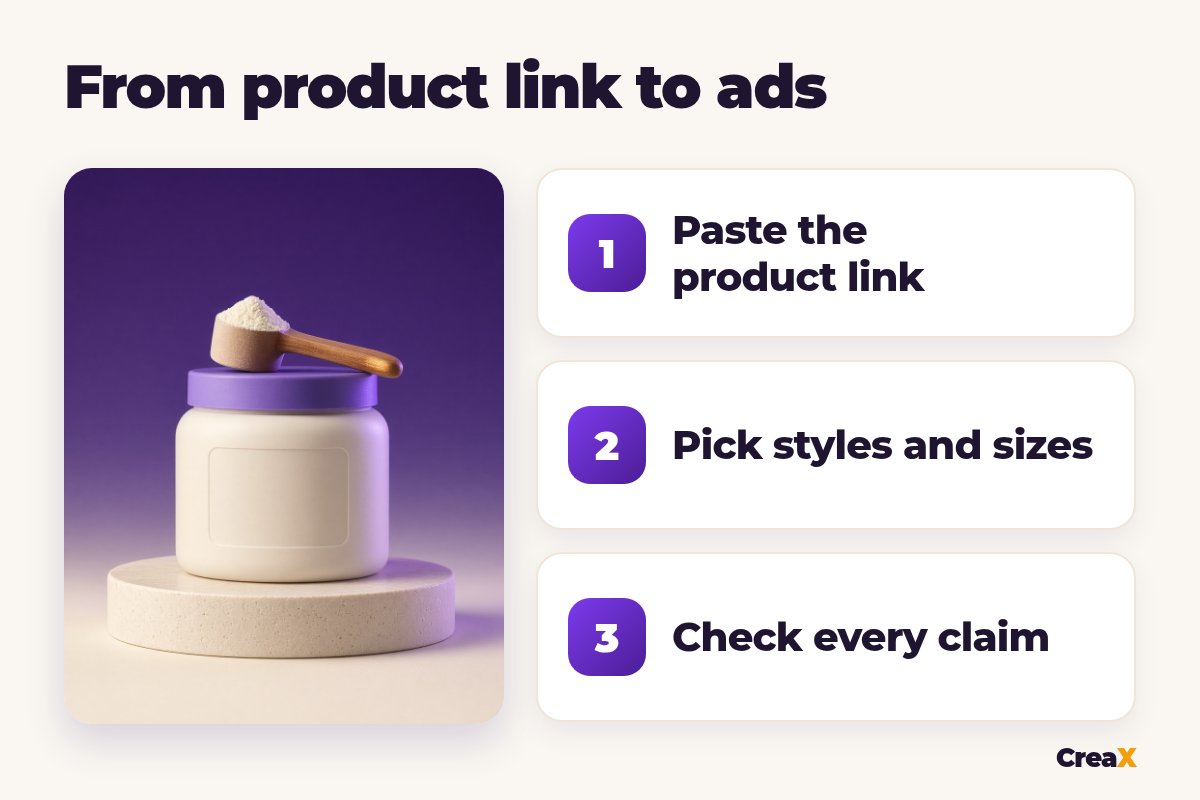
Paste the product link or upload a photo
Review the landing page
Pick studio ad styles and sizes
Pick UGC-style videos
Check every claim, then launch
For the video side in more depth, see how CreaX UGC video ads work; for opening lines that stop the scroll without overpromising, our guide to UGC ad hooks by niche has examples you can adapt.
ExampleWorked example: a small wellness brand
Say a small brand sells a berry greens powder, vitamin gummies and a vanilla protein powder. They run each product link through CreaX and give each product two or three angles:
| Product | Angles to test | Ads | Page |
|---|---|---|---|
| Greens powder | Morning routine, berry taste, travel sachets | Classic and Luxe studio ads, 30-second UGC-style video | Detailed page with full ingredients list |
| Vitamin gummies | Taste and format, family bundle | Punch and Meta Feed ads, 18-second video | Simple page |
| Protein powder | How it mixes, subscribe-and-save offer | Humble Orbit ads, 45-second how-to video | Advanced page with subscription terms |
Hypothetical brand to show the workflow; choose styles, lengths and angles that fit your own products and label.
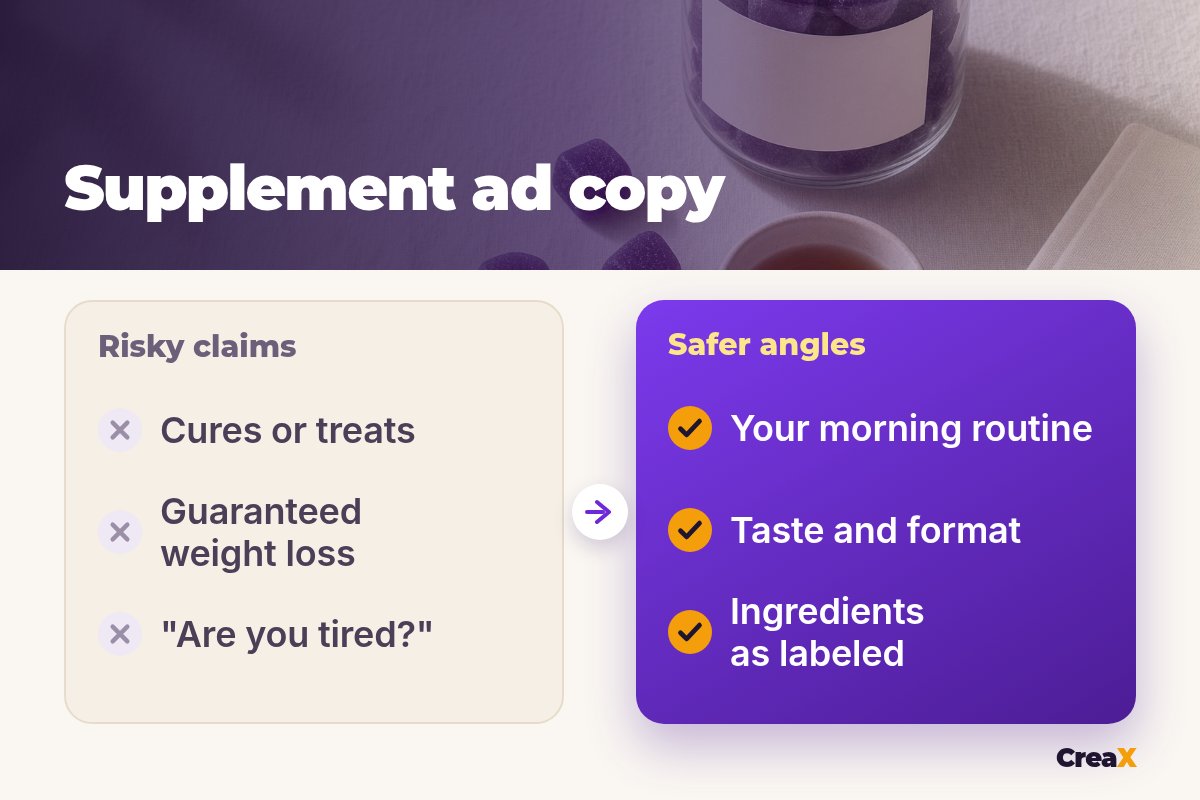
Before anything goes live, the owner reads every ad against the label. One generated caption says the greens powder "boosts immunity"; it gets replaced with "one scoop, berry flavor, ingredients listed on the jar." A video hook asking "Always tired after lunch?" becomes "My afternoon routine." The angles stay; the risky words go.
For the bundle, they build a separate page, following our guide to a bundle offer landing page, so the offer is explained clearly with the price and what's included.
PricingWhich CreaX plan fits a supplement brand?
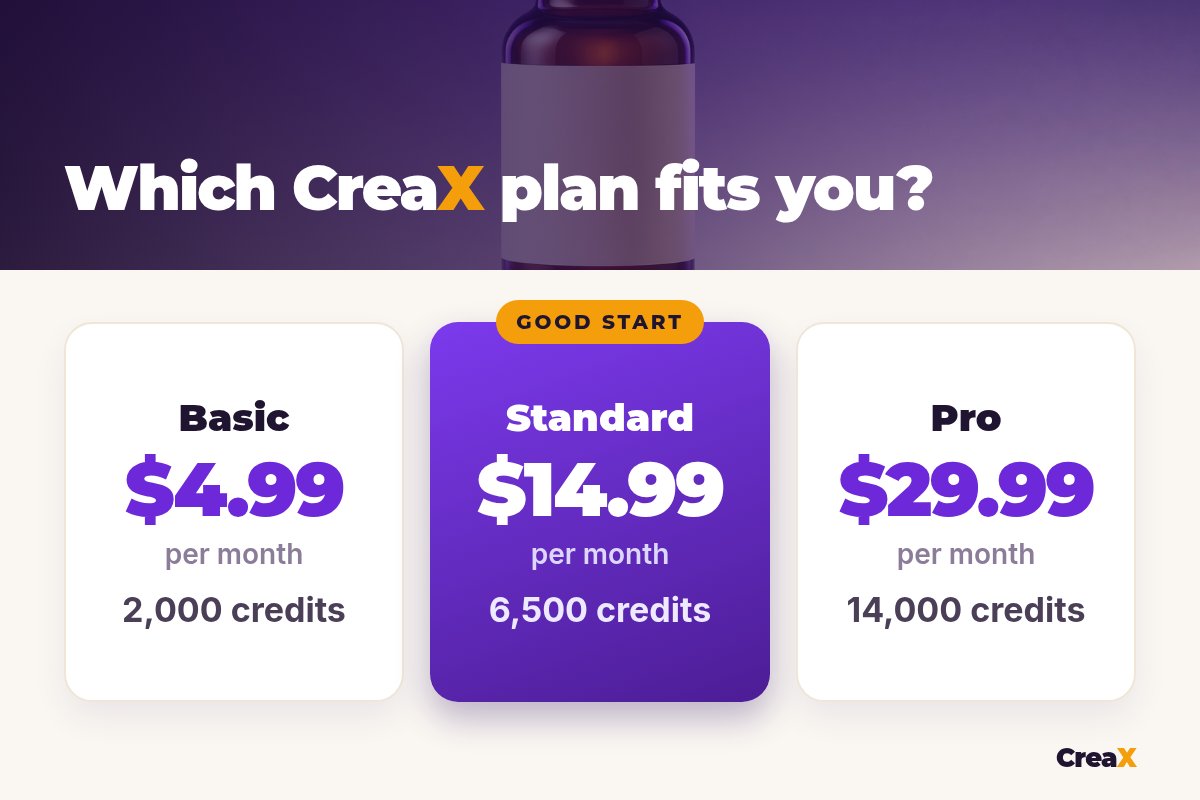
| Plan | Price / month | Credits | Good for |
|---|---|---|---|
| Free | $0 | 0 | Look around before buying credits |
| Basic | $4.99 | 2,000 | Testing one or two products |
| Standard | $14.99 | 6,500 | Regular new angles and flavors |
| Pro | $29.99 | 14,000 | Large ranges or several stores |
| Premium | $49.99 | 25,000 | Agencies and high-volume media buyers |
Current plans on creax.io/pricing. Top-ups are $1 per 500 credits.
Fresh supplement ads, minus the guesswork
Studio ads in four sizes, UGC-style video ads and a landing page from one product link or photo. You stay in control of every claim.
Do thisTips for better supplement ads
Supplement ad checklist
- ✓Start from a clear product photo with the real label visible.
- ✓Copy ingredients and directions exactly from your label.
- ✓Target 18+ for supplement ads where the platform requires it.
- ✓Lead with routine, taste, format, convenience or an offer.
- ✓Never ask the viewer about their health, weight or body.
- ✓Skip body before-and-after imagery entirely.
- ✓Read every AI-written line before it runs.
Beauty and skincare brands face similar claim limits; our guide to CreaX for beauty and skincare brands covers that category, and CreaX for fashion and apparel brands shows the same workflow for fast-moving product drops.
Honest takeLimits and when to use other tools
CreaX is built for product ads and pages, so be clear about what it doesn't do:
- It is not a compliance checker. CreaX doesn't know your evidence, your label approvals or your local rules. You are responsible for every claim.
- It is not legal advice. For claims beyond the basics, or for new markets, talk to a regulatory specialist.
- Details need checking. AI can change small details on packaging, so compare every ad with the real product.
⚖Where other help fits
And if an ad account does get restricted, our guide on what to do when a Facebook ad account is disabled walks through the next steps.
FAQFrequently asked questions
Q.Can I advertise supplements on Facebook and Instagram?
Q.Can I advertise supplements on TikTok?
Q.Can I use before-and-after photos for a supplement?
Q.Does CreaX write compliant copy automatically?
Q.Can CreaX make ads in other languages?
Q.How much does it cost?
Ready to test new supplement angles?
Paste a product link or upload a photo and get studio ads, UGC-style video ads and a landing page in about 60–120 seconds.
This guide is published by CreaX. We describe other tools from their own public websites, last checked October 2026, avoid invented scores or prices, and recommend checking each vendor's site for current features and plans.
Your next campaign starts with a link.
Paste a product link and get UGC video ads, ad images and a landing page — everything in under 60 seconds.
Start creating