
Are AI UGC Ads Allowed on Meta and TikTok?
FAQ · AI ad policy
Are AI ads allowed on TikTok and Meta? Yes, AI UGC ads are allowed on both platforms, but they come with rules: AI labels, honest claims, no fake customers and no borrowed faces. This guide explains what each platform's public policies actually say, what gets AI ads rejected, and gives you a checklist to run before every launch.
Updated October 2026 · By the CreaX team
Key takeaways
- ✓AI UGC ads are allowed on Meta and TikTok. Neither platform bans AI avatars or AI-generated video in ads as such.
- ✓TikTok requires disclosure when an ad's image, video or audio is fully AI-generated or significantly changed by AI: use the AI-generated content toggle or your own clear label.
- ✓Meta labels AI ads itself: it adds “AI info” to ads made or significantly edited with its own AI tools and to ads it detects as made with third-party AI tools.
- ✓Most rejections are not about AI at all. They come from exaggerated claims, fake testimonials, before-and-afters and ad/page mismatches, which AI just makes easier to produce.
In this guide
TL;DRThe short answer
Yes. You can run AI UGC ads (videos with AI avatars, AI voices or AI-generated scenes that look like creator content) on both Meta and TikTok. What you cannot do is use AI to deceive: pretend an AI actor is a real customer, invent results, use a real person's face or voice without permission, or hide that a realistic video was generated when the platform requires you to say so.
Think of the rules in two layers. The first layer is specific to AI: labels and disclosure. The second layer is the normal advertising rulebook (misleading claims, testimonials, before-and-after images, landing page consistency), which applies to every ad whether a camera or a model made it. Most AI ads that get rejected fail the second layer.
iWhat this guide is based on
DisclosureDo I need to label AI content?
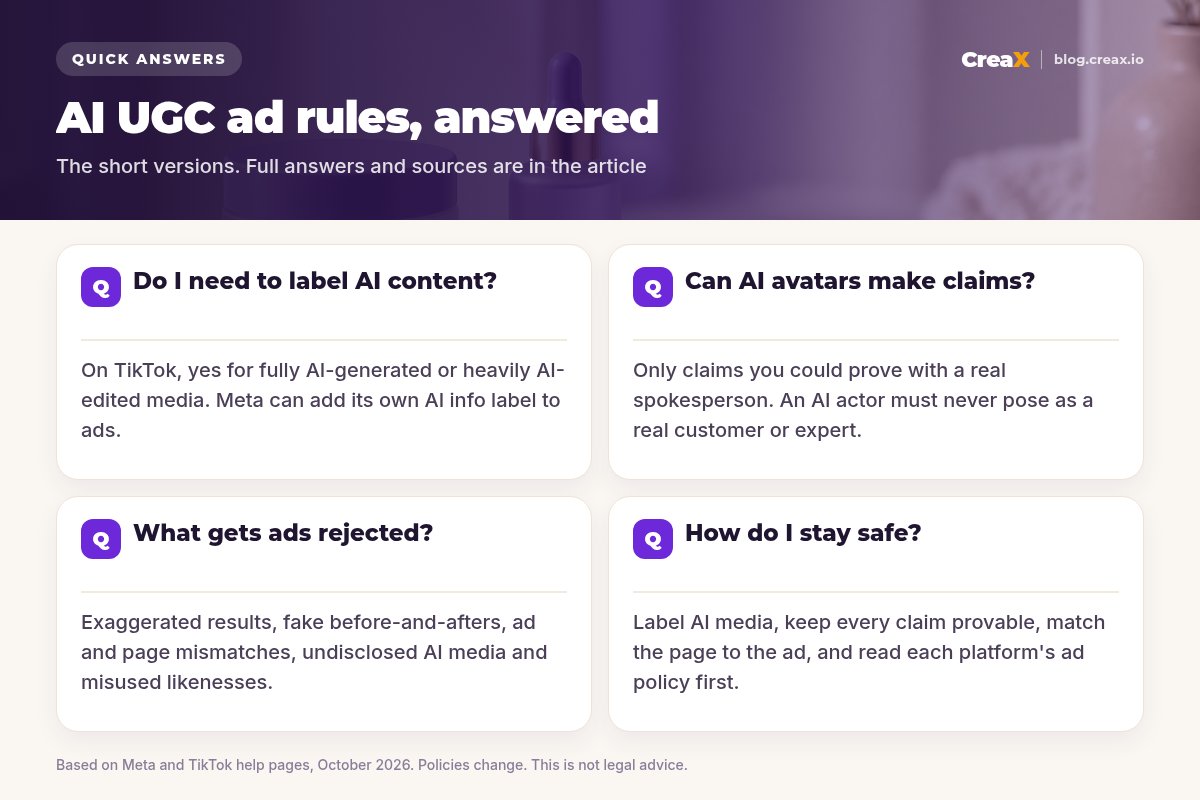
On TikTok: yes, for fully or significantly AI-generated media
TikTok's ad policy says significantly edited media and AI-generated content are allowed if you disclose them, either with TikTok's AI-generated content (AIGC) label or with “a clear disclaimer, caption, watermark, or sticker” of your own. If TikTok finds undisclosed AI-generated content, the policy says the ad will be rejected or restricted.
What counts as “significantly modified by AI”? TikTok's examples include:
- Completely AI-generated images, video or audio (an AI avatar talking about your product falls here).
- Showing the main subject doing something they didn’t do.
- Making the main subject say something they didn’t say, for example with voice cloning.
Minor AI edits do not need a label: TikTok lists lighting, brightness and color adjustments, removing or changing backgrounds, and denoising as insignificant edits. If you are unsure, TikTok's own advice is to label it.
In TikTok Ads Manager the label is a toggle called “This ad contains AI-generated content” in the ad creation step (TikTok’s disclaimer help page walks through it). Two details trip sellers up:
- Spark Ads (boosted organic posts) can't use the toggle. They follow TikTok's Community Guidelines, so the AI label has to be set on the organic post itself.
- Duplicating a campaign resets the toggle, according to TikTok's help page, even if you reuse the same ad. Re-check it every time you duplicate.
On Meta: Meta labels AI ads, and political ads must self-disclose
Meta's approach is mainly automatic labelling. According to its help pages, Meta adds an “AI info” label to ads created or significantly edited with its own generative AI features (such as background or image generation) and to ads it detects as created or edited with third-party AI tools, using industry-standard signals. The label sits in the “About this ad” menu and sometimes next to the Sponsored label. Minor changes like resizing or color correction don't get it.
A separate, stricter rule applies to ads about social issues, elections or politics: there, advertisers must disclose photorealistic images, video or realistic audio created or edited with AI in certain ways. A normal ecommerce product ad is not in that category, but if your product touches a social issue, check the policy.
★Practical rule for sellers
Claims and testimonialsCan AI avatars make claims?
An AI avatar can say anything a human spokesperson could say truthfully. It can describe the product, demonstrate a use, explain an offer and speak to a problem. The platforms judge the claim, not the face delivering it, so the usual rules apply in full:
- No exaggerated results. TikTok's policy lists examples such as instant slimming claims and creams that make wrinkles disappear in a before-and-after. If the product can't reliably do it, the avatar can't say it.
- No absolute claims you can’t back up, such as “number 1” statements. TikTok calls these out explicitly.
- No fake customer stories. An AI actor saying “I’ve used this for a year and it changed my skin” presents an experience nobody had. That is a fabricated testimonial, whatever the platform says about AI.
- No fake experts. Don't dress an avatar as a doctor, dentist or trainer to imply professional endorsement you don't have.
Outside the platforms, consumer protection law points the same way. In the US, for example, the FTC's rule on consumer reviews and testimonials bans fake reviews and testimonials, including ones attributed to people who don't exist, and AI-generated ones are covered. Other regions have similar rules on misleading advertising.
A safe way to write AI UGC scripts is to cast the avatar as a presenter, not a customer: “Here’s why this bottle doesn’t leak in a gym bag” instead of “I’ve tested every bottle and this is the only one that works.” You keep the native, creator-style feel without inventing a life story. For more on the format, see our explainer on what a UGC video ad is.
Common rejection reasonsWhat gets AI ads rejected?
Based on the policies above, these are the patterns most likely to get an AI UGC ad rejected or restricted:
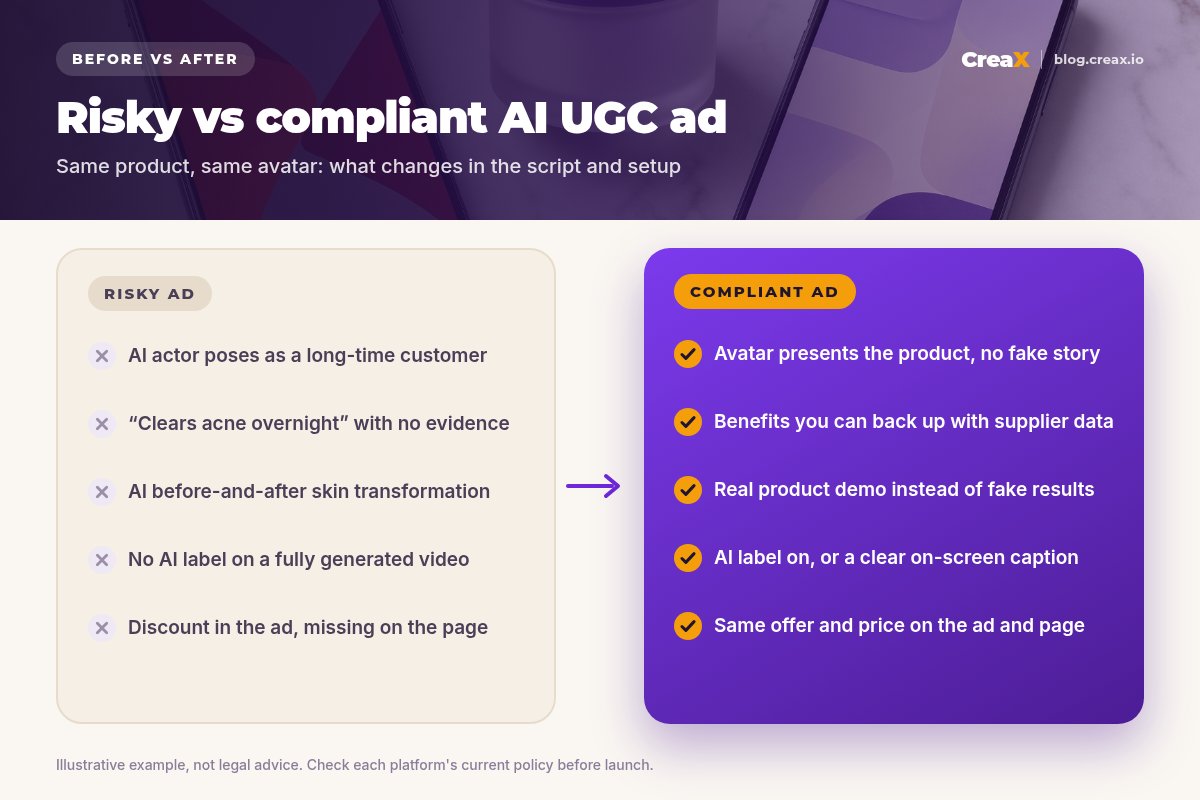
| What the ad does | Why it's a problem | Safer version |
|---|---|---|
| Fully AI video with no label on TikTok | Undisclosed AIGC can be rejected or restricted | AIGC toggle on, or a clear on-screen caption |
| Avatar claims dramatic, fast results | Misleading or exaggerated claims | Describe what the product does, with proof |
| AI before-and-after transformation | Before-and-after effect comparisons are restricted | Show the product being used, not invented results |
| AI actor poses as a real customer | Fabricated testimonial | Avatar as presenter; real reviews only on the page |
| Celebrity or creator look-alike or voice clone | Likeness used without permission | Stock or licensed AI actors only |
| Ad discount differs from the landing page | Inconsistent information between ad and page | Same product, price and offer everywhere |
Summarised from TikTok's ad policies and Meta's help pages, October 2026. Categories such as health, finance and supplements have extra rules.
Notice that only the first row is truly about AI. The rest are ordinary advertising mistakes. AI just makes them faster to produce at scale, which is why a quick review step matters more when you generate many variations. If your ads get through review but still don't sell, our guide to creative fixes for ads that don’t convert covers the next problem.
!Watch the landing page too
Get compliant-ready ads and a matching page from one link
CreaX generates UGC-style video ads, studio creatives and a landing page from the same product, so the offer in the ad and on the page starts out consistent. You review the claims and add the labels before you launch.
A safe processHow do I stay safe?
A repeatable process beats memorising policies. This is the workflow we recommend for any AI UGC ad:
Start from provable facts
Write the avatar as a presenter
Use licensed AI actors only
Label it on every platform
Check ad and page side by side
Keep a record
MistakesCommon mistakes to avoid
- Assuming “everyone does it” means it’s allowed. Plenty of rule-breaking ads run for a while before they're caught. Your account carries the risk, not theirs.
- Labelling once and forgetting. Duplicated TikTok campaigns reset the AI toggle. Build the check into your launch routine.
- Letting AI write claims unchecked. AI copy tends to be confident. “Clinically proven”, “best on the market” and “results in days” often appear unprompted. Delete anything you can't prove.
- Using AI before-and-afters. Even if the product works, a generated transformation shows a result nobody achieved.
- Cloning a creator’s voice or style too closely. Recreating a competitor's popular ad beat for beat with a look-alike presenter invites likeness and IP problems.
- Ignoring category rules. Supplements, weight loss, skincare with medical claims, finance and adult products have stricter policies on both platforms, AI or not.
If you test many creatives per product, these mistakes multiply quickly. Our guide on how many ad creatives to test per product helps you keep volume manageable enough to review every ad properly.
ChecklistChecklist you can copy
Before every AI UGC ad goes live
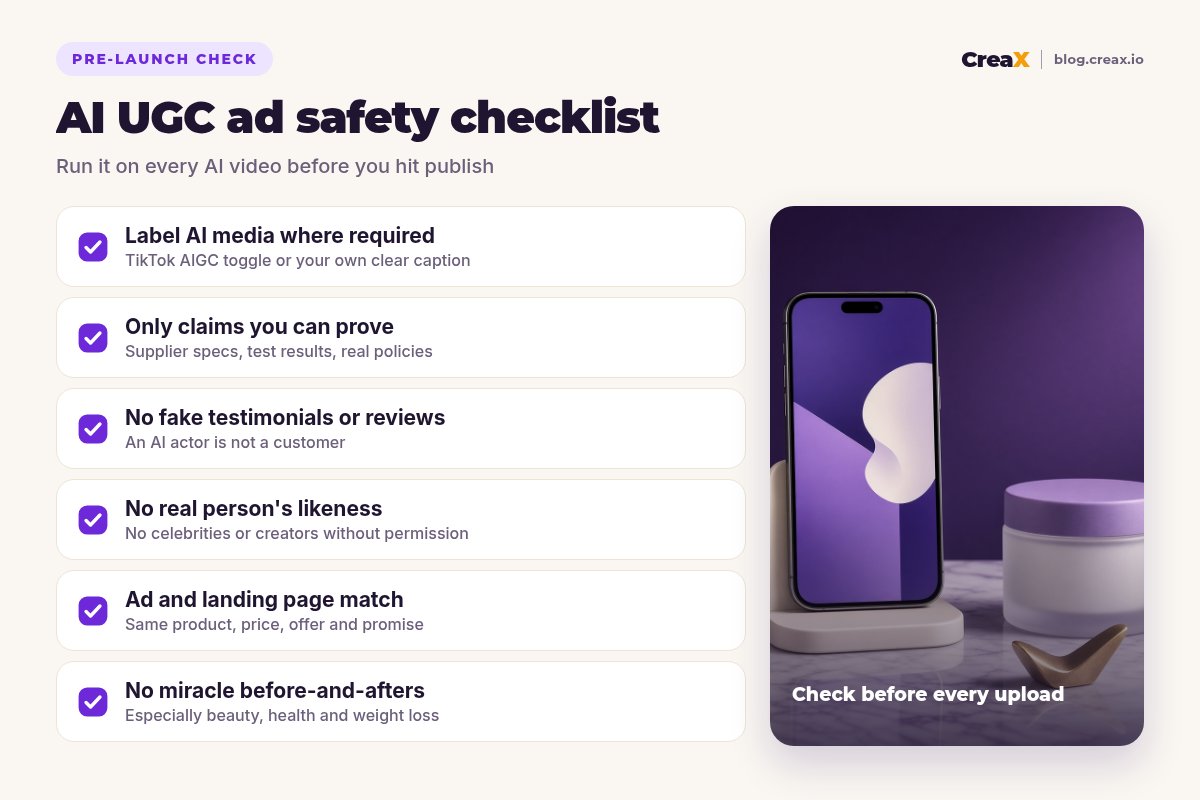
- ✓Every claim in the script traces back to a supplier spec, test or real policy
- ✓The avatar presents the product; it never claims personal experience or professional credentials
- ✓No real person's face, voice or name is used without written permission
- ✓No AI-generated before-and-after or “results” imagery
- ✓TikTok: AIGC toggle on for non-Spark ads (re-checked after duplicating); Spark Ads labelled on the organic post
- ✓Meta: realistic AI video carries a clear caption if there is any doubt; political or social issue ads follow the AI disclosure rules
- ✓Product, variant, price and offer match between the ad and the landing page
- ✓Category-specific rules checked (health, beauty, supplements, finance)
- ✓Script, claim sources and label settings saved for each ad
Make more ad variations, then review them properly
CreaX turns one product link into UGC-style video ads, studio creatives and a landing page in about 60–120 seconds, which leaves you time for the part only you can do: checking claims and labels.
CreaXHow CreaX helps (briefly)
CreaX is an all-in-one AI ecommerce creative OS. Paste a product link or upload a product image and, in about 60–120 seconds, it generates UGC-style video ads, studio ad creatives, a publish-ready landing page and a multi-tenant store. It is built for dropshippers, media buyers, affiliates and ecommerce brands that need to test products quickly.
Two things make compliance easier in practice. First, because the ads and the page come from the same product input, the product and the promise start out consistent, which helps with the ad/page mismatch problem. Second, faster generation gives you time back for review. What CreaX does not do is make the legal call for you: you still check every claim, choose the right labels for each platform and follow the rules for your category. Plans start at $4.99 a month for 2,000 credits.
Want to compare tools first? Our roundup of the best AI UGC video ad generators for dropshipping covers other options.
FAQMore questions sellers ask
Q.Will an AI label hurt my ad performance?
Q.Do I need to label AI product photos?
Q.Can I use an AI clone of myself in my ads?
Q.Are AI ads allowed for supplements or skincare?
Q.What should I do if my AI ad is rejected?
Q.Does the same apply to Instagram and Reels ads?
Launch your next AI UGC test the right way
One product link, about 60–120 seconds: UGC-style video ads, studio creatives and a matching landing page, ready for your review.
This guide is published by CreaX. It summarises public Meta and TikTok help pages and ad policies as of October 2026 and is not legal advice. Policies change and vary by region and category, so check the current versions before launching ads.