
How to Make Before-and-After Ads That Don't Get Rejected
How to · Ad policies
Before-and-after ads are one of the clearest ways to show what a product does, and one of the easiest ways to get an ad rejected. This guide shows you how to make before-and-after ads that stay within Meta and TikTok rules: which niches have extra restrictions, which comparisons are safe, how to shoot them honestly and what to check before you submit.
Updated October 2026 · By the CreaX team
Key takeaways
- ✓The risk is not the format itself but what it shows and claims: bodies, weight, skin and health results get the most scrutiny on Meta and TikTok.
- ✓The safest before-and-after ads show a product working on an object, space or task: a cleaned shoe, a tidy drawer, a protected phone screen.
- ✓Shoot both halves with the same angle, light and framing, show a typical result, and never mock or shame the 'before'.
- ✓Policies change. Read the current rules for your niche on every platform before launch, and treat this guide as a starting point, not legal advice.
In this guide
The goalWhat you'll have at the end
By the end of this guide you will have one before-and-after creative (a static or a short video) that:
- shows a real, typical change your product makes, in matching shots;
- avoids the imagery and wording that platforms restrict most;
- uses plain copy without guarantees or shaming;
- sends people to a landing page that makes the same promise as the ad.
You will also have a short review routine you can reuse for every comparison-style ad you make.
PreparationWhat you need before you start
- Real before and after photos or footage of your product in use, taken by you or with a customer's written permission.
- A tripod or a fixed phone position so both shots match.
- Proof for any claim you plan to make, such as test results, supplier documentation or your own repeatable tests.
- The current ad policies for your platforms, open in a browser tab.
- A landing page that repeats the promise. If you do not have one yet, CreaX can build it from your product link.
iNot legal advice
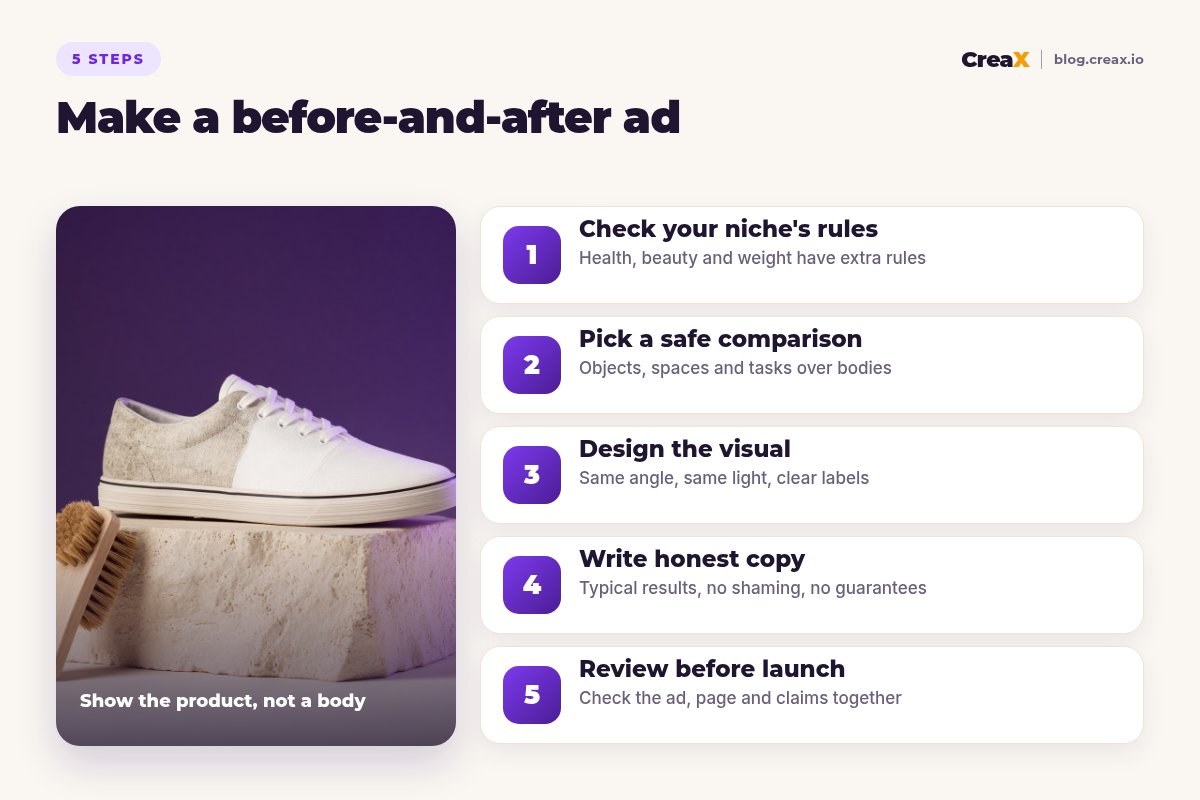
Rules firstStep 1: Check your niche's rules
Before-and-after imagery is treated very differently depending on what you sell. In general, the closer the comparison is to a person's body, health or appearance, the stricter the rules:
| Niche | Risk level | What to watch |
|---|---|---|
| Weight loss and weight gain | High | Age targeting, exaggerated or fast results, body shaming, close-ups of body areas |
| Skincare, cosmetics, hair and teeth | Medium to high | Results that look idealised or guaranteed, negative wording about appearance |
| Supplements and health products | High | Health and efficacy claims you cannot support |
| Cosmetic procedures | Very high | Often needs platform approval and risk disclosures |
| Cleaning, home, car care, organising | Lower | The result shown must be typical and real |
| Accessories and protection (cases, covers) | Lower | No faked damage or impossible stress tests |
General risk levels across platforms. Always confirm the current rules for your specific product and market.
Some current examples, summarised from the platforms' own policy pages:
- Meta: its Health and Wellness standards require ads for weight loss or weight gain products to target people 18 or older, prohibit statements of inferiority about someone's appearance, body parts or hygiene, and prohibit close-ups of pinched fat for weight products. Meta has revised these rules over time, so guides online may describe older versions.
- TikTok: its weight management policy bans exaggerated or harmful weight claims and limits weight claims to 18+ audiences, and its body image rules ban shaming or suggesting an ideal body. TikTok Shop guidance also says weight-related before-and-after photos are not allowed for most products and asks for a 'results may vary' style disclaimer on other before-and-after results, such as skincare.
If your product is in a high-risk niche, consider whether a before-and-after is the best angle at all. A demo, a texture shot or a how-to video often works without the policy risk. Our guide for beauty and skincare brands covers other angles.
Choose the angleStep 2: Pick a safe comparison
The best before-and-after ads show something the viewer can see changing, without needing a body in the frame. Good options:
- Object results: a stained sneaker cleaned, a scratched table polished, a cloudy headlight cleared.
- Space results: a messy drawer organised, a dark corner lit by a lamp, a cluttered desk tidied by a cable box.
- Task results: tangled cables vs a neat charging station, a crowded bag vs a packing cube.
- Process comparisons: the old way vs the new way, shown as steps rather than people.
- Product upgrades: a worn-out item next to your new product, if the comparison is fair.
If you want to compare your product with alternatives instead, a comparison ad may fit better; see our guide on us-vs-them comparison ads.
★The 'no body' rule of thumb
Make it fairStep 3: Design the visual
A before-and-after is only convincing if the comparison is fair. Viewers and reviewers both notice when it is not.
Fix the camera
Match the light
Label clearly
Pick a layout
Don't retouch the result
For video, show the change happening, not just the two end states. A short demo of the brush or spray in action is more believable than a cut between two photos. Our guide on product demo video ads has more ideas.
Words matterStep 4: Write honest copy
Copy is where many before-and-after ads get into trouble. Keep it plain and specific:
| Avoid | Use instead |
|---|---|
| "Guaranteed results in days" | "Here is how this shoe looked after one clean" |
| "Stop being embarrassed by your…" | "An easier way to keep your… looking new" |
| "The only product that works" | "What we use for scuffs and dust" |
| Best-case photos with no context | A typical result, with the material and number of uses noted |
| "Doctors hate this" style hooks | A simple description of what the product does |
Example wording. Make sure every claim you keep is one you can prove.
If results vary by material, stain or person, say so in the ad or on the page. It sets expectations and reduces refunds.
Final checkStep 5: Review before launch
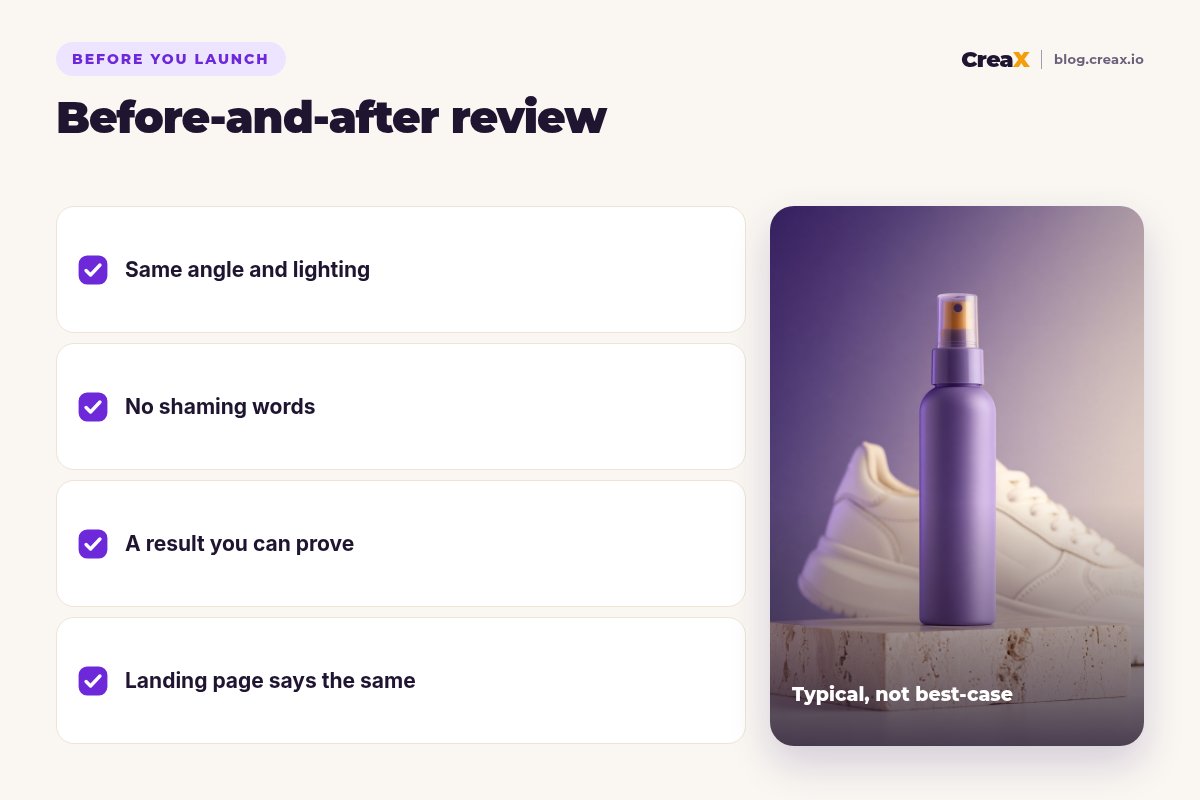
Before you submit, look at the ad and the landing page together, as a reviewer would. Does the page make the same promise? Does it show the same typical result? A page that exaggerates what the ad carefully avoided can still cause problems.
If an ad is rejected, read the reason, fix the specific issue and resubmit or request a review through the platform. Do not try to hide the same claim behind different wording. For other creative fixes, see creative fixes when Facebook ads are not converting.
Need the rest of the creative kit?
Paste your product link into CreaX for studio ads, UGC-style video ads and a landing page that matches your before-and-after ad.
ExampleWorked example: a sneaker cleaning kit
Say you sell a sneaker cleaning kit: a brush, a cloth and a foam cleaner. A before-and-after is a natural fit, and it does not involve a body at all.
- Rules: cleaning products are a lower-risk niche, but the result must be real and typical.
- Comparison: one white canvas sneaker with everyday dust and scuffs, cleaned once with the kit.
- Visual: phone on a tripod, same daylight spot, same angle. A 9:16 video showing the brush working, plus a 4:5 static with 'Before' and 'After' labels.
- Copy: "One clean, everyday scuffs. Results depend on the stain and the material." No guarantees, no 'brand new forever'.
- Kit: paste the product link into CreaX to get studio ads of the kit itself, UGC-style video ads and a landing page. Test the before-and-after creative next to two product-focused angles, all sending traffic to the same page.
This gives you a clean test: the before-and-after is one angle among three, so you learn whether it actually beats the alternatives. Our guide to testing ad angles for a new product explains how to read the results.
Common trapsMistakes to avoid
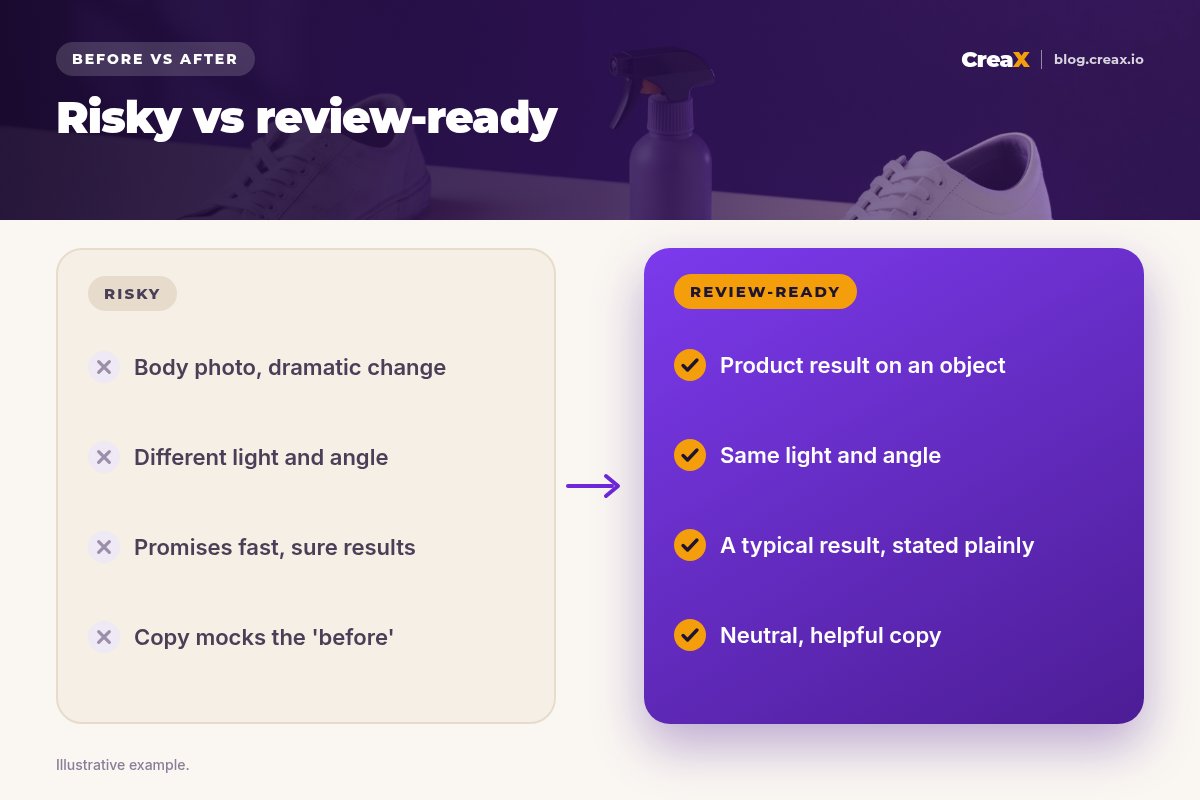
- Using a body when an object would do. It adds risk without adding much proof.
- Faking or borrowing results. Stock photos, competitor images or AI-generated 'results' are not your product's result.
- Unfair shots. A dark, blurry 'before' and a bright 'after' looks manipulated.
- Shaming the viewer. Copy that attacks how someone looks or lives breaks platform rules and turns people off.
- A page that over-promises. Reviewers can check the landing page as well as the ad.
- Ignoring customer permission. Only use a customer's photos with their clear, written consent.
!AI images are not proof
Copy thisChecklist
Before-and-after ad checklist
- ✓Rules read: you checked the current policy for your niche on every platform.
- ✓Safe angle: the comparison shows an object, space or task where possible.
- ✓Fair shots: same angle, light, framing and editing for both halves.
- ✓Real result: your own product, a typical outcome, no AI or stock 'after'.
- ✓Plain copy: no guarantees, no shaming, results-may-vary note where it applies.
- ✓Matching page: the landing page makes the same promise and shows the same result.
- ✓Permission: written consent for any customer photo or video.
Build the page and ads around your best angle
One product link, about 60–120 seconds: studio ads, UGC-style video ads and a landing page for your next test.
FAQFrequently asked questions
Q.Are before-and-after ads allowed on Facebook and Instagram?
Q.Can I run before-and-after ads on TikTok?
Q.What is the safest type of before-and-after ad?
Q.Should I add a 'results may vary' line?
Q.Can CreaX make before-and-after ads?
Q.My ad was rejected. What now?
Ready to test your next angle?
Paste a product link and get the studio ads, UGC-style video ads and landing page for your first test, from $4.99 a month.
This guide is published by CreaX. It is general information, not legal advice. Platform ad policies change and are applied case by case, so check the current rules for your niche and market before you launch.