
What Makes a Good Ecommerce Offer? Questions Sellers Ask
FAQ · Offers
Looking for ecommerce offer ideas that actually work? A good offer is not just a discount: it is the whole deal a buyer gets for the price, explained in one line and shown the same way in your ad and on your page. This guide answers the questions sellers ask most about discounts, bundles, gifts, guarantees and testing, with examples and a checklist.
Updated October 2026 · By the CreaX team
Key takeaways
- ✓An offer is everything the buyer gets for the price: the product, quantity or bundle, bonuses, shipping, guarantee and timing.
- ✓Bundles and free gifts often protect margin better than a straight discount; discounts are the simplest to understand. Choose based on your costs and product.
- ✓Say the offer early in the ad and at the top of the page, in the same words. Mismatched offers waste clicks.
- ✓Test offers by changing only the offer while the creative and page stay the same, and judge on cost per purchase and margin, not clicks.
In this guide
TL;DRThe short answer
A good ecommerce offer is clear, valuable to the buyer, affordable for you and honest. Clear means a stranger understands it in one line. Valuable means it removes a reason not to buy: price, risk, shipping cost or doubt about which option to pick. Affordable means you still make money after product cost, shipping, fees and ad spend. Honest means no fake deadlines, no inflated “was” prices and no surprises at checkout.
Most stores do not need a cleverer product to sell more. They need a better offer, shown clearly in the ad and repeated on the page.
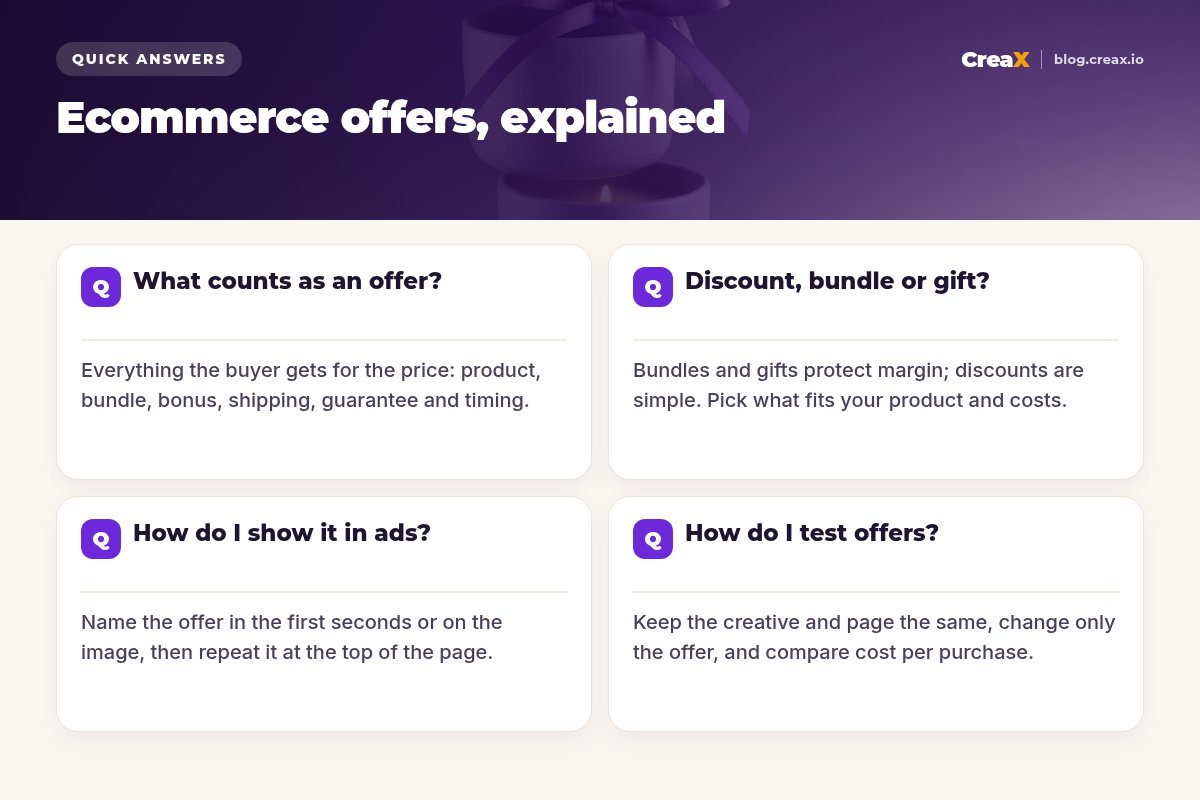
Q1What counts as an offer?
Your offer is the full package a buyer weighs against the price. It includes:
| Part of the offer | Examples |
|---|---|
| The core product | What it is, what it does, what is in the box |
| Quantity or bundle | Buy 2, a starter kit, a family pack, a refill set |
| Price and payment | The price itself, a discount, a payment plan where available |
| Bonuses | A free gift, a free accessory, a digital guide |
| Shipping | Free shipping, a free-shipping threshold, delivery time |
| Risk reversal | A return window, a guarantee, an easy exchange |
| Timing | A real seasonal deadline, a launch price, limited real stock |
Every row is a lever you can change. You do not need all of them; you need the right one or two.
Thinking about the offer this way opens options beyond “10% off”. A cheaper product with an unclear offer can lose to a pricier product with a clear one. For pricing itself, see how to price a dropshipping product.
Q2Discount, bundle or gift?
These are the three most common offer types. Each has a job:
Discount
Strengths
- +Easiest to understand
- +Works for well-known products and price-sensitive buyers
- +Simple to run in ads and at checkout
Trade-offs
- −Cuts straight into margin
- −Can train buyers to wait for sales
- −Weak if the price was never believable
Bundle
Strengths
- +Raises order value without lowering the unit price
- +Natural for consumables, sets and gifts
- +Helps buyers who are unsure which option to pick
Trade-offs
- −Only works if buyers want more than one
- −Needs clear pricing per bundle
Free gift
Strengths
- +Feels generous, often costs less than its perceived value
- +Protects the main product's price
- +Great for seasonal campaigns
Trade-offs
- −The gift must be relevant and wanted
- −Adds a fulfilment step
A simple rule: if your product is consumable or giftable, start with a bundle. If it is a one-off purchase, test a free gift or free shipping before a big discount. If it is a known product competing on price, a clear discount can be the right call. Our guide to the bundle offer landing page shows how to present bundles.
★Do the margin maths first
Q3How do I show it in ads?
An offer nobody notices does nothing. Make it visible:
Name it early
Use one line
Show the bundle or gift
Repeat it on the page
Keep fine print fair
Good creative still matters: the offer gives people a reason to act, but the product and hook make them care. For page structure, see what makes a high-converting product page.
Show your offer in every ad and on the page
Paste a product link into CreaX and get static ads, UGC-style video ads and a landing page built around the same message.
Q4How do I test offers?
Offer tests are some of the most useful tests you can run, as long as they are fair:
- Pick two offers that are meaningfully different, for example “15% off” versus “Buy 2, get 1 free”.
- Keep everything else the same: the same creative, the same hook, the same page layout. Only the offer line and price change.
- Use separate pages or a clean split, so each visitor sees one offer consistently from ad to checkout.
- Judge on the right numbers: cost per purchase, average order value and margin per order. A higher click-through rate means little if the margin disappears.
- Give it enough data before deciding. Small samples can mislead.
If you are testing angles and offers at the same time, keep them in separate tests so you know which one made the difference. Our guide to testing ad angles for a new product covers the angle side.
ExampleWorked example: a scented candle store
Say you sell scented soy candles and your ads get clicks but few orders. Here is how you might rethink the offer:
| Option | Offer line | Why it might work | What to check |
|---|---|---|---|
| A: Discount | “15% off your first candle” | Simple and familiar | Margin after ad cost per sale |
| B: Bundle | “Buy 2, get the 3rd free” | Candles are giftable and consumable | Shipping cost for three jars |
| C: Gift | “Free matches and a wick trimmer with every order” | Feels generous, protects the candle price | Cost and stock of the gift |
An illustrative example, not a performance claim. The right offer depends on your costs and buyers.
Run A and B first with the same creative and page, changing only the offer line. If the bundle wins on cost per purchase and margin per order, make it your main offer and test the free gift as a bonus later. Whatever you choose, show the offer on the ad image and at the top of the page, and state shipping costs upfront.
MistakesCommon mistakes to avoid
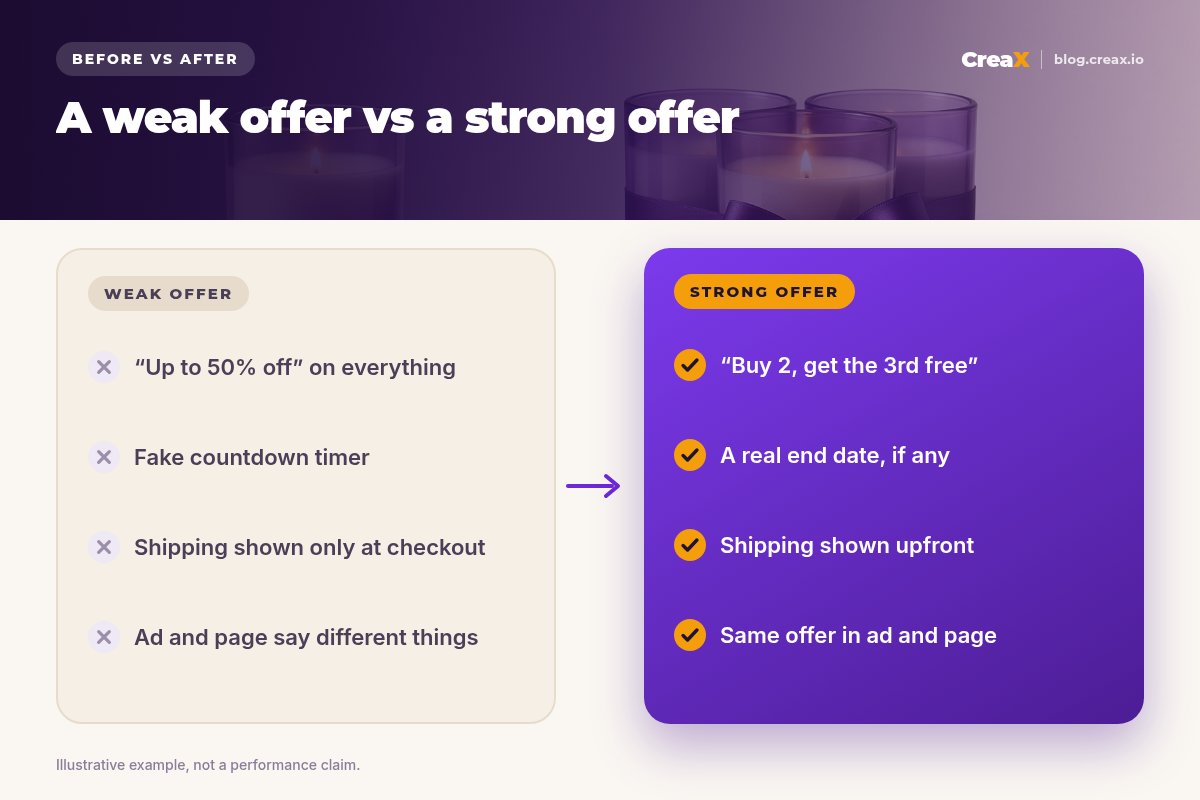
- Fake urgency. Countdown timers that reset and “only 3 left” messages that are not true mislead buyers and can break ad platform and consumer rules where you sell.
- Inflated “was” prices. A discount from a price you never really charged is not a real discount.
- Hidden shipping. Surprise shipping costs at checkout give buyers a reason to leave. Show them upfront.
- Too many offers at once. A discount, plus a gift, plus free shipping, plus a bundle confuses buyers. Pick one main offer.
- An offer that does not match the page. If the ad says “free gift” and the page does not mention it, buyers lose trust.
- Offers you cannot afford. Always run the margin maths first.
ChecklistChecklist you can copy
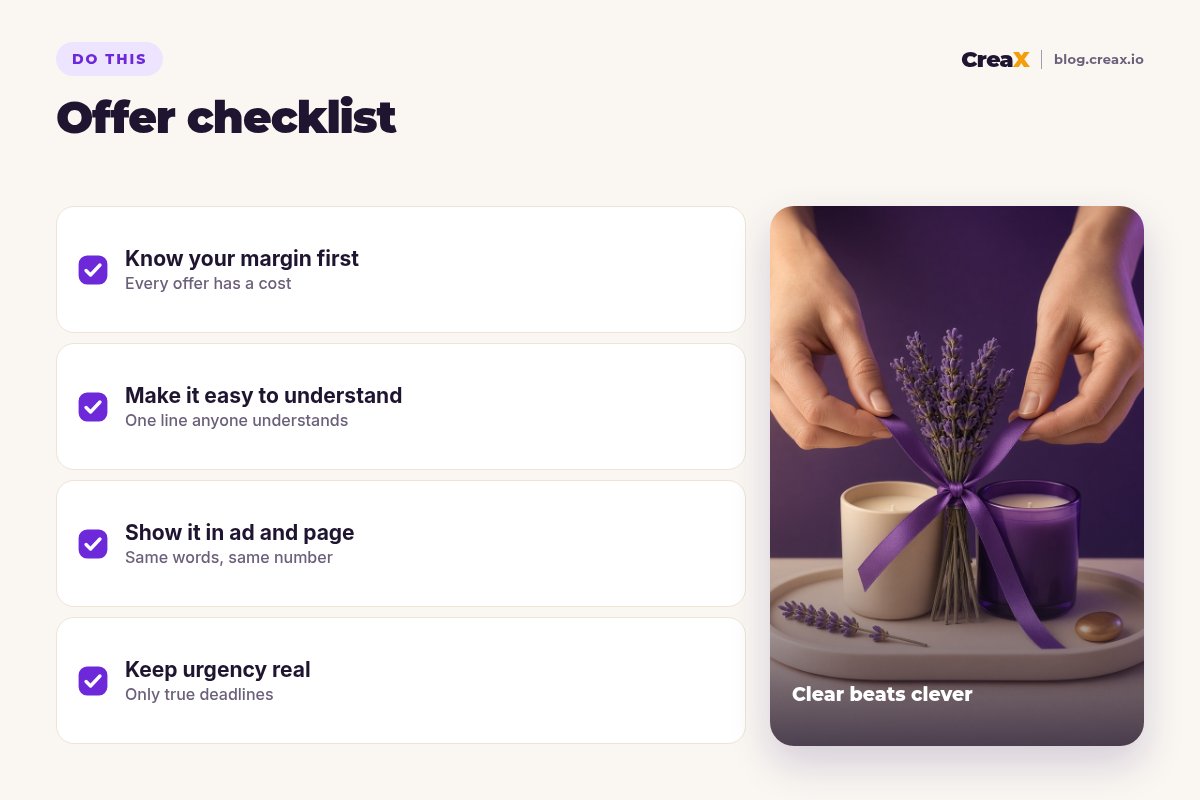
Before you launch an offer
- ✓Margin calculated: you know what you keep per order with this offer.
- ✓One main offer, explained in one line a stranger understands.
- ✓Offer visible early in every ad, video and static.
- ✓Same words and price at the top of the landing page and at checkout.
- ✓Shipping and conditions shown upfront.
- ✓Urgency only if real: true end dates and true stock levels.
CreaXHow CreaX helps (briefly)
The hard part of a new offer is usually not the idea; it is rebuilding the ads and the page so they all say the same thing. CreaX handles that in one pass: paste a product link from Alibaba, AliExpress, Amazon, Etsy or any product page, or upload a product image, and in about 60–120 seconds you get studio static ads in five ad styles and four sizes (1:1, 3:4, 4:5 and 9:16), UGC-style video ads in 18, 30 or 45 seconds, and a publish-ready landing page.
Review the generated page, set the offer line, price and conditions, and make sure the ads you pick show the same offer. When you want to test a second offer, generate a fresh set and keep the rest of the test identical. Plans start at $4.99 a month; see creax.io/pricing. For writing the page copy around your offer, read how to write product page copy that converts.
Build your next offer test in one pass
One product link, about 60–120 seconds: static ads, UGC-style videos and a landing page that tells the same story.
FAQFrequently asked questions
Q.What is a good offer for cold traffic?
Q.Is free shipping better than a discount?
Q.How big should my discount be?
Q.Should I use countdown timers?
Q.Can I combine a bundle and a gift?
Q.How often should I change my offer?
Ready to make your offer impossible to miss?
Paste a product link and get static ads, UGC-style video and a landing page built around one clear offer.
This guide is published by CreaX. Examples are illustrative, not performance claims. CreaX features are described from creax.io.