
How to Write UGC Ad Hooks That Stop the Scroll (With Examples by Niche)
How to · Video ad hooks
The first one to three seconds of a UGC ad decide whether anyone sees the rest. This guide shows you how to write UGC ad hooks that stop the scroll: the three layers every strong hook stacks, 12 fill-in-the-blank formulas, hook examples for eight ecommerce niches, and a simple way to test hooks without wasting budget.
Updated October 2026 · By the CreaX team
Key takeaways
- ✓A hook is three things at once: what people see, what they read on screen and what they hear in the opening seconds.
- ✓Write hooks from angles first, wording second. Three different angles teach you more than ten versions of one sentence.
- ✓Plan frame one for every hook. If the ad paused on its first frame with the sound off still makes sense, the hook is working.
- ✓Test hooks on the same ad body: keep the demo, offer and page identical and change only the opening.
In this guide
The goalWhat you'll have at the end
By the end of this guide you will have nine written hooks for one product: three angles, three hooks each, every one with a planned first frame and on-screen text. You will also have a simple test plan that tells you which opening deserves more budget.
People decide in a moment whether to keep watching, long before they hear your offer. That opening moment is the hook, and it is often the biggest single lever you have on a video ad. The good news: hooks follow patterns, and once you know them you can write strong options for almost any product in minutes.
iAbout the examples in this guide
PrepWhat you need before you start
- One product and its real benefits. List the specific problems it solves and the visible results it creates.
- Real customer language. Reviews of similar products and comments under competitor ads show how buyers describe the problem.
- A finished ad body. The demo, proof and call to action after the hook. You will reuse it for every hook you test.
- A landing page that matches. The hook sets an expectation; the page has to keep it. If you need one, see how to turn a product link into a landing page.
- Your ad platform rules. Health, weight-loss, finance and before-and-after claims are restricted on Meta and TikTok. Our guide on whether AI UGC ads are allowed on Meta and TikTok covers the basics.
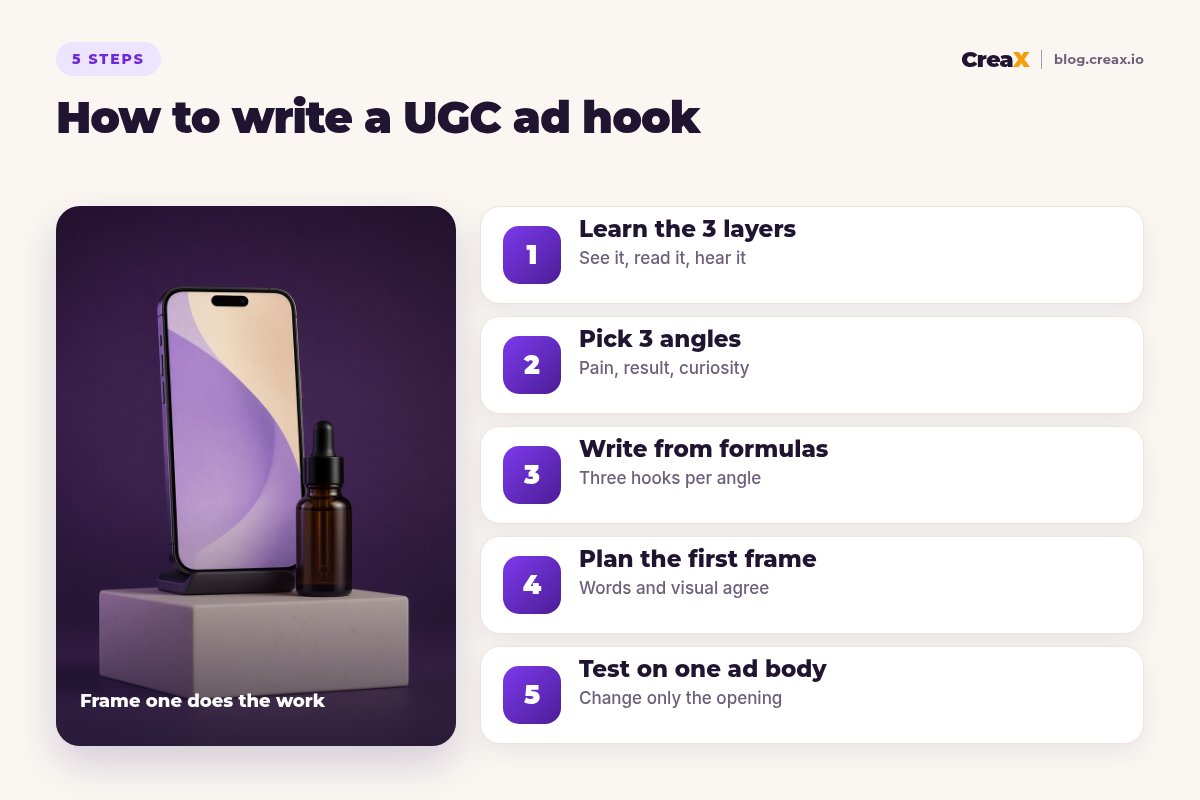
Step 1Step 1: Learn the 3 hook layers
A UGC ad hook is the opening of a user-generated-style video ad. Its only job is to earn the next few seconds. It doesn't need to explain the product or close the sale; it needs the right person to think “wait, this is for me”.
Most weak hooks fail because only one layer is doing any work. Strong hooks stack all three, so the message lands whether the viewer has the sound on, off, or is only half paying attention:
| Layer | What it is | What good looks like |
|---|---|---|
| Visual hook | The first frame and first movement | Motion in the first second; the product or the result visible immediately; a close-up or unusual angle |
| Text hook | The on-screen words over the opening | Short, large and readable on a phone; the core idea in a few words |
| Verbal hook | The first line spoken or voiced | Natural, specific and conversational; sounds like a person, not an advert |
Many people scroll with the sound off, so the visual and text layers should work without audio.
★The frame-one test
Step 2Step 2: Pick 3 angles
An angle is the reason to buy; a hook is how one ad opens to express it. Pick three angles that are genuinely different, then write hooks for each. Different angles teach you far more than different wording. (For a full angle-testing method, see how to test ad angles for a new product.)
Scroll-stopping hooks usually do one of four jobs. Use them to find your angles:
- Name a pain. Call out a specific, familiar frustration so the viewer recognises themselves.
- Show a result. Open on the after-state: the clean surface, the calm dog, the finished look.
- Open a loop. Raise a question the viewer wants answered, so they stay for the answer.
- Break the pattern. Show something unexpected that looks nothing like the content around it.
A practical default is one pain angle, one result angle and one curiosity angle.
Turn your angles into finished UGC video ads
Paste a product link or upload a product image and CreaX generates UGC-style video ads, studio ad creatives and a matching landing page in about 60–120 seconds.
Step 3Step 3: Write hooks from formulas
Use these formulas as starting points. Fill the blanks with your product's real problem, result and audience, and write three hooks per angle. Keep each one short enough to say in about two seconds.
| # | Formula | Template | Best when |
|---|---|---|---|
| 1 | Problem call-out | “If you [specific frustration], watch this.” | The pain is common and easy to recognise |
| 2 | Result first | Open on the after-state: “This took me [short time].” | The transformation is visual |
| 3 | Stop doing X | “Stop [common habit] if you want [result].” | There is a common wrong way to solve it |
| 4 | I was wrong | “I thought [belief] until I tried this.” | Skepticism is the main objection |
| 5 | Specific audience | “[Audience] who [situation], this is for you.” | The product serves a clear niche |
| 6 | Unexpected demo | Open mid-action on the most surprising moment. | The product does something unusual |
| 7 | Question | “Why does nobody talk about [problem]?” | There is an overlooked angle |
| 8 | Old way vs new way | [Old way] next to [your product], side by side. | The difference is easy to show |
| 9 | Mistake list | “3 mistakes you’re making with [task].” | The audience wants to do it right |
| 10 | Unboxing reaction | “Okay, this is not what I expected.” | Packaging or first impressions are strong |
| 11 | Day in the life | “Things that make my [routine] easier, part 1.” | The product fits a daily routine |
| 12 | Objection first | “Yes, it’s another [category]. Here’s why it’s different.” | The category is crowded |
ExamplesUGC ad hook examples by niche
Each niche has its own hook language. Here are three examples per niche to adapt. Make sure every claim is true for what you sell.
Beauty and skincare
Lead with texture, the after-look or a familiar routine.
- “My skincare routine went from ten steps to three. Here’s what stayed.”
- Close-up of the texture going on, text on screen: “the step I skipped for years”.
- “Dry skin girls, you need to see this before winter.”
Home and kitchen
Show the mess, then the fix.
- Open on the dirtiest corner of the oven: “I didn’t scrub this. Watch.”
- “Stop chopping onions with a knife if you hate crying.”
- “Small apartment? This saved my entire counter.”
Pets
Open on the animal reacting, then show the product.
- “My dog destroys every toy in a day. This one is still alive.”
- The cat ignoring an expensive bed, then curled up in the new one.
- “If your dog pulls on walks, try this before you buy another lead.”
Fitness and wellness
Specific, achievable situations beat big transformation promises.
- “No gym, no time, ten minutes: here’s my morning.”
- Open mid-rep: “the only home equipment I actually use”.
- “I travel every week and this fits in my carry-on.”
Gadgets and tech accessories
Lead with the surprising feature or a shared frustration.
- “I didn’t know my phone could do this until I got this.”
- “Your desk cables are a mess. Mine were too.”
- The gadget doing its trick in the first second, no intro at all.
Fashion and jewellery
Show it worn in the first frame.
- “One necklace, five outfits. Let’s go.”
- “If your jewellery turns your skin green, this is for you.”
- Open on the finished outfit, then rewind: “how I styled it”.
Baby and parenting
Real moments and practical relief; careful with claims.
- “Things I wish someone told me before my first baby.”
- “If bath time is a battle in your house, watch this.”
- The messy high chair, then the clean-up in seconds.
Coaching and digital products
The hook is a sharp insight or a mistake the viewer is making.
- “You don’t need more followers. You need this one page.”
- “If you post every day and still get no clients, here’s why.”
- “Stop giving free calls if you want people to buy.”
!Keep it honest
Step 4Step 4: Plan the first frame
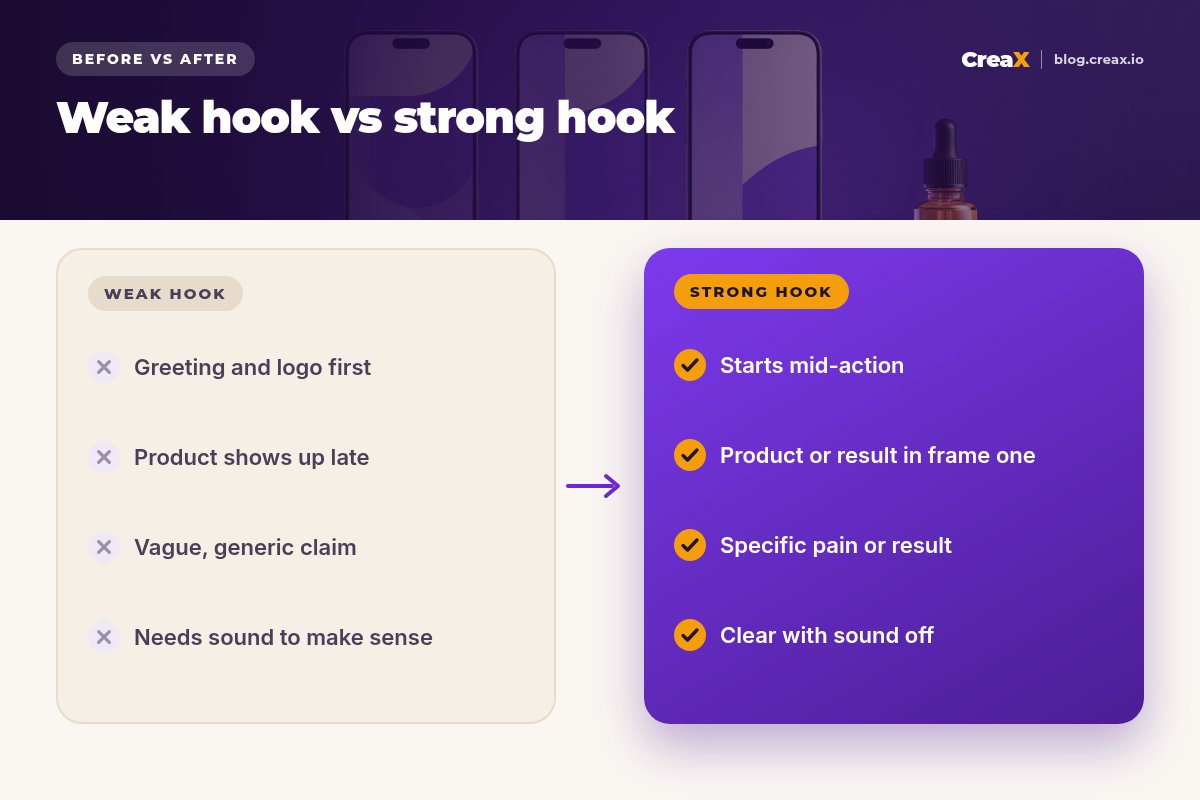
For every hook, decide exactly what is on screen at second zero. If the visual doesn't support the words, rewrite one of them. A strong first frame usually has the product or the result visible, some movement, and one short line of text.
On TikTok, Reels and Shorts, hooks work best when the ad looks and sounds like the content around it:
- Start in the middle. Skip greetings and logos. Open on the action, the result or the problem.
- Use creator-style formats. “POV”, “things I wish I knew”, “part 1” and reaction openings feel native to the feed.
- Keep text in the safe zone. Captions and buttons cover the bottom and right side of the screen, so place on-screen text where it won't be hidden.
- Use motion early. A hand reaching in, a lid popping, a pour or a quick zoom gives the eye a reason to stop.
- Talk to one person. “You” and a specific situation beat broad statements to everyone.
Step 5Step 5: Test hooks on one ad body
Hooks are the cheapest part of a video to test: keep the rest of the ad identical, swap only the opening, and you learn which hook works rather than which ad happened to be better.
Same body, new opening
Watch early attention
Judge on sales, not views
Iterate on the winner
Winning hooks wear out too. When results slide on a creative that used to work, a fresh opening on the same body is often the quickest refresh; here are the signs of ad creative fatigue to watch for.
Test more openings without filming more
CreaX turns one product link or image into UGC-style video ads, studio creatives and a matching landing page in about 60–120 seconds, so the only thing you change between tests is the hook.
ExampleWorked example
Say you sell a small electric vegetable chopper. Here is how the five steps turn into a test plan:
| Angle | Hook (spoken or on screen) | First frame |
|---|---|---|
| Pain | “Stop chopping onions with a knife if you hate crying.” | A knife and a whole onion, then the chopper |
| Pain | “Meal prep takes me forever. Or it did.” | A pile of uncut vegetables on a counter |
| Result | “This is dinner prep now.” | Diced vegetables dropping into a pan |
| Result | Text: “one press, done” | Close-up of the blade finishing a cut |
| Curiosity | “Why does nobody talk about this kitchen gadget?” | The closed chopper, a hand reaching in |
| Curiosity | “I thought these were gimmicks until I tried one.” | The box being opened on the counter |
Illustrative plan. Only say what the product really does: no invented times or results.
Each hook is attached to the same short body (demo, proof, offer, call to action) and one landing page. Launch the openings side by side with equal budgets and a spend limit agreed in advance. If the result angle keeps people watching but the pain angle produces cheaper purchases, scale the pain angle and write new variations of its best opening.
Common pitfallsMistakes to avoid
- Slow intros. Greetings, logos and “so today I want to show you” waste the most valuable seconds.
- Vague claims. “This changed my life” says nothing. “My cables stopped falling behind the desk” says something.
- Bait and switch. If the hook promises a trick, show the trick. Mismatched hooks lose viewers and trust.
- Tiny or hidden text. On-screen text that is too small or covered by the app interface is wasted.
- Only testing wording. Changing one word rarely moves results. Test different angles and different first frames.
- Forgetting the page. A great hook that leads to a page with a different message still loses the sale.
Before you launchChecklist
Hook test checklist
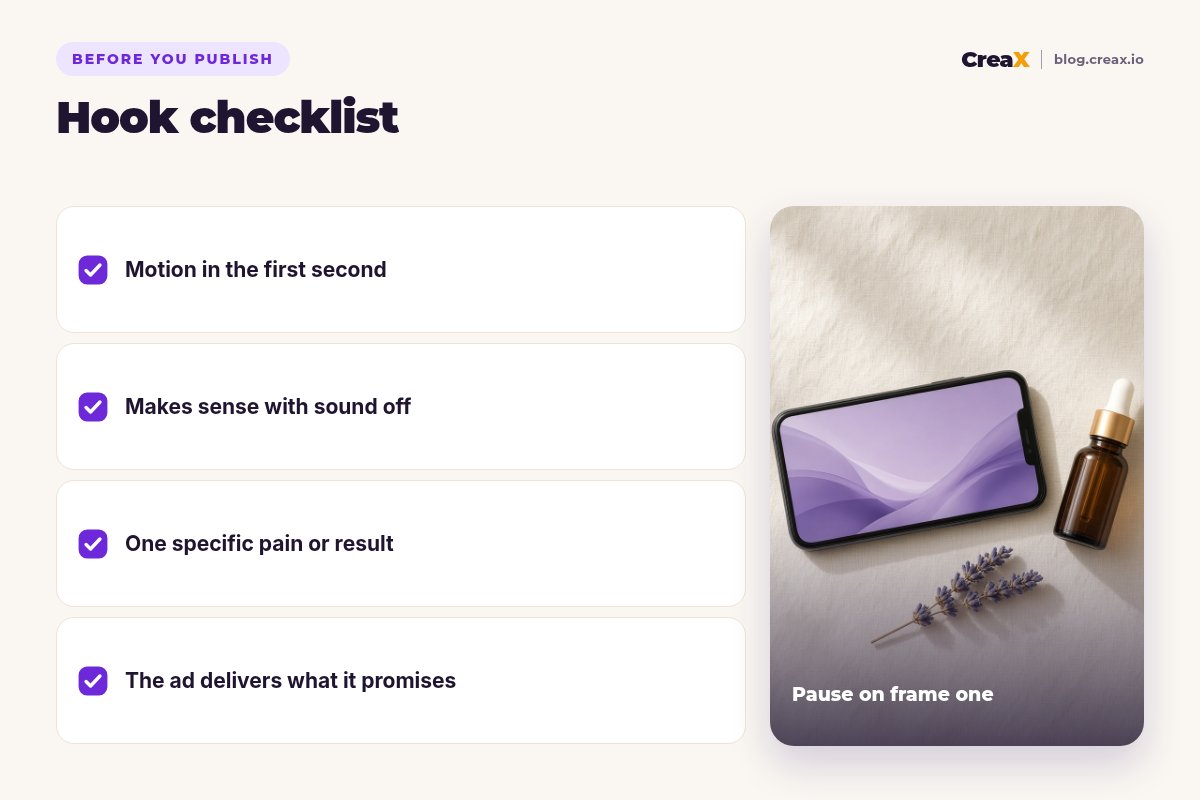
- ✓Three different angles, three hooks each
- ✓Every hook short enough to say in about two seconds
- ✓First frame planned: product or result visible, with motion
- ✓On-screen text large, short and inside the safe zone
- ✓Makes sense with the sound off
- ✓Every claim true for the product and allowed on the platform
- ✓Same ad body and landing page for every hook in the test
- ✓Budget per hook and the cost per purchase that counts as a win written down
FAQFrequently asked questions
Q.How long should a UGC ad hook be?
Q.What makes a hook scroll-stopping?
Q.How many hooks should I test per ad?
Q.Do these TikTok hook ideas work on Reels and Shorts?
Q.Can AI write UGC ad hooks?
Q.How does CreaX help with hooks?
Your next hook deserves a great ad behind it
Open CreaX, paste a product link or upload an image, and get UGC video ads, studio creatives and a landing page ready to test.
This guide is published by CreaX. Example hooks are writing samples, not customer quotes, and the article contains no invented statistics. Results depend on your product, offer, audience and ad platform.