
Why Is My Store's Conversion Rate Low? What to Check First
FAQ · Conversion rate
A low conversion rate is one of the most frustrating problems in ecommerce: the ads get clicks, visitors arrive, and almost nobody buys. The good news is that the cause is usually findable, and it is rarely just “bad luck”. This guide walks through the questions to ask, in the order that usually saves the most time and money, from the traffic itself to the page, the offer, trust, checkout and the creative.
By the CreaX team
Key takeaways
- ✓Check the traffic before the page. If the wrong people are clicking, no page fix will save the conversion rate.
- ✓The page must keep the ad’s promise. A mismatch between the ad angle and the first screen of the page is a common problem, and one of the cheapest to fix.
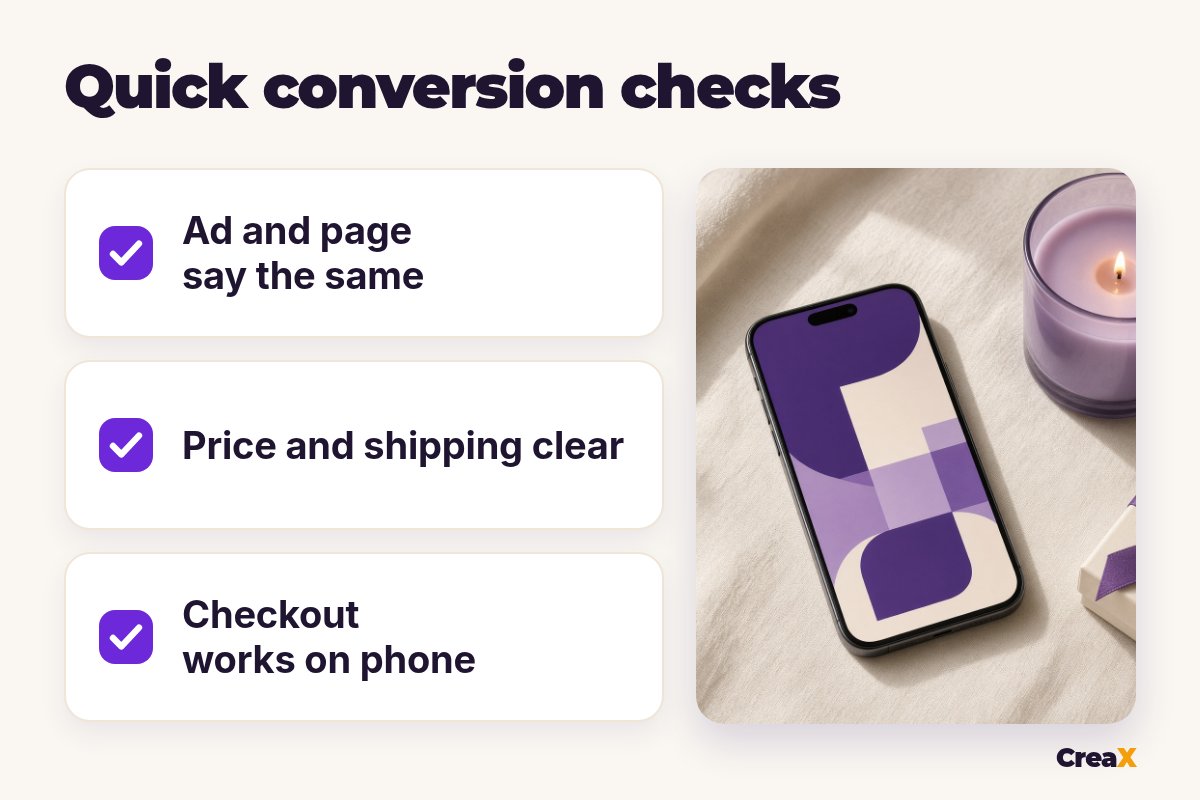
- ✓Hidden costs and broken mobile flows kill sales quietly. Buy your own product on a phone before you change anything else.
- ✓Change one thing at a time. Fix the biggest likely leak first, give it enough traffic to judge, then move to the next.
In this guide
- The short answer
- Is the traffic right for the product?
- Does the page match the ad?
- Is the offer clear and strong enough?
- Does the store look trustworthy?
- Is something broken on mobile or at checkout?
- Is it time to change the creative or the product?
- Common mistakes to avoid
- Checklist you can copy
- How CreaX helps
- More questions sellers ask
Start hereThe short answer
Your conversion rate is the share of visitors who buy. When it is low, one of three things is usually true: the wrong people are arriving, the right people arrive but the page doesn’t convince them, or they want to buy but something gets in the way. Each has different fixes, so the first job is to find out which one you have.
Work through the questions below in order. The early ones are quick to check and often explain the problem on their own. The later ones (changing the creative or the product) cost more, so leave them until you have ruled out the simple leaks.
iThere is no universal “good” conversion rate
Question 1Is the traffic right for the product?
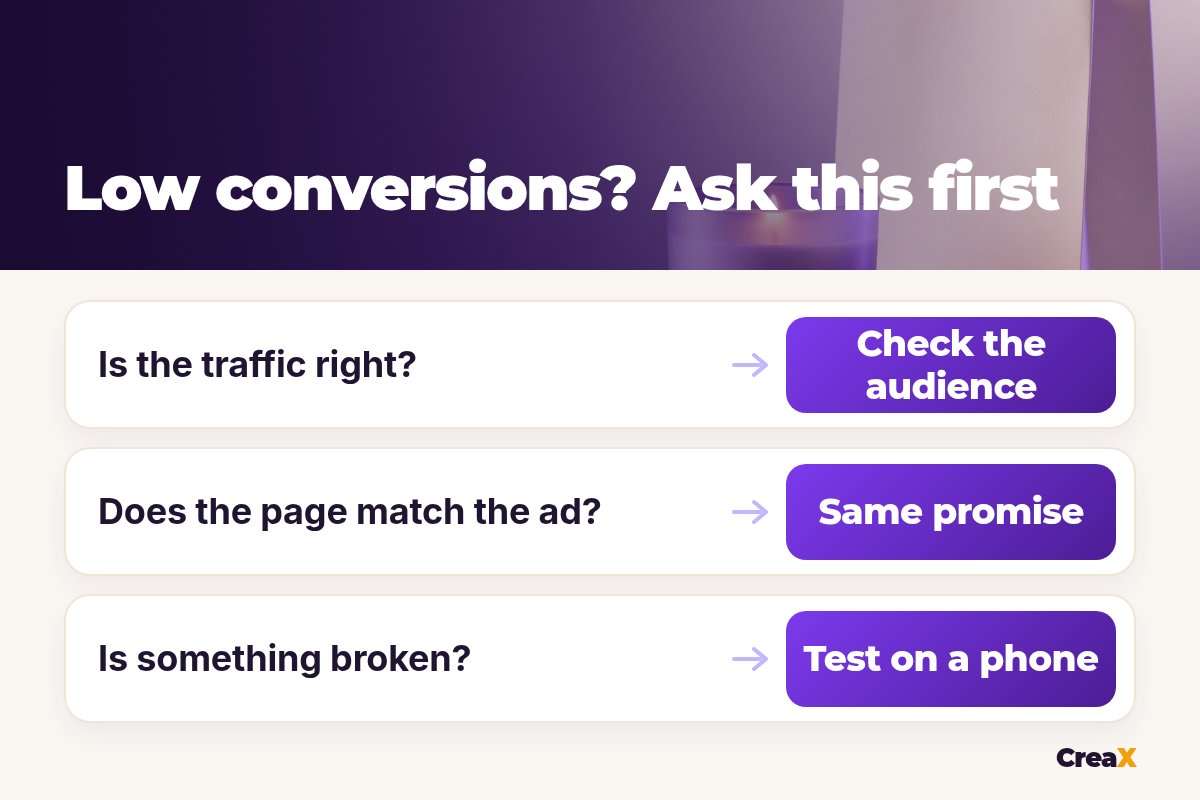
Before you touch the store, look at who is arriving. A beautiful page can't sell a pet product to people who clicked an ad because the video was funny. Signs of a traffic problem:
- Very short visits and people leaving from the first screen, across all devices.
- Clicks from a placement or country you didn't expect, or from audiences far outside your buyer.
- A hook that is entertaining but not about the product. It earns clicks from curious people, not buyers.
- Cheap clicks that never add to cart. Low cost per click is not a win if the clicks don't buy.
Fix it at the source: tighten the ad so it qualifies people (show the product, the use and the price range early), and check your placements and locations. If your ads get clicks but few sales, our guide to why Facebook ads are not converting goes deeper into the creative side of this problem.
Question 2Does the page match the ad?
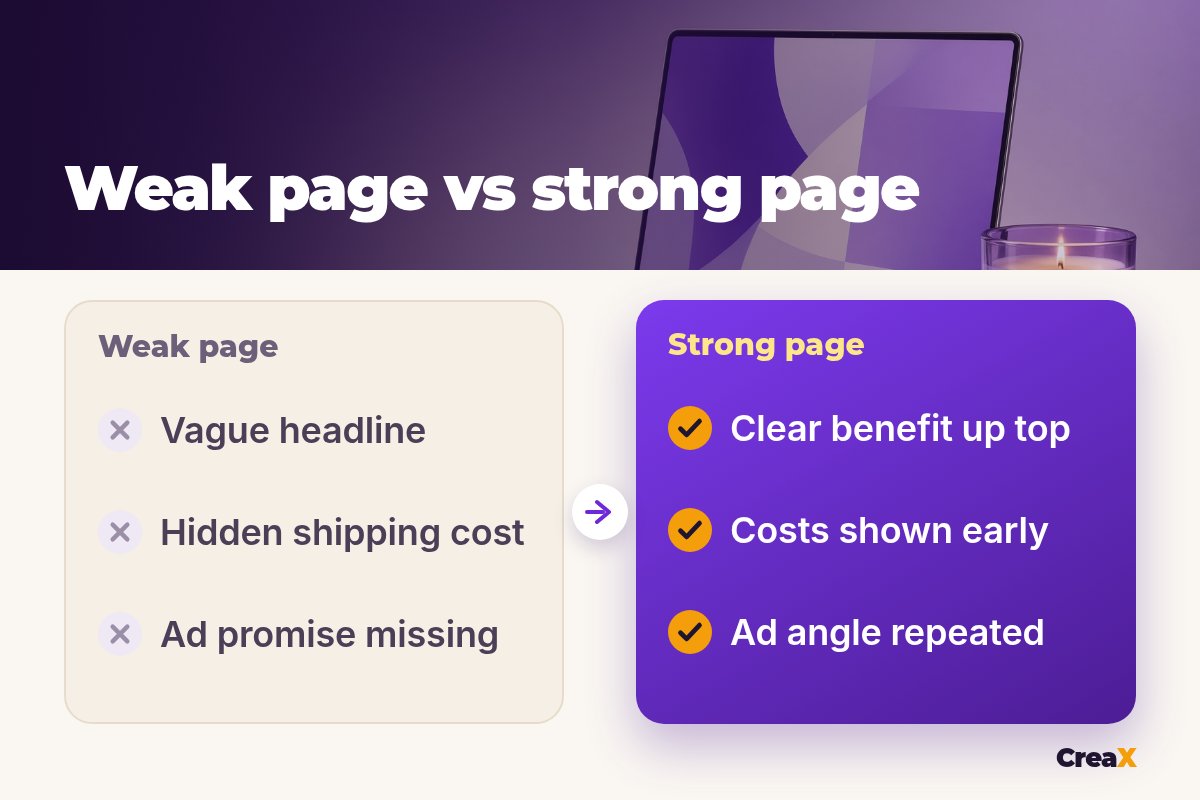
This question often finds the problem for the least effort. Someone clicks an ad about “no more tangled cables” and lands on a page whose headline is the product name and a list of specs. The promise that earned the click has disappeared, and so does the visitor.
Open your best ad and your landing page side by side and check:
- Does the first screen repeat the ad's main benefit, in similar words?
- Is the product shown the same way (same colour, same use) as in the ad?
- If the ad shows an offer, is that offer visible on the page without scrolling?
- If you run several angles, does each angle land on a page or section that continues it?
Where you send the traffic matters too. A dedicated page built around one angle often keeps the message tighter than a general product page; our comparison of a landing page vs product page explains when each works best.
Question 3Is the offer clear and strong enough?
Visitors may understand the product and still not buy because the deal doesn't feel right. An offer is more than the price: it is what they get, what it costs in total, how fast it arrives and what happens if they don't like it.
- Total cost: is shipping shown early, or is it a surprise at checkout?
- Delivery time: is it stated clearly, and is it realistic?
- Risk: is the returns or refund policy easy to find and easy to understand?
- Value: does the page explain why the product is worth the price, with real benefits rather than adjectives?
- Bundles or quantity options: would a simple bundle make the deal clearer for your buyer?
Don't solve this with fake timers or invented scarcity: it hurts trust and can break ad platform rules. Our guide to what makes a good ecommerce offer shows honest ways to make the deal stronger.
Get a landing page that matches your ad
Paste a product link and get a landing page, studio ads and UGC-style video ads built around the same product, in about 60–120 seconds.
Question 4Does the store look trustworthy?
A first-time visitor from an ad doesn't know your brand. In a few seconds they decide whether your store looks like a real business. Things that make people hesitate:
- Missing or hard-to-find contact details, returns policy and shipping policy.
- Low-quality or inconsistent product images, or images that clearly don't match the product.
- Spelling mistakes, placeholder text or a theme that looks unfinished.
- Reviews that look fake, or no social proof at all for a new product.
- Payment options buyers in your country don't recognise.
Fix the basics first: real policies, a clear about section, consistent images and honest reviews. Our checklist on how to make your store look trustworthy covers each point, and if you're launching without reviews yet, see how to advertise a new product with no reviews.
Question 5Is something broken on mobile or at checkout?
A lot of ad traffic, especially from social apps, arrives on phones, and small problems there are easy to miss when you check the store on a laptop. Do this today: open one of your ads on your own phone, tap through and buy the product (then refund yourself). Watch for:
- A slow first screen, or images that load after the visitor has already scrolled.
- Buttons hidden under pop-ups, chat widgets or cookie banners.
- Variant pickers (size, colour) that are hard to tap or reset the page.
- Errors in the cart or checkout, missing payment methods, or forms that reject valid addresses.
- Discount codes from the ad that don't work at checkout.
If people add to cart but stop at checkout, the leak is at the end of the funnel, not the start. Our guide to why people add to cart but don’t buy lists the most common checkout fixes.
Question 6Is it time to change the creative or the product?
If the traffic is right, the page matches the ad, the offer is clear, the store looks trustworthy and nothing is broken, the problem may sit higher up: the angle you're selling, or the product itself.
Signs it's the creative
- One angle converts and others don't, with the same page.
- Clicks come from people curious about the video, not the product.
- Results were fine and slowly faded as the same ads kept running.
Signs it's the product
- Every angle and every page gets clicks but no sales.
- Visitors ask the same doubt again and again (size, quality, use).
- Similar products are cheaper or easier to find elsewhere.
Test new angles before you drop the product: show a different use, a different buyer or a different problem it solves. Each angle needs a page that continues its story, which is where a strong product page earns its keep; our guide to what makes a high-converting product page breaks down every section.
Avoid theseCommon mistakes to avoid
- Changing five things at once. You won't know which change helped.
- Judging too early. A handful of visits can't tell you much; give each change enough traffic to see a pattern.
- Redesigning the whole store when one mismatch between ad and page was the real issue.
- Cutting the price first. A lower price can't fix a confusing page or broken checkout.
- Adding fake urgency or fake reviews. It damages trust and can get ads or stores restricted.
- Only checking on desktop. Many of your buyers are likely on phones.
Test a new angle without starting from scratch
Get fresh studio ads, UGC-style video ads and a matching landing page from the same product link, then compare angles.
Copy and useChecklist you can copy
Conversion rate checklist
- ✓Ad placements, locations and audience match your real buyer.
- ✓The page's first screen repeats the ad's main benefit.
- ✓Product images match the product in the ad.
- ✓Total price, shipping cost and delivery time are visible early.
- ✓Returns policy, contact details and shipping policy are easy to find.
- ✓Reviews are real, or the page is honest about being new.
- ✓You bought the product yourself on a phone, from the ad, without errors.
- ✓Pop-ups and chat widgets don't cover the buy button.
- ✓Discount codes from ads work at checkout.
- ✓You change one thing at a time and give it enough traffic to judge.
Our toolHow CreaX helps (briefly)
CreaX can't fix your checkout or your shipping times, but it helps with two of the leaks above: ad-to-page mismatch and testing new angles. Paste a product link (from Alibaba, AliExpress, Amazon, Etsy or any product page) or upload a product image, and in about 60–120 seconds you get:
- A publish-ready landing page at Simple, Detailed or Advanced level, built from the same product as your ads.
- Studio ad creatives in five styles (Classic, Humble Orbit, Punch, Luxe and Meta Feed) and four sizes (1:1, 3:4, 4:5 and 9:16).
- UGC-style video ads of 18, 30 or 45 seconds.
Because the ads and the page come from the same input, they tell the same story, and a new angle is one more generation instead of a new design project. Plans start at $4.99 a month for 2,000 credits, with top-ups at $1 per 500 credits. CreaX works in 40+ languages and 160+ target countries.
FAQMore questions sellers ask
Q.What is a good ecommerce conversion rate?
Q.Why do I get traffic but no sales?
Q.Will lowering my price increase conversions?
Q.How long should I wait before changing something?
Q.Should I send ads to a landing page or a product page?
Q.Can a better ad improve my conversion rate?
Fix the mismatch, then test new angles
One product link, about 60–120 seconds, and you have a landing page, studio ads and UGC-style video ads that tell the same story.
This guide is published by CreaX. It gives general advice, not guaranteed results: conversion rates depend on your product, traffic, offer and market.