
How to Advertise a New Product With No Reviews Yet
How-to · Product launch
Every product starts with zero reviews, and that is when you most need ads to work. The good news is that you can advertise a new product with no reviews yet without faking anything. This guide shows you how in five steps: honest trust signals, demo-led creatives, a clear guarantee, warm audiences first, and a simple system to collect your first real reviews.
Updated October 2026 · By the CreaX team
Key takeaways
- ✓Never fake social proof. Invented reviews, ratings or buyer counts break platform rules and consumer protection laws, and they backfire when real buyers notice.
- ✓Let the product prove itself. A clear demo in the first seconds of the ad does the job reviews would normally do: it shows the product works.
- ✓Lower the risk with a guarantee and clear policies you will actually honour, shown on the page and in the ad.
- ✓Start warm, then collect proof. Launch to people who already know you, and ask every early buyer for an honest review.
In this guide
GoalWhat you'll have at the end
By the end of this guide you will have a launch plan for a brand-new product with no reviews: a list of real trust signals, two or three demo-led ad creatives, a product or landing page that lowers the buyer's risk, a first audience to show it to, and a simple process to turn early buyers into honest reviews you can use later.
This works for dropshippers testing a new product, brands launching their first item, and stores adding a new line. If you are testing many products quickly, our guide to launching a product test in 24 hours covers the speed side.
PrepWhat you need before you start
- The real product facts. Materials, dimensions, what is in the box, how it is used. Ideally, the product in your hands.
- Your policies. Shipping times, returns, refunds and how customers can contact you.
- A product or landing page. Somewhere to send traffic that answers the questions a review would. See what makes a high-converting product page.
- Creatives that show the product working. Video is ideal; clear studio images help too.
- A way to reach early buyers after delivery. Email or a printed card in the package.
!The one rule that matters most
Step 1Step 1: List honest trust signals
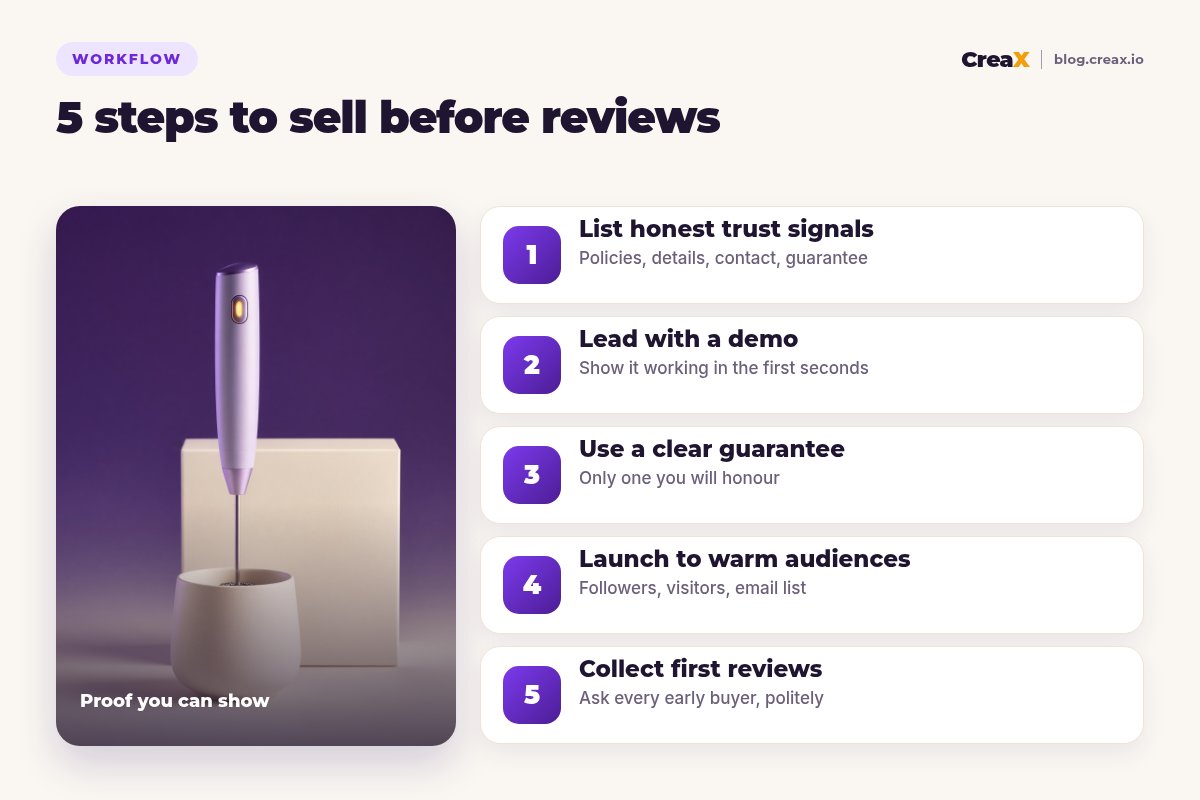
Reviews are only one kind of trust signal. Before you write a single ad, list everything true that would help a stranger feel safe buying from you:
| Trust signal | Example | Where to show it |
|---|---|---|
| Clear product details | Materials, size, what is in the box | Page, ad copy |
| Guarantee | A returns or satisfaction policy you will honour | Ad, page, checkout |
| Shipping and returns | Realistic delivery times, how returns work | Page, FAQ |
| Real contact | Email, chat or phone that someone answers | Page footer, FAQ |
| Demo | The product working, start to finish | Ad, page |
| Secure checkout | Familiar payment methods | Checkout, page |
| Founder or brand story | Why you made or chose this product | Page, organic posts |
Use only signals that are true for your store.
You will use these in every later step. A buyer with no reviews to read is really asking two questions: does it work, and what happens if it does not? Your trust signals should answer both.
Step 2Step 2: Lead with a demo
Without reviews, your creative has to carry the proof. The strongest way is a demo: show the product doing its job in the first seconds of the ad. A milk frother whipping milk into foam, a lint roller clearing a sofa, a phone stand holding a phone at the right angle. People believe what they can see.
- Start with the result or the problem, not a logo or an unboxing intro.
- Show it in real use, at real scale, in a setting your buyer recognises.
- Keep claims to what the video shows. If the frother makes foam in the video, you can say so. Do not add claims you cannot show or prove.
- Make two or three angles. The same demo with different hooks lets you learn what people care about. See how to test ad angles for a new product.
You do not need a film crew. Our guide to product demo video ads without filming shows how to make them from a product link or image, and our list of the best AI tools to launch a new product covers other options.
Get demo-led ads for a brand-new product
Paste a product link into CreaX and get UGC-style video ads, studio creatives and a landing page in about 60–120 seconds.
Step 3Step 3: Use a clear guarantee
A guarantee replaces some of the reassurance reviews would give, because it moves the risk from the buyer to you. It only works if it is clear and if you honour it.
Choose a guarantee you can afford
Write it in plain words
Show it everywhere
Honour it fast
★Say it is new, with confidence
Step 4Step 4: Launch to warm audiences
People who already know your brand need less proof. Start where trust already exists, then widen:
- Your followers and email list. Announce the launch with the demo video. Consider an early-buyer offer you can afford.
- Past visitors and customers. Retarget people who visited your store or bought before. Our guide to retargeting ads for ecommerce shows what to show each group.
- Creators who genuinely use it. Send the product to a few creators in your niche. If they post, disclose the partnership properly. See UGC vs influencer marketing.
- Then cold audiences. Once you have early sales and some feedback, launch demo-led ads to new people.
Dropshippers testing products often skip straight to cold traffic. That is fine for testing demand, but expect the demo and guarantee to do all the work, and judge results over a few days, not a few hours.
Step 5Step 5: Collect first reviews
Your first reviews are the most valuable ones. Build the request into your process from day one:
- Ask after delivery, once the buyer has had time to use the product, by email or with a card in the package.
- Make it easy: one link, a short form, and an option to add a photo.
- Ask everyone, not only happy buyers. Selectively asking for positive reviews can mislead shoppers.
- Do not pay for positive reviews or offer rewards that depend on a good rating.
- Reply to every review, especially the critical ones. A calm, helpful reply builds trust.
With permission, the best reviews and customer photos become new ad creatives and page content. That is when your ads move from “trust the demo” to “trust the demo and these real buyers”.
ExampleWorked example: a handheld milk frother
Say you are launching a handheld electric milk frother with no reviews. Here is how the five steps come together:
| Step | What you do |
|---|---|
| Trust signals | Clear specs (what is in the box, how it charges), realistic shipping times, contact email, a returns policy |
| Demo | A 9:16 video: milk in a cup, frother on, foam in seconds, poured onto coffee. Two hooks: café drinks at home, and the morning routine |
| Guarantee | A returns window you can afford, stated in the ad copy and next to the buy button |
| Warm launch | Post the demo to your followers and email list, then retarget recent store visitors |
| First reviews | A card in the box and a follow-up email after delivery asking for an honest review and a photo |
Example plan. Use your own product facts and policies.
The ad copy can be simple: “New: café-style foam at home. Watch it work in seconds. Returns accepted within [your window].” Every word is true, the demo proves the main claim, and the guarantee lowers the risk.
MistakesMistakes to avoid
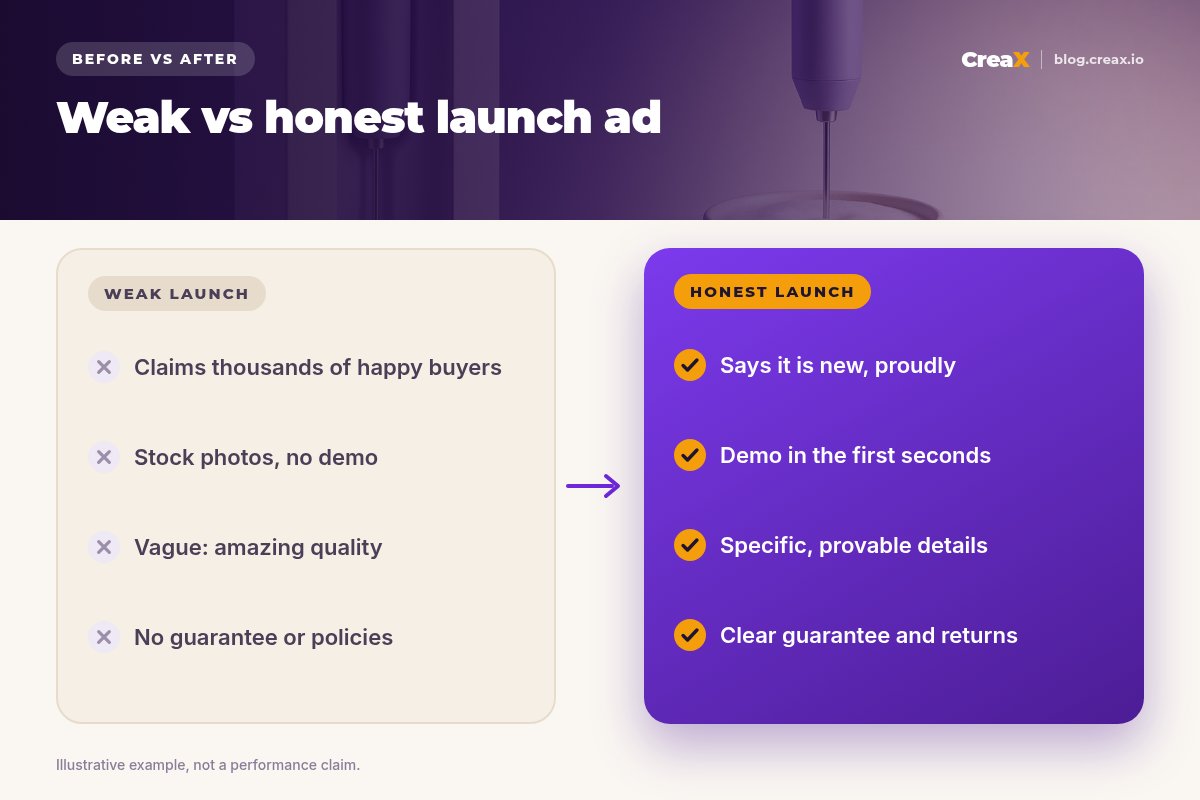
- Faking proof. Fake reviews, ratings, “10,000 sold” badges or AI testimonials presented as real customers.
- Hiding the product behind lifestyle shots. Without reviews, people need to see it work.
- A guarantee you will not honour. It turns one unhappy buyer into a public complaint.
- Vague claims. “Amazing quality” persuades nobody. Specific, provable details do.
- Forgetting to ask for reviews. Months later you still have none, and the problem never goes away.
- Sending traffic to a thin page. A page with no details, policies or FAQ gives buyers every reason to leave.
ChecklistChecklist
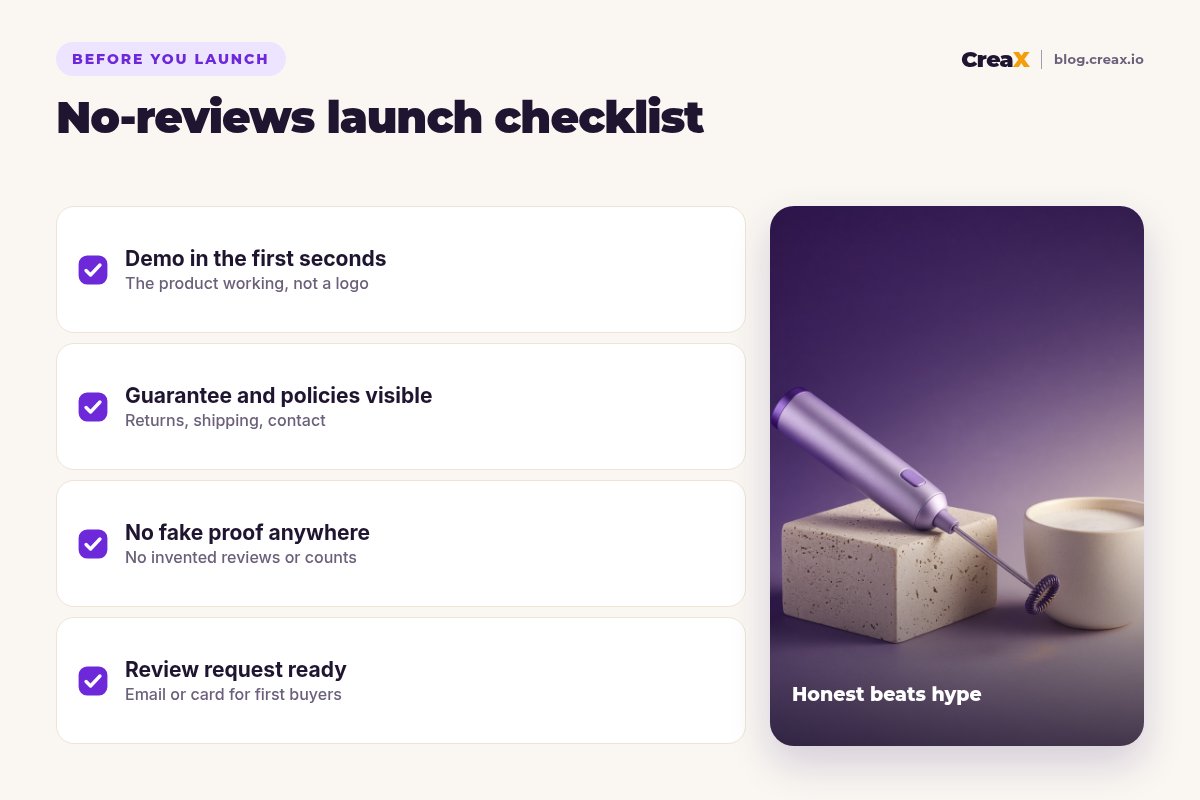
Before you launch
- ✓Trust signals listed and shown on the page: details, policies, contact.
- ✓Demo in the first seconds of at least two ad creatives.
- ✓Guarantee written in plain words and visible in the ad and near the buy button.
- ✓No fake proof anywhere: no invented reviews, ratings, counts or testimonials.
- ✓Warm audiences first: followers, email list, recent visitors.
- ✓Review request ready for every buyer after delivery.
- ✓Plan to reuse real reviews as creatives, with permission.
Launch your next product with proof you can show
CreaX turns one product link into demo-ready UGC-style videos, studio ads and a landing page, so the product can prove itself from day one.
FAQFrequently asked questions
Q.Can I run ads for a product with no reviews?
Q.Is it okay to use supplier or Amazon reviews?
Q.Can I give free products in exchange for reviews?
Q.Can AI-generated UGC videos replace reviews?
Q.How long does it take to get first reviews?
Q.Should I offer a discount to early buyers?
Ready to launch your new product?
One product link, about 60–120 seconds, and you have demo-led video ads, studio creatives and a landing page.
This guide is published by CreaX. It is general guidance, not legal advice. Advertising and review rules differ by platform and country, so check the current rules where you sell.