
Landing Page vs Product Page: What's the Difference?
FAQ · Landing pages
Landing page vs product page: both show your product and both can take a sale, so why do marketers keep insisting they are different? The short version is that a product page is built for shoppers who browse your store, and a landing page is built for one specific click, usually from an ad. Here is what each page is for, which one to send paid traffic to, and how to decide with a simple test instead of a guess.
Updated October 2026 · By the CreaX team
Key takeaways
- ✓A product page lives in your store and serves everyone: browsers, returning customers, search visitors. It has menus, variants, specs and related products.
- ✓A landing page is built for one campaign or audience, with one offer and one call to action. It continues the story the ad started.
- ✓For cold paid traffic, a focused landing page often fits better. For warm visitors and search traffic, the product page usually does the job.
- ✓Don't argue about it, test it: send the same ad to both pages and let your numbers decide.
In this guide
TL;DRThe short answer
A product page is a page in your store for one product. A landing page is a standalone page built for a specific traffic source and goal. Product pages are designed to help people browse and compare; landing pages are designed to keep one visitor focused on one decision.
| Product page | Landing page | |
|---|---|---|
| Main job | Help any shopper understand and buy a product | Convert visitors from one campaign or audience |
| Typical visitor | Browsers, returning customers, search and social | People who just clicked a specific ad or email |
| Navigation | Full store menu, search, related products | Minimal or none, so attention stays on the offer |
| Message | Neutral, covers every use and buyer | Matches one ad angle, one promise |
| Calls to action | Add to cart, plus many other links | Usually one: buy, claim the offer, or add to cart |
| How many you have | One per product | As many as you have angles or campaigns |
Q1What is a landing page?
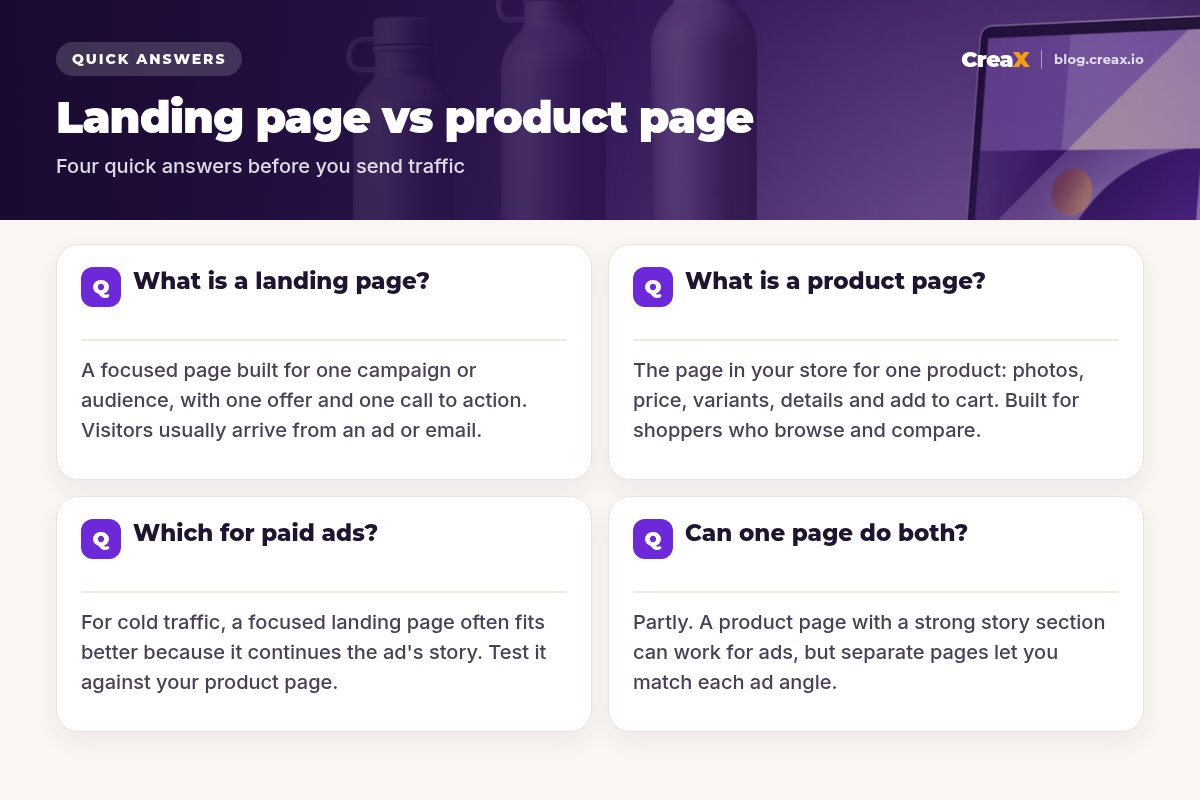
In ecommerce, a landing page is a page you create for a specific campaign: an ad angle, a promotion, an influencer collaboration or an email. Its job is to take someone who just clicked a promise and show them, as quickly as possible, that this product delivers on it.
Good product landing pages tend to share a few traits:
- A headline that echoes the ad. If the ad said “the water bottle that keeps ice for your whole shift”, the page opens with that same idea.
- One product and one offer. No catalog, no competing promotions, often no top menu.
- A story order. Problem, product, proof, offer, then the button, repeated as the visitor scrolls.
- Proof close to the action. Real reviews, guarantee, shipping and returns next to the call to action.
A landing page doesn't have to live outside your store. Many sellers build them as separate pages on their store domain, with a page builder or an AI tool. If you sell as an affiliate, the same idea applies to a pre-sell page; see how to build an affiliate pre-sell page without code.
Q2What is a product page?
Your product page (often called a PDP, product detail page) is the permanent home of a product in your store. It has to serve everyone who arrives: someone comparing three water bottles, someone who already owns one and wants another color, someone who found you on Google. That's why it carries more: variants, specs, size guides, shipping details, FAQs, related products and the store menu.
A great product page still sells hard. It leads with the main benefit, shows the product clearly, handles objections and makes adding to cart easy. Our FAQ on what makes a high-converting product page goes through 15 questions on exactly that. The difference is not quality, it's focus: a product page is built for many visitors and many intents.
iWords vary, the idea doesn't
Q3Which should get your paid ads?
For cold traffic, people who have never heard of you and clicked an ad in their feed, a focused landing page often fits better. They arrived with one specific promise in mind. A page that continues that promise, without menus and side quests, gives them fewer reasons to leave.
For warm traffic (retargeting, returning customers, branded search), the product page is usually fine and sometimes better. These visitors already know you and may want to check variants, compare or browse.
There's also a practical reason landing pages suit testing: if you test three ad angles, you can give each one a page that speaks its language. Your product page can only say one thing at a time.
Pick one ad and one product
Build a landing page for that angle
Split the traffic
Compare what matters
Keep the winner, test again
Before you decide a page is the problem, make sure the ad isn't. If you're getting clicks but no sales, our guide to Facebook ads that aren’t converting helps you tell a creative problem from a page problem.
Get a landing page for every ad angle
Paste a product link and CreaX generates a publish-ready landing page, studio ads and UGC-style video ads in about 60–120 seconds.
Q4Can one page do both?
Partly. A strong product page with a clear benefit headline, good photos, a short story section and proof near the button can convert ad traffic well, especially for simple products and a single main angle. Many small stores start that way, and that's fine.
Where one page struggles is when you run several angles to different audiences. A water bottle ad aimed at nurses on long shifts and one aimed at hikers need different headlines, images and proof. One product page can't open with both. That's when a landing page per angle starts to pay off.
Example: one water bottle, two angles
Say you sell an insulated steel water bottle and run two ads: one for nurses on 12-hour shifts (“still ice-cold at the end of your shift”) and one for weekend hikers (“light enough for the trail, tough enough for the drop”). Your product page can lead with only one of those ideas. Two landing pages can each open with the matching headline, show the bottle in the matching setting and put the most relevant proof first, while both buttons lead to the same product in your cart.
★A simple rule of thumb
MistakesCommon mistakes to avoid
- Sending every ad to the homepage. The visitor has to find the product themselves. Most won't.
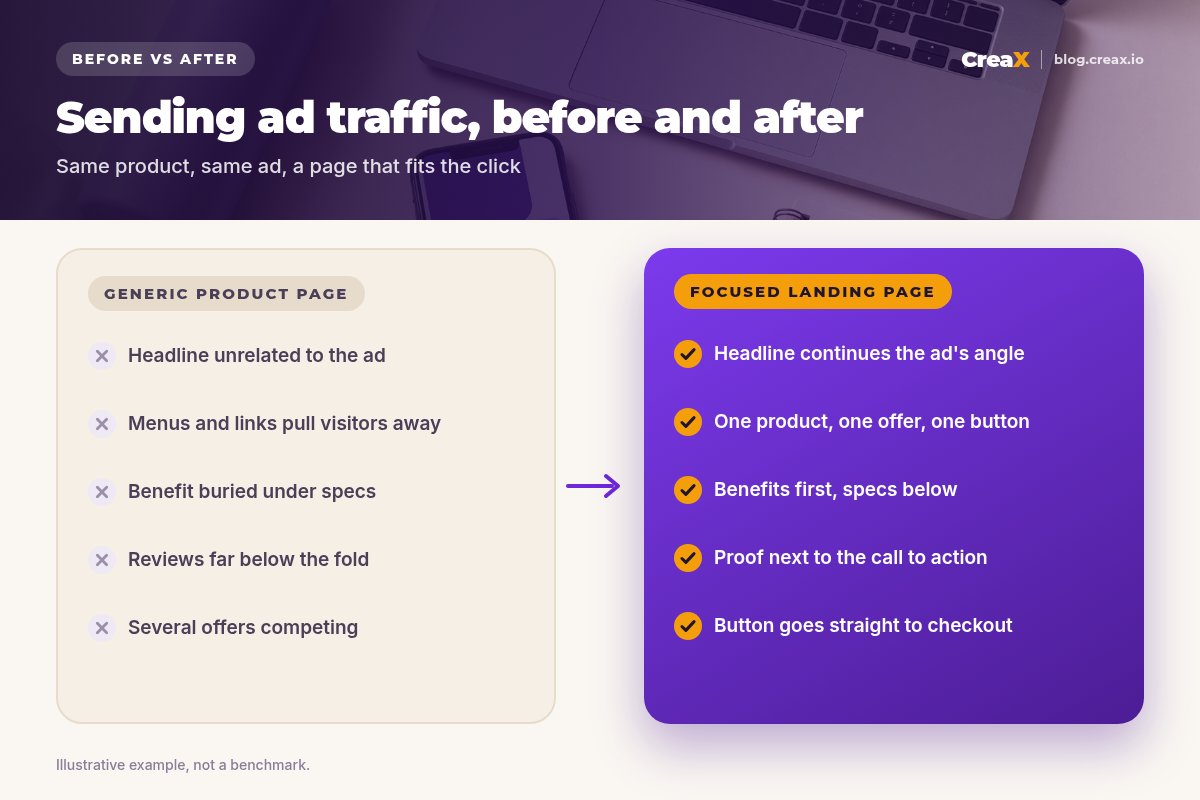
- A headline that ignores the ad. If the ad promised a benefit, the first screen must repeat it.
- Too many exits. Menus, pop-ups, links to other products and blog posts all compete with the buy button on a campaign page.
- A landing page that hides the price. Surprises at checkout lose sales and trust. Show the price and shipping clearly.
- Changing the page and the ad at once. You won't know which change worked. Test one variable at a time.
- Claims the product can’t back up. A page that over-promises may win the click and lose the customer, and can get ads rejected.
ChecklistChecklist you can copy
Before you send traffic to any page
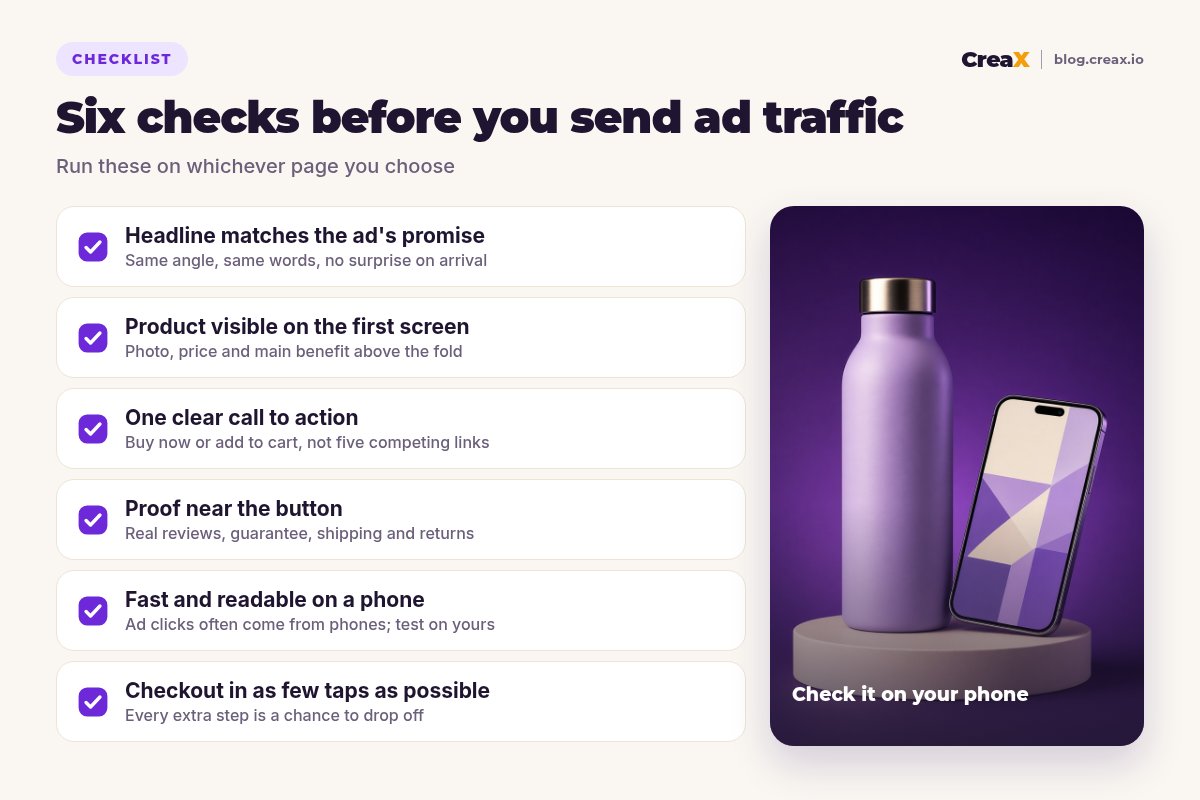
- ✓Match: the headline and hero image repeat the ad's promise.
- ✓First screen: product, price and main benefit visible without scrolling on a phone.
- ✓One action: a single, clear call to action, repeated as people scroll.
- ✓Proof: real reviews, guarantee, shipping and returns near the button.
- ✓Speed: the page loads fast on mobile data; check it on your own phone.
- ✓Path: the button leads straight to the product in the cart or to checkout.
- ✓Honesty: every claim on the page is one you can prove.
CreaXHow CreaX helps (briefly)
CreaX is an all-in-one AI ecommerce creative OS. Paste a product link or upload a product image and, in about 60–120 seconds, it generates a publish-ready landing page together with studio ad creatives and UGC-style video ads, plus a multi-tenant store if you need one. Because the page and the ads come from the same input, the headline and visuals match the ads from the start, which is exactly what a landing page needs.
You keep control: edit the copy, check every claim and decide where the button goes. If you prefer a page builder, our comparison of CreaX vs PageFly and GemPages covers when each approach fits, and turning a product link into a landing page walks through the workflow step by step.
Test a landing page against your product page
One product link gives you a matching landing page and ads in about two minutes. Run the split test this week.
FAQFrequently asked questions
Q.Is a landing page better than a product page?
Q.Should a landing page have a menu?
Q.Can I build landing pages on Shopify?
Q.How many landing pages do I need?
Q.Does a landing page help SEO?
Q.How much does CreaX cost?
Ready to give every ad the page it deserves?
Paste a product link: landing page, studio ads and UGC-style video ads in about 60–120 seconds.
This guide is published by CreaX. It describes general ecommerce practice and CreaX features as of October 2026, avoids invented statistics, and recommends testing pages with your own traffic before drawing conclusions.