
What Is CPA in Dropshipping? Questions Answered
FAQ · Ad metrics
What is CPA in dropshipping? It is what you pay in ads, on average, for each sale. It decides whether a product makes money. This guide explains CPA in plain English: how to calculate it, how it differs from CPC, CPM and ROAS, how to find your break-even CPA, and what to do when it climbs.
By the CreaX team
Key takeaways
- ✓CPA = ad spend ÷ purchases. In Meta Ads Manager it shows up as cost per purchase (or cost per result when your goal is purchases); TikTok Ads Manager calls it CPA or cost per conversion.
- ✓Your break-even CPA is selling price minus every cost per order. Pay more than that for a sale and you lose money on it.
- ✓There is no universal good CPA. A CPA that is great for a high-margin bundle can sink a cheap single item. Judge it against your own break-even number.
- ✓CPA usually rises because of tired creatives, weak hooks, a page that does not match the ad, or the learning phase. You lower it with fresh angles, a matching page and offers that raise order value.
In this guide
TL;DRThe short answer
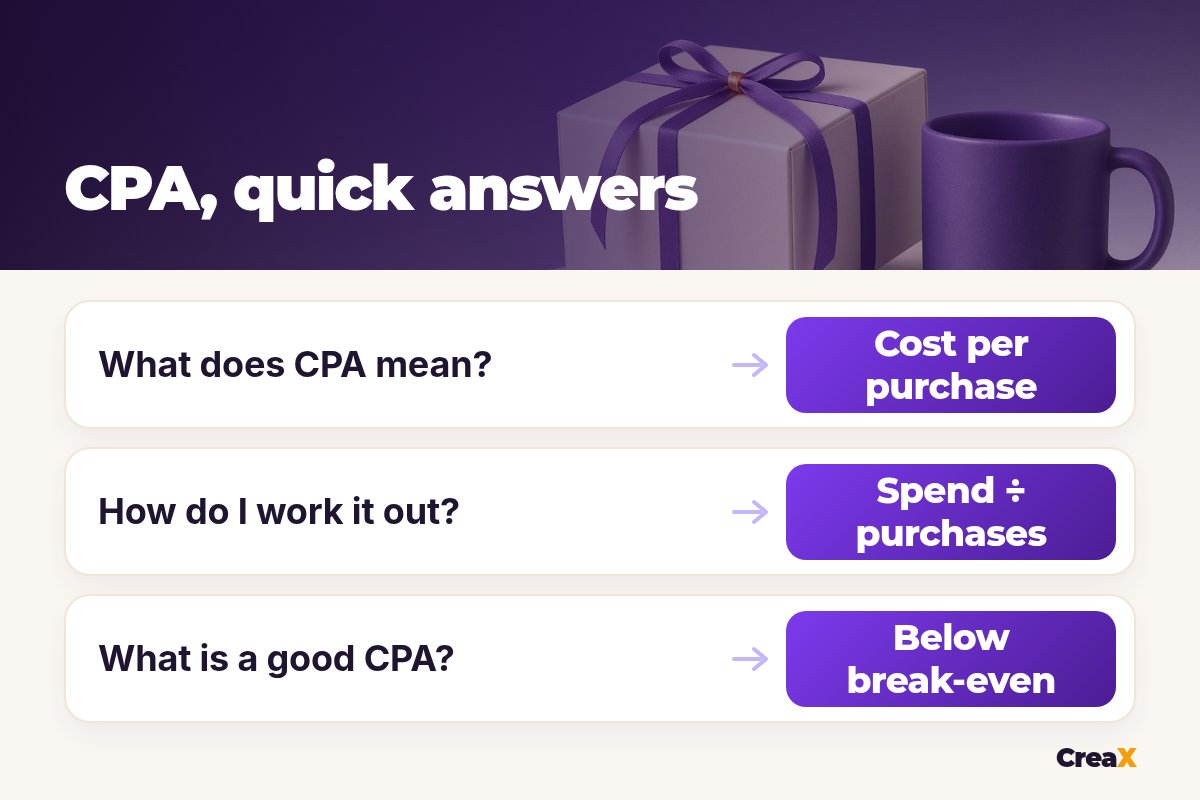
CPA stands for cost per acquisition. In dropshipping the acquisition you care about is a purchase, so most sellers read it as cost per purchase: how much ad money you spent to get one order. If you spent a certain amount on ads and got a certain number of sales, divide the first by the second and you have your CPA.
On its own, CPA is just a number. It becomes useful when you compare it with your break-even CPA, the most you can pay for a sale without losing money. Below break-even, the product can make money. Above it, every sale costs you.
Question 1What does CPA mean in Meta and TikTok Ads Manager?
In Meta Ads Manager, CPA is not a single column called CPA. When your campaign optimizes for purchases, the Cost per result column shows what you paid per purchase, and you can also add the Cost per purchase column through Columns › Customize columns. In TikTok Ads Manager, the metric is labelled CPA or cost per conversion, where the conversion is the action you chose, such as a complete payment.
Two details trip people up:
- The result must be a purchase. If your campaign optimizes for add-to-carts or landing page views, “cost per result” is the cost of that action, not the cost of a sale. A cheap cost per add-to-cart can still hide an expensive CPA.
- Ads Manager counts attributed purchases. The platform only counts sales it can credit to your ads under its attribution setting, so its numbers can differ from your store's order count. Many sellers also track a blended CPA: total ad spend divided by total store orders over the same period.
If you are just starting, our guide on starting dropshipping on a small budget shows where CPA fits in your first few weeks of testing.
Question 2How is CPA calculated?
The formula is simple: CPA = total ad spend ÷ number of purchases. Use the same time window and the same campaign, ad set or ad for both numbers. Here is an example with made-up numbers, just to show the arithmetic:
| Example (hypothetical) | Ad spend | Purchases | CPA |
|---|---|---|---|
| Ad A | $150 | 6 | $25 |
| Ad B | $150 | 3 | $50 |
| Ad C | $150 | 0 | No CPA yet |
Hypothetical numbers to show the formula. Your own spend and sales will be different.
Notice ad C. With zero purchases there is no CPA, only spend. That is why you set a spending limit before a test starts (more on that below). If you are not sure how much a test should spend per day, our article on how much to spend on Facebook ads per day when testing walks through it.
A useful way to see what drives CPA: CPA = cost per click ÷ conversion rate. If clicks get more expensive, or fewer visitors buy, CPA goes up. That simple link tells you where to look when CPA moves.
Question 3CPA vs CPC vs CPM vs ROAS: what's the difference?
These four metrics describe different steps of the same journey, from someone seeing your ad to someone paying you:
| Metric | What it measures | Formula | What it tells you |
|---|---|---|---|
| CPM | Cost per 1,000 impressions | Spend ÷ impressions × 1,000 | How expensive it is to reach people |
| CPC | Cost per click | Spend ÷ clicks | How expensive each visit is |
| CPA | Cost per purchase | Spend ÷ purchases | What each sale costs you in ads |
| ROAS | Return on ad spend | Revenue ÷ spend | How much revenue each ad dollar brings back |
CPM and CPC describe the top of the funnel; CPA and ROAS describe the money end.
CPM and CPC are early signals. A high CPM means reaching people is expensive (our guide on why your CPM is high covers the usual causes). A high CPC often means the ad isn't earning clicks. But neither tells you whether people buy. CPA and ROAS do.
CPA and ROAS are two views of the same thing. CPA looks at cost per order; ROAS looks at revenue per dollar. If your average order value stays the same, a lower CPA means a higher ROAS. Some sellers think in ROAS, some in CPA; pick one as your main number and know how to convert. Our article on break-even ROAS for dropshipping shows the ROAS side of the same maths.
Question 4What is break-even CPA, and how do I work it out?
Your break-even CPA is the most you can spend in ads to get one sale and still not lose money on it. It is your selling price minus every cost that comes with an order, before ads:
- Selling price the customer pays (including any shipping you charge).
- Product cost from your supplier.
- Shipping cost you pay to get it to the customer.
- Fees: payment processing, platform or app fees per order, packaging.
- An allowance for refunds if your product gets returned or charged back.
Worked example (hypothetical numbers)
| Item | Example value | Note |
|---|---|---|
| Selling price | $35 | Your store price |
| Product + shipping | $15 | From your supplier |
| Fees, packaging, refund allowance | $3 | Your own estimate per order |
| Break-even CPA | $17 | $35 − $15 − $3 |
| Target CPA (to keep some profit) | Below $17 | How far below is your choice |
Hypothetical example to show the method, not a benchmark. Use your own price and costs.
In this example, any sale that costs less than $17 in ads makes some money; any sale that costs more loses money. Most sellers set a target CPA below break-even so there is profit left after ads. That's also the number that tells you whether you have a winner: our guide on how to know if a product is a winner uses the same idea.
Test more angles for the same budget
Paste a product link and get studio ads, UGC-style video ads and a matching landing page in about 60–120 seconds.
Question 5What is a good CPA for dropshipping?
There is no universal number, and anyone who quotes one without knowing your product is guessing. A good CPA is simply one that sits comfortably below your break-even CPA and leaves the profit you want.
Two things move the line:
- Margin. A product with a large gap between price and cost can afford a much higher CPA than a cheap gadget with a thin margin.
- Average order value (AOV). If customers often buy two units or a bundle, each order brings in more money, so your break-even CPA rises. The same ad cost per order suddenly looks fine.
So ask “is my CPA below break-even, with room to spare, over enough spend to trust it?” If yes, it's good for you.
⚖Why we don't give benchmark CPAs
Question 6Why is my CPA going up?
When CPA climbs, one of the steps between impression and purchase got worse. The common causes:
Creative fatigue
A weak hook
Landing page mismatch
The learning phase
Audience saturation or scaling too fast
Use the CPC ÷ conversion rate link to narrow it down. If CPC jumped but conversion rate held, look at the ad and audience. If CPC is steady but fewer visitors buy, look at the page, price and offer.
Question 7How do I lower my CPA?
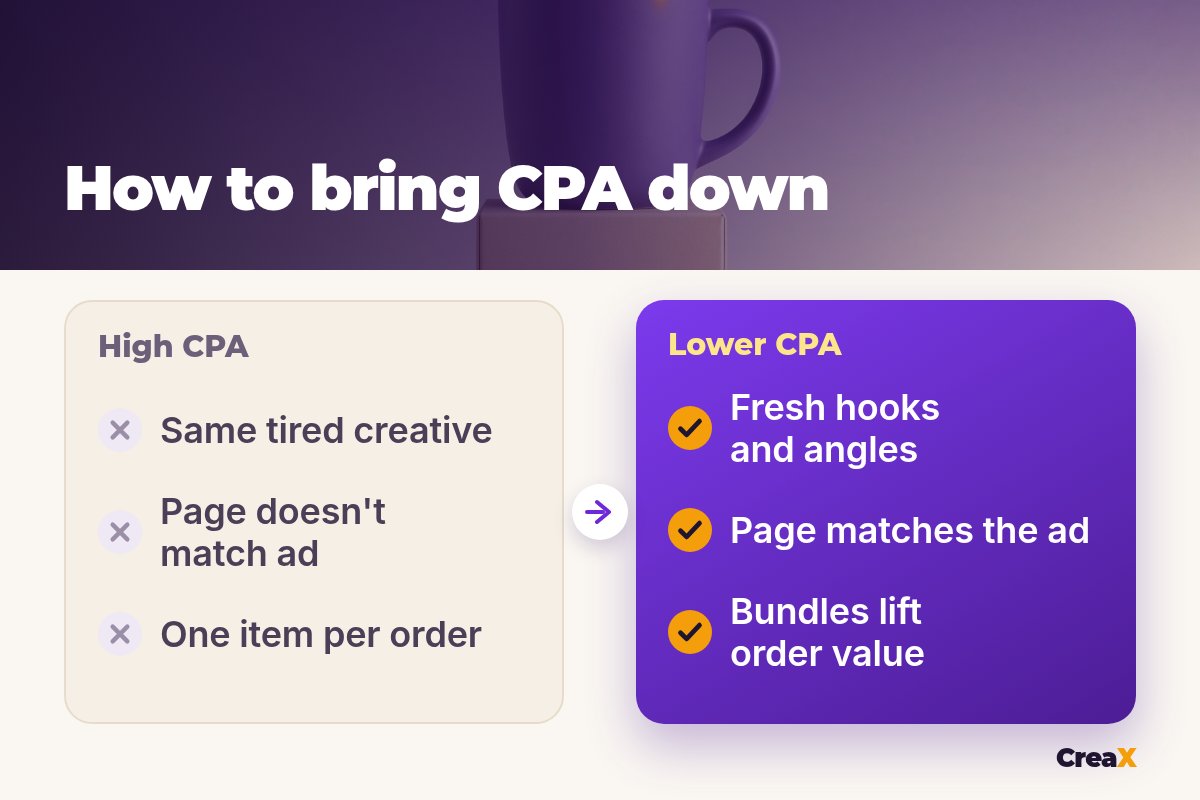
You can't control the auction, but you control three big levers: the creative, the page and the offer.
1. Better creatives and new angles
Most CPA wins come from the ad itself. Test genuinely different angles, not new colours on the same idea: a problem ad, a demo ad, a gift or lifestyle ad, a comparison with the old way. Strong hooks in the first seconds, clear product shots and one message per ad. When one ad works, build fresh variations of it before it tires; our guide to scaling winning creative variations shows how.
2. A page that matches the ad
If the ad sells “stops back pain at your desk”, the page headline should say the same thing, with the same product shots and the same offer. A matching page turns more clicks into purchases, which lowers CPA without touching the ad. If you see clicks but few sales, start here, and check our guide to TikTok ads with views but no sales for more fixes.
3. An offer that raises order value
Bundles, multi-buy discounts and useful add-ons raise how much each order brings in. That doesn't always lower the raw CPA, but it raises your break-even CPA, so the same CPA becomes profitable. Our article on building a bundle offer landing page shows how to present one clearly.
Question 8When should I kill or scale an ad set based on CPA?
Decide your rules before the test starts, and judge on enough spend to trust the result. A common rule of thumb is to let an ad set spend around two to three times your break-even CPA before you judge it, because one lucky or unlucky sale can mislead you. It's a rule of thumb, not a law; adjust it to your margin and budget.
| What you see after your planned test spend | What to do |
|---|---|
| No purchases and weak clicks | Kill it, or rethink the angle and offer before retesting |
| Clicks but no or very few purchases | Fix the landing page, price and trust before spending more |
| Purchases, but CPA above break-even | Keep the product, test new creatives and improve the page |
| CPA at or below your target over several days | Scale gradually and keep adding fresh creatives |
A simple decision table. Set the thresholds from your own break-even CPA.
When you scale, raise budgets in modest steps rather than huge jumps, watch CPA over several days instead of hours, and keep new creatives coming so the winner has backup when it starts to tire.
Verdict
CPA is only useful next to your break-even number
Watch outCommon CPA mistakes to avoid
- Optimizing for the wrong result. A cheap cost per add-to-cart is not a cheap CPA.
- Judging after a handful of sales. Small numbers swing wildly; wait for your planned spend.
- Comparing with other sellers. Their margin, price and country are not yours.
- Forgetting fees and refunds. Leave them out and your break-even CPA looks better than it is.
- Blaming the ad for a page problem. Clicks without sales usually point to the page or offer.
Before your next testChecklist you can copy
CPA checklist
- ✓My campaign optimizes for purchases, so cost per result is my CPA.
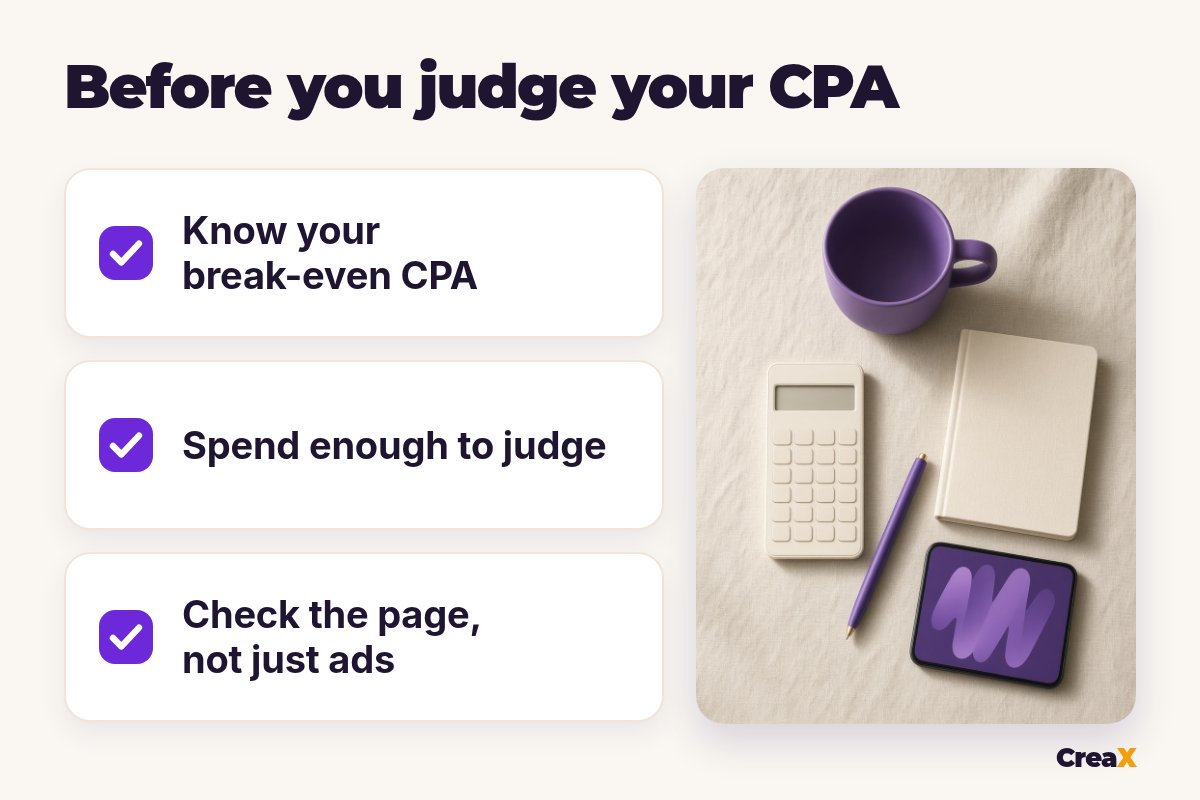
- ✓I know my break-even CPA, including fees and a refund allowance.
- ✓I've set a target CPA below break-even.
- ✓I've decided how much each ad set spends before I judge it.
- ✓I have several ads with genuinely different angles and hooks.
- ✓My landing page repeats the ad's promise, shots and offer.
- ✓I've written my kill, fix and scale rules down.
Our toolHow CreaX helps (briefly)
Most of the CPA levers come down to having fresh creatives and a page that matches them, fast. CreaX turns one product link or image into studio ad creatives in five styles and four sizes, UGC-style video ads of 18, 30 or 45 seconds and a publish-ready landing page, in about 60–120 seconds. When CPA creeps up, new angles and a matching page can be ready the same day. Plans start at $4.99 a month, with top-ups at $1 per 500 credits.
Fresh creatives and a matching page from one link
Give every test new angles and a landing page that matches the ad, without hiring a designer.
FAQFrequently asked questions
Q.Is CPA the same as cost per purchase?
Q.Why is my CPA in Ads Manager different from my store numbers?
Q.Should I use CPA or ROAS?
Q.Can I set a target CPA in Meta or TikTok?
Q.How long should I wait before judging CPA?
Q.Does a higher price always mean a higher allowed CPA?
Ready to bring your CPA down?
Get studio ads, UGC-style video ads and a landing page from one product link in about 60–120 seconds.
This guide is published by CreaX. We describe other tools from their own public websites, last checked October 2026, avoid invented scores or prices, and recommend checking each vendor's site for current features and plans.