
Why Is My CPM So High? Ecommerce Ad Questions Answered
FAQ · Ad costs
Why is my CPM so high? It is one of the first questions sellers ask when ad costs creep up on Meta or TikTok. CPM, the cost per thousand impressions, is set by an auction, so some of what drives it is outside your control. But a surprising amount is not. This guide explains what pushes CPM up, when a high CPM is fine, how creatives affect it, and what to check first.
Updated October 2026 · By the CreaX team
Key takeaways
- ✓CPM comes from an auction. You compete with every advertiser trying to reach the same people at the same time, so competition and seasons move it.
- ✓A high CPM is not automatically bad. If the people you reach buy, your cost per purchase can still be healthy. Judge results, not reach.
- ✓You control more than you think: audience size, overlap between your own ad sets, placements and, above all, how relevant and fresh your ads are.
- ✓Creatives matter because ad platforms consider predicted engagement and ad quality, not just your bid. Fresh, relevant ads tend to win reach more efficiently.
In this guide
TL;DRThe short answer
Your CPM is high because many advertisers want the same people you do, at the same time, and the platform charges whoever it thinks will make the best use of each impression. Seasons such as the run-up to Black Friday and the holidays make that competition fiercer. Narrow audiences, overlapping ad sets and expensive placements make it worse. And ads that people ignore or hide are at a disadvantage in the auction, so they tend to pay more for the same reach.
Before you panic, put CPM next to the numbers that pay your bills: click-through rate, conversion rate and cost per purchase. A high CPM with a strong conversion rate can still be profitable. A low CPM with no sales is just cheap reach.
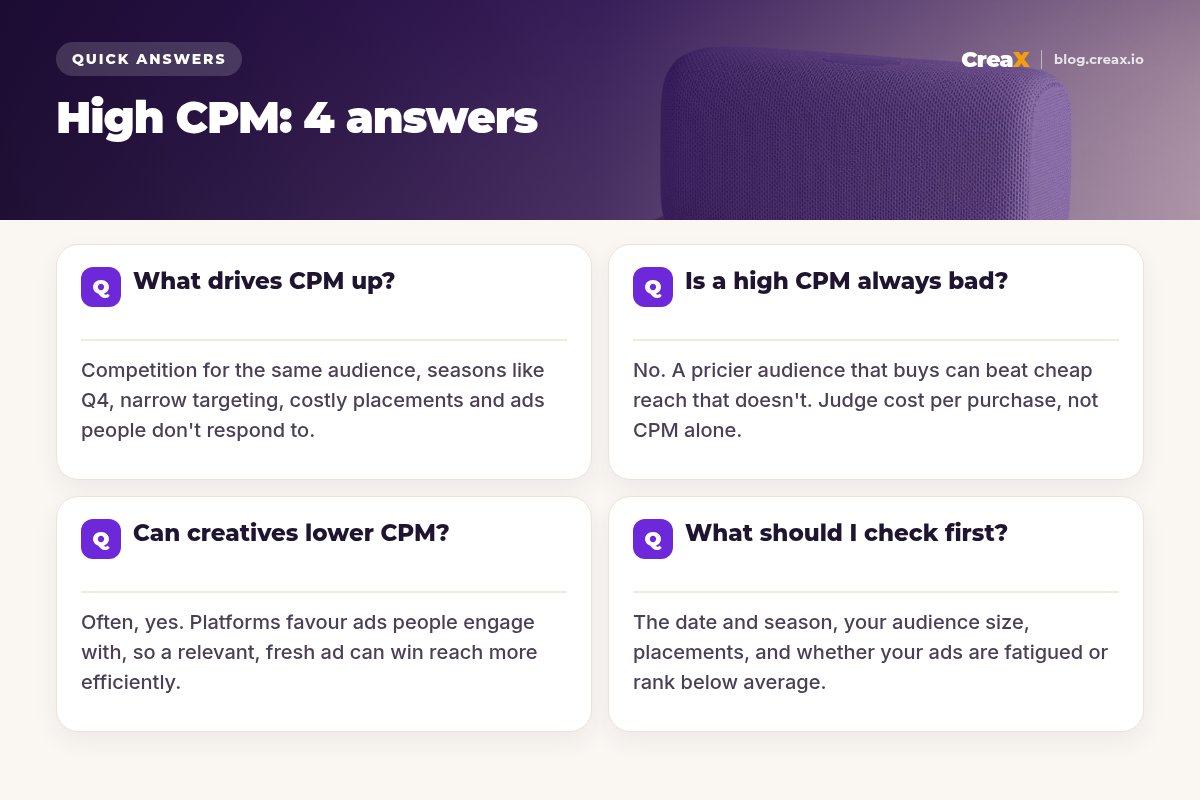
Q1What drives CPM up?
Think of CPM as the price of attention in a live market. These are the main forces that move it:
| Driver | Why it raises CPM | Can you control it? |
|---|---|---|
| Competition | More advertisers bidding for the same audience | No, but you can avoid peak overlap |
| Seasonality | Q4, Black Friday, holidays and big sales days pack the auction | Partly: plan and test before peaks |
| Narrow targeting | A small pool means fewer, pricier impressions | Yes: broaden where it makes sense |
| Self-competition | Your own ad sets bidding for the same people | Yes: consolidate |
| Placements | Some placements cost more than others | Yes: let the system use more inventory |
| Ad relevance | Ads people ignore or hide are at a disadvantage | Yes: better, fresher creatives |
| Country and audience value | Some markets and audiences are more contested | Partly: by choosing markets |
General drivers of auction-based ad pricing on platforms such as Meta and TikTok. Exact mechanics vary by platform.
Meta explains that its ad auction does not simply award the highest bid. It combines the bid with how likely someone is to take the action you want and a measure of ad quality. That is why two advertisers can pay very different prices to reach the same person.
iCPM vs CPC vs CPA
Q2Is a high CPM always bad?
No. A high CPM is a problem only if it is not matched by results. Some audiences cost more because they are more valuable: people with a history of buying online, or shoppers in markets where many brands compete. Paying more to reach them can be worth it.
Here is a simple way to read it:
- High CPM, good CTR, good conversion rate: you are paying for valuable attention. Usually fine.
- High CPM, low CTR: people see the ad and scroll past. The creative or the targeting is the likely problem.
- High CPM, good CTR, low conversion rate: the ad works but the page or offer does not. See why Facebook ads are not converting.
- Low CPM, no sales: cheap reach to people who do not buy. Not a win.
Work out your break-even cost per purchase first, then decide whether a CPM is too high. Our guide to break-even ROAS walks through the maths.
Q3Can creatives lower CPM?
Often, yes. Because ad platforms factor in how people respond to an ad, a creative that earns attention and engagement tends to compete better than one people skip. That does not mean any single trick will cut your costs, but it does mean creative quality is one of the few levers you fully control.
What tends to help:
- A strong first second. If people stop, the platform learns the ad is relevant. Our guide to hook rate explains how to measure this.
- Native-looking formats. Vertical video and UGC-style content tend to fit Reels and TikTok better than repurposed TV-style ads.
- The right size for each placement. An ad squeezed into the wrong frame looks out of place. See ecommerce ad creative sizes.
- Freshness. When people have seen an ad many times, engagement drops and costs can rise. See signs of ad creative fatigue.
- Variety. Several genuinely different angles give the system more options to match the right ad to the right person.
Ads Manager on Meta shows relevance diagnostics (quality ranking, engagement rate ranking and conversion rate ranking) compared with ads competing for the same audience. Below-average rankings are a strong hint that the creative is part of your CPM problem.
Refresh your creatives without a shoot
CreaX turns one product link into studio ad creatives and UGC-style video ads in about 60–120 seconds, in 1:1, 3:4, 4:5 and 9:16.
Q4What should I check first?
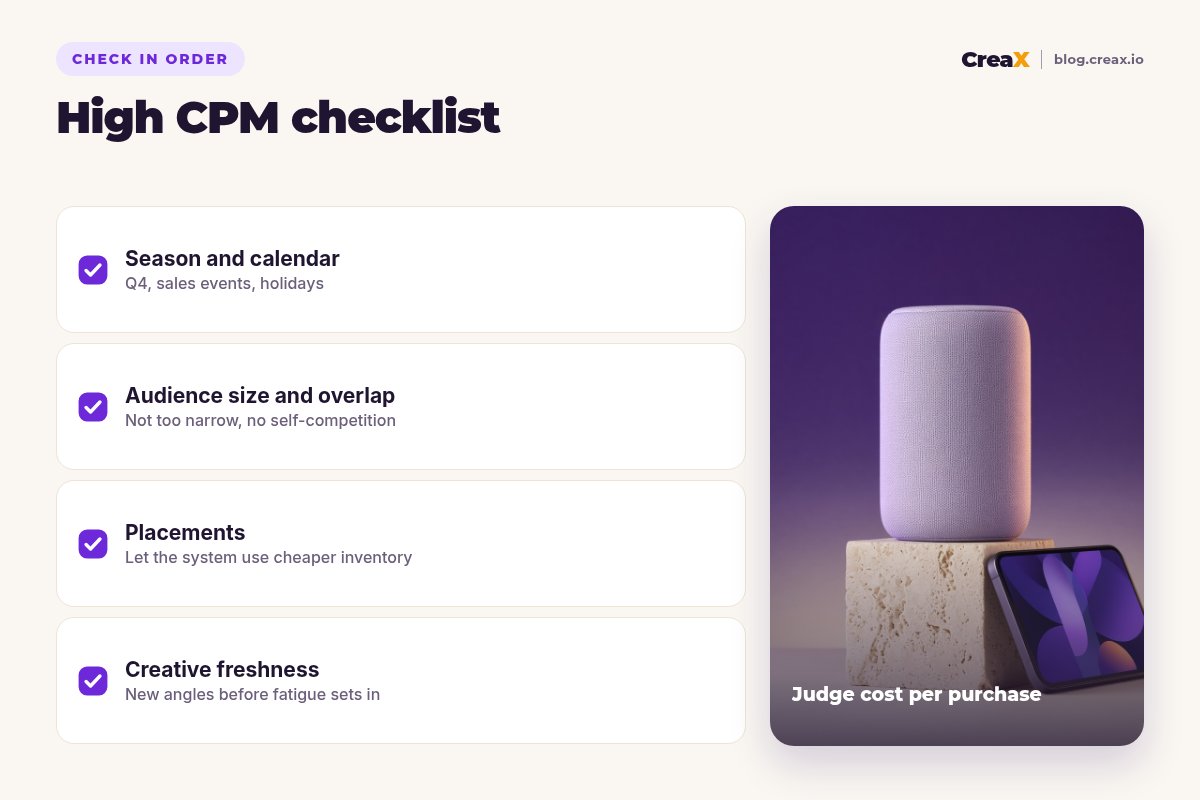
Work through these in order, from causes you cannot control to the ones you can:
Check the calendar
Compare with your own history
Check audience size and overlap
Review placements
Check the creative
★Change one thing at a time
MistakesCommon mistakes to avoid
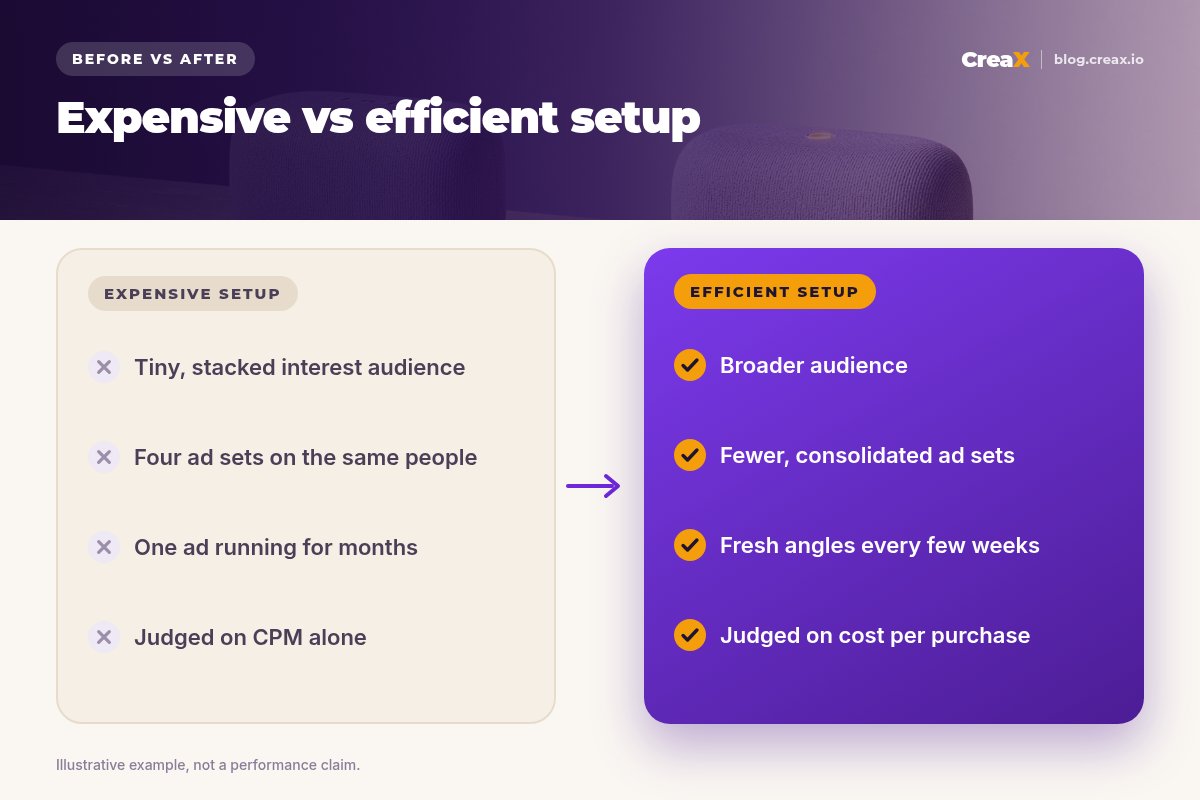
- Judging a campaign on CPM alone. Cost per purchase is what matters for an ecommerce store.
- Over-narrowing audiences to save money. Smaller audiences often cost more per impression, not less.
- Running many overlapping ad sets. You end up competing with yourself in the same auctions.
- Leaving one ad running for months. Fatigue lowers engagement and can make reach more expensive.
- Launching new products at the peak of Q4 with no data. Test earlier, when auctions are calmer, and scale proven ads into the peak.
- Chasing low-CPM placements that never convert. Cheap impressions are only useful if some of them turn into sales.
ChecklistChecklist you can copy
When CPM jumps
- ✓Season checked: you know whether a sales event or holiday is lifting prices.
- ✓Compared with your own history: same audience, same placements, recent weeks.
- ✓Audience not too narrow: few stacked interests, room for the system to find buyers.
- ✓No self-competition: ad sets consolidated so they do not chase the same people.
- ✓Placements open where possible: tested before excluded.
- ✓Creatives fresh: frequency and relevance rankings checked, new angles ready.
- ✓Judged on cost per purchase: not on CPM by itself.
If CPM is fine but people do not click, the problem is the creative or the offer. Our guide to why your CTR is low picks up from there.
CreaXHow CreaX helps (briefly)
CreaX cannot change auction competition or the holiday calendar. What it helps with is the lever you control: fresh, relevant creatives in the right formats. CreaX is an AI ecommerce creative OS. Paste a product link or upload a product image and, in about 60–120 seconds, you get studio ad creatives in five styles (Classic, Humble Orbit, Punch, Luxe and Meta Feed), UGC-style video ads at 18, 30 or 45 seconds, a publish-ready landing page and a multi-tenant store.
That makes it practical to keep several genuinely different angles running and to refresh a winner before it fatigues, without booking a shoot or briefing a designer every time.
Keep your ads fresh and your reach efficient
Paste a product link and get new studio ads, UGC-style videos and a matching landing page, ready to test today.
FAQMore questions sellers ask
Q.What is a good CPM for ecommerce?
Q.Why did my CPM suddenly go up?
Q.Is CPM higher on Meta or TikTok?
Q.Does broad targeting lower CPM?
Q.Do video ads have a lower CPM than static ads?
Q.Should I pause ads when CPM is high?
Ready to give the auction better ads?
One product link, about 60–120 seconds, and you have fresh creatives, video ads and a landing page for your next test.
This guide is published by CreaX. We describe how ad auctions work based on Meta's own Business Help Center as of October 2026 and avoid invented numbers. Platforms change often, so check their current help pages.