
How to Scale a Winning Creative With Variations
How to · Creative iteration
To scale a winning ad creative, you don't just raise the budget and hope. You make variations that keep what made the ad win and change one thing at a time, so you get more winners and the original lasts longer. Here's a five-step method, a worked example and a checklist you can use on your next winner.
Updated October 2026 · By the CreaX team
Key takeaways
- ✓First diagnose why the ad wins: the angle, the hook, the format, the offer or the presenter. Your variations depend on the answer.
- ✓Keep the core: the same angle and promise in every variation. Change one variable at a time.
- ✓Start with the cheapest, highest-impact changes: new hooks and first frames, then new formats and presenters.
- ✓Keep the original running, judge variations on cost per purchase with a pre-set rule, and retire losers fast.
In this guide
OutcomeWhat you'll have at the end
By the end you'll have a batch of variations built around one proven ad: several new hooks, at least one new format, and a clear rule for which variations stay and which go. The original winner keeps running while the variations compete with it, so you're adding to what works rather than replacing it.
Why bother? Every winning ad eventually wears out as the same people see it again. Variations extend the life of a winning idea, reach people the original didn't, and give the ad platform more creative options to match to different viewers. When you see the signs of creative fatigue, variations are usually the first fix to try.
PrepWhat you need before you start
- A real winner: an ad that has beaten others on cost per purchase over meaningful spend, not one lucky day.
- Its numbers: spend, purchases, cost per purchase, click-through rate and, for video, how many people watch past the first seconds. Our guide to hook rate explains that last one.
- The product link or images, so you can generate new creatives quickly.
- A kill rule written down before you launch: the minimum spend per variation and the cost per purchase that counts as a loss.
Find the causeStep 1: Diagnose why it wins
Before changing anything, write down your best guess at why this ad works. The usual suspects:
| Possible reason | What it looks like | What to vary next |
|---|---|---|
| Angle | Other ads with different angles lost | Keep the angle; vary hooks and formats |
| Hook | Strong early watch time and click-through | Keep the hook style; vary format and presenter |
| Format | The same message as a static lost | Keep the format; vary hooks and angles |
| Offer | Ads with the offer win regardless of creative | Keep the offer; vary everything else |
| Presenter or tone | Comments mention the person or the style | Keep the tone; vary hooks |
A diagnosis is a hypothesis. Your variations will confirm or reject it.
Read the comments too. Buyers often tell you exactly what caught them, in words you can reuse in new hooks.
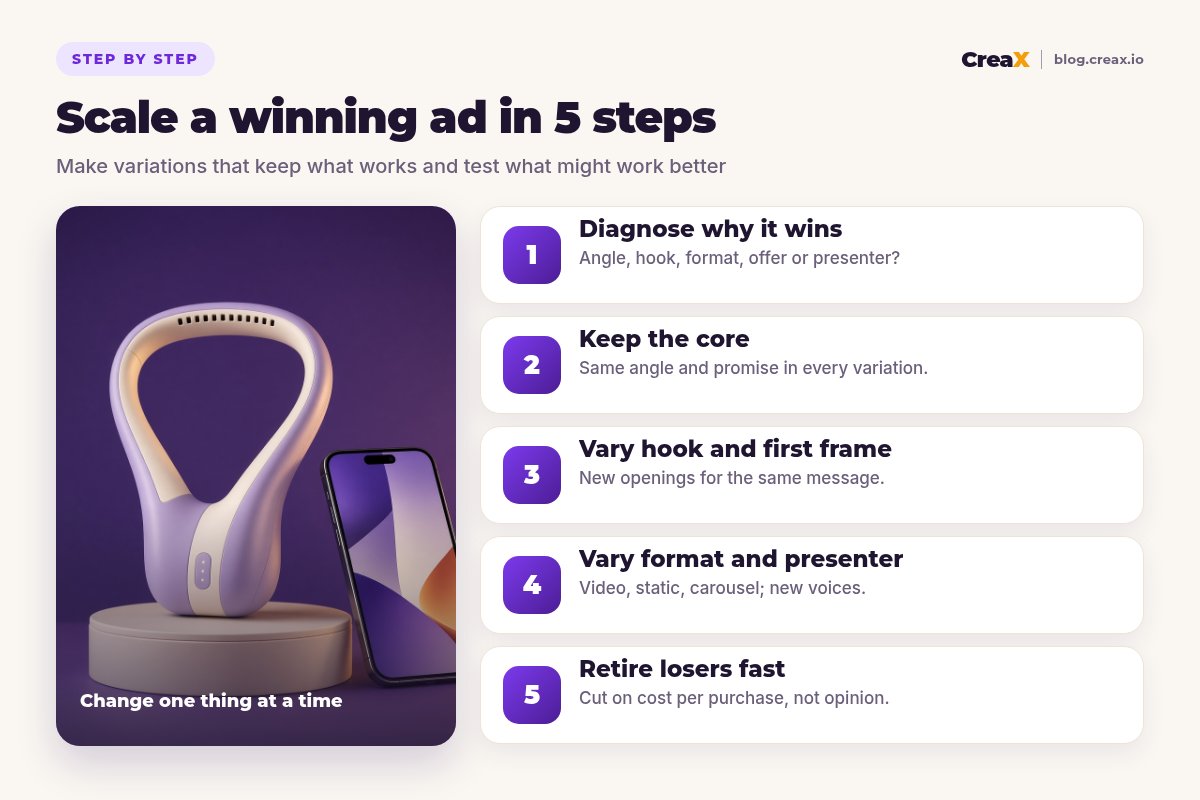
Don't break itStep 2: Keep the core
The core is the part you think made the ad win, usually the angle and the promise. Every variation keeps it. If your winner sells a portable neck fan with the angle “stay cool on your commute without holding anything”, every variation should still be about hands-free cooling on the go.
This is where many sellers go wrong: they make “variations” that are really new ads with new angles. That's angle testing, which is useful but different. For that, see how to test ad angles. Here, the goal is to scale one proven idea.
★Write the core in one sentence
Make new variations from the same product link
CreaX generates new UGC-style video ads and studio creatives from one product link in about 60–120 seconds, so a winning angle can get fresh variations fast.
Highest impactStep 3: Vary the hook and first frame
The first second decides whether anyone sees the rest. New openings for the same message are usually the cheapest, highest-impact variations:
- A different first frame: the product in use, the problem, the result, or a close-up.
- A different opening line: a question, a bold statement, a “POV” setup or a direct callout of the buyer.
- A different on-screen text in the first second.
- A different pace: a fast cut versus a calm demo.
Make three to five hook variations and keep the body of the ad the same. If one hook clearly beats the original, you've learned something about what stops your buyers, and you can reuse it. Our guide on how many creatives to test per product helps size the batch to your budget.
Reach new peopleStep 4: Vary format and presenter
Once you've found strong hooks, change the delivery while keeping the angle:
- Format: turn a winning video into a static, a carousel or a shorter cut; turn a winning static into a UGC-style video.
- Length: a short and a longer version of the same story.
- Presenter and voice: a different person, voice or tone telling the same story.
- Placement fit: vertical for Reels and TikTok, square or 4:5 for feeds.
Different formats reach different people, even with the same message. If you've only tested video, our comparison of static vs video ads explains what each format is good at.
Stay focusedStep 5: Retire losers fast
Variations only help if you're strict about cutting the ones that don't work. Use the rule you wrote before launch:
Give each variation its minimum spend
Compare with the original
Cut on cost per purchase
Keep the learnings
Repeat on the next winner
Where to run the variations? Many advertisers add them to the same campaign or ad set as the winner so the platform can compare them under similar conditions. If you use automated campaigns, our guide to Meta Advantage+ creatives explains how creative variety fits in.
Keep your winners fresh every week
Paste the product link into CreaX for new UGC-style videos, statics and a matching landing page whenever a winner starts to tire.
ExampleWorked example: a portable neck fan
Say your winner is a UGC-style video for a portable neck fan with the angle “stay cool on your commute without holding anything”. It opens with someone stepping off a crowded bus. Here's a first batch:
| Variation | What changes | What stays |
|---|---|---|
| Hook A | Opens on a close-up of the fan switching on | Angle, body, offer |
| Hook B | Opens with “If your commute is a sauna, watch this” | Angle, body, offer |
| Hook C | Opens on the result: relaxed at the office desk | Angle, body, offer |
| Format | A static with the same promise and a product close-up | Angle, offer |
| Presenter | A different voice and tone telling the same story | Angle, hook style, offer |
Illustrative batch. Claims must match the real product, such as its real battery life.
In CreaX, you'd paste the fan's product link again to generate new UGC-style videos and statics, then pick the ones that fit the same angle. The landing page should keep telling the commute story, so a click from any variation lands on a matching promise. Our guide on turning one product image into a week of ad tests shows a full weekly routine.
AvoidMistakes to avoid
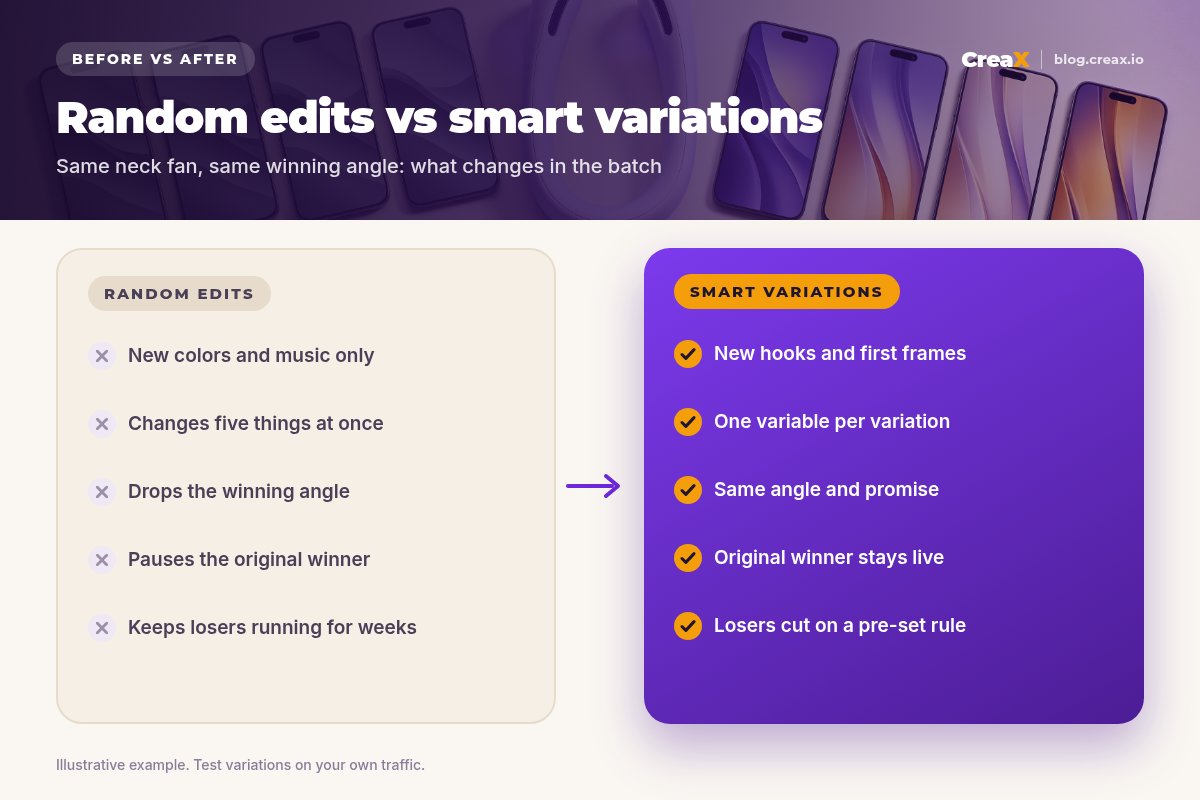
- Pausing the original to make room. Let it keep running while variations prove themselves.
- Changing everything at once. If a variation wins, you won't know why.
- Cosmetic “variations”. New colors or music alone rarely teach you anything.
- Drifting from the angle. A new angle is a new test, not a variation.
- Judging too early or too late. Stick to the minimum spend and kill rule you set.
- Forgetting the page. A great new hook that promises something the page doesn't mention will lose buyers.
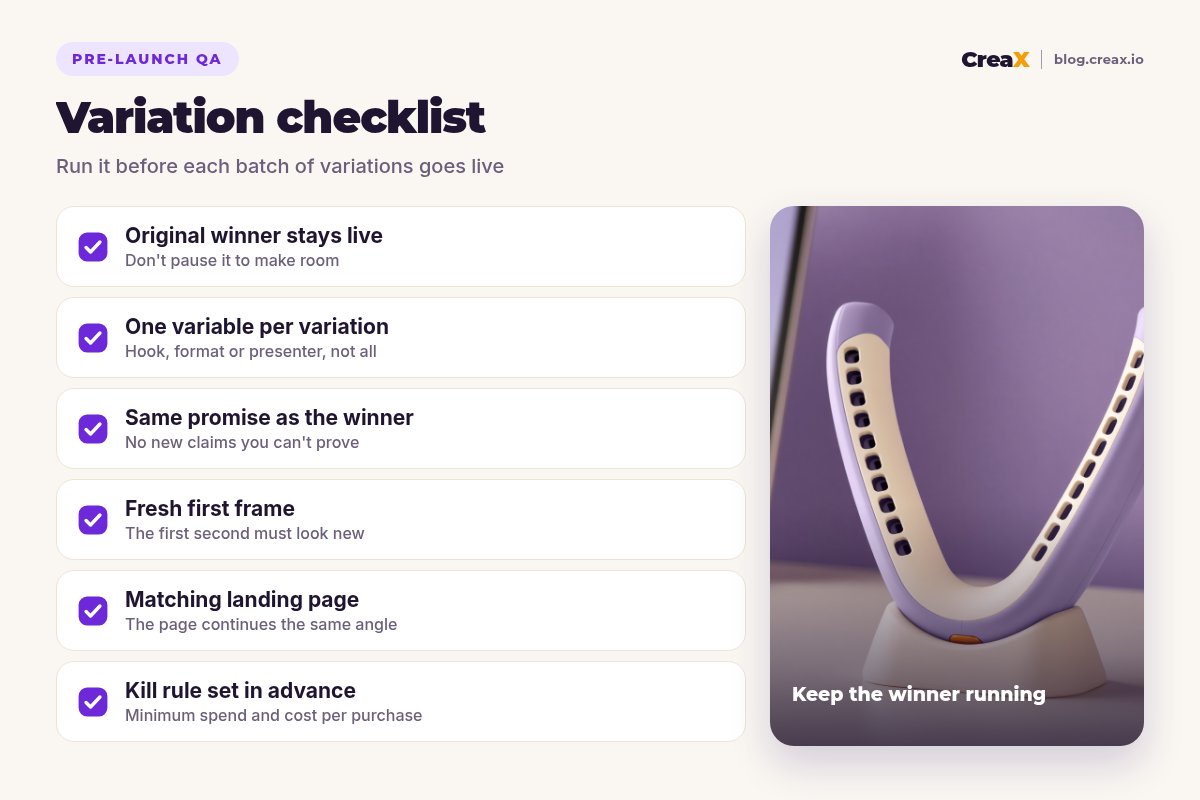
⚖When variations aren't the answer
Before each batchChecklist
Scaling checklist
- ✓The winner has beaten others over meaningful spend
- ✓You've written down why you think it wins
- ✓The core angle and promise are written in one sentence
- ✓Each variation changes one thing
- ✓Three to five new hooks or first frames
- ✓At least one new format or length
- ✓Original winner still running
- ✓Landing page matches the angle
- ✓Minimum spend and kill rule set in advance
FAQFrequently asked questions
Q.How many variations should I make of a winning ad?
Q.Should I pause the original winner?
Q.What should I change first?
Q.Is a new angle a variation?
Q.How do I know a variation won?
Q.Can AI tools help make variations?
Ready to scale your next winner?
One product link, about 60–120 seconds: UGC-style video ads, studio creatives and a landing page from the same product story.
This guide is published by CreaX. We describe other tools from their own public websites as of October 2026, avoid invented scores or prices, and recommend checking each vendor's site for current features and plans.