
What Is Hook Rate and How Do You Improve It?
FAQ · Ad metrics
Hook rate is the metric media buyers check first when a video ad underperforms. It tells you how many people stopped scrolling long enough to watch the opening of your ad. It's simple to calculate, easy to misread and one of the most useful numbers for deciding what to change next. Here's what hook rate is, how to calculate it, what it does and doesn't tell you, and how to improve it.
Updated October 2026 · By the CreaX team
Key takeaways
- ✓Hook rate = 3-second video views ÷ impressions. It measures how well the first seconds of a video ad stop the scroll.
- ✓Hold rate measures what happens next: how many people who were hooked keep watching.
- ✓Hook rate doesn't predict sales on its own. Judge ads on cost per purchase and use hook rate to diagnose why a video wins or loses.
- ✓To improve it, test new openings while keeping the body, offer and page the same: show the product or result at once and add on-screen text.
In this guide
TL;DRThe short answer
Hook rate is the share of people who saw your video ad and watched at least the first three seconds. If 10,000 people saw the ad and 2,500 watched three seconds or more, your hook rate is 25%. Those numbers are only an illustration, not a benchmark.
It matters because the opening is where most video ads lose people. On a fast-scrolling feed, the first second or two decide whether anyone sees your product, your offer or your call to action. A low hook rate means the rest of your video barely gets a chance.
| Metric | What it measures | Typical formula |
|---|---|---|
| Hook rate | Did the opening stop the scroll? | 3-second video views ÷ impressions |
| Hold rate | Did people keep watching? | ThruPlays (or longer views) ÷ 3-second views |
| Click-through rate | Did the ad earn the click? | Link clicks ÷ impressions |
| Cost per purchase | Did the ad make money? | Spend ÷ purchases |
Teams define hold rate in slightly different ways; pick one definition and use it consistently.
Q1How is hook rate calculated?
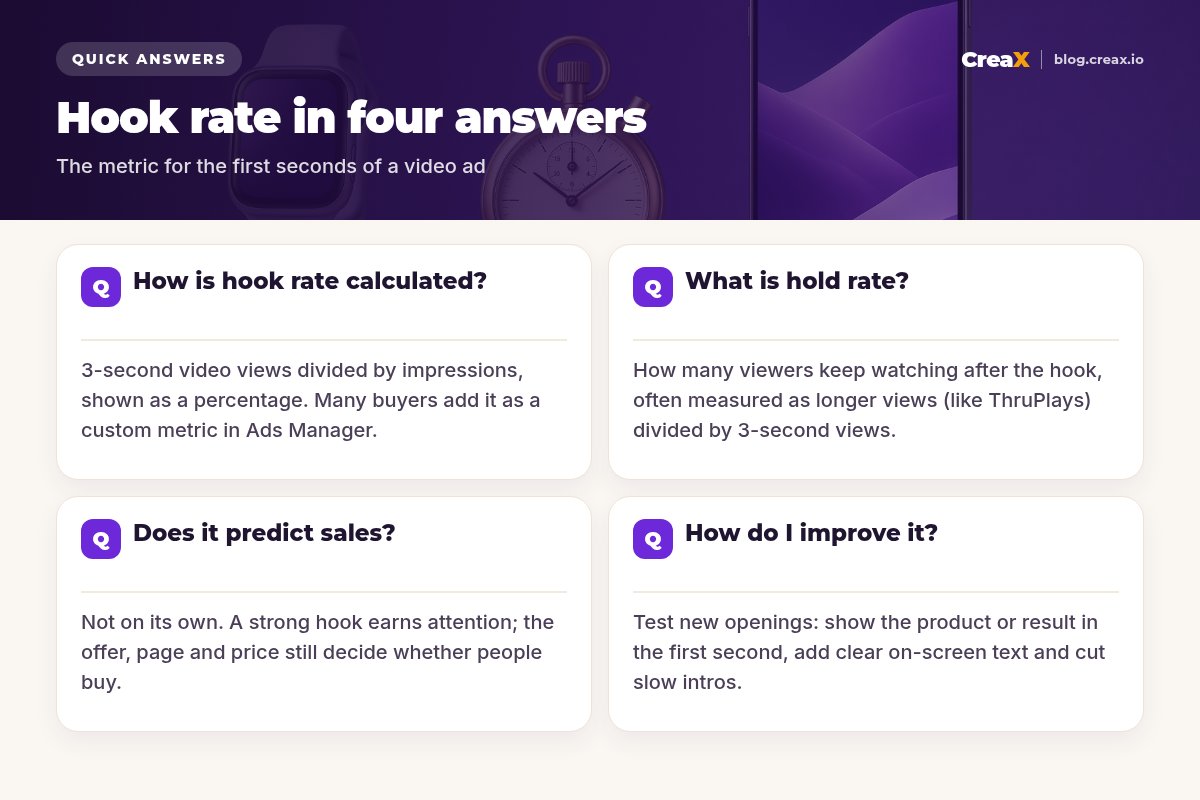
The standard formula is 3-second video views divided by impressions, multiplied by 100 for a percentage. On Meta, the views metric is called 3-second video plays. Meta doesn't show hook rate as a default column, so most media buyers create a custom metric in Ads Manager that divides 3-second video plays by impressions and save it in their reporting columns.
On TikTok, Ads Manager reports 2-second and 6-second video views rather than 3-second views. Many buyers use 2-second views ÷ impressions as their TikTok hook rate. That's fine, as long as you don't compare a TikTok number directly with a Meta number calculated another way.
Calculate it per ad, not per campaign. A campaign-level number blends strong and weak openings together and hides the information you need. And give each ad enough impressions before reading it: a hook rate from a few hundred impressions moves a lot from one day to the next.
★Name your ads so you can compare hooks
Q2What is hold rate?
Hold rate measures how many hooked viewers keep watching. A common version is ThruPlays divided by 3-second video plays. On Meta, a ThruPlay is counted when someone watches a video to completion or for at least 15 seconds. Some teams use 15-second views or average watch time instead.
Hook rate and hold rate diagnose different problems:
- Low hook rate, decent hold rate: the body works for people who stay, but the opening doesn't stop the scroll. Test new first seconds.
- High hook rate, low hold rate: the opening grabs attention but what follows doesn't keep it. The hook may promise something the video doesn't deliver, or the middle is slow.
- Both low: the angle itself may not resonate. Try a new angle, not just a new edit.
- Both healthy, few sales: the creative is doing its job. Look at the offer, price and landing page.
Q3What is a good hook rate?
You'll see confident benchmarks online, but a single “good” number doesn't hold across products, platforms, placements and audiences. A hook rate that's strong for a kitchen gadget in Reels may be weak for a beauty product in TikTok's feed. The most useful benchmark is your own account.
Compare each new ad against the median hook rate of your recent video ads for the same product or category, on the same platform and placements. If a new opening clearly beats your usual range, it's a keeper candidate. If it's well below, it's a candidate for a new hook before you spend more.
⚖Why we don't publish a target number
Q4Does hook rate predict sales?
Not on its own. Hook rate tells you whether people started watching, not whether they bought. A shocking or funny opening can score high and still attract viewers who never intended to buy. A quieter opening aimed at the right buyer can score lower and still win on cost per purchase.
Use hook rate as a diagnostic metric, not a decision metric. Decide which ads to scale on cost per purchase (or your target cost per result), then use hook rate and hold rate to understand why an ad won or lost and what to change next. If your ads get views but no sales, our guide to TikTok ads with views but no sales walks through the rest of the funnel.
The healthiest pattern is a hook that attracts the right people: those who have the problem your product solves. That's why the best hooks usually show the product, the problem or the result immediately, instead of using a generic attention trick.
Q5How do I improve hook rate?
Change the first seconds and keep everything else the same. Here are opening styles worth testing; each one is a different hook, not a different ad:
- Product first: the product fills the frame in the first second, in use if possible.
- Problem first: show the frustration the product fixes, such as a tangled cable, a dull knife or a messy desk.
- Result first: open on the after state, then show how you got there.
- Bold text claim: a short, specific on-screen line that states the benefit; keep it true and checkable.
- Unexpected motion: a quick action, a pour, a snap or a reveal that catches the eye in a static feed.
- Direct question: on-screen text that names the viewer's situation, like “Still charging your watch every night?”
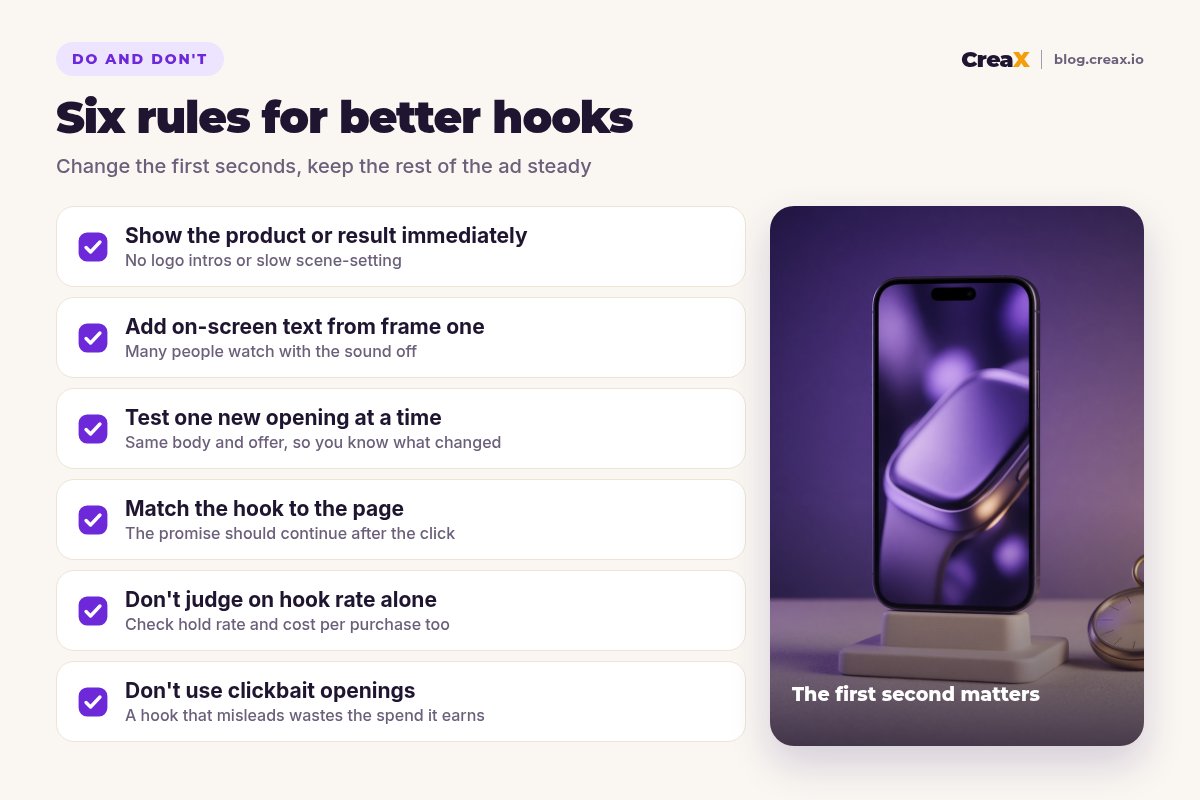
Whatever the style, a few rules help almost every opening:
- Cut logo animations and slow intros; brand later, not first.
- Add on-screen text from the first frame, because many people watch with the sound off.
- Keep important text and the product inside the platform's safe zones so interface elements don't cover them.
- Make sure the hook matches the page: the promise in the first second should still be there after the click.
For more opening ideas in UGC-style ads, see what a UGC video ad is. If a once-strong ad is slipping, the hook may simply be tired; our guide to ad creative fatigue shows the signs.
Example: a smartwatch ad
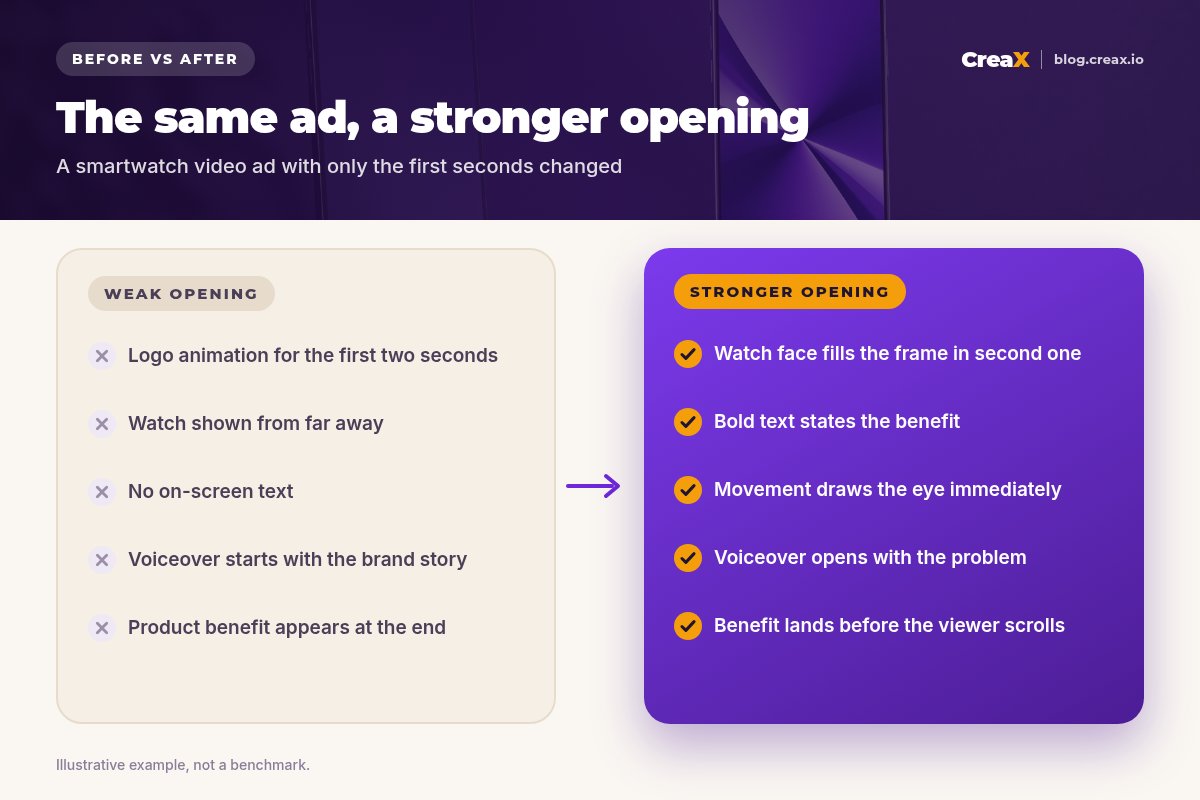
Say a fitness smartwatch video opens with a two-second logo animation and a wide shot of the watch on a table. The hook rate is below your usual range. Instead of re-shooting the whole ad, you test two new openings on the same body: one with the watch face filling the frame and bold text stating the main benefit, and one that opens on the problem the watch solves. Everything after the third second stays the same, so any change in hook rate comes from the opening.
Avoid theseCommon hook rate mistakes
- Chasing hook rate instead of sales. A clickbait opening can lift the number and hurt cost per purchase.
- Changing several things at once. New hook, new music and a new offer in one test tells you nothing about the hook.
- Comparing across platforms. Meta 3-second and TikTok 2-second views aren't the same metric.
- Reading results too early. Small samples swing; wait for meaningful impressions per ad.
- Looking at campaign averages. Hook rate is an ad-level metric.
!Don't let the hook overpromise
ChecklistHook test checklist you can copy
Before you launch a hook test
- ✓Hook rate column saved in Ads Manager (3-second plays ÷ impressions).
- ✓Baseline from your recent video ads for the same product and platform.
- ✓Two or three new openings on the same body, offer and page.
- ✓Ad names that include the hook style.
- ✓Enough impressions per ad before you compare.
- ✓Decision on cost per purchase, with hook and hold rate as the explanation.
For the broader testing setup, see how to test ad angles for a new product and how many ad creatives to test per product.
Our toolHow CreaX helps (briefly)
Hook testing needs variations, and variations are where most sellers run out of time. CreaX turns a product link or image into UGC-style video ads, studio ad creatives and a matching landing page in about 60–120 seconds, so you can generate several video options for one product and compare their openings without booking a new shoot each time. You still choose the angles and check every claim; CreaX speeds up the making.
Plans start free, then $4.99 a month for 2,000 credits, with top-ups at $1 per 500 credits. Compare it with other options in our list of the best AI UGC video ad generators.
Get video ads you can test hooks on
Paste a product link: UGC-style video ads, studio creatives and a landing page in about 60–120 seconds.
FAQFrequently asked questions
Q.What is hook rate in Facebook ads?
Q.Is hook rate the same as thumb-stop ratio?
Q.What's the difference between hook rate and CTR?
Q.Does hook rate apply to static ads?
Q.How many hooks should I test?
Q.How much does CreaX cost?
Ready to test better openings?
One product link, about 60–120 seconds: UGC-style video ads, studio creatives and a landing page for your next hook test.
This guide is published by CreaX. We describe other tools from their own public websites as of October 2026, avoid invented scores or prices, and recommend checking each vendor's site for current features and plans.