
Why Is My ROAS Dropping After Scaling? Questions Answered
FAQ · Scaling ads
ROAS dropping after scaling is one of the most common problems in paid social. You find an ad that works, raise the budget, and the return falls. It is rarely bad luck. More spend reaches people who are less ready to buy, the same ads are shown more often, and big changes can unsettle the delivery system. Here is how to tell what is going on, and what to change first.
Updated October 2026 · By the CreaX team
Key takeaways
- ✓Some ROAS drop when you scale is normal: extra budget goes to people less likely to buy than your first buyers.
- ✓A sharp, ongoing drop usually means creative fatigue, budget jumps that are too big, or an offer and page that only work for the warmest buyers.
- ✓Diagnose with frequency, click-through rate, cost per click and conversion rate over time, not ROAS alone.
- ✓Fix the creative first: scale with several angles and a steady supply of new ads, and change one thing at a time.
In this guide
TL;DRThe short answer
When you spend more, the ad platform has to find more people. The first people it finds are usually the most likely to buy; the next ones are a little less likely, and so on. Your ads are also shown more often to the same people, which wears them out. So a small drop in ROAS as you scale is expected. The question is whether you are still above your break-even point.
A big or ongoing drop usually has a fixable cause: one ad doing all the work and wearing out, budget increases that are too big and too frequent, or an offer and landing page that only convince your warmest buyers. The rest of this guide shows how to tell which one it is.
★Know your break-even ROAS first
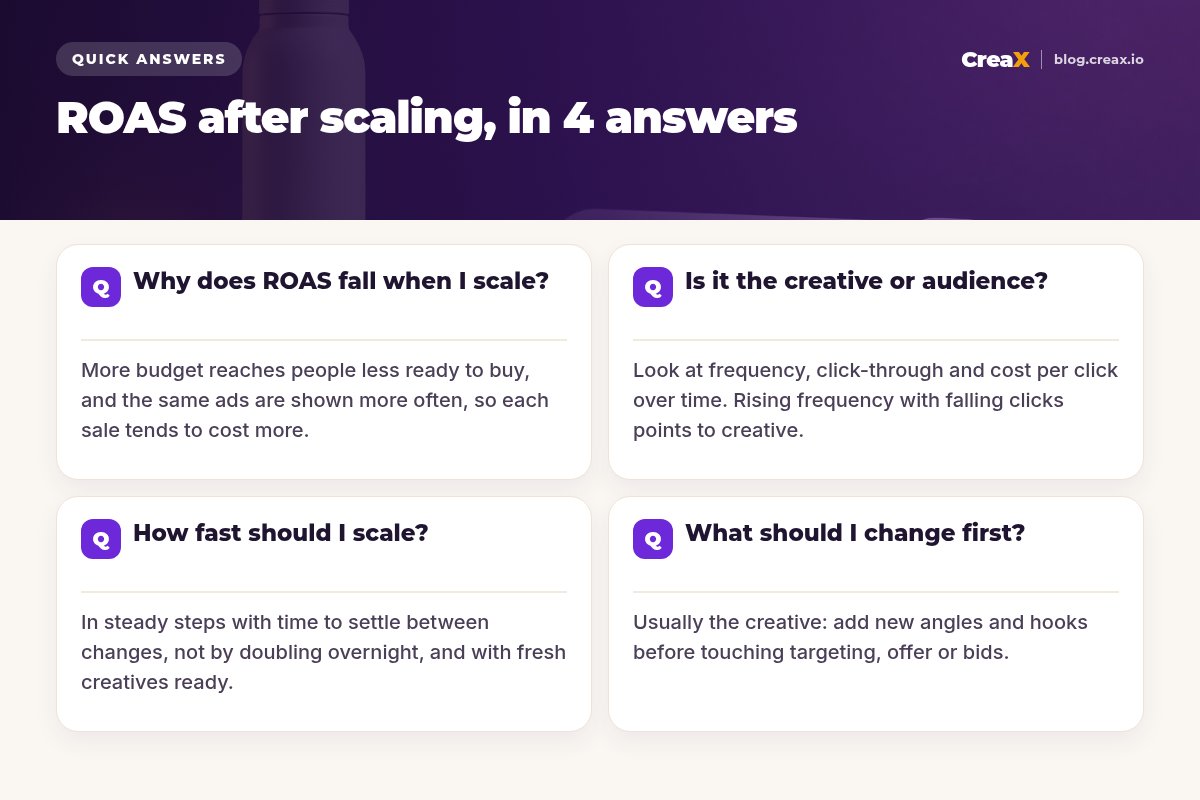
Q1Why does ROAS fall when I scale?
There are four common reasons, and they often happen together:
1. You reach less-ready buyers
At a small budget, the platform shows your ad to the people it thinks are most likely to buy. As budget grows, it has to go further out. Those people may be interested, but they need more convincing, so each sale costs more.
2. Your best ads wear out
Scaling usually means pushing more money through the same one or two winning ads. The same people see them again and again, stop noticing them and stop clicking. This is creative fatigue, and it is the most common cause of falling ROAS. See signs of ad creative fatigue for how to spot it.
3. Big changes unsettle delivery
Ad platforms learn who to show your ads to. Meta's help center notes that significant edits to an ad set, including large budget changes, can send it back into the learning phase, when performance is often less stable. Doubling a budget overnight, or changing budget, targeting and creative at once, makes this more likely.
4. The offer and page only convince warm buyers
Your first buyers may have been the easiest to convince: people who already wanted the product. Colder buyers need clearer benefits, proof and reassurance. If your landing page does not answer their questions, more traffic just means more people leaving.
Q2Is it the creative or the audience?
Look at a few metrics over the days or weeks you scaled, ideally per ad. The pattern usually points to the cause:
| What you see | Likely cause | What to do |
|---|---|---|
| Frequency rising, click-through rate falling | Creative fatigue | Add new angles and hooks; rotate out tired ads |
| Cost per click rising, click-through rate steady | Reaching a costlier or more competitive audience | Broaden or refresh targeting; check seasonality |
| Click-through steady, conversion rate falling | Page or offer not convincing colder buyers | Improve the landing page, proof and offer |
| Everything jumped after a big budget change | Delivery reset after a large edit | Hold steady, then scale in smaller steps |
| One ad gets almost all the spend | Too dependent on one creative | Launch more variations to share the spend |
Patterns to investigate, not hard rules. Look at the trend over several days, not one day.
If clicks are the problem, our guide to why your CTR is low helps. If people click but do not buy, start with Facebook ads not converting.
iCheck tracking before anything else
Q3How fast should I scale?
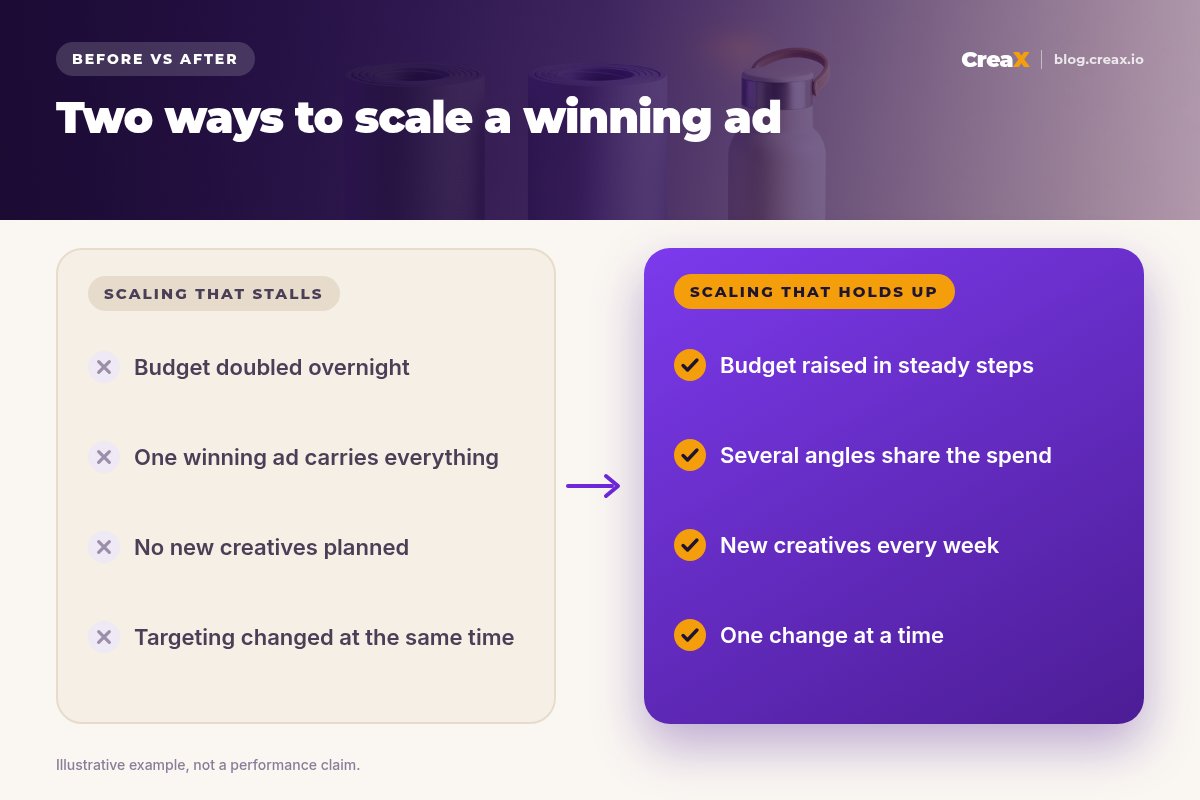
There is no universal safe percentage, and anyone who promises one is guessing. What works for most stores is a simple discipline:
Scale in steady steps
Give each change time
Scale horizontally too
Feed the campaign new creatives
Set a floor
If you use automated campaigns such as Meta's Advantage+, the creative supply matters even more, because targeting is largely automated. Our guide to Advantage+ creatives covers how many to give it.
Q4What should I change first?
In most cases, the creative. It is the lever you control most directly, and it affects who sees the ad, whether they click and whether they arrive ready to buy. A useful order:
- Check tracking so you know the drop is real.
- Add new creatives: new angles (different reasons to buy) and new hooks for the winning angle. Our guide to scaling winning creative variations shows how.
- Fix the page if click-through holds but conversion falls: clearer promise, real proof, shipping and returns visible.
- Adjust the offer if colder buyers need more reason to act: a bundle, a guarantee you can honour, clearer value.
- Change targeting or bidding last, and only one setting at a time.
Get fresh creatives before your winner wears out
Paste a product link in CreaX and get new studio ad creatives and UGC-style video ads in about 60–120 seconds, ready for your next scaling step.
ExampleWorked example: a yoga mat that stopped scaling
Say you sell a non-slip yoga mat. One UGC-style video with the angle “stays put in hot yoga” has been profitable at a small daily budget, so you double the budget overnight and also add a new interest audience. Within days, ROAS falls below break-even. Here is how to work through it:
| Check | What you find | Action |
|---|---|---|
| Tracking | Store orders match the ad platform | The drop is real |
| Spend split | Almost all spend on the one video | Too dependent on one creative |
| Frequency and CTR | Frequency up, click-through down | The video is wearing out |
| Conversion rate | Roughly steady for people who click | The page is not the main problem |
An illustrative example with no real figures. Your own numbers decide the diagnosis.
The fix is not a new audience. Roll the budget back to a level that was profitable, keep the interest audience change out for now, and add new creatives: two new hooks for the same “stays put” angle, plus two new angles such as “thick enough for sore knees” and “rolls up small for travel”, as both video and static ads. When the new ads share the spend, raise the budget again in steady steps, one change at a time.
!Only use claims you can prove
MistakesCommon mistakes to avoid
- Doubling budgets overnight and then panicking when results swing.
- Relying on one winning ad with nothing ready to replace it.
- Changing several things at once: budget, audience and creative on the same day.
- Judging on one day of data instead of the trend.
- Ignoring the page: sending more, colder traffic to a page built for warm buyers.
- Not naming and tracking ads, so you cannot tell which variation is tired. See ad creative naming and tracking.
- Scaling below break-even because ROAS “still looks fine” without knowing your real margin.
ChecklistChecklist you can copy
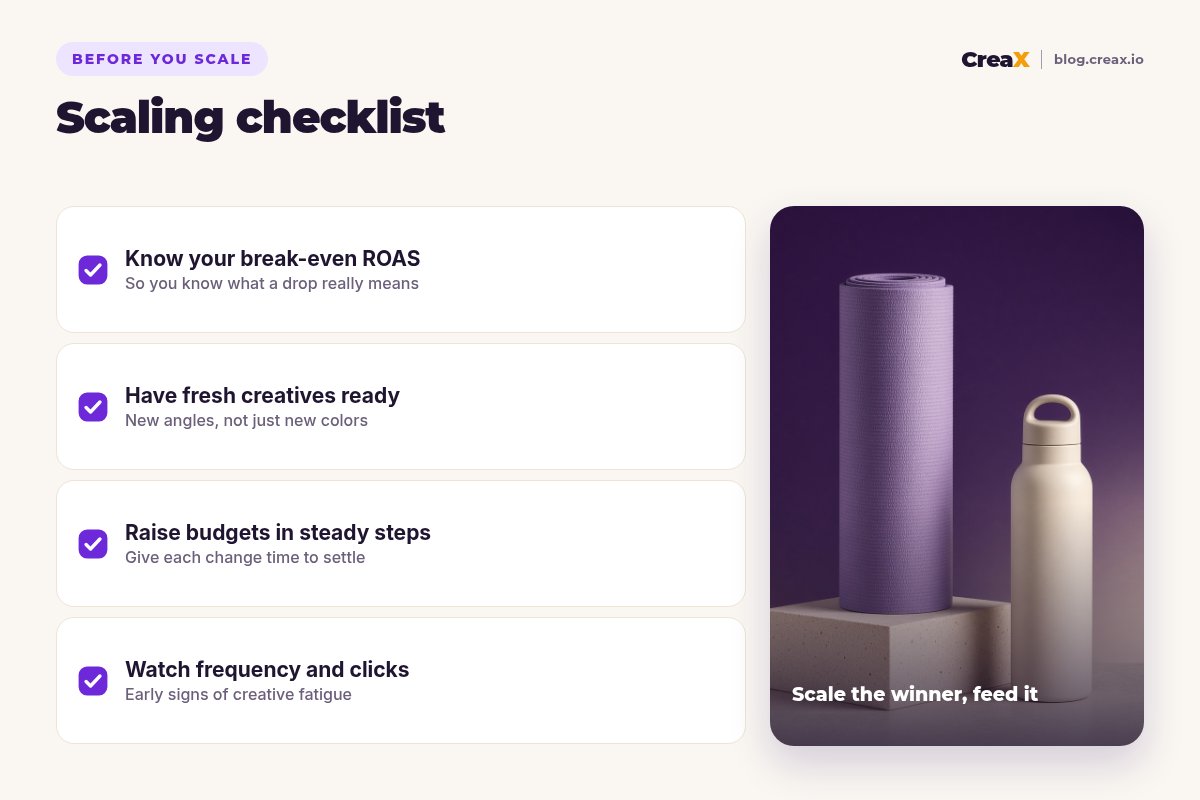
Before and during scaling
- ✓Break-even ROAS worked out and written down.
- ✓Tracking checked against real store orders.
- ✓At least three working angles, not one winning ad.
- ✓New creatives planned weekly while you scale.
- ✓Budget increases in steady steps, one change at a time.
- ✓Frequency, CTR, CPC and conversion rate reviewed per ad every few days.
- ✓Landing page ready for colder buyers: clear promise, proof, shipping and returns.
CreaXHow CreaX helps (briefly)
Most scaling problems come back to creative supply: you need more good ads, faster, than one designer or one creator can make. CreaX is an AI ecommerce creative OS. Paste a product link or upload a product image and, in about 60–120 seconds, you get studio ad creatives (in five styles and four sizes), UGC-style video ads (18, 30 or 45 seconds) and a publish-ready landing page.
That makes it practical to keep several angles running and to add fresh variations every week while you raise budgets, and to give colder buyers a page that repeats the same promise as the ad. See how many creatives to test per product for how many to aim for.
Scale with a steady supply of new ads
One product link gives you new statics, UGC-style videos and a matching landing page, so your winner never has to carry everything.
FAQMore questions sellers ask
Q.Is it normal for ROAS to drop when scaling?
Q.Should I turn off an ad when ROAS drops?
Q.Is vertical or horizontal scaling better?
Q.How often should I add new creatives when scaling?
Q.Can a better landing page fix falling ROAS?
Q.Does Advantage+ stop ROAS from dropping?
Ready to scale without losing your ROAS?
One product link, about 60–120 seconds, and you have new studio ads, UGC-style video ads and a landing page for your next step.
This guide is published by CreaX. It contains no invented benchmarks; results depend on your product, market, offer and creative. Ad platform behaviour changes, so check each platform's current help pages.