
How Do You Know a Product Is a Winner?
FAQ · Product testing
Every dropshipper asks the same question after launching a product: is this a winner, or am I about to waste more money? The answer isn't a feeling or a single great day. It comes from a few numbers you decide on before the test starts, read over enough time to trust them. This FAQ covers the signals that matter, how long to test, when to scale and when to walk away.
Updated October 2026 · By the CreaX team
Key takeaways
- ✓A winner is a product that sells at a cost per purchase below your break-even point, consistently, with orders that are delivered and not refunded.
- ✓Early signals like click-through rate and add-to-carts help you diagnose a test, but only purchases prove it.
- ✓Set a kill budget and a test window before launch, and test two or three angles so one weak ad doesn't kill a good product.
- ✓Scale gradually and keep refreshing creatives: winners fade when the same ad runs too long.
In this guide
TL;DRThe short answer
A product is a winner when it makes money at a cost you can repeat. In practice, that means your cost per purchase stays below your break-even cost per purchase for several days, across real orders that customers keep. Everything else, from likes to comments to a viral view count, is a supporting signal at best.
The most important work happens before launch: know your break-even number, decide how much you'll spend before giving up, and prepare more than one angle. With those three decisions made, the test answers the question for you.
| Signal | What it tells you | Decision weight |
|---|---|---|
| Purchases below break-even | The product makes money at this cost | Decides |
| Add-to-carts and checkouts started | Buying intent; the page and price are close | Strong hint |
| Click-through rate | The ad and angle earn attention and clicks | Diagnostic |
| Video watch time | The opening and story hold people | Diagnostic |
| Likes, comments, shares | Interest, sometimes from non-buyers | Weak on its own |
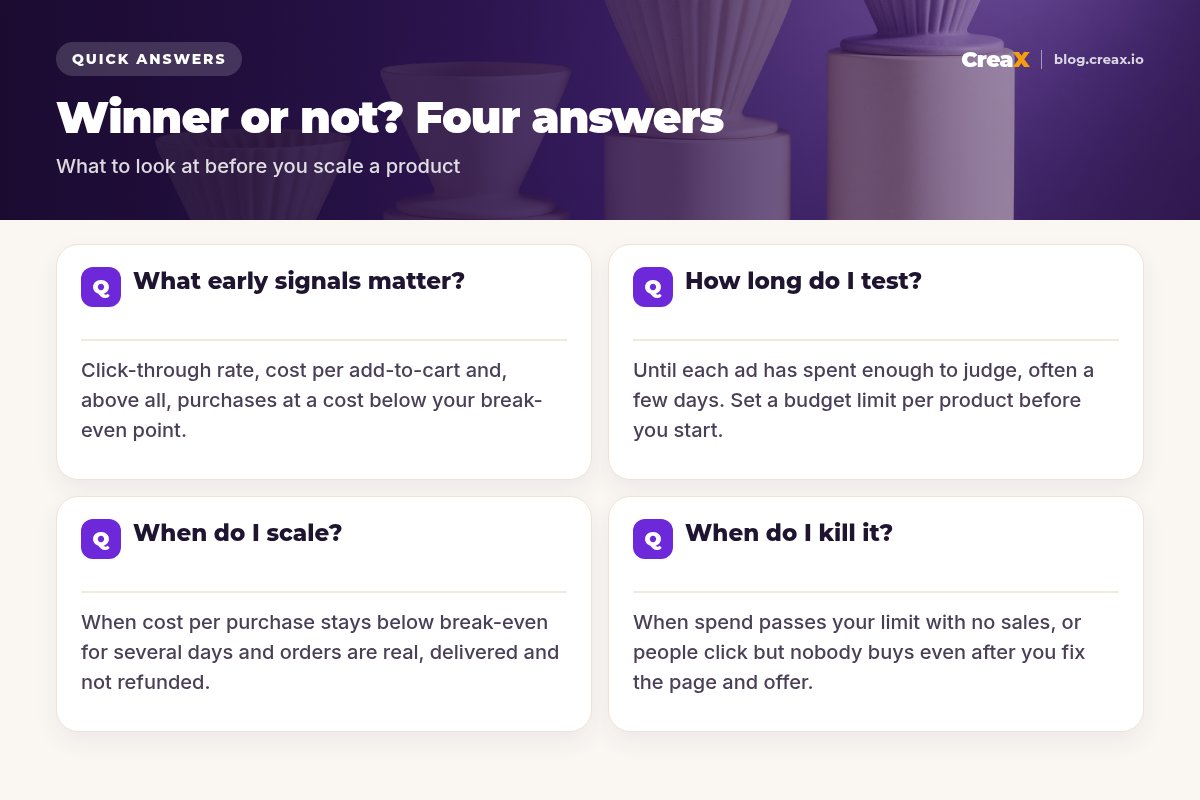
Q1What early signals matter?
Read the funnel from top to bottom. Each step tells you where a test is working or breaking:
- Click-through rate (CTR): are people interested enough to click? A low CTR usually points to the creative or the angle, not the product.
- Landing page behavior: do visitors scroll, view the offer and add to cart? Lots of clicks with no add-to-carts often means the page, the price or the promise doesn't match the ad.
- Checkouts started vs completed: many abandoned checkouts can point to shipping costs, delivery times or payment options.
- Purchases and cost per purchase: the only signal that proves demand at a price that works.
The key number is your break-even cost per purchase: the most you can spend on ads to get one order without losing money. Calculate it from your price, product cost, shipping, fees and expected refunds. Our guide to break-even ROAS walks through it step by step.
★Write the numbers down before launch
Q2How long do I test?
Long enough for each ad to spend a meaningful amount and for the platform's delivery to settle, which is often a few days rather than a few hours. Results in the first hours swing a lot: a single order can make an ad look brilliant, and a slow morning can make a good ad look dead.
A practical approach is to set the test by budget, not by calendar. Decide how much you'll spend per product before making a call, for example a multiple of your break-even cost per purchase. If the product spends that amount with no sales, you have your answer. If it sells, keep going and watch whether costs hold.
How many ads do you need in that test? Usually two or three angles, each with a couple of creatives. Our guide to how many ad creatives to test per product gives a practical range, and how to test ad angles for a new product shows how to set them up fairly.
Q3When do I scale?
Scale when three things are true at the same time:
- Cost per purchase is below break-even for several days, not just one.
- Orders are real: delivered, not refunded, and without unusual complaints.
- You can fulfill more: your supplier, shipping times and support can handle a higher volume.
Then raise budgets in steps rather than all at once, and watch cost per purchase after each increase. Many sellers also duplicate the winning angle into new creatives early, because the ad that wins this week usually fades in the coming weeks. Our guide to creative fatigue explains the signs.
⚖A winner isn't forever
Q4When do I kill it?
Stop a product when:
- It spends your kill budget with no sales, across at least two or three angles.
- People click but don’t buy, even after you've checked the page, price, shipping and offer.
- Cost per purchase stays well above break-even and fixes to the creative and page don't move it.
- Orders come with problems: high refunds, complaints or delivery issues you can't solve.
Before you kill a product, ask one question: did it get a fair test? If you ran one angle with one weak creative, the product never really had a chance. If you tested several angles with good creatives and a matching page, trust the data and move on to the next product. For ideas on where to look next, see the best tools to find and test winning products.
Example: a pour-over coffee dripper
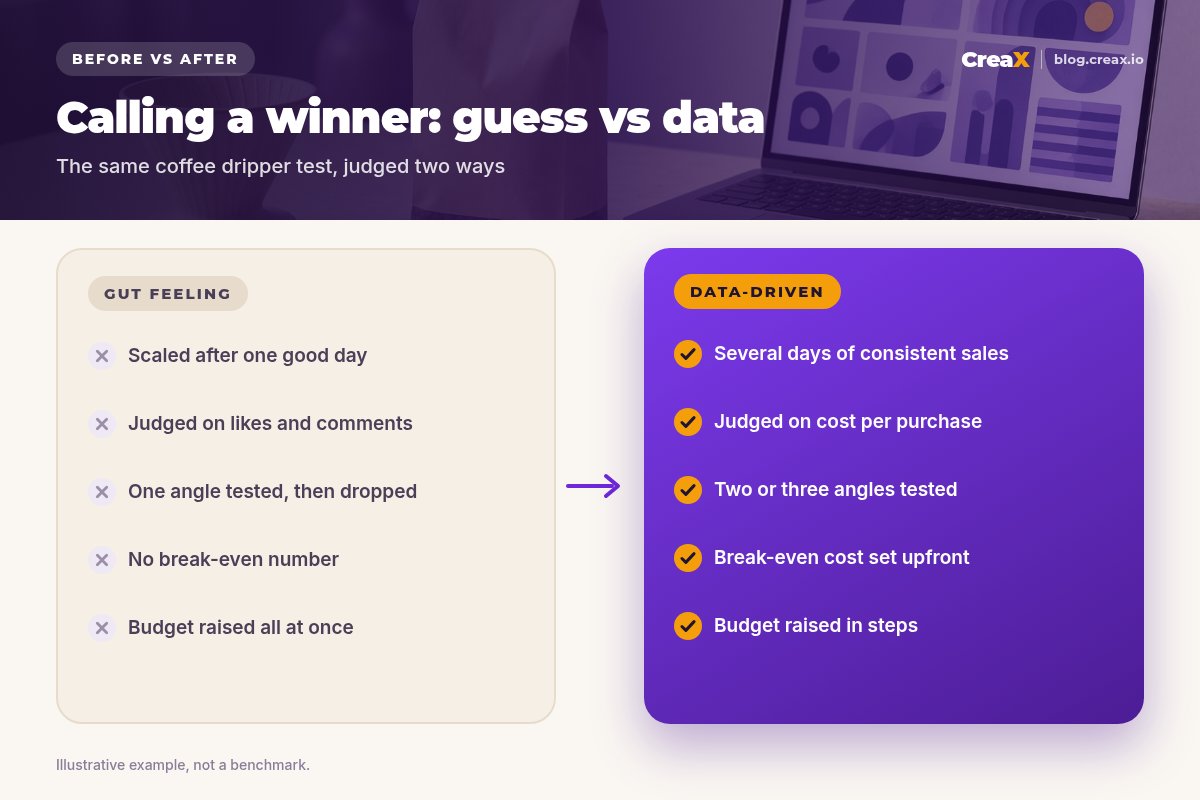
Say you test a ceramic pour-over coffee dripper with three angles: “café-quality coffee at home”, “a calm morning ritual” and “a gift for coffee lovers”. Before launch you calculate your break-even cost per purchase and set a kill budget. After a few days, the gift angle has a strong click-through rate but few purchases, the ritual angle sells steadily below break-even, and the café angle barely spends. You don't scale everything: you move budget to the ritual angle in steps, generate fresh creatives for it, and keep the gift angle for a seasonal test later. That's a winner decided by data, not by the loudest metric.
Avoid theseCommon mistakes to avoid
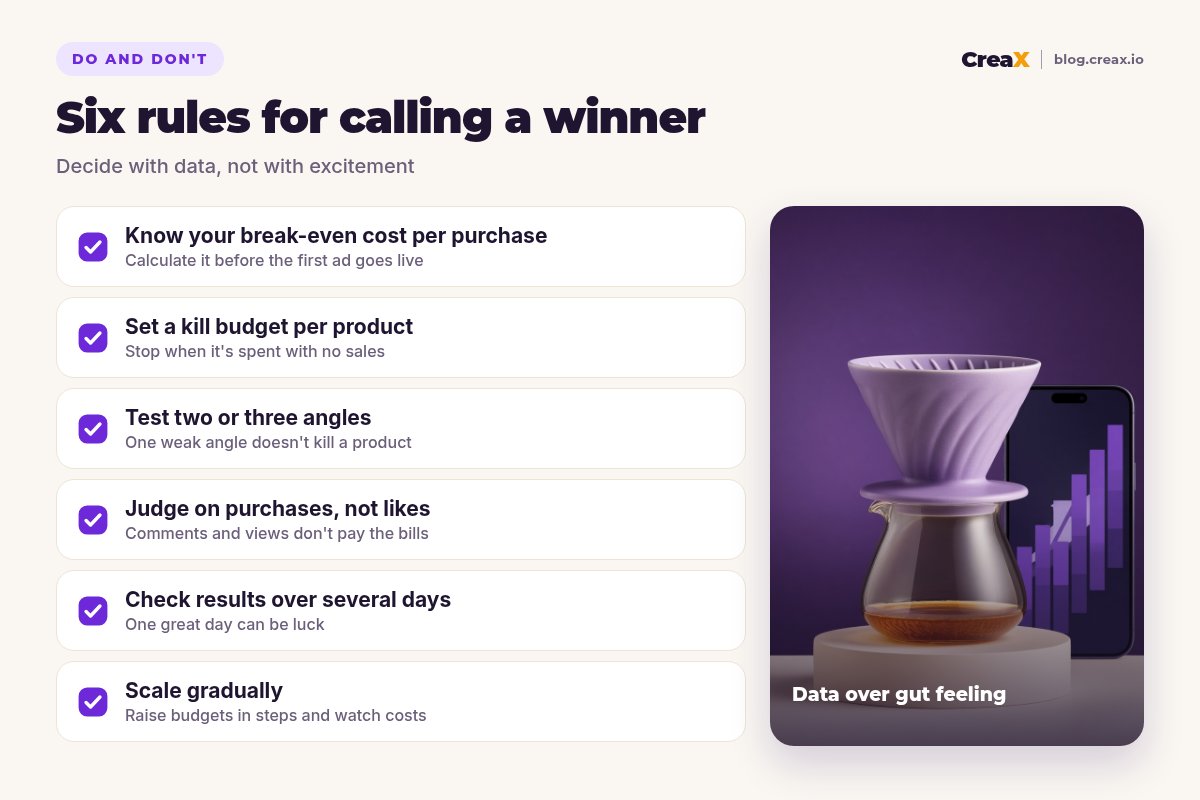
- Scaling after one good day. One great day can be luck; wait for consistency.
- Judging on engagement. Likes and comments can come from people who will never buy.
- Killing too early. A few hours or a tiny spend tells you very little.
- Testing one angle. A product often wins with the second or third angle.
- Ignoring the page. Ads can earn clicks that a weak or mismatched page wastes. See why Facebook ads don’t convert.
- No break-even number. Without it, you can't tell a winner from an expensive hobby.
!Watch refunds and deliveries
ChecklistChecklist you can copy
Before you call a winner
- ✓Break-even cost per purchase calculated and written down
- ✓Kill budget per product decided before launch
- ✓Two or three angles ready, each with matching creatives
- ✓Landing page matches each angle's promise
- ✓Results reviewed over several days, not hours
- ✓Decision made on cost per purchase, with refunds included
- ✓Scaling plan: budget steps and fresh creatives ready
Our toolHow CreaX helps (briefly)
The hardest part of a fair product test is having enough good creative for several angles, plus a page that matches them. CreaX turns a product link or image into a publish-ready landing page, studio ad creatives and UGC-style video ads in about 60–120 seconds, so each angle gets a proper chance without days of production. When a product wins, you can generate fresh creatives for the winning angle before the first ones fade.
Plans start free, then $4.99 a month for 2,000 credits, with top-ups at $1 per 500 credits. For the full launch timeline, see how to launch a product test in 24 hours.
Give every product a fair test
Paste a product link: a landing page, studio creatives and UGC-style video ads for each angle, ready in minutes.
MoreMore questions sellers ask
Can a product win on TikTok and lose on Meta? Yes. Audiences, formats and costs differ between platforms. A product can be a winner on one and break-even on another, so judge each platform on its own numbers.
Should I change the price during a test? Not in the first round. Changing the price mid-test mixes two variables. Once you know the product sells, test price as its own experiment.
What if only one ad works? That's common. Put more budget behind it carefully, and make new variations of that angle with different hooks and formats so you're not relying on a single ad.
Do I need a full store to test? Not always. Many sellers test with a single product landing page, then build out a store for products that prove themselves.
FAQFrequently asked questions
Q.How do I know if a product is a winner?
Q.How much should I spend testing a product?
Q.Is a high CTR a sign of a winner?
Q.How many angles should I test?
Q.When should I refresh creatives on a winner?
Q.How much does CreaX cost?
Ready to find your next winner?
One product link, about 60–120 seconds: a landing page, studio creatives and UGC-style video ads for your next test.
This guide is published by CreaX. We describe other tools from their own public websites as of October 2026, avoid invented scores or prices, and recommend checking each vendor's site for current features and plans.