
How to Make AI UGC Ads That Don't Look Fake
How-to · AI UGC ads
AI UGC ads can look fake fast: a stiff script, a product that doesn't match the real one, a “customer” who never existed. They don't have to. This guide shows how to make AI UGC ads that feel real and stay honest, in five practical steps, with a worked example, the mistakes to avoid and a checklist you can use on every video.
By the CreaX team
Key takeaways
- ✓Most AI UGC ads look fake because of the script and the product, not the AI. Fix those first.
- ✓Start from a real buyer problem and write the way people actually talk: short sentences, one idea, plain words.
- ✓Show the real product exactly as it is, and never invent reviews, results or customers. Honesty is what makes it believable.
- ✓Keep the edit native to the platform, label AI content where the platform requires it, and let testing decide which version wins.
In this guide
The goalWhat you'll have at the end
By the end of this guide you'll have a simple process for AI UGC-style video ads that look like something a real person would post, not an obvious advert. You'll know what to write, what to show, what to check, and how to test a few versions against each other.
A quick definition first. UGC means user-generated content: videos that look like a customer filmed them on a phone. AI UGC is the same style made with AI: an AI presenter, AI voice or AI-generated footage. If you're new to the format, our FAQ on whether AI video ads work for ecommerce answers the common doubts before you start.
PrepWhat you need before you start
- The product in your hands, or accurate photos of it. You need to know exactly how it looks, feels and works.
- Real buyer language. Reviews of similar products, comments under competitor ads, questions in your inbox. Copy the words people use, not your marketing words.
- The claims you can prove. Size, materials, what's in the box, delivery times. Nothing more.
- A tool that makes UGC-style video. An AI UGC generator, or an editor with AI avatars and voices.
- The platform rules. Meta and TikTok both have policies on AI-generated content in ads. Read them before you run anything.
Step 1Step 1: Start from a real buyer problem
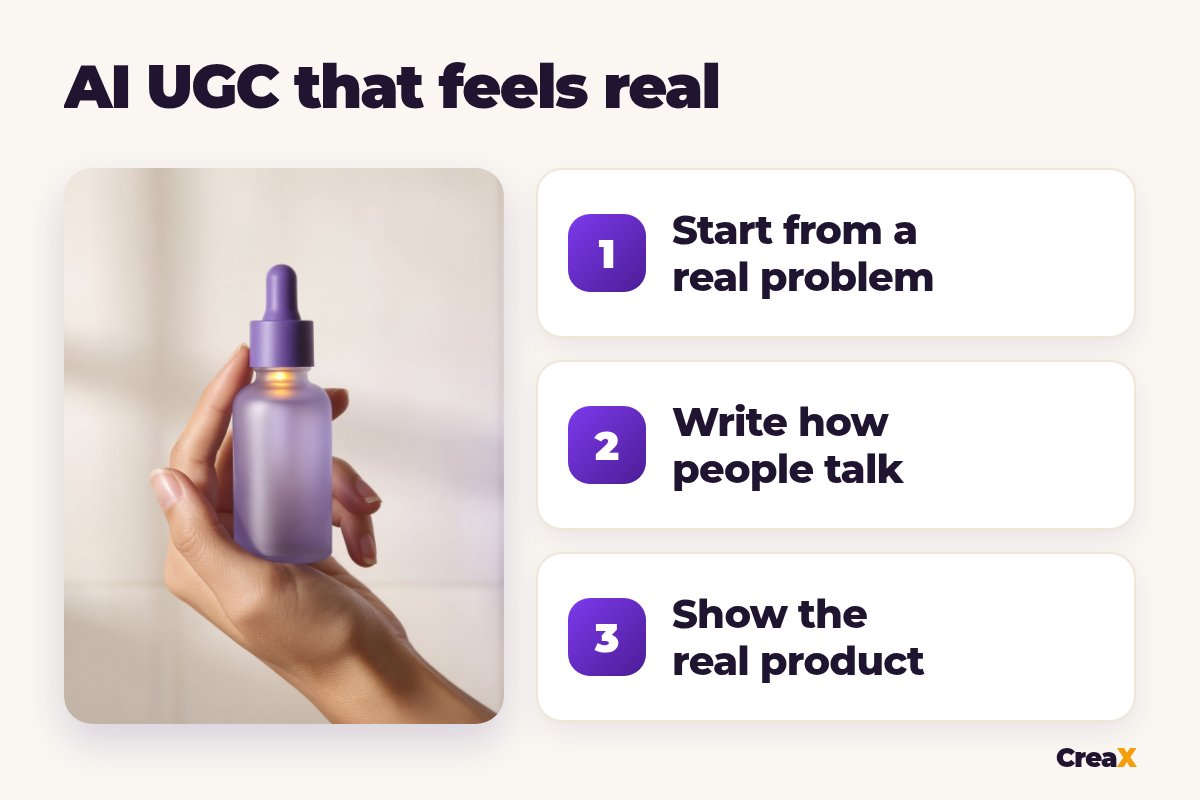
Fake-looking ads usually start from the product: “Introducing the revolutionary…”. Real UGC starts from a moment in someone’s day: “My serum kept leaking in my gym bag.” That's the first thing viewers check, even if they don't notice it: does this sound like a person, or a brand?
Pick one problem per video. Good sources:
- One-star reviews of competing products (what disappointed people).
- Questions buyers ask before they buy (what worries them).
- The exact moment the product helps (morning routine, commute, travel, gift).
This is the same logic behind a classic problem-solution video ad: name the problem in the buyer's words, then show the product solving it.
Step 2Step 2: Write a script people would say
Read your script out loud. If it sounds like a TV advert, rewrite it. Real people use short sentences, contractions, small hesitations and specific details. They don't say “premium quality” or “game-changer”.
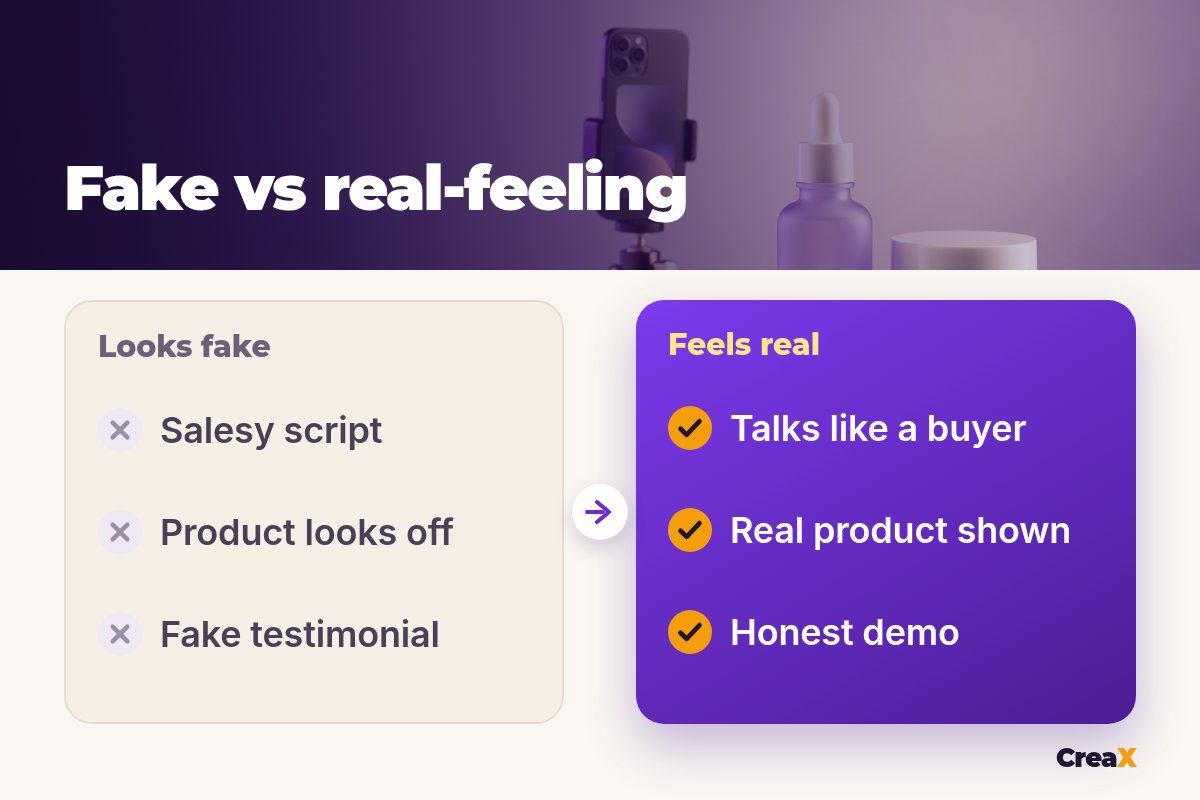
| Sounds fake | Sounds real |
|---|---|
| “This revolutionary serum will transform your skin!” | “I wanted something light I could use before make-up.” |
| “Order now before it's too late!” | “The link's below if you want to try it.” |
| “Thousands of happy customers love it!” | “Here's how much you actually need per use.” |
| “The best product on the market.” | “It's the one I keep in my bag now.” |
Examples of tone, not claims. Only say what is true for your product.
Structure stays simple: a hook in the first seconds, one problem, the product in use, one reason to believe, a calm call to action. Our guide to writing a UGC video ad script breaks this down line by line, and our list of UGC ad hooks that stop the scroll gives you openers to test.
!Never script a fake customer
Step 3Step 3: Show the real product
Nothing breaks trust faster than a product that looks different in the ad and in the parcel. AI can change small details: the cap, the colour, the label, the number of buttons. Viewers may not notice. Buyers will.
- Start from accurate product images or the real product page, so the product stays the same across videos.
- Watch every frame where the product appears and compare it with the real thing.
- Show real use: how it opens, how much comes out, how it fits in a bag. Demonstration beats adjectives.
- Avoid before/after transformations you can't prove.
In CreaX, you paste the product link or upload a product image, and in about 60–120 seconds you get UGC-style video ads of 18, 30 or 45 seconds, plus studio ads and a landing page from the same input. Our explainer on how CreaX UGC video ads work shows the steps. Whatever tool you use, the check is the same: does the product look exactly like what the buyer will receive?
Make UGC-style videos from your product link
Paste one link and get UGC-style video ads, studio ads and a landing page in about 60–120 seconds. Then check, pick and test.
Step 4Step 4: Keep the edit native
A real UGC video looks like it belongs in the feed. A fake one looks like it was dropped in from a TV channel. Small editing choices make the difference:
Vertical and full-screen
Captions like a creator would add
Natural pacing
One message per video
Step 5Step 5: Be honest and test
Honesty is not a weakness in UGC ads; it's the reason they work. Two things matter here: platform rules and testing.
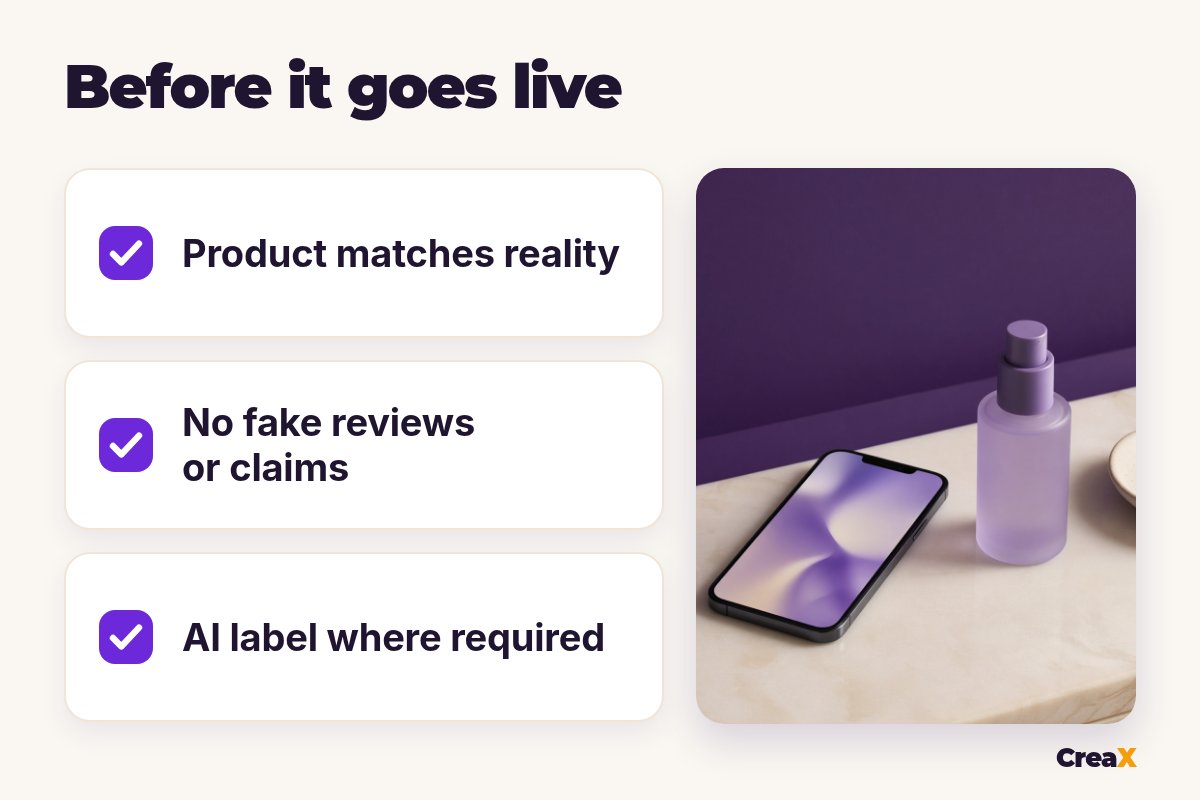
Meta and TikTok both have policies about AI-generated and digitally altered content in ads, and they can label or limit ads that break them. Our guide on whether AI UGC ads are allowed on Meta and TikTok explains what to label and what to avoid. When a platform asks you to disclose AI content, do it. A disclosure rarely hurts a good ad, and a rejected ad or a restricted account costs far more.
Then test. Make three to five versions that change one thing at a time (the hook, the problem, the presenter style) and let the results pick the winner. Keep what works and retire what doesn't.
⚖What AI UGC can't do
ExampleWorked example
Say you sell a leak-proof travel serum bottle set. Here's how one fake-looking ad becomes a real-feeling one:
| Element | Fake-looking version | Real-feeling version |
|---|---|---|
| Hook | “The ultimate travel solution is here!” | “My serum leaked in my bag again, so I switched.” |
| Problem | Generic “travel is hard” | Leaks in a gym bag, a specific moment |
| Product | AI render with a different cap | Accurate bottle, shown opening and closing |
| Proof | “Loved by thousands” | Shows the seal, the size and how it fits in a pouch |
| Call to action | “Buy now before it sells out!” | “Link's below if you travel a lot.” |
An illustration of the edits, not real results.
Make three of the real-feeling versions with different hooks, run them with the same budget, and keep the winner. If you'd rather work with real creators for some videos, our CreaX vs Billo comparison explains when a creator marketplace is worth it.
Test real-feeling UGC ads this week
One product link gives you UGC-style videos, studio ads and a landing page, so you can test several honest angles fast.
Watch outMistakes to avoid
- Writing like an advert. If it sounds like a TV spot, it'll look fake no matter how good the AI is.
- Inventing reviews, results or customers. It breaks trust and can break the law.
- Letting AI change the product. Check every frame against the real thing.
- Medical, financial or before/after claims you can’t prove. These get ads rejected and buyers angry.
- Over-editing. Flashy transitions and stock music make UGC look produced.
- Skipping the AI label when the platform requires it.
Use on every videoChecklist
AI UGC ad checklist
- ✓One real buyer problem, in the buyer's own words.
- ✓Script read aloud and rewritten until it sounds like a person.
- ✓No invented reviews, testimonials, results or customers.
- ✓Product looks exactly like the real one in every frame.
- ✓Vertical, captioned, natural pacing, one message.
- ✓AI disclosure added where Meta, TikTok or local rules require it.
- ✓Three or more versions ready to test against each other.
FAQFrequently asked questions
Q.Do AI UGC ads work?
Q.Are AI UGC ads allowed on Meta and TikTok?
Q.Can an AI presenter say they used the product?
Q.Why do my AI UGC ads look fake?
Q.How long should an AI UGC ad be?
Q.Should I still use real creators?
Ready to make honest UGC ads?
One product link, about 60–120 seconds, and you have UGC-style video ads, studio ads and a landing page for your first test.
This guide is published by CreaX. We describe other tools from their own public websites, last checked October 2026, avoid invented scores or prices, and recommend checking each vendor's site for current features and plans.