
How to Write a UGC Video Ad Script (Hook, Body, CTA)
How-to · UGC ads
A good UGC video ad script is short, specific and built around one buyer. It opens with a hook they recognise, shows the product doing its job, adds something real as proof and ends with one clear action. This guide gives you a five-step method, a fill-in template, a full worked example and a checklist, so you can write a UGC ad script in under an hour and test three versions.
Updated October 2026 · By the CreaX team
Key takeaways
- ✓Structure: hook → problem → demo → proof → CTA. Each beat has one job.
- ✓Write three hooks for every script. The hook is the part you will test and replace most often.
- ✓Show, do not list. A demo of the product in use beats a list of features.
- ✓Keep every claim provable: no invented results, reviews or numbers. Then make three versions that change only the hook.
In this guide
OutcomeWhat you'll have at the end
By the end of this guide you will have:
- One complete script for a 20–45 second vertical video, split into scenes with what is said and what is shown.
- Three hook variations you can swap into the same body.
- A reusable template you can fill in for your next product in minutes.
This works whether you film the video yourself, brief a creator, or generate a UGC-style video with AI. If you are new to the format, start with our explainer on what a UGC video ad is.
PrepWhat you need before you start
- The product page or product link. You need the real features, materials, sizes and what is in the box.
- Customer language. Read your reviews, competitor reviews, comments and support questions. Copy the exact words buyers use for their problem.
- The offer. Price, any bundle or discount, shipping and returns. The CTA has to match it.
- The video length. Decide roughly how long the video will be. Our guide on how long a video ad should be helps you choose.
★Write in scenes, not paragraphs
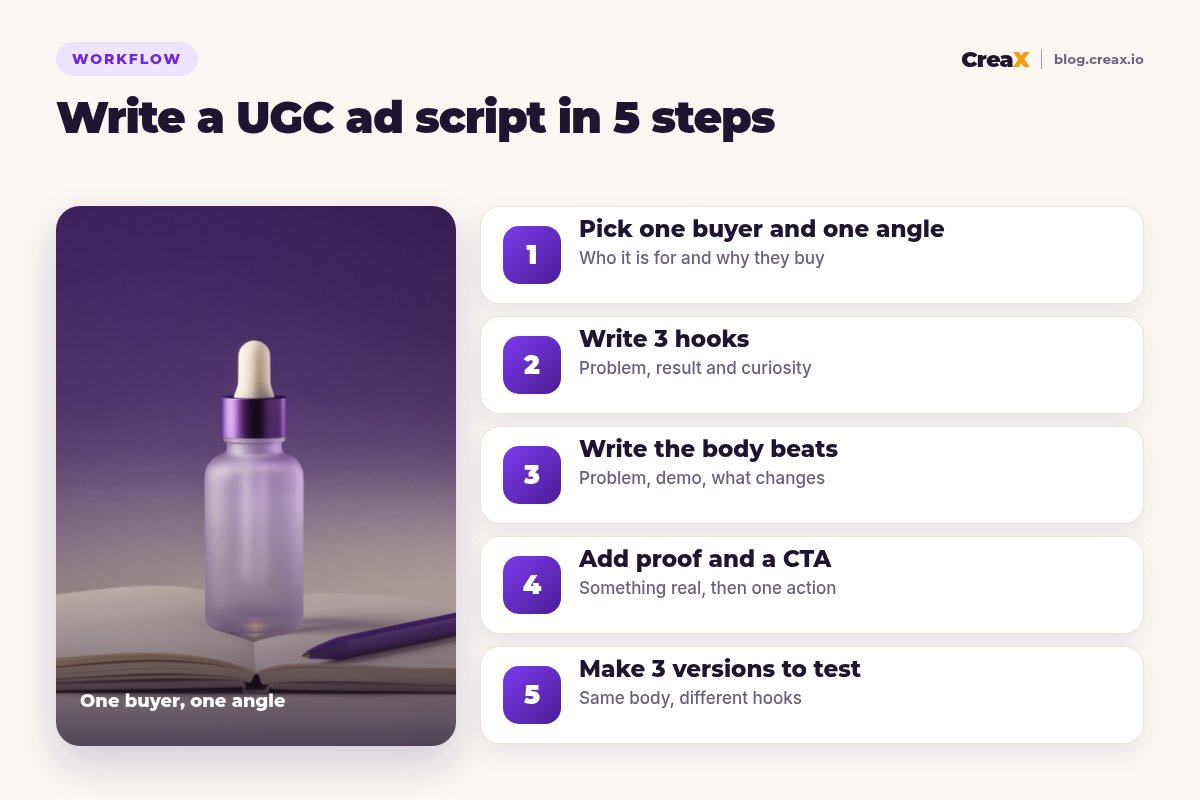
Step 1Step 1: Pick one buyer and one angle
Most weak scripts try to sell to everyone with every benefit. A strong script picks one person and one reason to buy. Fill in this sentence:
iThe angle sentence
Examples for the same product, a lightweight hydrating face serum:
- For people whose skin feels tight by midday, this serum adds a light layer of hydration that sits well under makeup.
- For someone who hates sticky skincare, this serum absorbs quickly so they can get dressed straight after.
- For someone buying a gift, this serum comes in a box that looks good enough to give.
Each one is a different ad. Pick one per script. If you are not sure which angle to lead with, our guide to testing ad angles for a new product explains how to choose and compare them.
Step 2Step 2: Write 3 hooks
The hook is the first line and the first shot. Its only job is to make the right person keep watching. Write three different types for the same angle:
| Hook type | How it works | Example (serum, “tight by midday” angle) |
|---|---|---|
| Problem | Names the exact problem in the buyer's words | “If your skin feels tight by lunchtime, watch this.” |
| Result | Shows the after state first | Close-up of the serum going on, then: “This is the only step I don't skip.” |
| Curiosity | Opens a loop the viewer wants closed | “I changed one thing in my morning routine…” |
Examples are illustrative. Keep claims to what your product can actually do.
Make the first shot do the same work as the words: the product, a hand, a texture, a before-state. Avoid logos, slow intros and “Hi guys”. For more patterns, see UGC ad hooks that stop the scroll.
Step 3Step 3: Write the body beats
The body turns attention into understanding. Keep it to three beats, one scene each:
Problem
Demo
What changes
Rules for the body:
- One idea per scene. If a line needs a comma and an “and”, split it.
- Show before you tell. Every line of voiceover should match something on screen.
- Write how people talk: short sentences, contractions, no marketing words.
- Cut anything that is true but not relevant to this buyer.
Turn your script into a UGC-style video
Paste a product link in CreaX and get UGC-style video ads, studio creatives and a matching landing page in about 60–120 seconds.
Step 4Step 4: Add proof and a CTA
Proof answers “why should I believe this?”. Use only proof you really have:
- A close-up of the material, texture or detail.
- A real demonstration that is hard to fake on camera.
- A guarantee or return policy you actually offer.
- Real customer reviews, quoted accurately and with permission where needed.
!Never invent proof
The CTA tells the viewer exactly what to do next and repeats the reason. Keep it to one action that matches the page: “Tap the link to get yours with free returns” works better than “Check it out”. The landing page should open with the same promise as the video.
Step 5Step 5: Make 3 versions to test
Now multiply. Keep the body, proof and CTA the same, and swap only the hook. That way, when one version does better, you know why.
- Version A: the problem hook.
- Version B: the result hook.
- Version C: the curiosity hook.
Run them to the same page with the same budget, then compare how many people keep watching past the first seconds and how many click. Our guide to hook rate explains the metric, and how many creatives to test per product covers volume.
★Change one thing at a time
ExampleWorked example: a full 30-second script
Product: a lightweight hydrating face serum. Buyer: people whose skin feels tight by midday. Five scenes, about 30 seconds:
| Scene | Voiceover | On screen |
|---|---|---|
| 1. Hook | “If your skin feels tight by lunchtime, watch this.” | Close-up of a hand pressing a cheek, then the serum bottle |
| 2. Problem | “Every moisturiser I tried felt heavy under makeup.” | Makeup bag, a heavy cream pushed aside |
| 3. Demo | “Two drops of this, pressed in. It sinks in fast.” | Dropper, two drops, pressing into skin, texture close-up |
| 4. Proof | “It's fragrance-free, and they offer 30-day returns.” | Ingredient panel, then the returns line on the product page |
| 5. CTA | “Tap the link and try it with free returns.” | Bottle on a shelf, on-screen text with the offer |
Illustrative script. Only use details like “fragrance-free” or a returns period if they are true for your product.
Two alternative hooks for versions B and C:
- B (result): open on the serum going on, then “This is the only step I don't skip in the morning.”
- C (curiosity): “I changed one thing in my morning routine and stopped re-applying moisturiser at lunch.” (Only if it is honestly true for your product.)
You can film this yourself, send it to a creator, or use it as the brief for an AI-generated UGC-style video. With CreaX, paste the product link, generate a 30-second video (5 scenes), and compare it with your script: keep what matches your angle and regenerate with a different angle if not. Our explainer on how the CreaX UGC video generator works shows the details.
MistakesMistakes to avoid
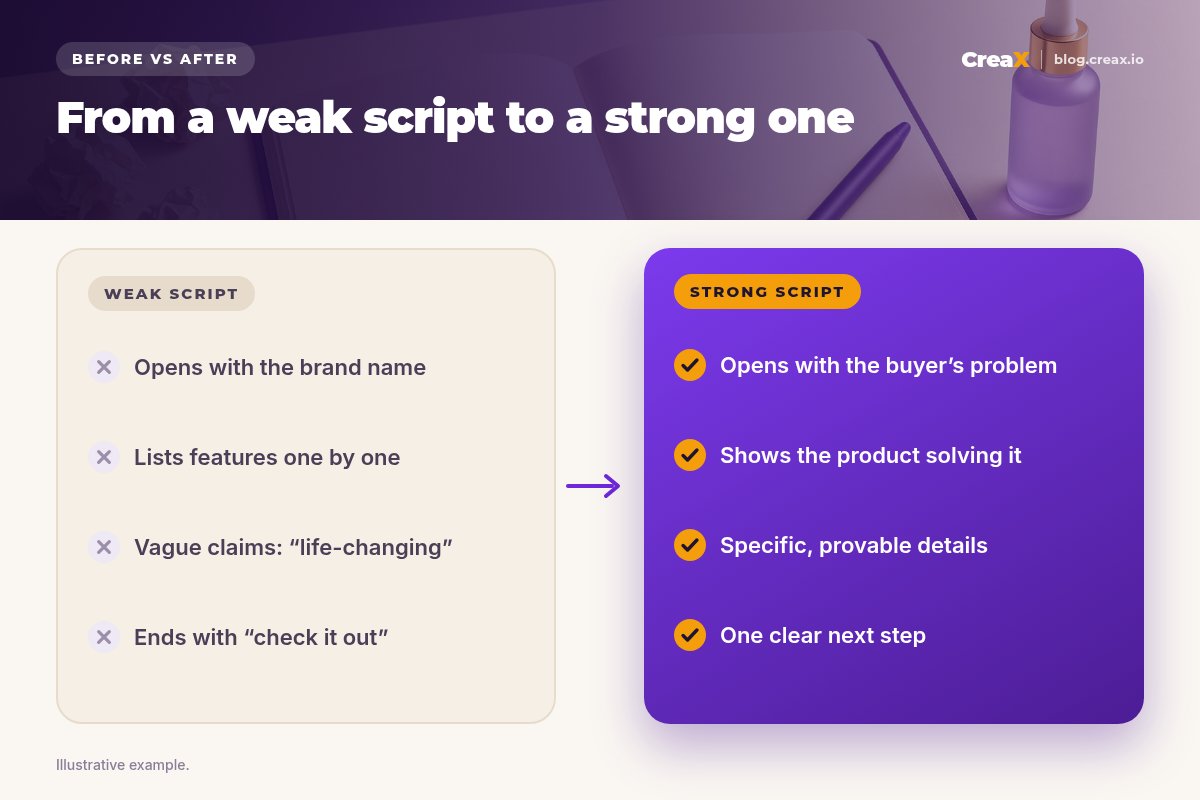
- Opening with the brand name. Nobody scrolls for a logo. Open with the buyer's problem or the result.
- Listing features. Pick the one or two that matter for this angle and show them.
- Vague superlatives. “Amazing” and “life-changing” say nothing. Specific details persuade.
- Several CTAs. “Follow, like, visit our site and use code…” Pick one.
- Script and page do not match. If the video promises one thing and the page leads with another, buyers leave.
- Testing everything at once. Change the hook first, then other parts one at a time.
ChecklistChecklist before you record
Script checklist
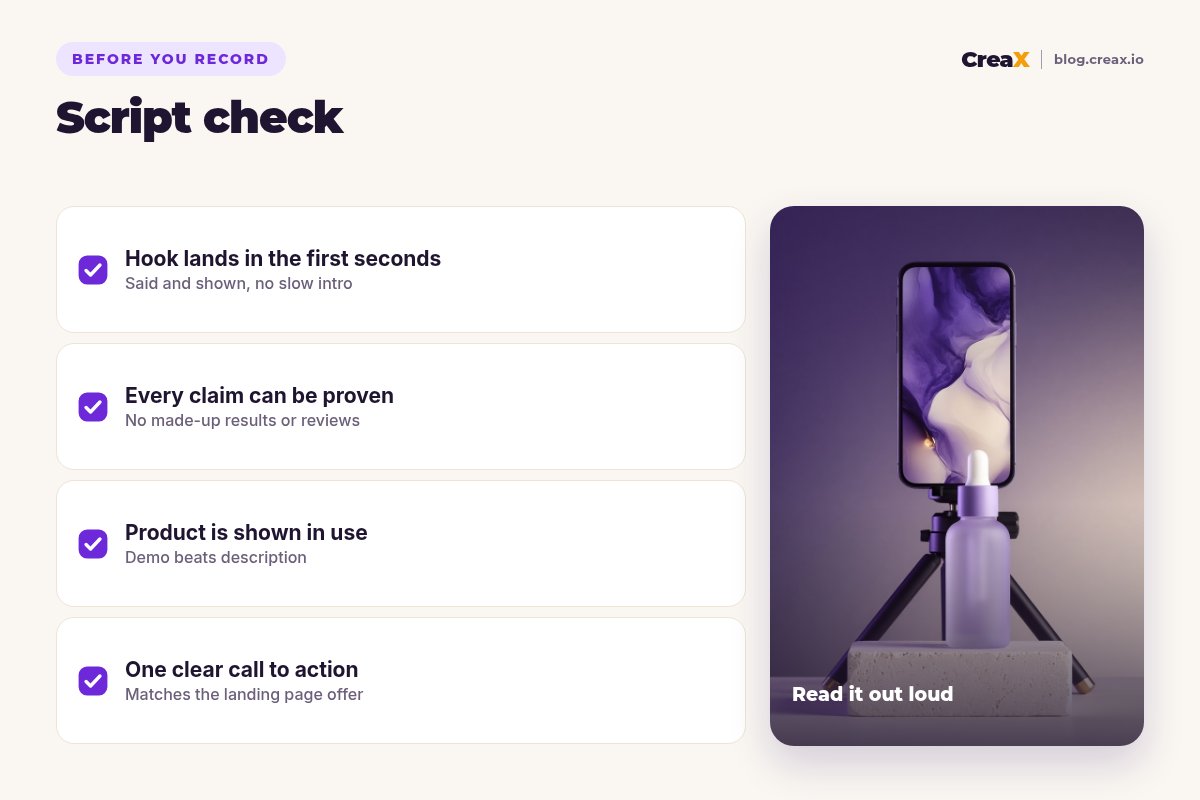
- ✓One buyer, one angle written down in a single sentence.
- ✓The hook works with the sound off: the first shot shows the problem or the product.
- ✓Every line has a matching visual.
- ✓Every claim can be proven, and there are no invented reviews or numbers.
- ✓One CTA that matches the landing page offer.
- ✓Three hooks ready to swap into the same body.
- ✓Read out loud at natural speed, and it fits the target length.
From script to video ad in one pass
CreaX turns your product link into UGC-style video ads, studio creatives and a landing page that repeats the same promise.
FAQFrequently asked questions
Q.How long should a UGC ad script be?
Q.What is the best structure for a UGC video ad?
Q.Should I write the script word for word for creators?
Q.Can AI write my UGC script?
Q.How many hooks should I test?
Q.Do I need captions on UGC ads?
Ready to test your first script?
One product link, about 60–120 seconds, and you have UGC-style video ads, studio creatives and a landing page for your test.
This guide is published by CreaX. Examples are illustrative and contain no real customer quotes or results. Check each ad platform's current policies before you launch.