
Do AI Video Ads Work for Ecommerce? 12 Questions Answered
FAQ · AI video ads
Do AI video ads work for ecommerce? Yes, when they are used for what they're good at: showing a product clearly and testing many angles quickly and cheaply. They don't rescue a weak product, a vague offer or a page that doesn't match. Below we answer the 12 questions sellers ask most, from when real creators still win to how many AI ads to test and which numbers to watch.
Updated October 2026 · By the CreaX team
Key takeaways
- ✓AI video ads work best for products that are easy to show and for testing angles fast; they are a testing engine, not a magic trick.
- ✓Real creators still win when trust depends on lived experience: visible results, fit, taste or a familiar face.
- ✓Test 2–3 angles with two hooks each, send them to one matching page, and judge on cost per purchase against your break-even, not on views.
- ✓Follow the rules: label AI media where platforms require it, keep claims provable, and never fake testimonials.
In this guide
- The short answer
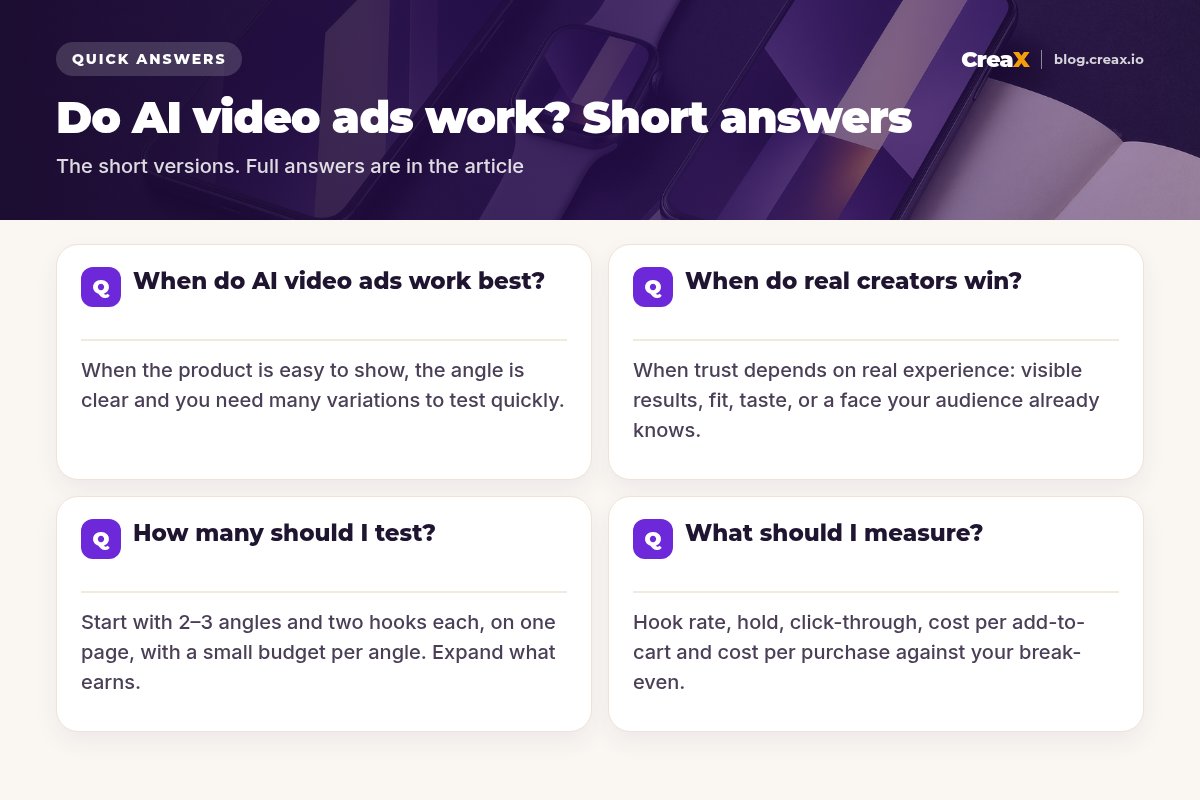
- 1. When do AI video ads work best?
- 2. When do real creators win?
- 3. Are AI video ads allowed on Meta and TikTok?
- 4. Will people notice it's AI?
- 5. How many should I test?
- 6. How long should an AI video ad be?
- 7. What should I measure?
- 8. How long before I judge an ad?
- Checklist you can copy
- Common mistakes to avoid
- How CreaX helps (briefly)
- More questions (9–12)
TL;DRThe short answer
AI video ads are a faster, cheaper way to produce the raw material of ad testing: hooks, angles, demos and variations. They work when the fundamentals are right: a product people want, an offer that makes sense, a clear angle, and a page that repeats the promise. They fail for the same reasons any ad fails, only faster.
Think of them this way: AI doesn't change what makes an ad sell. It changes how many ideas you can afford to test before you find the one that does.
Question 11. When do AI video ads work best?
AI video ads tend to be a good fit when most of these are true:
- The product is easy to show. Gadgets, kitchen tools, accessories, home goods, pet products: things whose value is obvious once you see them used.
- The angle is clear. You can say who it's for and what it fixes in one sentence.
- You need volume. You're testing several products or several angles per product, and paying a creator for each variation doesn't make sense yet.
- Speed matters. A trend, a season or a competitor is moving, and waiting a week for content means missing the window.
- The claims are simple and provable. “Fits in a gym bag” works; “clears acne in 3 days” doesn't, with AI or without.
In short: AI shines in the discovery phase, when you're looking for the product and angle that work. If you're new to the format, our FAQ on what a UGC video ad is explains why native-looking videos often fit social feeds better than polished commercials.
Question 22. When do real creators win?
Real creators are hard to beat when the ad depends on genuine experience:
- Visible results: skincare, haircare, fitness. You can't show results that didn't happen, and AI before-and-afters are a fast way to get ads rejected.
- Fit and feel: clothing, shoes, anything where buyers want to see a real body and real fabric.
- Taste and trust: food, supplements, kids' products, where the audience wants a real person's opinion.
- Known faces: when an audience already follows a creator, their recommendation carries trust an avatar can't borrow.
| Situation | AI video ads | Real creators |
|---|---|---|
| Finding a winning angle for a new product | Strong: many variations, low cost per idea | Slower and more expensive per idea |
| Showing a product in use | Good for demos and product-in-hand scenes | Good, with real hands and settings |
| Results, before-and-after, personal experience | Avoid: can't show results that didn't happen | Strong, if results are real and typical |
| Fit, feel, taste | Limited | Strong |
| Scaling a proven angle | Good for fresh variations of the winner | Good for a premium, trusted version |
A rule of thumb, not a benchmark. You can use both: AI to find the angle, creators to scale it.
⚖Honest take
Question 33. Are AI video ads allowed on Meta and TikTok?
Yes, with rules. Both platforms allow AI-generated content in ads, but both care about transparency and honesty:
- TikTok has a setting in Ads Manager for ads that contain AI-generated content and says undisclosed AI-generated content can be rejected or restricted. Minor edits such as lighting or background cleanup are treated differently from fully generated people and scenes.
- Meta may show an “AI info” label on content made with its own generative AI tools or when it detects industry-standard AI signals. Ads about social issues, elections or politics have stricter self-disclosure rules for realistic digitally created or altered media.
- Both reject misleading claims, fake testimonials, impersonation and ads that don't match the landing page.
!Never fake a customer
Question 44. Will people notice it's AI, and does it matter?
Some will. AI avatars and voices have improved a lot, but attentive viewers can often tell, and labels may tell them anyway. The better question is whether it hurts the ad, and that depends on what the ad asks viewers to believe.
If the ad is a clear demo (“here's the product, here's what it does, here's the price”), being AI matters less, because nobody is being asked to trust a stranger's personal story. If the ad leans on “I tried this and it changed my life”, being AI is a problem, both for trust and for platform rules. Lead with the product, keep the presenter in a guide role, and let the product do the convincing.
Test angles, not guesses
Paste a product link and get UGC-style video ads, studio creatives and a matching landing page, so each angle gets a fair test.
Question 55. How many AI video ads should I test?
Enough to learn something, not so many that each ad starves of budget. A simple starting structure: 2–3 angles per product, two hooks per angle, all pointing at one landing page that matches. That gives you 4–6 videos, which is a manageable number to review and fund.
Write 2–3 angles
Make two hooks per angle
Point everything at one page
Give each angle a small, equal budget
Keep the winner, refresh the rest
For a deeper breakdown, see our guide to how many ad creatives to test per product.
Question 66. How long should an AI video ad be?
Shorter than you think, with the product early. TikTok's in-feed ads can run from 5 to 60 seconds, and TikTok's own creative guidance for small businesses points to roughly 21–34 seconds as a sweet spot for many ads, with the key message in the first few seconds. Meta supports much longer videos, but feed and Reels viewers scroll fast, so the same rule applies: show the product and the reason to care immediately.
For AI video ads specifically, shorter also hides weaknesses. A tight 15–30 second demo with captions usually beats a long avatar monologue. Test length like any other variable.
Question 77. What should I measure?
Views and likes are not the goal. Use a simple chain from attention to profit:
| Metric | What it tells you | If it's weak, fix… |
|---|---|---|
| Hook rate (3-second views ÷ impressions) | Do the first seconds stop the scroll? | The opening shot and first line |
| Hold rate (watched most of the video) | Is the middle interesting and clear? | Pacing, length, demo clarity |
| Click-through rate | Does the ad create intent? | The angle, offer and call to action |
| Cost per add-to-cart | Does the page continue the story? | Page headline, price, proof |
| Cost per purchase vs break-even | Is it profitable? | Offer, margin, or the product itself |
Use the definitions your ad platform reports. Compare ads within the same campaign and time window.
The last row is the one that pays the bills. If you don't know your break-even cost per purchase yet, our guide to break-even ROAS shows how to calculate it.
Question 88. How long before I judge an AI video ad?
Long enough for the numbers to mean something. Judging an ad after a few hours or a handful of clicks mostly measures luck. A common rule of thumb is to let each angle spend roughly one to two times your target cost per purchase before deciding, and to look at the early signals (hook rate, click-through) first. If an angle has strong attention but no add-to-carts, the problem may be the page, not the video.
If your ads are getting clicks but not sales, our guide to Facebook ads that are not converting walks through creative and page fixes.
Before you scaleChecklist you can copy
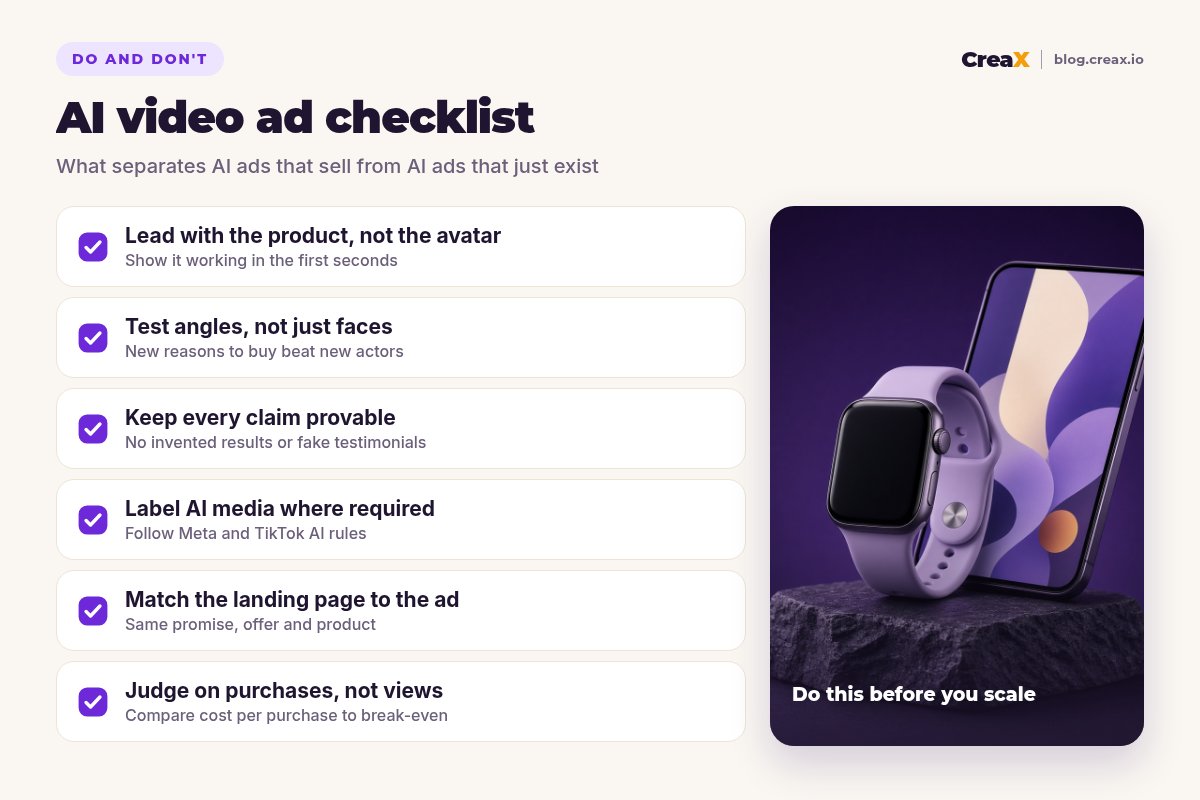
AI video ad pre-flight
- ✓Product visible and in use in the opening seconds
- ✓2–3 angles, two hooks each, not just different avatars
- ✓Every claim checked against real specs
- ✓No fake testimonials, results or before-and-afters
- ✓AI-content labels set where TikTok or Meta ask
- ✓Captions readable with the sound off
- ✓Landing page repeats the ad's promise and offer
- ✓Break-even cost per purchase written down before launch
- ✓Decision rule set: spend per angle before you judge
What goes wrongCommon mistakes to avoid
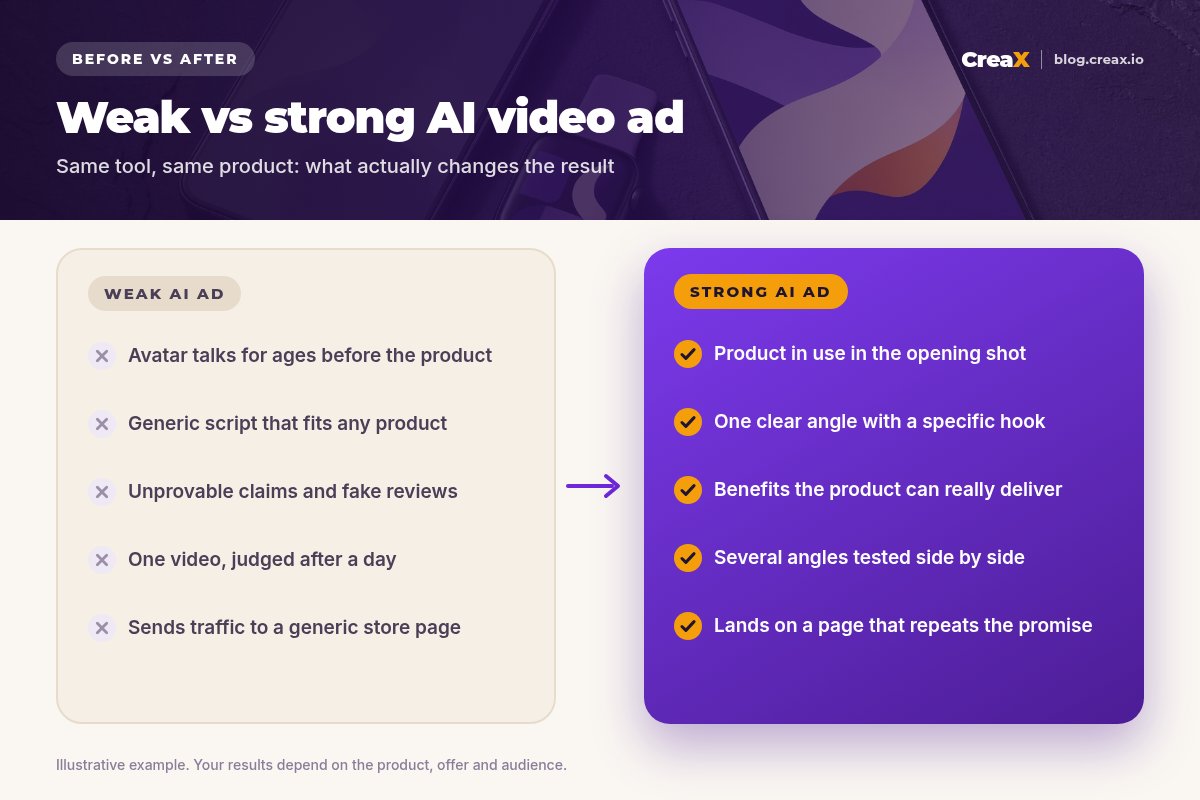
- Testing faces instead of angles. Five avatars saying the same script is one test, not five.
- A slow start. If the product isn't on screen in the first seconds, many viewers never see it.
- Generic scripts. “This changed everything!” fits every product and convinces nobody.
- Unprovable claims. AI writes confident copy. You're responsible for every word.
- Ignoring fatigue. Even winners wear out. Watch frequency and click-through, and refresh before results collapse. Our guide to signs of ad creative fatigue shows what to watch.
Where we fitHow CreaX helps (briefly)
CreaX is an all-in-one AI ecommerce creative OS built for exactly this testing loop. Paste a product link or upload a product image and, in about 60–120 seconds, you get UGC-style video ads, studio ad creatives, a publish-ready landing page and a multi-tenant store. Because the videos and the page come from the same input, the angle in the ad and the promise on the page start out matched instead of being stitched together from different tools.
Plans start at $4.99 a month for 2,000 credits, with top-ups at $1 per 500 credits. It won't pick your product or set your budget, and you should still review every claim, but it removes most of the waiting between an idea and a live test.
Build your next AI video ad test in about two minutes
One product link or image: UGC-style video ads, studio creatives and a landing page that tell the same story.
FAQMore questions sellers ask (9–12)
Q.9. Can AI video ads replace UGC creators completely?
Q.10. Which products are the worst fit for AI video ads?
Q.11. Do AI video ads fatigue faster than real ones?
Q.12. How much do AI video ads cost to make with CreaX?
Q.Do I need a landing page for AI video ads?
Ready to find out if AI video ads work for your product?
Paste a product link and get UGC-style video ads, studio creatives and a matching landing page in about 60–120 seconds.
This guide is published by CreaX. We describe other tools from their own public websites as of October 2026, avoid invented scores or prices, and recommend checking each vendor's site for current features and plans.