
How to Make a Problem-Solution Video Ad
How-to · Video ads
A problem solution ad is the simplest video ad structure that still sells: show a problem your buyer already feels, show your product fixing it, add honest proof and tell people what to do next. This guide walks through it step by step, with a shot list, a worked example and the mistakes that make these ads feel fake.
Updated October 2026 · By the CreaX team
Key takeaways
- ✓A problem-solution video ad has four parts: problem, solution, proof, call to action. Problem-agitate-solve (PAS) adds a short beat that makes the problem feel real before the fix.
- ✓Open on the problem, not your logo. The first seconds decide whether anyone sees the fix.
- ✓Show the product solving the problem on screen, early and clearly. A demo beats a description.
- ✓Make three versions with different hooks and the same offer, and send them all to a page that repeats the promise. CreaX can generate UGC-style versions from one product link.
In this guide
The outcomeWhat you'll have at the end
By the end of this guide you will have a script and shot list for a short vertical video ad built on the problem-solution structure, plus three variations to test. The structure looks like this:
| Part | Job | Typical length |
|---|---|---|
| Hook: the problem | Make the viewer recognise their own situation | The first 1–3 seconds |
| Agitate (optional) | Show why the problem is annoying or costly | A few seconds |
| Solution | Show the product fixing it, on screen | The middle of the ad |
| Proof | Give a reason to believe: demo, detail, guarantee | A few seconds |
| Call to action | One clear next step | The last 2–3 seconds |
Lengths are rough guides for short social video ads, not rules.
It works for UGC-style videos, product demos and simple motion ads. If you are new to video ads, read our guide to writing a UGC video ad script alongside this one.
PrepWhat you need before you start
- A product that solves a visible problem. Tangled cables, a messy car boot, dry skin, a pet shedding on the sofa. If the problem cannot be shown, it is harder to use this format.
- Real buyer language. Read reviews of your product and similar products, comments under competitor ads and questions in forums. Write down how people describe the problem in their own words.
- Footage or a way to generate it. Your own phone clips, supplier videos you have the right to use, or AI-generated UGC-style video from the product.
- A landing page that repeats the promise. The ad sells the fix; the page has to deliver the same message.
★Steal the words, not the ads
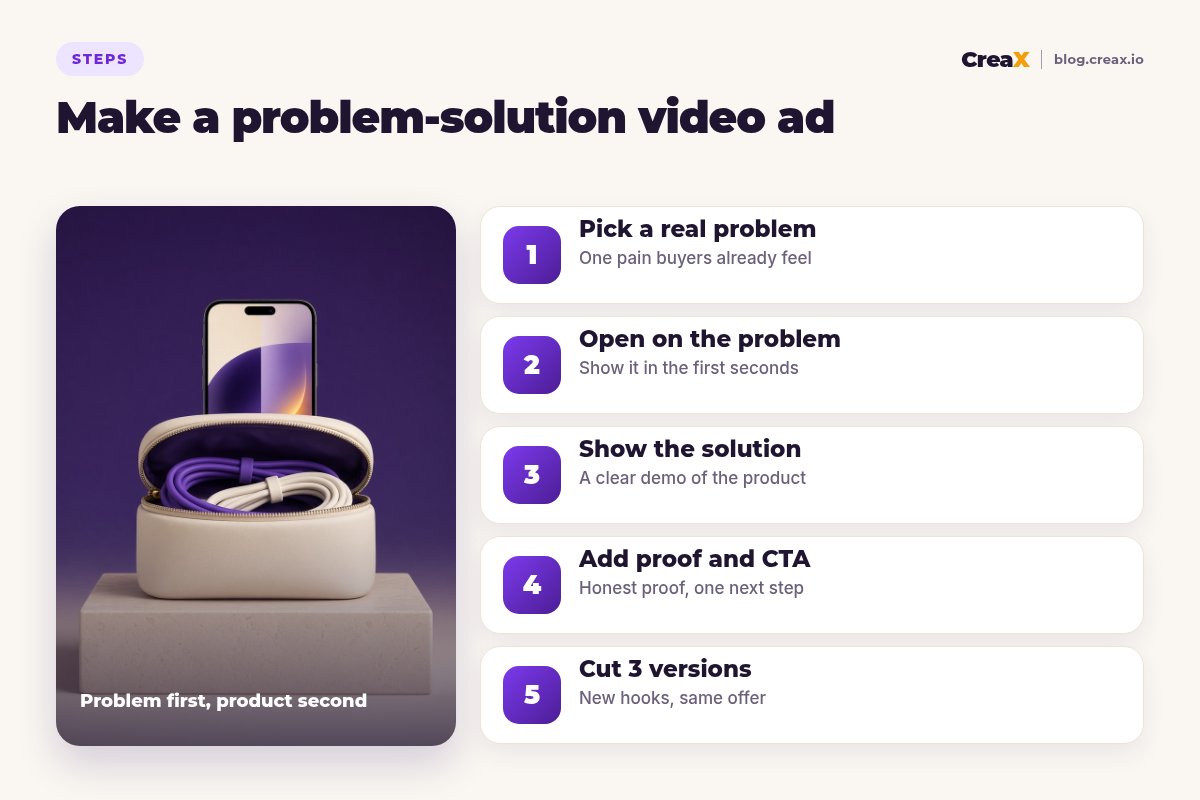
Step 1Step 1: Pick a real problem
Choose one problem, not five. The best problems for this format are:
- Specific: “cables tangle in my bag” is better than “stay organised”.
- Frequent: something that happens every day or every week.
- Visible: you can show it in a few seconds without explaining.
- Solved by your product, in a way you can show and prove.
If you have several problems your product solves, each one is a separate ad angle. Test them as different videos rather than stuffing them into one. Our guide to testing ad angles for a new product shows how to set that up.
Step 2Step 2: Open on the problem
The first seconds of the ad should show the problem happening, ideally without needing sound. Good openings:
- The moment of frustration: hands pulling a knot of cables out of a bag.
- A question on screen: “Why are your cables always tangled?”
- A relatable line spoken to camera: “I used to spend five minutes untangling my charger every morning.” Only say this if it is true for the person speaking, or frame it as a scenario.
Then, if you want, add a short agitate beat: show what the problem costs (being late, a broken cable, a messy desk). Keep it short. The longer you stay on the problem, the more viewers drop before the fix. For more opening ideas, see UGC ad hooks that stop the scroll and what hook rate is.
!Don't shame the viewer
Step 3Step 3: Show the solution
Now show the product fixing the problem, on screen, as clearly as you can:
Introduce the product quickly
Demo the fix
Show the result
Keep it real
If you do not have footage, generated product video can work, as long as it shows the product accurately. See product demo video ads without filming for options.
Step 4Step 4: Add proof and CTA
Proof gives viewers a reason to believe what they just saw. Use only proof you actually have:
- The demo itself, shown in one continuous shot, is strong proof.
- Product details: materials, size, what is in the box, as long as they are accurate.
- A guarantee or return policy you really offer.
- Real reviews with permission, quoted accurately. Never invent testimonials, ratings or customer counts.
End with one call to action that matches your page: “Tap to get yours”, “See how it works”, or your current offer. If the offer is a bundle or a discount, show it on screen. Then make sure the landing page repeats the same problem, the same fix and the same offer.
Turn your product into problem-solution video ads
Paste a product link into CreaX and get UGC-style video ads in 18, 30 or 45 seconds, studio static ads and a landing page that repeats the promise.
Step 5Step 5: Cut 3 versions
One video is a guess. Three versions are a test. Keep the solution, proof and offer the same, and change one thing at a time:
| Version | What changes | Example hook |
|---|---|---|
| A | Hook: the moment of frustration | Hands pulling a knot of cables from a bag |
| B | Hook: a question on screen | “Why are your cables always tangled?” |
| C | Hook: the result first | A perfectly neat bag, then “here's how” |
Change one element per version so you can tell what made the difference.
With CreaX, you paste a product link from Alibaba, AliExpress, Amazon, Etsy or any product page, or upload a product image, and get UGC-style video ads in 18, 30 or 45 seconds (3, 5 or 7 scenes), plus studio static ads and a publish-ready landing page, in about 60–120 seconds. That makes it practical to produce several versions and a matching page for one test. For length, see how long a video ad should be.
ExampleWorked example: a cable organizer pouch
Say you sell a travel cable organizer pouch. Here is a 30-second problem-solution script with a simple shot list:
| Seconds | Shot | On-screen text / voice |
|---|---|---|
| 0–3 | Hands pull a tangled knot of cables out of a backpack | “Every trip starts like this.” |
| 3–7 | Close-up: struggling with the knot, a cable end bent | “Tangled, bent, and always the one you need at the bottom.” |
| 7–15 | The pouch opens; cables slide into elastic loops | “This pouch gives every cable its own place.” |
| 15–22 | Pouch zipped, dropped into the bag; bag looks neat | “Zip it, drop it in, done.” |
| 22–26 | Pouch open on a table showing what fits | Accurate details: compartments, size |
| 26–30 | Product on a clean background with the offer | “Tap to get yours” + your real offer |
An illustrative script, not a performance claim. Only include details your supplier can confirm.
Notice what is not there: no logo intro, no list of ten features, no invented “thousands of happy customers”. The problem, the fix and one clear next step do the work.
MistakesMistakes to avoid
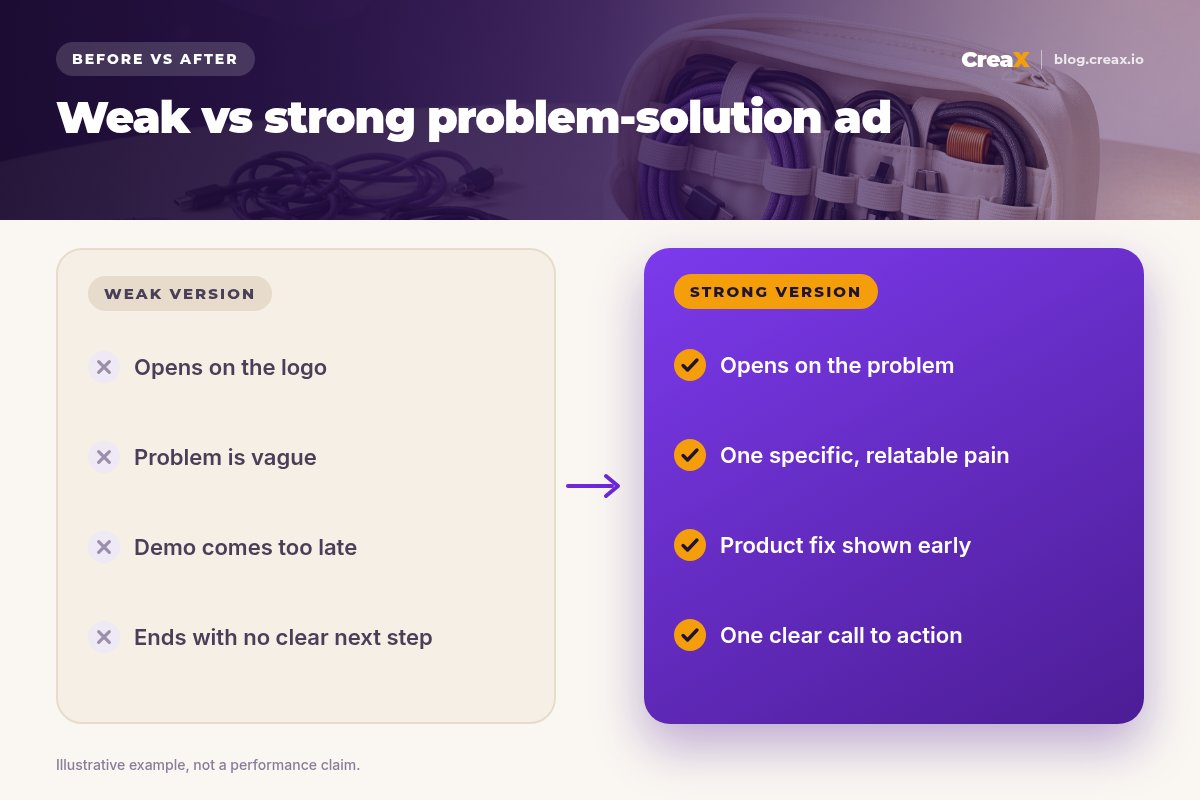
- Starting with the brand. Viewers do not care about your logo until they care about the problem.
- A vague problem. “Life is busy” is not a problem anyone can see.
- Showing the product too late. If the fix appears in the last two seconds, most viewers never see it.
- Exaggerated before-and-after. Results the product cannot deliver can get ads rejected and erode trust. See before-and-after ads that do not get rejected.
- Fake proof. Invented reviews, ratings or “as seen on” claims are dishonest and against ad platform rules.
- A page that tells a different story. If the ad is about tangled cables and the page opens with a generic product description, the click is wasted.
Before you launchChecklist
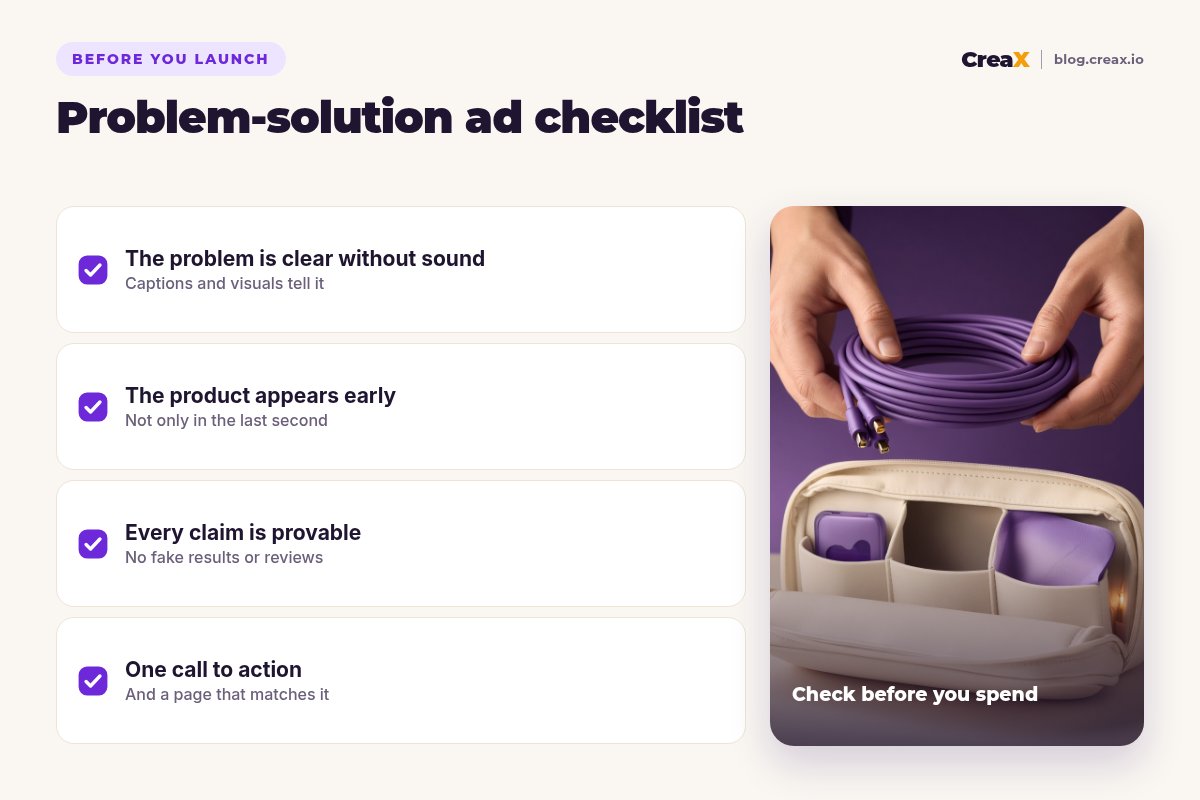
Problem-solution ad QA
- ✓One specific problem buyers already describe in their own words.
- ✓The problem shows in the first seconds, clear even with the sound off.
- ✓The product appears early and fixes the problem on screen.
- ✓Every claim is provable; no invented reviews, results or numbers.
- ✓One call to action and an offer that matches the landing page.
- ✓Three versions with different hooks, ready to test together.
Make your problem-solution test in one pass
One product link, about 60–120 seconds: UGC-style video ads, static ads and a landing page that tells the same story.
FAQFrequently asked questions
Q.What is a problem-solution ad?
Q.What is the difference between problem-solution and PAS?
Q.How long should a problem-solution video ad be?
Q.Do I need to film the product myself?
Q.Which products work best with this format?
Q.Can I use customer reviews as proof?
Ready to make your first problem-solution ad?
Paste a product link and get UGC-style video ads, static ads and a matching landing page.
This guide is published by CreaX. Examples are illustrative, not performance claims. CreaX features are described from creax.io.