What Is Cost Cap Bidding in Meta Ads and When Should You Use It?
by the CreaX team
In this guide
- DefinitionWhat is cost cap bidding?
- CompareHow is cost cap different from highest volume?
- Other strategiesWhat about bid cap and ROAS goal?
- Use casesWhen should you use cost cap?
- The riskWhy does a cost cap under-deliver?
- SetupHow do you set the cap?
- Testing and scaling in separate campaigns
- Avoid theseWhat are the common mistakes?
- CreativesWhere do creatives fit in?
- ExampleWorked example: scaling a proven product
- FAQFrequently asked questions
- Q.What is cost cap bidding in Meta ads?
- Q.Is cost cap the same as bid cap?
- Q.Why are my cost cap ads not spending?
- Q.Should I start a new product on cost cap?
- Q.Is cost cap better than ROAS goal?
- Q.Can CreaX set my bids?
FAQ · Meta ads bid strategies
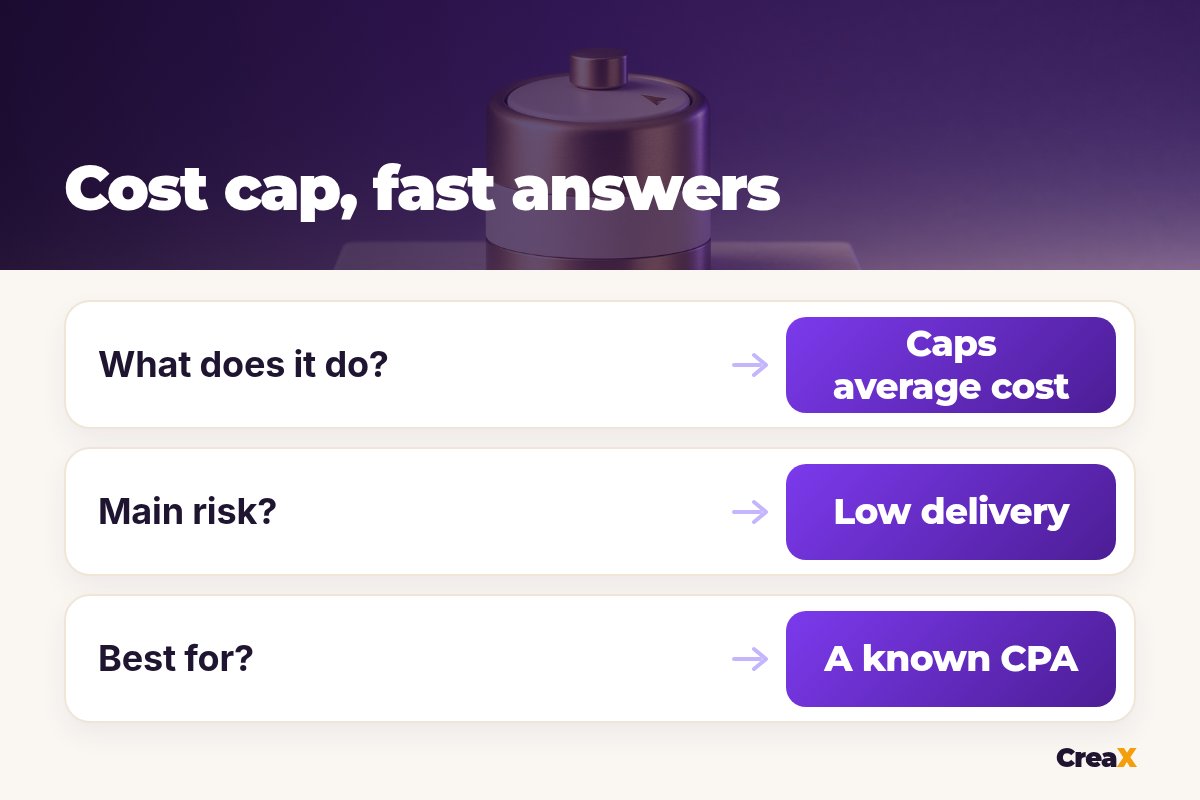
Cost cap bidding tells Meta roughly what you're willing to pay for each result, such as a purchase, and asks the system to keep your average cost around that amount while it spends. It sounds like the perfect setting for any store with a target cost per purchase, but it has a catch: if the cap is lower than what results really cost, your ads may barely spend. This guide explains cost cap in plain words, how it differs from highest volume, bid cap and ROAS goal, when it helps, why it under-delivers, and how to set it.
By the CreaX team
Key takeaways
- ✓Cost cap asks Meta to get as many results as it can while keeping the average cost per result around your cap. In Ads Manager it may appear as a cost per result goal.
- ✓Highest volume, the default, spends your budget to get the most results, without a cost target.
- ✓Bid cap limits the bid in each auction, and ROAS goal targets a return on ad spend instead of a cost.
- ✓The main risk is under-delivery: a cap below what results really cost can leave budget unspent. Fresh creatives help any strategy find results.
In this guide
DefinitionWhat is cost cap bidding?
Meta's ad auction decides who sees your ad and what you pay. Your bid strategy tells the system how to bid for you. With cost cap, you give a target cost per result, such as a cost per purchase, and Meta tries to get as many results as possible while keeping the average cost around that number.
The word average matters. Some results may cost more than your cap and some less; the system aims for the average over time, not a hard limit on every sale. Meta has described this strategy in its Business Help Center, and newer versions of Ads Manager may label it as a cost per result goal.
To pick a sensible target, you first need to know what a purchase can cost you and still make money; our guide to CPA in dropshipping explains how to work that out.
CompareHow is cost cap different from highest volume?
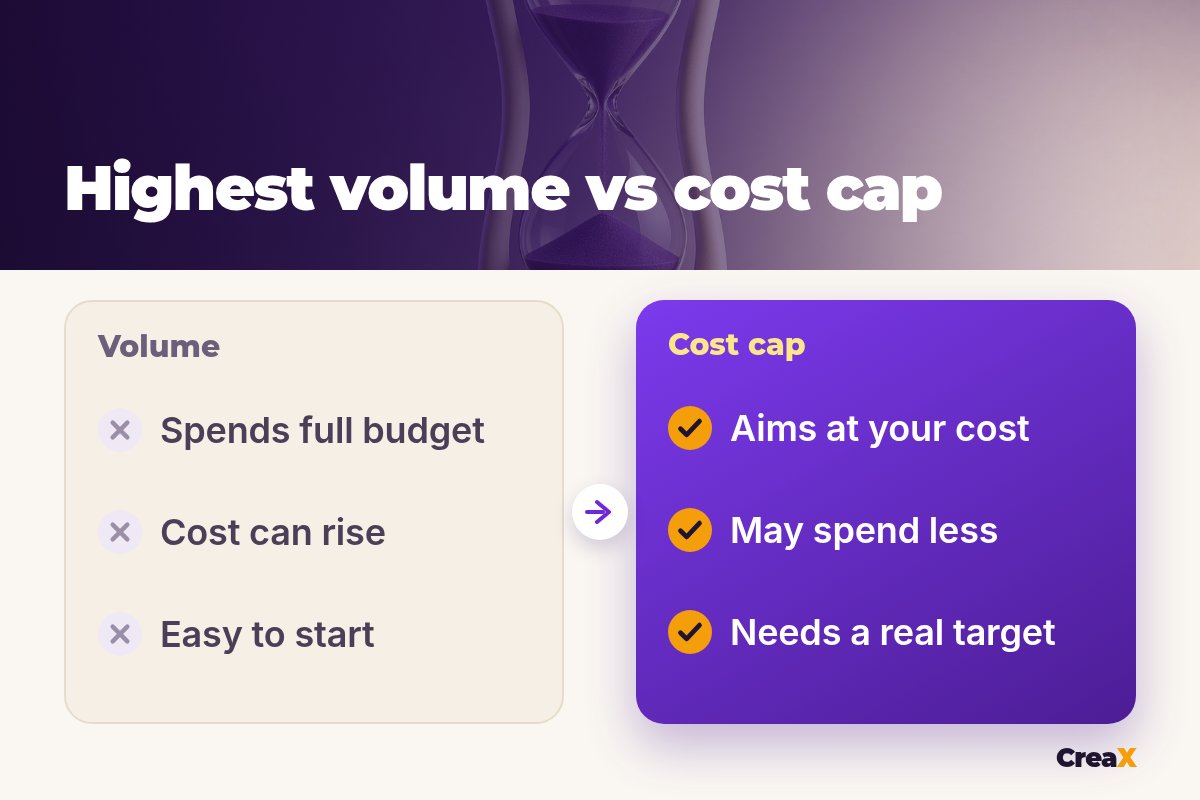
Highest volume (once called lowest cost) is the default. Meta spends your full budget and tries to get the most results for it. It's easy, it usually spends, and it suits testing, but there's no cost target, so your cost per result can rise as you spend more.
Cost cap adds a target. Meta still tries to get results, but it holds back when they would push the average cost above your cap. That gives you more control over cost, at the price of less predictable spend.
| Highest volume | Cost cap | |
|---|---|---|
| What you set | A budget | A budget and a target cost per result |
| Spends the full budget? | Usually | Only when results fit the cap |
| Cost per result | Can rise as you scale | Aims to stay around the cap |
| Good for | Testing and learning | Scaling with a known target |
A simplified comparison; Meta describes each bid strategy on its Business Help pages.
Other strategiesWhat about bid cap and ROAS goal?
- Bid cap sets the most Meta can bid in each auction. It's stricter and more hands-on than cost cap, and it can limit delivery even more.
- ROAS goal (minimum ROAS) asks Meta to aim for a return on ad spend instead of a cost per result. It needs purchase values tracked correctly.
- Cost cap sits in between: a cost target on the average, not on every auction.
If your return is falling as you spend more, read why ROAS drops after scaling before you switch strategy; the cause is often the audience or the creatives, not the bid.
Use casesWhen should you use cost cap?
Cost cap tends to make most sense when:
- You know your real target. You've worked out the cost per purchase that still leaves profit, from real data, not a guess.
- You have proven ads. The product and creatives already sell under highest volume, and you want to scale with more control.
- You can accept slower spend. You'd rather spend less than pay too much per result.
- The campaign has steady data. Enough results come in for the system to learn.
For a brand-new product with no sales history, highest volume is usually the simpler place to start, so the system can find buyers and you can learn what a purchase really costs. Our guide to scaling Facebook ads for dropshipping covers the order of moves.
The riskWhy does a cost cap under-deliver?
The most common complaint about cost cap is simple: the ads don't spend. Usual reasons:
- The cap is too low. If results really cost more than your cap, Meta holds back.
- The audience is small. There aren't enough people likely to convert at that cost.
- The creatives are tired. Weak or worn-out ads make results more expensive, so fewer fit under the cap.
- The campaign is still learning. Delivery can be uneven at the start.
If spend has stalled, our guides on Facebook ads not spending and the Meta learning phase walk through the checks.
SetupHow do you set the cap?
Find your break-even cost
Look at real results
Start near the real cost
Give it time
★Check Meta's own help pages
Testing and scaling in separate campaigns
Many advertisers keep testing and scaling apart. New products and new creatives go into a simple testing setup on highest volume, where the goal is to learn what works and what a purchase really costs. Once a product and a few ads have proven themselves, they move into a scaling campaign, and that's where a cost cap can add control. Our guide to ABO vs CBO for creative testing explains one common way to structure the testing side.
Keeping the two apart also makes the numbers easier to read. If a cost cap campaign slows down, you can still see from the testing campaign whether the product and the creatives are healthy, so you know whether to adjust the cap or refresh the ads. It also stops a strict cap from starving a brand-new ad of the delivery it needs to show what it can do.
Whichever setup you choose, write down why you picked each cap and when you'll review it. A short note saves a lot of guessing later, especially when several people touch the same ad account.
Avoid theseWhat are the common mistakes?
- Setting a dream cap. A target far below real costs usually means little or no spend.
- Changing the cap every day. Frequent edits make it harder for the system to learn.
- Using it on an unproven product. With no data, you don't know what a fair cap is.
- Blaming the bid for weak ads. If creatives don't convert, no bid strategy will fix it.
CreativesWhere do creatives fit in?
A bid strategy only decides how Meta bids. The ads themselves decide how many people buy. Stronger, fresher creatives tend to make results cheaper, which helps any strategy, and helps a cost cap find more results that fit under the target.
CreaX doesn't run or bid your ads. It helps on the creative side: paste a product link and, in about 60–120 seconds, get UGC-style video ads of 18, 30 or 45 seconds, studio ads in five styles and four sizes (1:1, 3:4, 4:5, 9:16) and a matching landing page, so you always have new angles ready to test.
Keep fresh creatives ready to test
Paste one product link and get UGC-style video ads, studio ads and a landing page in about 60–120 seconds.
ExampleWorked example: scaling a proven product
Say a kitchen gadget already sells under highest volume, and you've worked out the cost per purchase that still leaves profit. Here's a simple plan:
| Step | What you do |
|---|---|
| 1 | Keep the winning highest volume campaign running |
| 2 | Work out your break-even cost per purchase from real costs |
| 3 | Launch a cost cap campaign with a cap near what purchases really cost |
| 4 | Add two or three fresh creatives so the system has options |
| 5 | Compare spend and cost per purchase after enough data, then adjust once |
An example plan, not a results benchmark.
If the cost cap campaign barely spends, the cap is probably too tight for the audience or the creatives; raise it a little or refresh the ads before you give up on it.
!No strategy guarantees a cost
FAQFrequently asked questions
Q.What is cost cap bidding in Meta ads?
Q.Is cost cap the same as bid cap?
Q.Why are my cost cap ads not spending?
Q.Should I start a new product on cost cap?
Q.Is cost cap better than ROAS goal?
Q.Can CreaX set my bids?
Ready to test new angles?
One product link, about 60–120 seconds, and you have UGC-style video ads, studio ads and a landing page for your next test.
This guide is published by CreaX. We describe other tools from their own public websites, last checked October 2026, avoid invented scores or prices, and recommend checking each vendor's site for current features and plans.
Your next campaign starts with a link.
Paste a product link and get UGC video ads, ad images and a landing page — everything in under 60 seconds.
Start creating