
ABO vs CBO: Which Meta Campaign Setup Is Best for Testing Creatives?
Comparison · Meta campaign setup
ABO vs CBO is one of the most common questions in Meta advertising, especially when you are testing new creatives. ABO gives each ad set its own budget; CBO, now called Advantage+ campaign budget, lets Meta move one budget to whatever is working. Here is how each one spends, when to use which, a simple test structure and what creatives to feed it.
Updated October 2026 · By the CreaX team
Key takeaways
- ✓ABO (ad set budget) sets a budget per ad set, so each test gets a more predictable share of spend. It is the usual choice for fair creative tests.
- ✓CBO (Advantage+ campaign budget) sets one budget for the campaign and Meta distributes it in real time to the ad sets with the best opportunities. It is the usual choice for scaling winners.
- ✓Neither setup fixes weak creatives. The bigger lever is feeding the test with clearly different angles, all sending traffic to the same page.
- ✓A common pattern: test in ABO, scale in CBO. CreaX can generate the creatives and landing page for each test from one product link.
In this guide
TL;DRThe short answer: ABO vs CBO
Use ABO when you want each new creative or angle to get a fair, controlled amount of spend so you can compare them. Use CBO when you already know what works and want Meta to push budget toward the best-performing ad sets with less manual work.
Many advertisers use both: a testing campaign on ABO to find winners, and a scaling campaign on CBO to grow them. The right answer for you depends on your budget, how many creatives you test and how much control you want.
⚖How we wrote this
Ad set budgetWhat ABO is best at
ABO stands for ad set budget optimization: you set a daily or lifetime budget on each ad set. Meta still optimizes delivery inside each ad set, but it cannot move money from one ad set to another.
- Control. You decide how much each test gets. A new angle cannot be starved because an older ad set is doing well.
- Cleaner comparisons. If each ad set holds one angle or creative concept, spend per concept is more predictable.
- Easy to read. Results map to the budget you chose, so it is simple to see what each test cost.
The trade-off is work: more budgets to manage, and you have to move money to winners yourself.
Advantage+ campaign budgetWhat CBO is best at
CBO stands for campaign budget optimization. Meta now calls it Advantage+ campaign budget (also shown as "Campaign budget" or "Budget with Advantage+ on"). You set one budget at the campaign level, and Meta distributes it in real time to the ad sets it sees as having the best opportunities.
- Less manual work. One budget instead of many, and Meta moves spend for you.
- Built for scaling. When several ad sets hold proven ads, Meta can push budget to whichever performs best at that moment.
- Optional guardrails. Meta offers minimum and maximum ad set spend limits with campaign budgets, though it recommends using them sparingly because they limit its flexibility.
The trade-off is evenness. Meta says Advantage+ campaign budget may not spend equally across ad sets, so a new creative can get little spend if another ad set looks better early on.
ComparisonABO vs CBO side-by-side
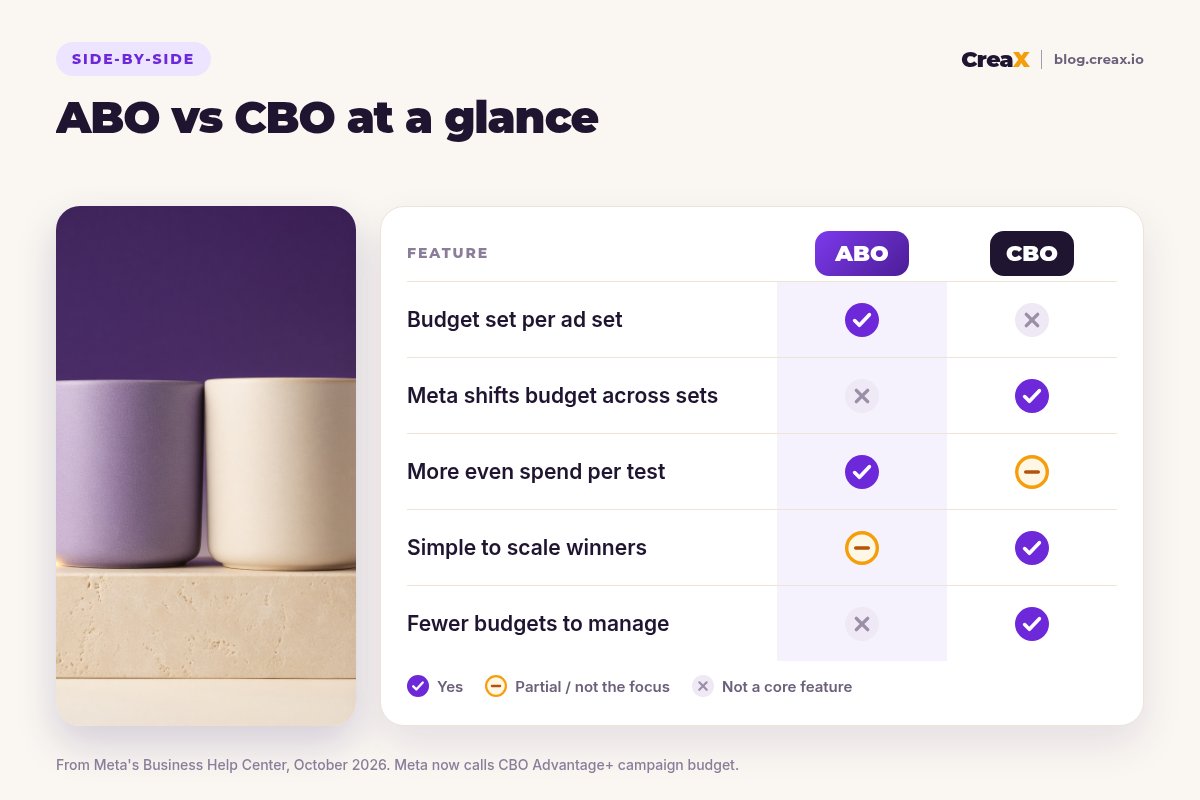
| ABO (ad set budget) | CBO (Advantage+ campaign budget) | |
|---|---|---|
| Where the budget lives | On each ad set | On the campaign |
| Who moves money between ad sets | You | Meta, in real time |
| Spend per ad set | More predictable | Can be very uneven, by design |
| Best for | Testing new creatives and angles | Scaling proven ads |
| Management effort | Higher: many budgets | Lower: one budget |
| Creative needs | One clear concept per ad set | Several proven ads to choose from |
Summarised from Meta's Business Help Center, October 2026. No benchmark numbers: results depend on your account and product.
Remember that both setups still rely on Meta's delivery system inside each ad set. Even with ABO, if you put several ads in one ad set, Meta decides how to deliver them, so spend per ad will not be equal.
Need fresh creatives for your next test?
Paste a product link into CreaX and get studio ads, UGC-style video ads and a landing page, ready to drop into your ABO test.
Use ABO when…Where ABO is the better pick
- You are testing new angles or hooks and want each one to get a fair amount of spend before you judge it.
- You are testing a new product and need to know which message works, not just which ad Meta liked first.
- You want simple reporting where each ad set's budget and result are easy to compare.
- You have a few clear concepts rather than dozens of small variations.
Use CBO when…Where CBO is the better pick
- You are scaling ads that already work and want Meta to keep pushing budget to the best ones.
- Your budget is small and splitting it across many ad sets would leave each one with too little to learn from.
- You want less day-to-day management and are comfortable letting Meta decide the split.
- You combine several proven audiences or ad sets and care about the overall result more than each one.
ABO (ad set budget)
Strengths
- +You control spend per test
- +Fair comparisons between angles
- +Easy to read results
Trade-offs
- −More budgets to manage
- −You move money to winners by hand
- −Can spread a small budget too thin
CBO (Advantage+ campaign budget)
Strengths
- +One budget, less management
- +Meta shifts spend toward what performs
- +Natural fit for scaling winners
Trade-offs
- −Spend across ad sets can be very uneven
- −New creatives can be starved early
- −Spend limits help, but Meta advises using them sparingly
★Avoid pausing and unpausing ad sets in CBO
Creative supplyWhat creatives each one needs (and where CreaX fits)
Budget setup decides how money is spread. Creatives decide whether anything works at all. Each setup needs a different kind of creative supply:
- For ABO testing: a few clearly different angles, for example price, a key benefit and a use case, each as its own concept. Small tweaks of the same idea teach you little. Our guide on how many ad creatives to test per product helps you size the test.
- For CBO scaling: proven ads plus regular fresh variations of the winners, so the campaign does not run out of steam. See how to scale winning creative variations.
- For both: one landing page that matches the ads, so the creative is the only thing that changes between tests.
This is where CreaX fits. Paste a product link or upload an image and, in about 60–120 seconds, CreaX generates studio ad creatives in five styles (Classic, Humble Orbit, Punch, Luxe and Meta Feed) and four sizes (1:1, 3:4, 4:5, 9:16), UGC-style video ads of 18, 30 or 45 seconds, and a landing page that repeats the promise of the ads. That gives you several angles for an ABO test and fresh variations for CBO, without a designer.
ExampleWorked example: one product on both setups
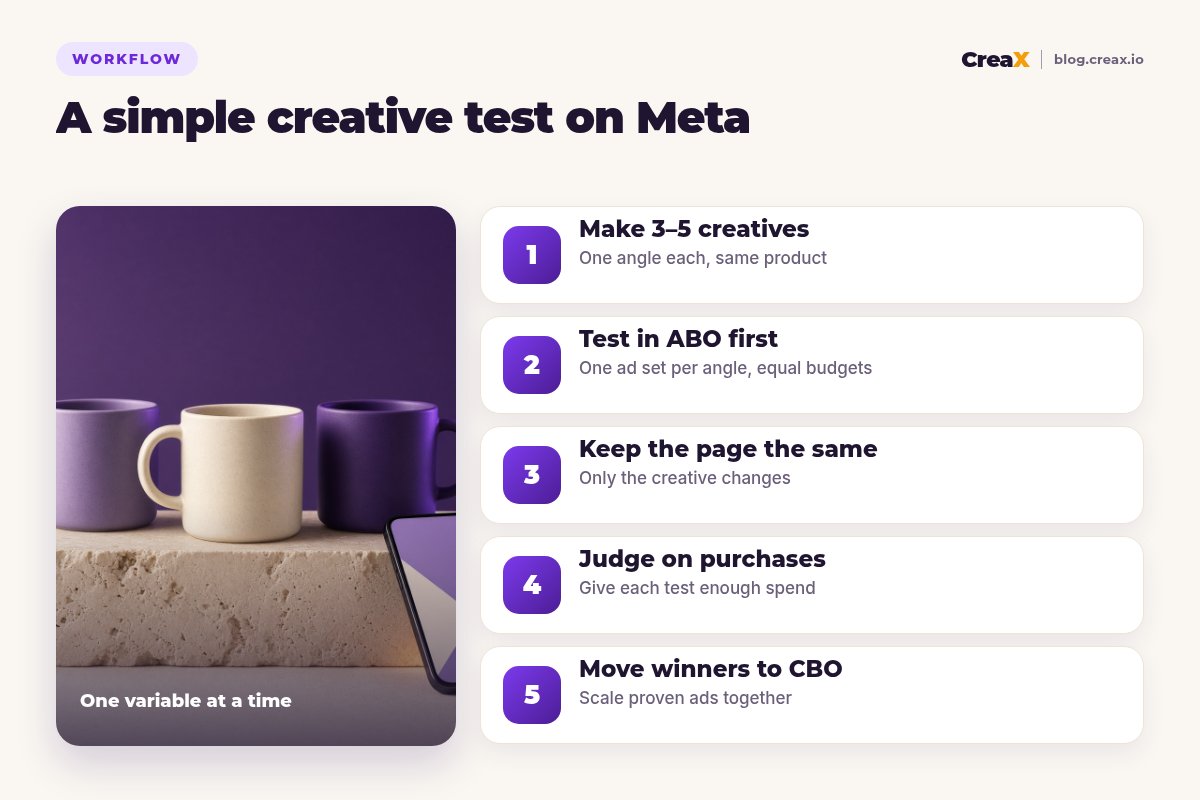
Say you sell a ceramic coffee mug that keeps drinks warm and want to find the best angle, then scale it. Only claim heat retention if you can prove it.
Make the creatives
Set up an ABO test
Judge on purchases
Move the winner to CBO
Keep feeding it
Name every ad clearly so you can trace results back to the angle; our guide to ad creative naming and tracking has a simple system.
Build the creatives for your next ABO test
Paste a product link and get studio ads, UGC-style video ads and a matching landing page in one pass.
Choose with confidenceDecision checklist
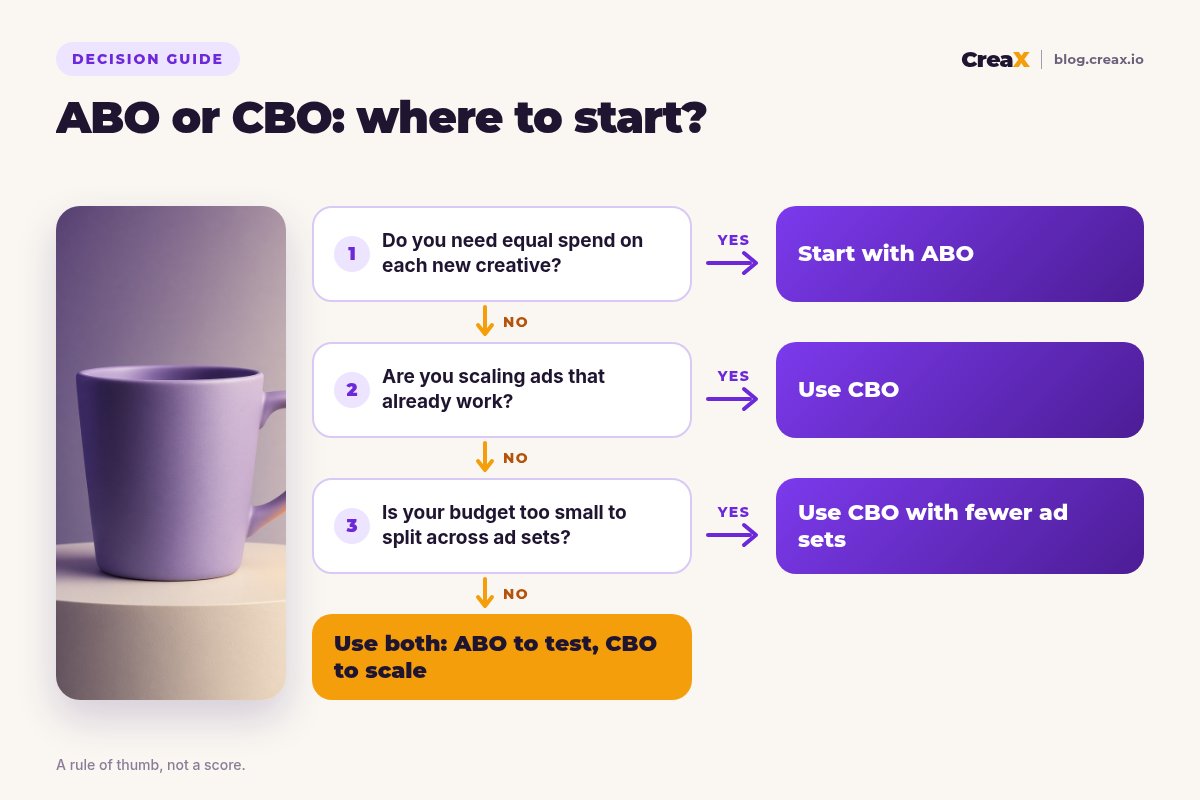
Answer these before you set up the campaign
- ✓Are you testing or scaling? Testing leans ABO; scaling leans CBO.
- ✓Do you need equal spend per angle? If yes, use ABO with one concept per ad set.
- ✓Is your budget small? Fewer ad sets, or CBO, so each one gets enough to learn.
- ✓Do you have clearly different creatives? If not, fix that before changing the budget setup.
- ✓Is the landing page the same across tests? Keep it fixed so the creative is the only variable.
- ✓Do you know your break-even cost per purchase? Decide it before you look at results.
Using both is a fair answer. ABO for testing new creatives and CBO for scaling the winners is a common, sensible structure. For more on the Meta side, see creatives for Meta Advantage+ campaigns.
FAQFrequently asked questions
Q.What is the difference between ABO and CBO?
Q.Is ABO or CBO better for testing creatives?
Q.Is CBO the same as Advantage+ campaign budget?
Q.Can I force CBO to spend on a new ad set?
Q.How many creatives should I test at once?
Q.Where does CreaX fit?
Ready for your next creative test?
One product link, about 60–120 seconds: studio ads, UGC-style video ads and a landing page for your next Meta campaign.
This guide is published by CreaX. Meta features are summarised from Meta's Business Help Center as of October 2026. Ad platform features and names change, so check Meta's current documentation before setting up campaigns.