
Why Is My Facebook Ad Stuck in Learning Limited?
by the CreaX team
In this guide
- The basicsWhat does Learning Limited mean?
- CausesWhy did my ad set get Learning Limited?
- ContextIs Learning Limited always bad?
- Don't panicShould I turn the ad set off?
- CreativeHow do creatives affect learning?
- BudgetHow does budget size matter?
- StructureWhen should I consolidate ad sets?
- Action planWhat should I try first?
- ExampleWorked example: a small store stuck in Learning Limited
- FAQFrequently asked questions
- Q.How long does Learning Limited last?
- Q.Does Learning Limited mean my ads are bad?
- Q.Will duplicating the ad set fix it?
- Q.Should I optimize for add to cart instead of purchase?
- Q.Does adding a new ad reset learning?
FAQ · Meta ads delivery
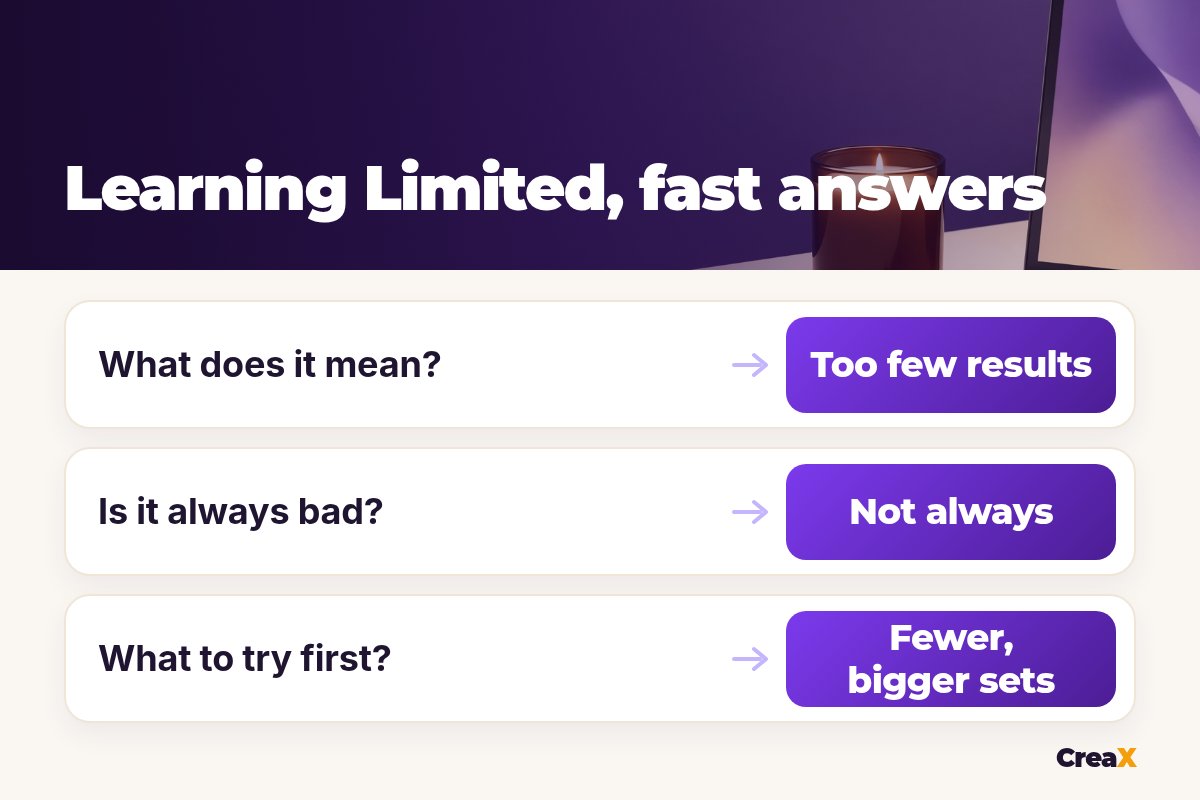
Seeing “Learning limited” next to your Facebook ad set is one of the most common worries in Meta Ads Manager. It sounds like a penalty, but it isn't. It means Meta doesn't expect the ad set to get enough results to finish learning with its current setup. Here is what Learning Limited really means, why ad sets get stuck there, and what to change, in order, before you start resetting everything.
By the CreaX team
Key takeaways
- ✓Learning Limited appears when an ad set is unlikely to get about 50 optimization events in the week after its last significant edit, according to Meta's help pages.
- ✓Meta says it isn’t a penalty. It is a sign that the setup is holding delivery back: too little budget, too small an audience, too rare an event or too many ad sets competing.
- ✓The usual fixes are structural: merge similar ad sets, broaden the audience, fund the ad set properly or optimize for a more frequent event.
- ✓Creatives matter too: fewer, stronger ads with clearly different angles give each ad set more to learn from than many near-copies.
In this guide
The basicsWhat does Learning Limited mean?
Every new ad set, and every ad set you edit in a big way, goes through a learning phase. During it, Meta's delivery system is still working out who to show your ads to and when. Meta's help pages say an ad set usually leaves learning once it delivers stably, which tends to happen after about 50 results in the week after its last significant edit. We explain the phase itself in our guide to the Meta learning phase.
Learning Limited is the status Meta shows in the Delivery column when it predicts that an ad set won't reach that point with its current setup. The count is of the event you optimize for. An ad set optimized for purchases is counted on purchases, not on clicks or add-to-carts.
CausesWhy did my ad set get Learning Limited?
Meta lists a handful of common causes. Most accounts have one or two of them at once:
| Cause | What it looks like | Typical fix |
|---|---|---|
| Low budget | Budget is small compared with your cost per result | Raise the budget or move it into fewer ad sets |
| Small audience | Tight interests, small countries, many exclusions | Broaden targeting or use broad audiences |
| Rare optimization event | Optimizing for purchases with few sales | Optimize for a more frequent event while you build volume |
| Low bid or cost control | A cost cap or bid cap set too low | Raise the cap or try lowest-cost bidding |
| Auction overlap | Several ad sets chasing the same people | Merge similar ad sets |
| Too many ads | Results spread thin across many ads | Run fewer, clearly different ads |
Causes and fixes as described in Meta's Business Help Center, October 2026.
Notice that most of these are about structure, not about one bad ad. The ad set simply can't collect enough results. If your ad sets are barely spending at all, that is a related but different problem, covered in why Facebook ads are not spending.
ContextIs Learning Limited always bad?
No. Meta itself says it isn't a penalty, and an ad set marked Learning Limited can still be profitable. If it brings sales at a cost you are happy with, you don't need to touch it just to clear the label.
It becomes a problem when results are unstable or too expensive and the status is a clue to why. A purchase campaign with a small daily budget and a high product price may never reach enough purchases in a week, so delivery stays guesswork. That is worth fixing.
⚖A label, not a verdict
Don't panicShould I turn the ad set off?
Usually not straight away. Turning it off and on, duplicating it, or making many edits in a row can each restart learning. Meta treats changes to targeting, creative or the optimization event, adding a new ad, changing the bid strategy and pausing for a week or more as significant edits, and large budget changes can count too.
Turn it off when it clearly loses money and you have a better structure ready to replace it. Otherwise, make one deliberate change, give it a few days, and judge it on results.
CreativeHow do creatives affect learning?
Creatives don't change the 50-event rule, but they change how fast you get there. An ad that stops the scroll and gets clicks from the right people brings results sooner, so the ad set learns faster. Weak or tired ads slow everything down.
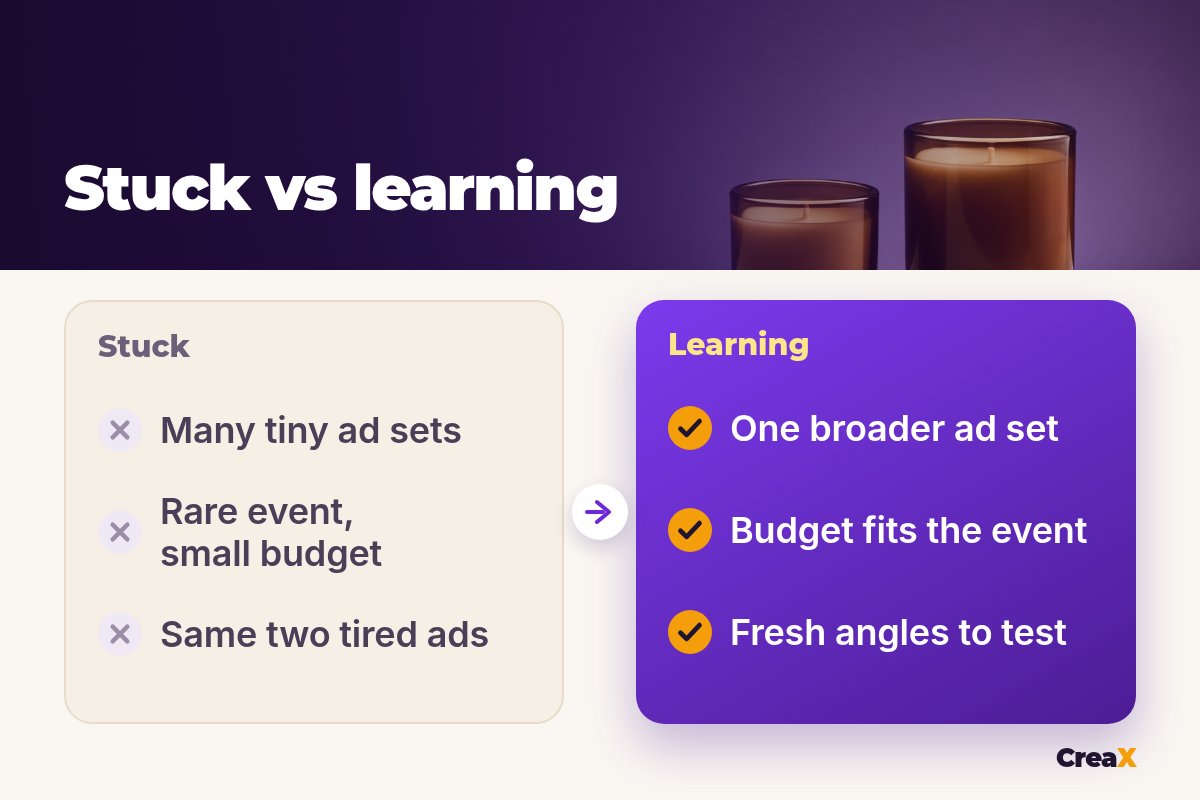
Two creative habits make Learning Limited more likely: running many near-identical ads that split a small budget, and keeping tired ads running long after they stopped working. Meta's newer delivery system also groups very similar ads together, which we cover in our Meta Andromeda explainer. A few ads with clearly different angles usually beat ten small variations.
Our guide on how many ad creatives to test per product has a simple starting point, and the creative fatigue checklist tells you when an ad has run its course.
Get fresh angles without a design team
Paste one product link and get studio ads in five styles, UGC-style video ads and a landing page in about 60–120 seconds.
BudgetHow does budget size matter?
Budget is the most common cause for small stores. If each purchase costs you a lot compared with your daily budget, the ad set simply can't collect many purchases in a week. Spreading the same budget across five ad sets makes it worse, because each one gets a fifth of the signal.
You have three honest options: put more budget behind fewer ad sets, optimize for an event that happens more often while you build volume, or accept the label while you test and judge on cost per result. Our guide to how much to spend per day when testing walks through how to size a test budget without guessing.
StructureWhen should I consolidate ad sets?
Consolidate when you have several ad sets with similar audiences, the same goal and small budgets. Merging them into one ad set, or into one campaign with campaign budget, gives Meta more results to learn from in one place and reduces auction overlap.
Keep things separate only when there is a real reason: a different country, a different offer or a test you want to read cleanly. Our comparison of ABO vs CBO for creative testing explains when each budget setup makes sense, and broad targeting on Meta covers why wider audiences often learn faster.
Action planWhat should I try first?
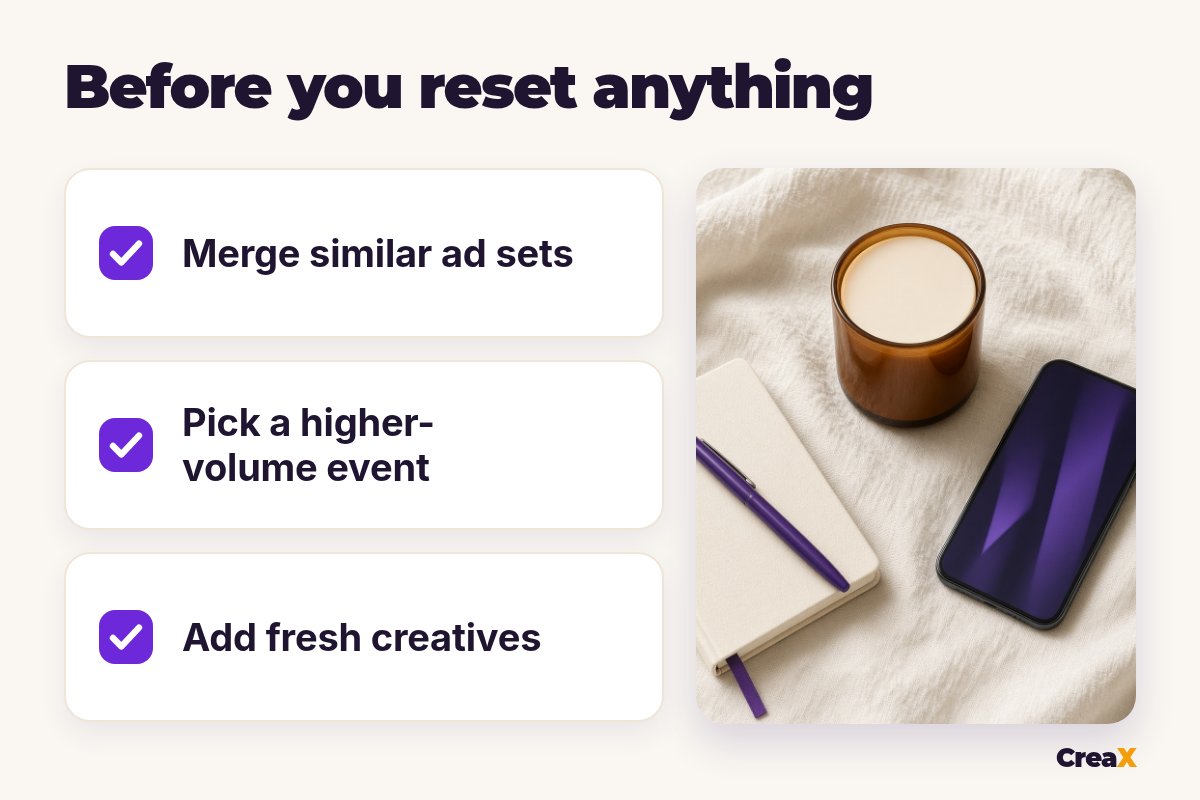
Work through these in order, one change at a time, and give each a few days:
Check if it is really a problem
Merge similar ad sets
Broaden the audience
Fix the budget or bid
Refresh the creatives
Pick a more frequent event if needed
!Don't change everything at once
ExampleWorked example: a small store stuck in Learning Limited
Say you sell an amber glass scented candle and run a purchase campaign with four ad sets: three interest groups and one lookalike, each with a small daily budget and the same two ads. All four show Learning Limited and costs jump around from day to day.
A calmer setup could be:
- One ad set with a broad audience in the same country, and the combined budget.
- Three clearly different angles: a cosy evening at home, a gift for a friend, and a close-up of the glass and scent.
- One change at a time: merge first, wait a few days, then swap the creatives.
For the new angles, a tool like CreaX can turn the candle's product link into studio ads and UGC-style video ads, so you have fresh options without a photoshoot. If the ad set learns but still doesn't sell, the problem may be further down the funnel; our guide to Facebook ads that are not converting covers the next checks.
Feed your ad set better creatives
Get several different angles from one product link: studio ads, UGC-style video ads and a matching landing page.
FAQFrequently asked questions
Q.How long does Learning Limited last?
Q.Does Learning Limited mean my ads are bad?
Q.Will duplicating the ad set fix it?
Q.Should I optimize for add to cart instead of purchase?
Q.Does adding a new ad reset learning?
Ready for fewer, stronger ads?
One product link, about 60–120 seconds, and you have studio ads, UGC-style video ads and a landing page to test.
This guide is published by CreaX. We describe other tools from their own public websites, last checked October 2026, avoid invented scores or prices, and recommend checking each vendor's site for current features and plans.
Your next campaign starts with a link.
Paste a product link and get UGC video ads, ad images and a landing page — everything in under 60 seconds.
Start creating