
What Is Hold Rate in Video Ads and How Do You Improve It?
by the CreaX team
In this guide
- DefinitionWhat is hold rate?
- The formulaHow is hold rate calculated?
- Set up a simple hold rate sheet
- Two gatesHold rate vs hook rate
- BenchmarksWhat is a good hold rate?
- CausesWhy do viewers drop off?
- FixesHow to improve hold rate
- LengthDoes video length matter?
- FatigueWhen to refresh the ad
- ExampleWorked example: a skincare jar
- FAQFrequently asked questions
- Q.What is hold rate in simple terms?
- Q.Is hold rate a Meta Ads Manager column?
- Q.What is the difference between hook rate and hold rate?
- Q.Should I divide by impressions or 3-second views?
- Q.Does a high hold rate mean more sales?
- Q.How can I test more versions?
FAQ · Video ad metrics
Hold rate tells you how many people keep watching your video ad after the hook has done its job. A great first second gets attention; hold rate shows whether the rest of the video earns it. This guide explains what hold rate means, common ways media buyers calculate it, how it differs from hook rate, and practical fixes that keep viewers watching long enough to see your product and offer.
By the CreaX team
Key takeaways
- ✓Hold rate measures how many viewers keep watching past the opening of a video ad, usually compared with impressions or with people who watched the first few seconds.
- ✓There is no single official formula. Teams commonly use ThruPlays or a longer view (such as 15-second views) divided by impressions or by 3-second views. Pick one and stick with it.
- ✓Hook rate is the first gate, hold rate the second. A high hook rate with a low hold rate means the opening works but the middle loses people.
- ✓Most fixes are creative: show the product early, cut slow moments, promise a payoff and add clear captions. Then test one change at a time.
In this guide
DefinitionWhat is hold rate?
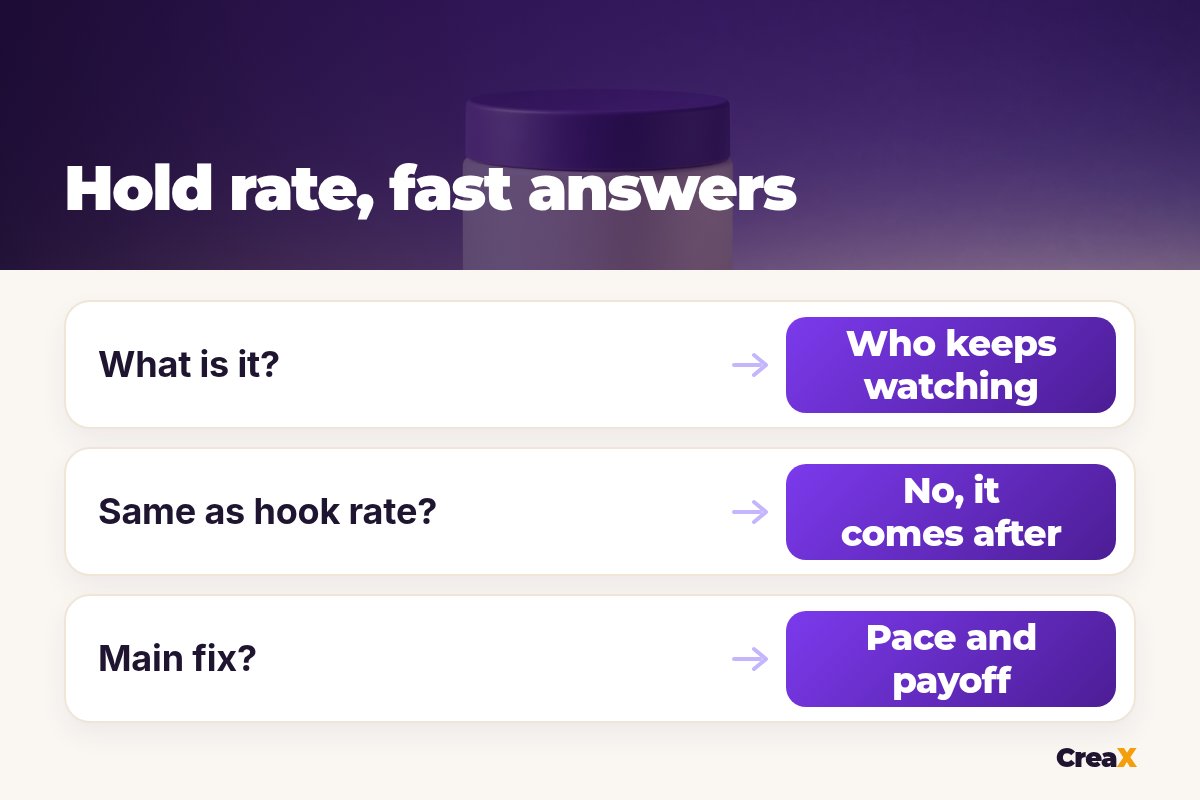
Hold rate is a video ad metric that shows how well your ad keeps attention after the first few seconds. Where hook rate asks "did they stop scrolling?", hold rate asks "did they stay?". It's not a standard column name in every ad platform; it's a metric media buyers build from the video data platforms already report, such as views at different lengths and completed plays.
It matters because most product videos need time to work. The product, the problem it solves, the proof and the offer rarely fit into the first second. If viewers leave before those moments, the ad can't sell, however good the hook was.
The formulaHow is hold rate calculated?
There is no single official formula, so it helps to know the common versions and choose one for your team:
| Common method | How it works | What it tells you |
|---|---|---|
| ThruPlays ÷ impressions | Plays to completion (or a set length) divided by impressions | How much of all your reach stayed |
| ThruPlays ÷ 3-second views | Long views divided by people who got past the hook | How well the middle holds hooked viewers |
| 15-second views ÷ 3-second views | A fixed longer view divided by hooked viewers | A simple, comparable hold check |
Common ways media buyers calculate hold rate. Metric names and definitions vary by platform, so check your ads manager's own definitions.
Dividing by 3-second views separates hold from hook, which makes it easier to see which part of the video needs work. Dividing by impressions mixes both, which is useful for an overall picture. Whatever you choose, use the same method for every ad you compare.
★Be consistent
Set up a simple hold rate sheet
You don't need special software. In your ads manager, add the video columns you need (impressions, 3-second views or video plays, ThruPlays, and a longer view such as 15-second views if your platform offers it) and export them per ad. In a sheet, add two columns: hook rate and hold rate, each with the formula your team agreed on.
- One row per ad, not per campaign, so each creative gets its own numbers.
- Note the length and placement next to each ad, because an 18-second Story and a 45-second feed video behave differently.
- Add the result column you care about most, such as purchases or cost per purchase, so hold rate never gets read alone.
- Wait for enough data before you judge. A handful of impressions can swing any ratio.
Once a week, sort by hold rate and look at the top and bottom videos side by side. The patterns, such as when the product appears, how fast the cuts are and whether captions are readable, usually tell you more than the number itself.
Two gatesHold rate vs hook rate
Hook rate is usually 3-second views divided by impressions: did the opening stop the scroll? Our guide on what hook rate is covers it in detail. Hold rate comes next: of the people you hooked, how many stayed?
| Pattern | What it usually means | Where to work |
|---|---|---|
| High hook, low hold | The opening works, the middle loses people | Pacing, payoff, product shown earlier |
| Low hook, high hold | Few stop, but those who do stay | A stronger first second |
| Low hook, low hold | The concept isn't landing | A new angle, not small edits |
| High hook, high hold | The video holds attention | Check the offer and the landing page |
Patterns to read together, not fixed rules.
If your hook is the weak part, start with these UGC ad hooks that stop the scroll.
BenchmarksWhat is a good hold rate?
We don't publish a benchmark number, and you should be careful with any you find. Hold rate depends heavily on the formula, the video length, the placement (feed, Stories, Reels), the audience and the product. A 15-second Story ad and a 45-second feed video simply aren't comparable.
The useful question is: is this ad holding better or worse than my other ads, measured the same way? Compare new creatives against your current best, and look at hold rate together with clicks, cost per result and sales. A video that holds well but doesn't sell still needs work on the offer or the page.
CausesWhy do viewers drop off?
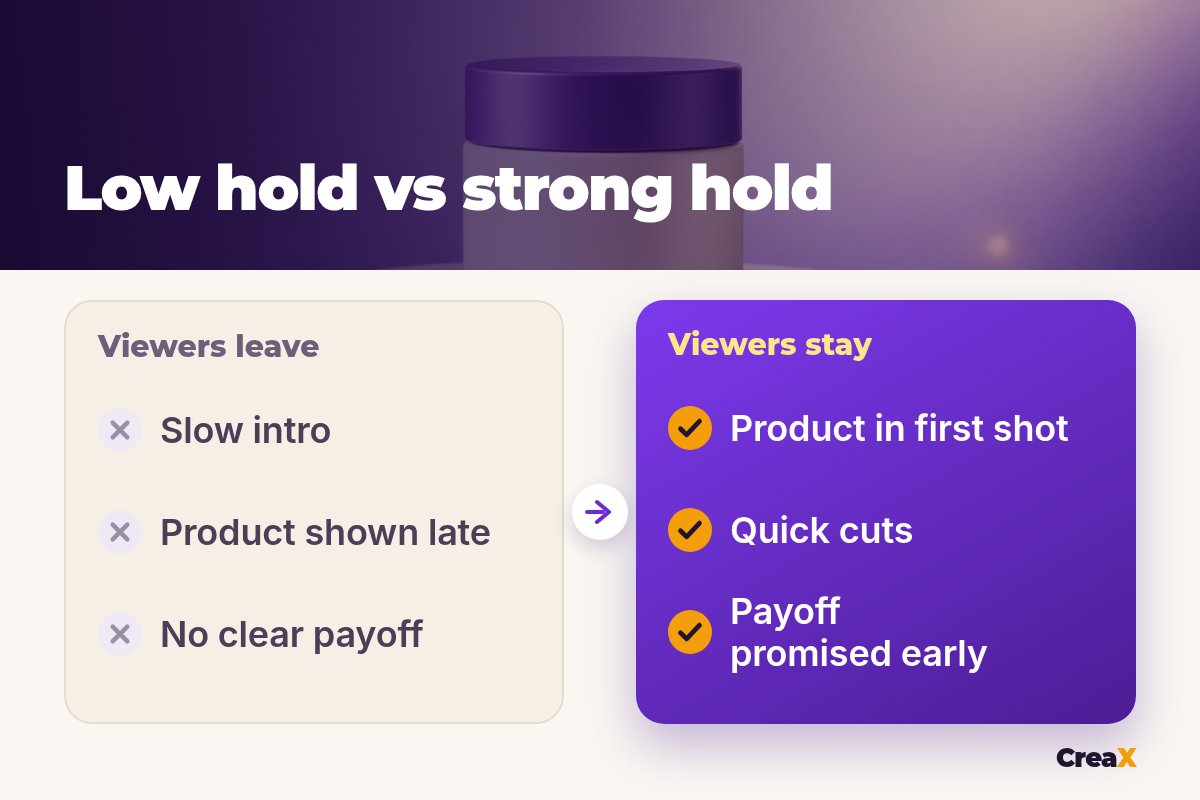
- A slow start after the hook. A logo intro, a long setup or a pause right after a strong opening.
- The product shows up late. Viewers don't know what is being sold, so they leave.
- No reason to keep watching. The video never promises a payoff, like a result, a reveal or an answer.
- Hard to follow without sound. Many people watch muted; without captions the story is lost.
- Too long for the message. Filler shots between the useful moments.
- The hook and the video don't match. The opening promises one thing, the rest talks about another.
FixesHow to improve hold rate
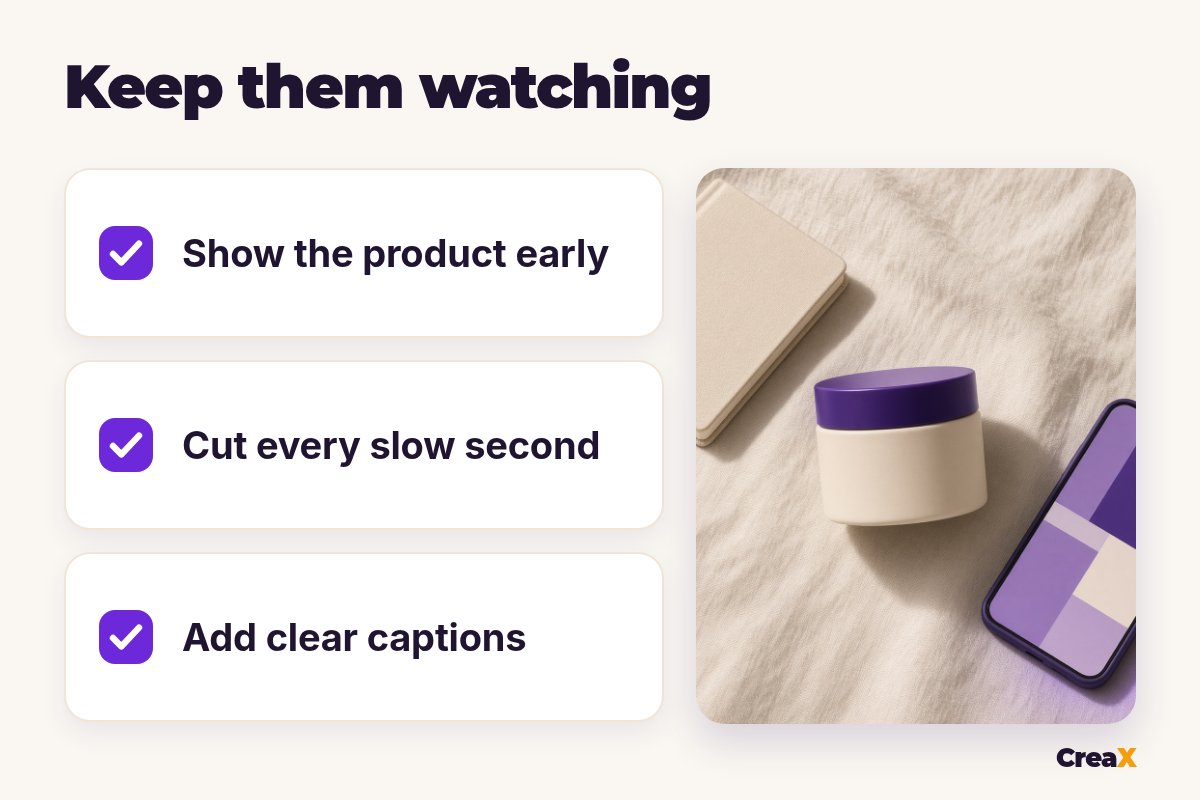
Show the product in the first shots
Promise a payoff early
Cut every slow second
Add clear captions
Test one change at a time
Captions are one of the easiest wins; our guide on whether video ads need subtitles explains why. Making several versions quickly also helps: CreaX turns a product link into UGC-style video ads of 18, 30 or 45 seconds, so you can test different angles and lengths without filming each one.
Test more video angles, faster
Paste a product link and get UGC-style video ads, studio ads and a landing page in about 60–120 seconds.
LengthDoes video length matter?
Yes, but shorter isn't always better. A shorter video makes it easier to hold viewers to the end, while a longer one has room for proof and detail. The right length is the shortest one that still tells the whole story. Our guide on how long a video ad should be goes through it by placement and goal.
A practical test is to run the same angle at two lengths, for example 18 and 30 seconds, and compare hold rate and results side by side.
FatigueWhen to refresh the ad
If hold rate on a good ad slowly drops while frequency rises, your audience may have seen it too often. That's a sign to bring in new angles, not to tweak the same video forever. See these signs of ad creative fatigue to know when it's time.
iHold rate is a creative signal
ExampleWorked example: a skincare jar
Say you sell a moisturiser in a jar and your video ad has a strong hook but viewers leave soon after. Here's how you might work through it:
| Step | What you change | What you look for |
|---|---|---|
| 1 | Move the product shot to right after the hook | Better hold, same hook |
| 2 | Add a payoff line: "see the texture at the end" | More viewers reach the end |
| 3 | Cut the slow intro and add captions | Fewer drop-offs in the middle |
| 4 | Test a shorter version | Compare hold and sales by length |
A process example, not a results benchmark.
Compare every version against the original, measured the same way, and keep the one that holds better and sells.
FAQFrequently asked questions
Q.What is hold rate in simple terms?
Q.Is hold rate a Meta Ads Manager column?
Q.What is the difference between hook rate and hold rate?
Q.Should I divide by impressions or 3-second views?
Q.Does a high hold rate mean more sales?
Q.How can I test more versions?
Make your next video test easier
One product link, about 60–120 seconds, and you have UGC-style video ads, studio ads and a landing page to test.
This guide is published by CreaX. We describe other tools from their own public websites, last checked October 2026, avoid invented scores or prices, and recommend checking each vendor's site for current features and plans.
Your next campaign starts with a link.
Paste a product link and get UGC video ads, ad images and a landing page — everything in under 60 seconds.
Start creating