
How Long Should a Video Ad Be on TikTok and Meta?
FAQ · Video ad length
How long should a video ad be? For most ecommerce ads on TikTok and Meta, shorter than you think, but not as short as possible: long enough to hook, show the product and make one clear offer. TikTok allows in-feed ads of 5 to 60 seconds and recommends 21–34 seconds; Meta allows far longer videos, but feed viewers decide in seconds. Here's how to pick a length by platform and goal, and how to structure 15, 30 and 60-second ads.
Updated October 2026 · By the CreaX team
Key takeaways
- ✓There's no single perfect length. Fit the length to the job: one idea in about 15 seconds, hook-demo-offer in about 30, story and objections in up to 60.
- ✓TikTok's own guidance: in-feed ads run 5–60 seconds, with 21–34 seconds recommended, and your proposition in the first 3 seconds.
- ✓On Meta, placements allow long videos, but the same rule holds: product and reason to care up front, captions on, one call to action.
- ✓Don't guess: once an angle works, cut the same ad to two lengths and compare cost per purchase.
In this guide
TL;DRThe short answer
For a typical ecommerce product ad, start with a 15–30 second cut. That's long enough to stop the scroll, show the product doing its job and make the offer, and it sits close to the 21–34 seconds TikTok recommends for in-feed ads. Go longer only when the extra seconds do real work: answering an objection, showing a process, or telling a short story that sells.
Length is a consequence, not a goal. A tight 40-second demo can outperform a padded 15-second ad. What matters is how quickly the ad gets to the point and whether every second earns its place.
Platform limitsWhat TikTok and Meta allow
Before deciding what's best, know what's allowed. These are the published limits and recommendations at the time of writing:
| Placement | Allowed length | Practical note |
|---|---|---|
| TikTok In-Feed ads | 5–60 seconds | TikTok recommends 21–34 seconds |
| Facebook Feed | Up to 241 minutes | Keep it short; feed viewers scroll fast |
| Facebook Stories | Up to 2 minutes | Vertical, quick, sound-on and captions |
| Instagram Feed and Stories | Up to 60 minutes | Vertical or 4:5, product early |
From TikTok and Meta help pages, October 2026. Specs change: check them before you export.
In other words, the platforms rarely stop you from running a long ad. The limit that matters is the viewer's thumb. TikTok's tips put it plainly: length should make sense for the message, but overall, shorter videos perform better.
Question 1Is shorter always better?
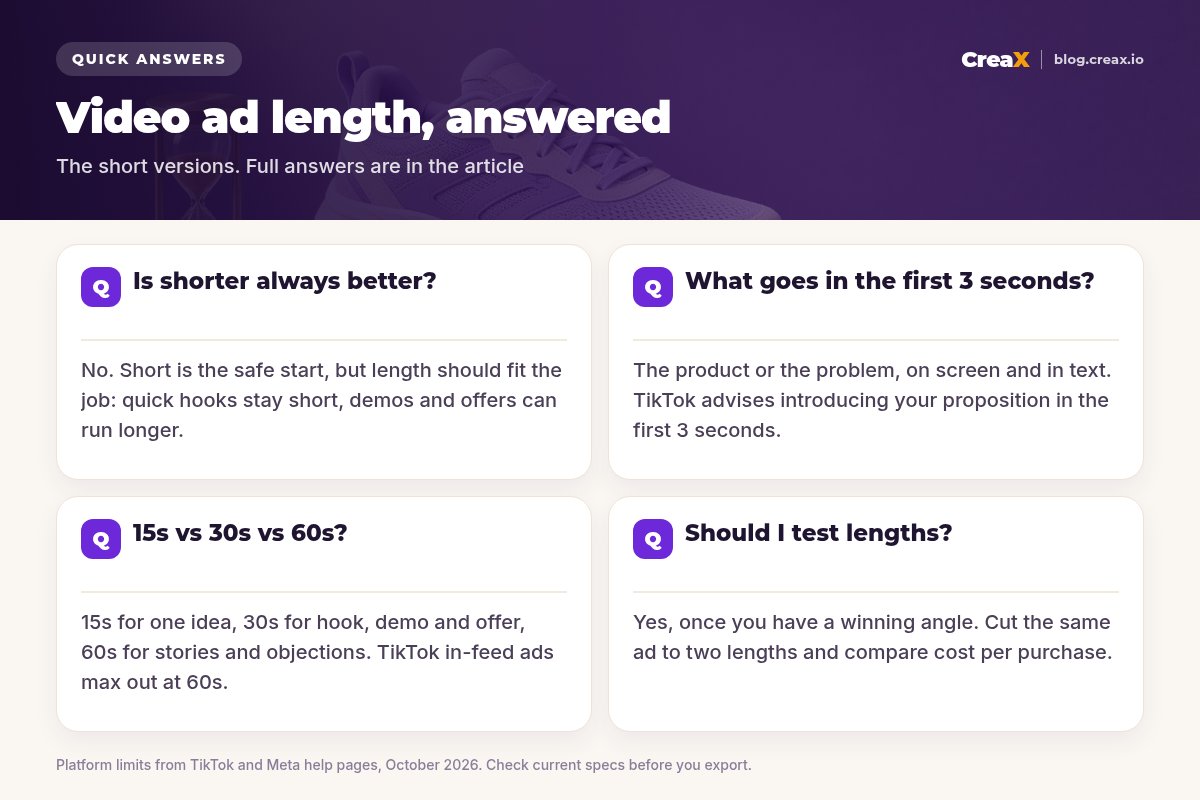
No. Shorter is the safer starting point, but cutting for the sake of cutting can remove the parts that sell. Think about what the viewer needs to believe before they click:
- Impulse, obvious products (a phone grip, a lint remover): one demo is enough. 10–20 seconds can do it.
- Products that need a demo (a kitchen tool, a running shoe's cushioning): show the problem, the product in use and the result. Around 20–40 seconds.
- Higher-priced or unfamiliar products: buyers have objections (fit, quality, shipping, returns). A longer ad that answers them can be worth it, up to the TikTok limit of 60 seconds.
⚖Honest take
Question 2What goes in the first 3 seconds?
TikTok's creative best practices recommend introducing your content proposition in the first 3 seconds and prioritizing the hook within the first 6. Whatever the total length, the opening decides whether anyone sees the rest. Good openings for product ads:
- The product in action: the sneaker hitting the pavement, not a logo.
- The problem, visually: sore feet after a long run, a cluttered desk, a tangled cable.
- A specific, true statement: “The running shoe I grab for long runs” works better than “You won't believe this.”
- Text on screen: a short line that states the angle, readable at a glance. TikTok suggests 5–10 words per second when you use text.
Avoid slow logo intros, scenic pans and presenters who warm up before getting to the point. If your ads get views but no clicks, the opening and the angle are the first things to check. Our guide to TikTok ads with views but no sales covers the next steps.
Question 315s vs 30s vs 60s: how to structure each
Here are simple structures for each length. Treat the timings as a guide for pacing, not a rule:
| Length | Structure | Best for |
|---|---|---|
| About 15 seconds | 0–3s hook with product • 3–11s one demo or benefit • 11–15s offer and CTA | One idea, retargeting, simple products |
| About 30 seconds | 0–3s hook • 3–20s demo and 2–3 benefits • 20–26s proof (real reviews, guarantee) • 26–30s offer and CTA | Most cold-traffic product ads |
| Up to 60 seconds | 0–3s hook • 3–40s story or problem → solution with demo • 40–52s objections (fit, shipping, returns) • 52–60s offer and CTA | Higher-priced or unfamiliar products |
Illustrative pacing. Adjust to your product, and keep the product on screen most of the time.
Notice that all three lengths share the same skeleton: hook, product, reason to buy, call to action. Longer versions add proof and objection handling; they don't add a slower start.
Get video ads you can cut to any length
Paste a product link and get UGC-style video ads, studio creatives and a matching landing page for your next test.
Question 4Which length for which goal?
The campaign goal changes what the ad has to do, and therefore how long it needs to be:
- Cold traffic, conversion campaigns: 15–30 seconds is a sensible default. The ad has to introduce the product, the angle and the offer to people who've never seen you.
- Retargeting: viewers already know the product. Short reminders (around 10–15 seconds) with the offer, a review or a guarantee often make sense.
- Unfamiliar or premium products: longer explainers (30–60 seconds) can carry the extra proof buyers need.
- Meta campaigns using automated placements: provide versions that fit vertical placements well and keep the key message early, since the same ad can show in Feed, Stories and Reels. Our guide to Advantage+ creatives covers feeding Meta enough variety.
Question 5Should I test lengths?
Yes, but only once you have an angle that works. Testing length before you've found a good angle just measures which version of a weak ad is less weak. A simple length test:
Start from a winning angle
Cut two lengths from one master
Run them side by side
Judge on cost per purchase
Keep the winner, then test the next variable
How many versions should you run at once? TikTok suggests 3–5 different creatives per ad group. For a fuller structure, see our guide to how many ad creatives to test per product.
Before you exportChecklist you can copy
Video ad length pre-flight
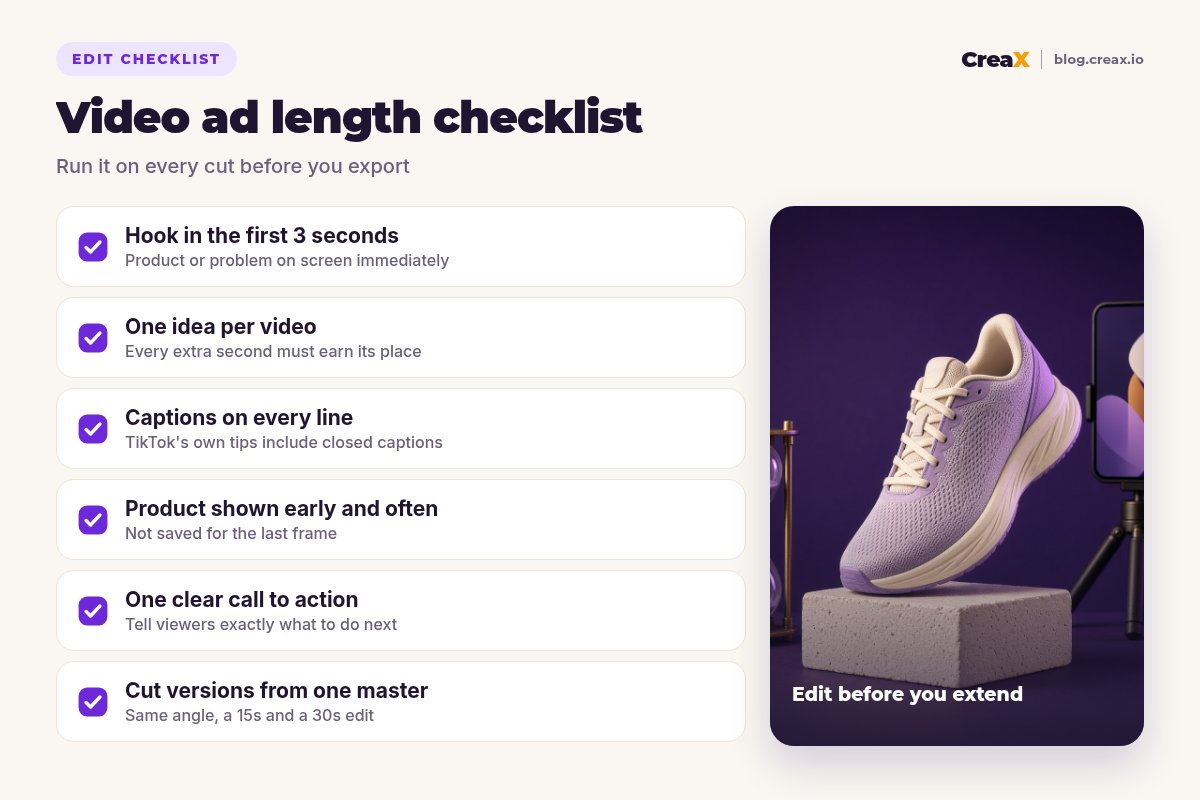
- ✓Proposition clear in the first 3 seconds
- ✓No logo intro or slow warm-up
- ✓One angle per video
- ✓Product on screen early and most of the time
- ✓Captions or text overlays on key lines
- ✓Every second earns its place (cut anything that doesn't)
- ✓Offer and one clear call to action at the end
- ✓Within the placement's allowed length
- ✓Same promise and offer on the landing page
What goes wrongCommon mistakes to avoid
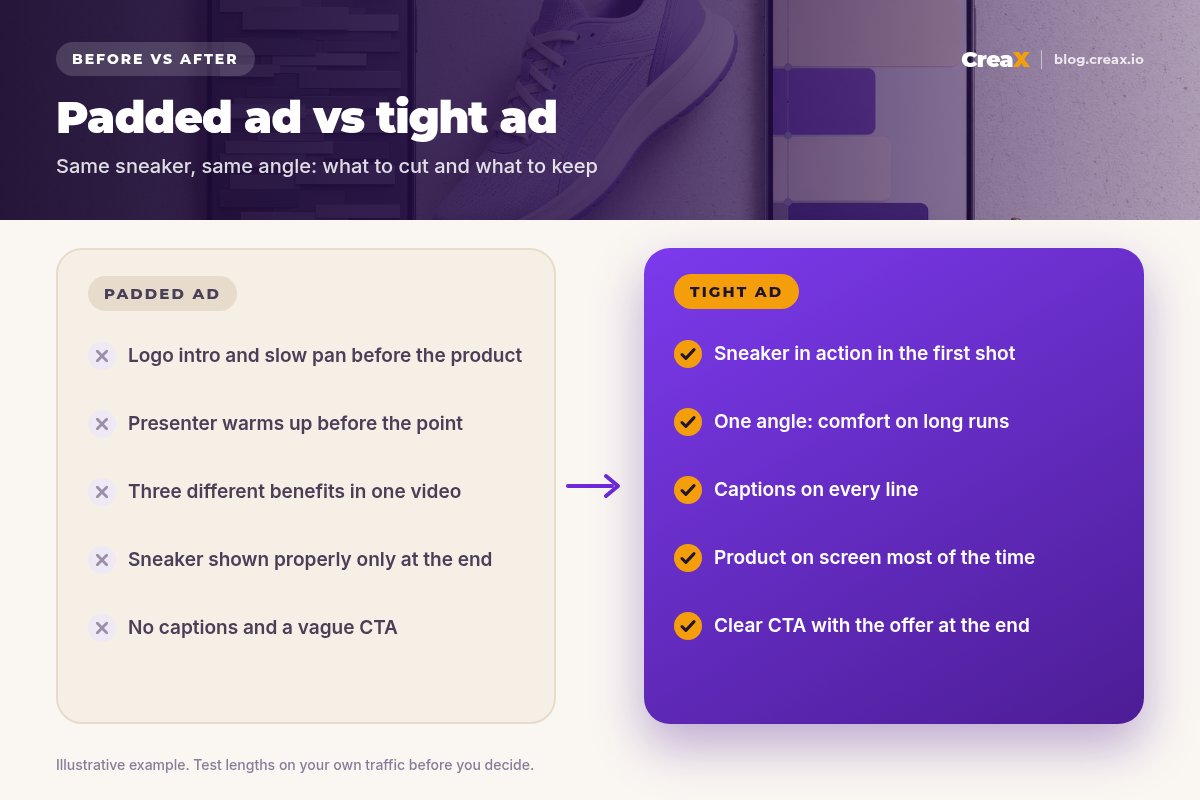
- Padding the start. Logos, pans and “Hey guys!” cost the seconds that matter most.
- Three angles in one ad. Comfort, style and price in one video means none of them lands. Make three ads.
- Saving the product for the end. If viewers leave early, they never saw what you sell.
- Cutting the proof. For pricier products, removing the objection-handling to hit 15 seconds can cost sales.
- Running one length forever. Fatigue hits every ad. Fresh cuts and angles keep results steady; see our guide to signs of ad creative fatigue.
!Keep claims honest at any length
Where we fitHow CreaX helps (briefly)
CreaX is an all-in-one AI ecommerce creative OS. Paste a product link or upload a product image and, in about 60–120 seconds, you get UGC-style video ads, studio ad creatives, a publish-ready landing page and a multi-tenant store. For length testing, that means you start from several video drafts built around the product instead of a blank timeline, and the landing page repeats the same promise whichever cut wins.
Plans start at $4.99 a month for 2,000 credits, with top-ups at $1 per 500 credits. Review every draft, and its claims, before it goes live. If you're new to the format, our FAQ on what a UGC video ad is explains why native-looking videos fit TikTok and Reels so well.
Build your next video ad test in about two minutes
One product link or image: UGC-style video ads, studio creatives and a landing page that tell the same story.
FAQMore questions sellers ask
Q.What is the ideal TikTok ad length?
Q.How long should a Facebook or Instagram video ad be?
Q.Is a 6-second ad too short?
Q.Do longer videos hurt ad performance?
Q.Should I make separate videos for TikTok and Meta?
Q.How much does CreaX cost?
Ready to test video ad lengths on your product?
Paste a product link and get UGC-style video ads, studio creatives and a matching landing page in about 60–120 seconds.
This guide is published by CreaX. We describe other tools from their own public websites as of October 2026, avoid invented scores or prices, and recommend checking each vendor's site for current features and plans.