
What Is Incrementality Testing in Ads and Do Online Stores Need It?
by the CreaX team
In this guide
- DefinitionWhat is incrementality testing?
- ReportingWhy is platform ROAS not enough?
- MethodWhat is a holdout test?
- MethodWhat is a geo test?
- ChooseDo small stores need incrementality testing?
- Step by stepHow can a small store test it simply?
- AvoidWhat are the common mistakes?
- CreativesWhere do creatives fit in?
- ExampleWorked example: a home decor store
- FAQFrequently asked questions
- Q.What is incrementality in simple terms?
- Q.Is incrementality the same as ROAS?
- Q.What is a lift study?
- Q.How long should a test run?
- Q.Can I test incrementality without special tools?
- Q.Can CreaX measure incrementality?
FAQ · Measuring ads for online stores
Incrementality testing asks one simple question: would this sale have happened without the ad? Ad platforms credit sales to ads that people clicked or saw, but some of those buyers were coming anyway. An incrementality test compares people or places that saw your ads with similar ones that didn't, so you can see what the ads really added. This guide explains incrementality in plain words, how holdout and geo tests work, why platform ROAS can overstate results, and how a small online store can test it simply.
By the CreaX team
Key takeaways
- ✓Incrementality is the extra sales your ads cause, compared with what would have happened without them.
- ✓Platform reports credit sales that happened after an ad interaction. That's useful, but it can include buyers who would have bought anyway.
- ✓A test needs a control group: people, regions or periods that don't see the ads, compared with similar ones that do.
- ✓Small stores can start simply: compare total sales and MER when ads run and when they pause, change one thing at a time, and keep the comparison fair.
In this guide
DefinitionWhat is incrementality testing?
Every store has some sales that would happen with no ads at all: loyal customers, word of mouth, people who search for your brand. Incremental sales are the ones on top of that baseline, the sales your ads actually caused.
An incrementality test measures that difference. You split your audience, regions or time into a group that sees the ads and a similar control group that doesn't, then compare results. If both groups buy at about the same rate, the ads added little. If the exposed group buys clearly more, the gap is the lift your ads created.
It's the same idea as a medical trial: you only learn what the treatment does by comparing it with a group that didn't get it. Our guide to ROAS vs ROI in ecommerce explains the profit side of the same question.
ReportingWhy is platform ROAS not enough?
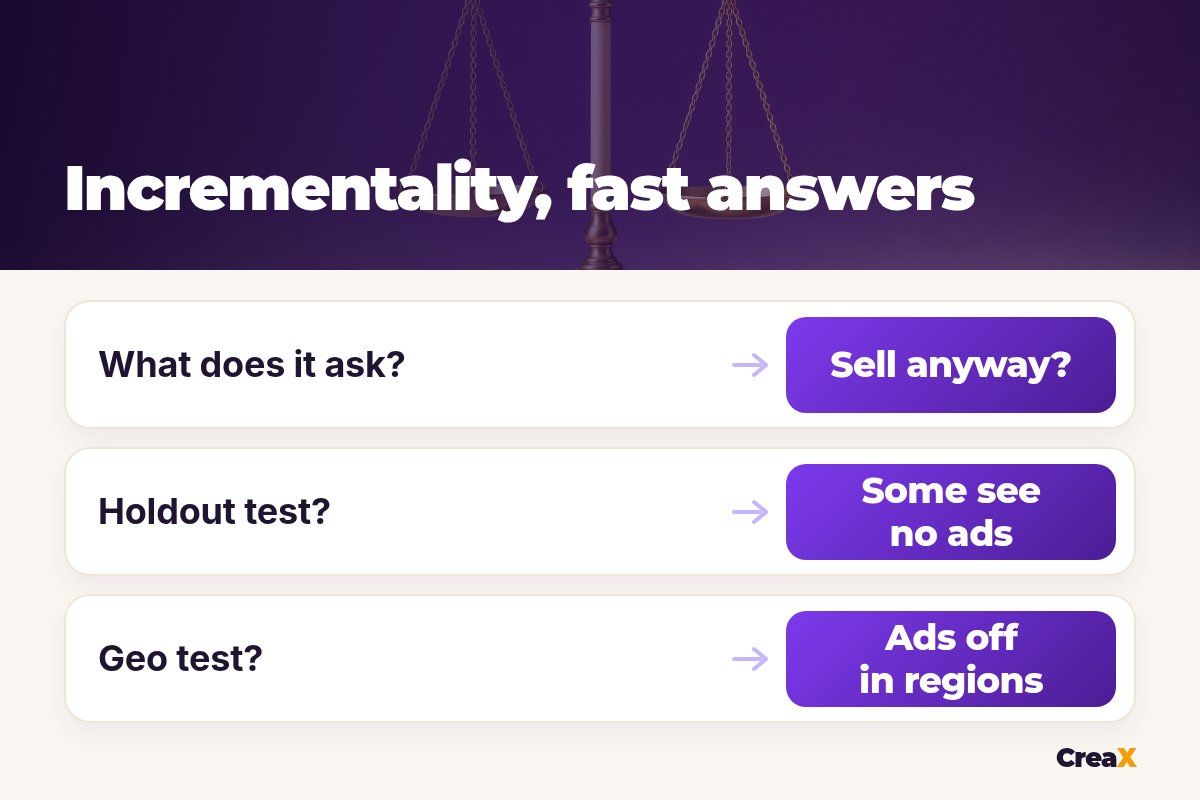
Ads Manager and other platforms report sales that happened within an attribution window after someone clicked, viewed or engaged with an ad. That's credit, not proof of cause. Several things can make credited sales look bigger than the real effect:
- People who were buying anyway. A loyal customer sees a retargeting ad, then buys as planned. The ad gets the credit.
- View-through credit. Someone scrolls past an ad and buys later for other reasons.
- Several channels claim the same sale. Meta, Google and email can each count one order in their own reports.
- Retargeting warm audiences. These often show high ROAS because the people were already close to buying.
That's why the attribution setting changes the numbers so much; our guide on the attribution window in Meta Ads explains it, and what a good ROAS is covers how to read the number. Incrementality testing is a way to check whether credited sales are also caused sales.
★Platforms know this too
MethodWhat is a holdout test?
In a holdout test, a random part of your target audience is held back and doesn't see your ads. Everyone else sees them as usual. Because the split is random, the two groups are alike, so the difference in purchases between them shows what the ads added.
Platform lift studies usually work this way, with the platform doing the split and reporting the lift. The strength of a holdout is that randomisation makes the comparison fair. The catch is that it needs enough people and conversions in both groups to tell a real difference from noise.
MethodWhat is a geo test?
A geo test splits by place instead of by person. You run ads in some regions or cities and pause them in similar ones, then compare sales in your own store data. It doesn't depend on tracking individuals, which makes it useful when tracking is limited.
The hard part is choosing regions that behave alike, so pick areas with similar past sales, and keep everything else (prices, emails, promotions) the same in both.
| Test type | How it splits | Good for | Watch out for |
|---|---|---|---|
| Holdout | Random people see no ads | Fair comparison inside one platform | Needs enough conversions |
| Geo test | Some regions see no ads | Checking with your own store data | Regions must be alike |
| On/off test | Some periods have no ads | Very small budgets | Seasons and other changes |
A simplified overview of common approaches, not a results benchmark.
ChooseDo small stores need incrementality testing?
Not in a formal, lab-grade way, at least not at first. Formal tests need volume, and a store with a handful of orders a day may not get a clear answer. But every store benefits from the habit behind it: asking whether the ads cause sales, not just whether they get credit.
It matters most when you spend a lot on retargeting or branded search, when platform ROAS looks great but total sales don't move, or when you are deciding whether to scale a channel. In those cases, even a simple test can save a lot of budget.

Incrementality also changes how you read other numbers. If part of your ad-attributed sales would have happened anyway, your true cost to win a new customer is higher than the dashboard suggests; our guide to what CAC is in ecommerce explains how to work it out from your own store data. In the same way, a customer who keeps coming back is worth more over time, so it helps to know what LTV is and how creatives raise it before you judge a channel on its first order alone.
Think of incrementality, MER, CAC and LTV as a set. Platform reports tell you what each campaign claims. Your store data tells you what really happened. Tests tell you which of those claims to trust. None of them is perfect alone, but together they give you a far clearer picture than a single ROAS figure, and they help you decide where the next euro, dollar or dirham of budget should go.
Step by stepHow can a small store test it simply?
Start from total sales
Pick one question
Create a control
Compare and decide
Clean data helps any test: if your website sends incomplete events, platform reports drift further from reality, so it's worth reading what the Meta Conversions API is.
AvoidWhat are the common mistakes?
Mistakes to avoid
- ✓No real control: comparing this month with last month isn't a test if prices or seasons changed.
- ✓Too short: a few days rarely tells signal from noise.
- ✓Changing several things: if you pause ads and launch a sale at once, you can't tell what did what.
- ✓Reading only platform numbers: the point is to check them against your own store data.
- ✓Ignoring profit: a lift that doesn't cover the ad cost isn't a win.
Give every test better creatives
Paste one product link and get UGC-style video ads, studio ads and a landing page in about 60–120 seconds.
CreativesWhere do creatives fit in?
Incrementality tells you whether ads add sales. Creatives decide how much they can add. Prospecting ads that reach new people with a strong hook tend to be where real lift comes from, because those buyers weren't coming anyway.
That's where CreaX helps. It doesn't run your ads, connect to your ad account or measure results. It makes the creatives you test: paste a product link and get UGC-style video ads of 18, 30 or 45 seconds, studio ads in five styles and four sizes, and a matching landing page, in about 60–120 seconds.
ExampleWorked example: a home decor store
Say you run a home decor store and your retargeting campaign shows a very high ROAS in Ads Manager. You wonder whether those buyers would have come back on their own.
You pause retargeting in half of your regions for a few weeks and keep it running in the other half, with the same prices, emails and promotions everywhere. Then you compare total orders per region against the weeks before. If the paused regions sell about as much as before, much of that retargeting credit wasn't incremental, and you can move budget to prospecting with new creatives. If sales drop clearly where it was paused, retargeting was earning its place.
Either way, you've learned something platform ROAS alone couldn't tell you, and you can make the next budget decision with more confidence.
⚖Where CreaX fits
FAQFrequently asked questions
Q.What is incrementality in simple terms?
Q.Is incrementality the same as ROAS?
Q.What is a lift study?
Q.How long should a test run?
Q.Can I test incrementality without special tools?
Q.Can CreaX measure incrementality?
Ready to test your next product?
One product link, about 60–120 seconds, and you have UGC-style video ads, studio ads and a landing page for your next test.
This guide is published by CreaX. We describe other tools from their own public websites, last checked October 2026, avoid invented scores or prices, and recommend checking each vendor's site for current features and plans.
Your next campaign starts with a link.
Paste a product link and get UGC video ads, ad images and a landing page — everything in under 60 seconds.
Start creating