
How to Write Product Page Copy That Converts
How-to · Product page copy
Good product page copy doesn't describe the product; it answers the buyer's question: “why should I buy this, and why now?” This guide shows you how to write product page copy that converts in five steps: find the core promise, turn features into benefits, answer objections, write the offer and edit for scanning, with a full before/after example.
Updated October 2026 · By the CreaX team
Key takeaways
- ✓Start with one core promise: the outcome your buyer wants, in their words. Every other line on the page supports it.
- ✓Turn each feature into a benefit with a simple chain: feature → so what → proof.
- ✓Answer the top objections (price, shipping, returns, fit, “will it work for me?”) on the page, close to the button.
- ✓Make the offer unmistakable, then edit for scanning: most visitors read on a phone and skim before they decide.
In this guide
OutcomeWhat you'll have at the end
By the end of this guide you'll have a complete set of copy for one product page:
- A headline and subheadline built around one promise.
- A benefits section where every feature earns its place.
- An objections block: shipping, returns, sizing or compatibility, and the “does it really work?” question.
- An offer section with price, bundle or guarantee and one clear call to action.
- A short FAQ that catches the questions people would otherwise leave to ask elsewhere.
The same structure works for a Shopify product page, a standalone landing page for ads or a pre-sell page. If you want to know which page elements matter most, our FAQ on what makes a high-converting product page covers the layout side; this guide focuses on the words.
PrepWhat you need before you start
- The product facts: specs, materials, sizes, what's in the box, shipping times and your return policy. Only write claims you can back up.
- Buyer language: reviews (yours or similar products'), comments under ads, questions people ask in groups or marketplaces. Copy the exact words they use.
- The ad angle, if the page is for paid traffic. The page should continue the promise of the ad that sent the visitor.
- One target buyer. A page written for “everyone” convinces no one.
★Mine reviews for words, not ideas
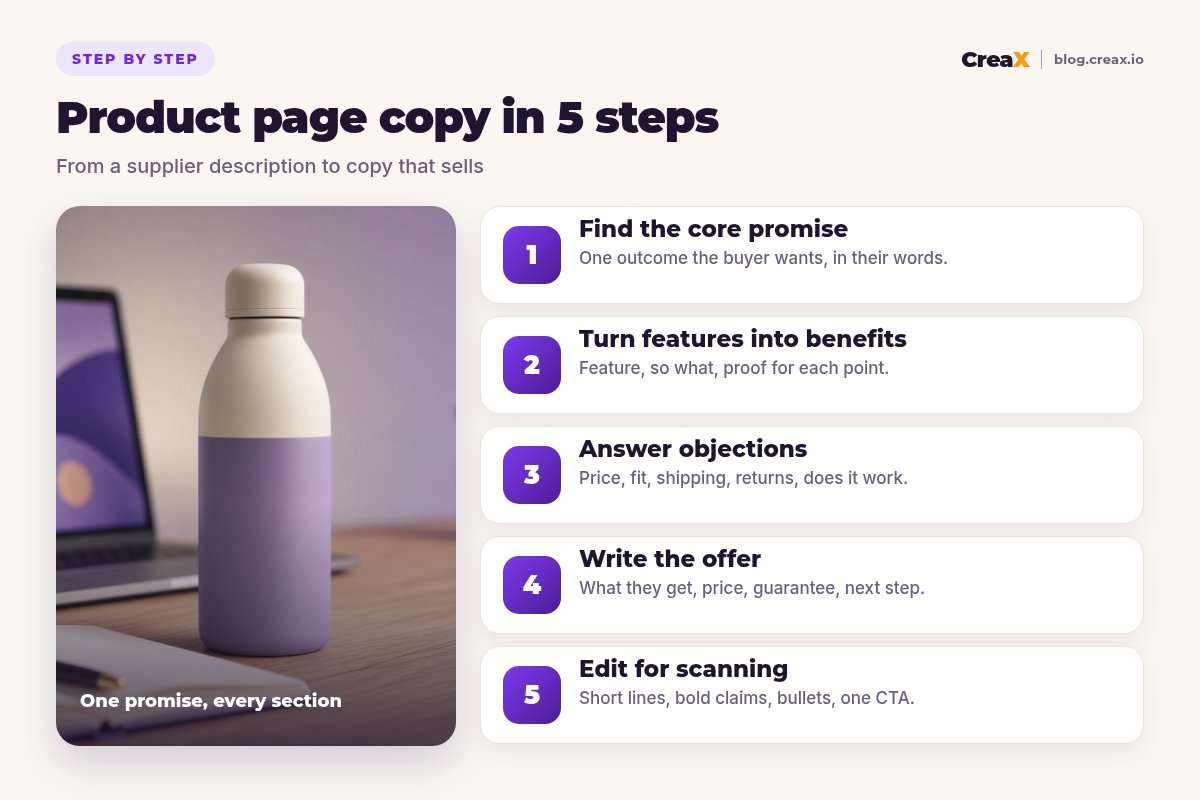
Step 1Step 1: Find the core promise
The core promise is the single outcome your buyer wants from the product. Not the category (“insulated water bottle”) and not a feature (“double-wall steel”), but the result (“ice-cold water all day at your desk”).
To find it, finish this sentence from your buyer's point of view: “I want this so that I can…”. Write five versions, then pick the one that is specific, believable and matches the ad that sends traffic to the page.
| Weak promise | Why it's weak | Stronger promise |
|---|---|---|
| Premium quality water bottle | Category plus a vague adjective | Cold water all day, from your morning commute to your evening workout |
| The best posture corrector | Unprovable superlative | Sit straighter at your desk without thinking about it |
| Innovative kitchen gadget | Says nothing about the result | Peel a full bag of garlic in under a minute |
Examples of rewriting a weak promise. Only use time or result claims you can actually show.
Put the promise in the headline and repeat it, in different words, in the subheadline, the first image and the button area.
Step 2Step 2: Turn features into benefits
Features tell people what the product is. Benefits tell them what it does for them. Use a three-part chain for every feature: feature → so what → proof.
| Feature | So what (benefit) | Proof |
|---|---|---|
| Double-wall vacuum insulation | Drinks stay cold through a full workday | Your own test or the supplier's stated hold time |
| Leak-proof screw lid | Toss it in your bag next to your laptop | Short demo clip: bottle upside down |
| Fits standard cup holders | Comes with you in the car | Dimensions and a photo in a cup holder |
Feature → benefit → proof, using an insulated bottle as the example.
- Lead with the benefit in bullets, then add the feature as support: “Cold all day: double-wall vacuum steel.”
- Cut features nobody cares about. If you can't answer “so what?”, delete the line.
- Show, don’t just say. A short clip or a photo often proves a benefit better than a sentence.
Step 3Step 3: Answer objections
Visitors who don't buy usually have an unanswered question. Find the top objections (from reviews, support emails and ad comments) and answer each one directly on the page, close to the button:
- Price: what makes it worth it, or what it replaces.
- Shipping: real delivery times and costs, stated plainly.
- Returns: your actual policy, in one sentence.
- Fit or compatibility: sizes, dimensions, what it works with.
- “Will it work for me?”: who it's for and who it isn't for. Saying who shouldn't buy builds trust.
!Don't invent proof
Step 4Step 4: Write the offer
The offer is what the buyer gets and why now is a good time. Make it impossible to miss:
- What they get: the product, what's in the box, any bonus.
- The price, and the bundle or discount if you have one.
- The risk reversal: your guarantee or return window, if you offer one.
- One next step: a single button with an action label (“Get yours”, “Add to cart”), repeated a few times down the page.
Avoid fake urgency such as countdown timers that reset or “only 2 left” when it isn't true. If there's a real reason to act now (a launch price, a seasonal deadline), say it plainly.
Get a first draft of the whole page in minutes
Paste a product link into CreaX and get a publish-ready landing page with AI copywriting and product images, plus ad creatives to match. Then check the copy against this guide.
Step 5Step 5: Edit for scanning
Most visitors skim on a phone before they read. Edit the page so the skim tells the whole story:
- Short paragraphs: one to three lines on mobile.
- Bullets for benefits, bold for the key phrase in each.
- Subheads that sell: “Cold all day” beats “Features”.
- One idea per section, in the order a buyer thinks: promise, proof, objections, offer.
- Read it on your phone before you publish. If you lose interest, so will they.
Then check that the page matches the ad. If your ad promises “no more warm water at the gym”, that phrase should appear near the top. Our guide on testing ad angles for a new product explains how to pick the angle the page should follow.
ExampleWorked example: an insulated water bottle
Here's the full process applied to a stainless steel insulated water bottle sold to office workers.
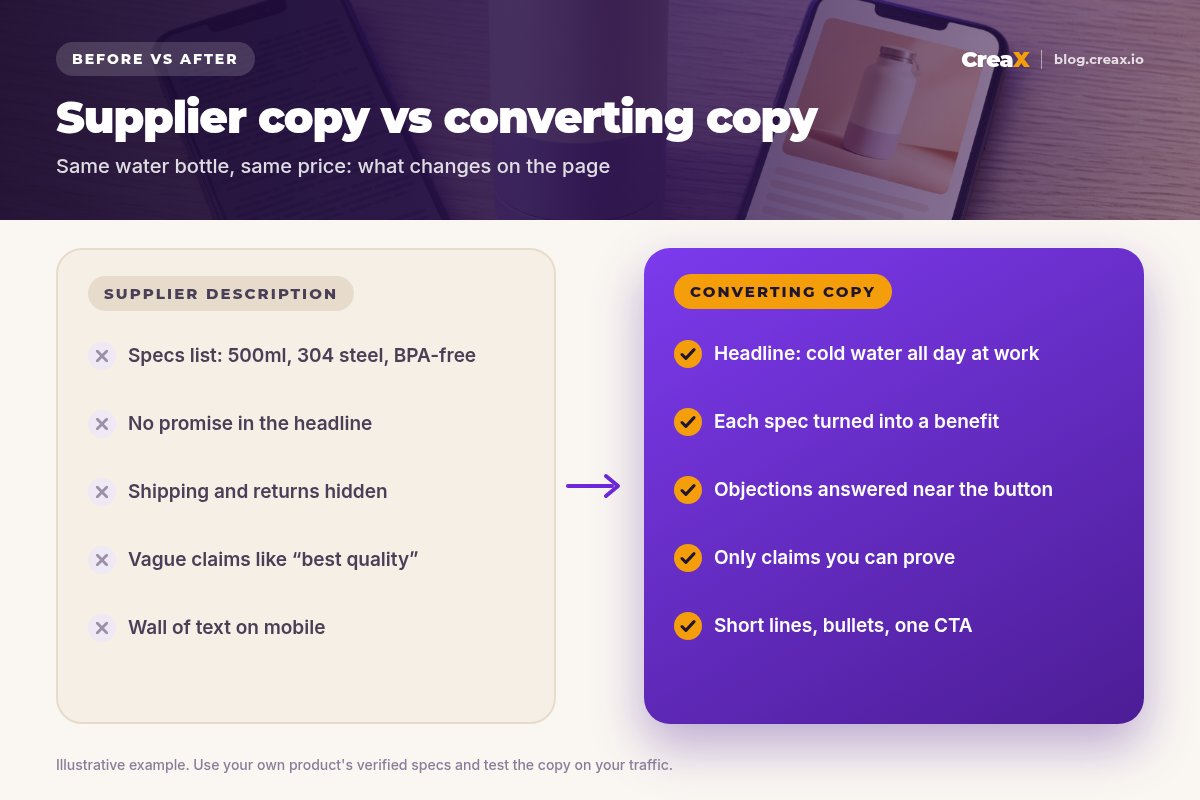
| Section | Before (supplier copy) | After |
|---|---|---|
| Headline | Stainless Steel Vacuum Flask 500ml BPA-Free | Cold water all day, right at your desk |
| Subheadline | (none) | Double-wall steel keeps drinks cold from your commute to your evening workout |
| Benefits | 304 steel. Vacuum insulation. Screw lid. | Cold all day: double-wall vacuum steel. Bag-safe: leak-proof screw lid. Car-ready: fits standard cup holders. |
| Objections | (none) | Ships in X days. Returns within your stated window. Fits most cup holders: see dimensions. |
| Offer | Buy now | One bottle or a two-pack for home and work, with one clear “Get yours” button |
Illustrative rewrite. Replace X and the return window with your real policy; use only hold times you've verified.
Notice what changed: the facts are the same, but every line now answers “what's in it for me?”, and the buyer's practical questions are handled before they leave to look elsewhere.
AvoidMistakes to avoid
- Pasting the supplier description. It's written for a catalog, not for your buyer, and many other stores use the same text.
- Superlatives without proof. “Best”, “#1” and “revolutionary” add nothing and can create compliance problems.
- Several promises at once. Pick one; support it with the rest.
- Hiding shipping and returns. Surprises at checkout often lead to abandoned carts.
- A page that ignores the ad. The visitor clicked a specific promise; continue it.
- Never testing. Your first headline is a hypothesis. Test a second promise once you have traffic.
If your ads get clicks but the page doesn't convert, see our list of creative fixes when Facebook ads aren’t converting.
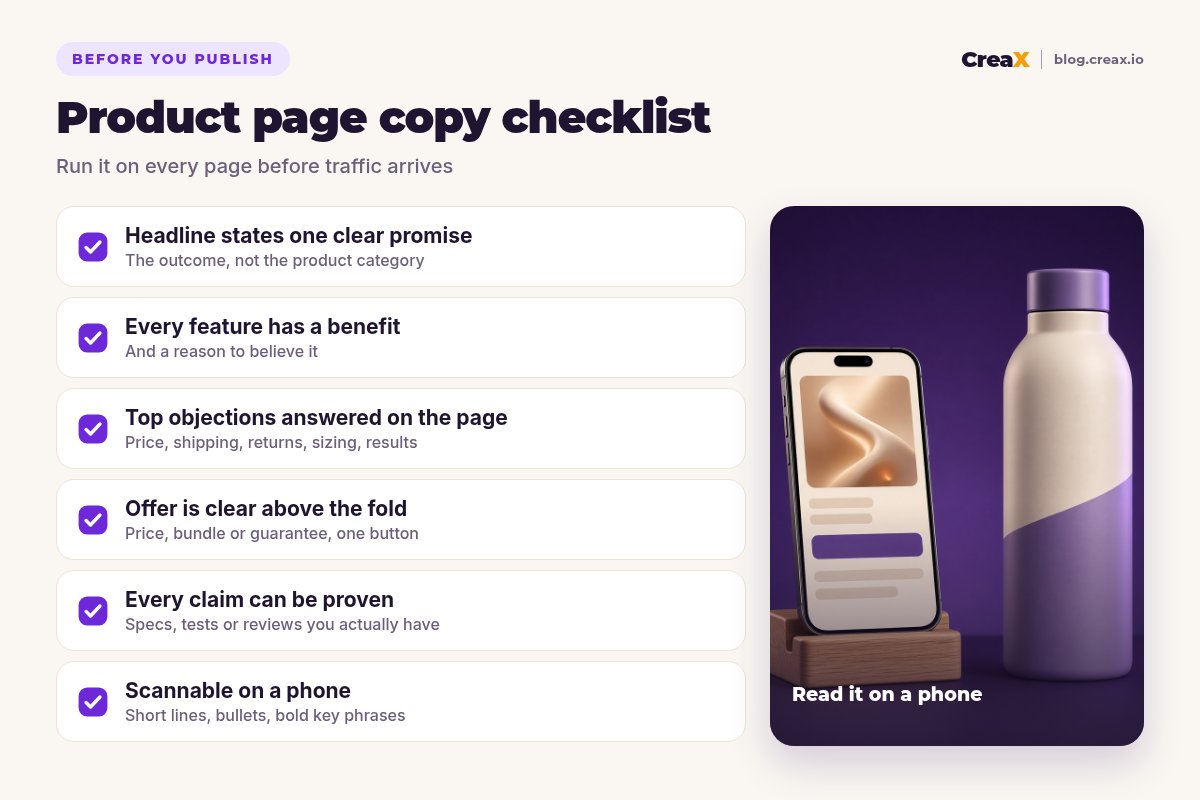
Copy thisChecklist
Before you publish
- ✓Headline states one clear, specific promise
- ✓Subheadline and first image support the same promise
- ✓Every feature has a benefit and a reason to believe it
- ✓Top objections answered near the button: shipping, returns, fit, results
- ✓Offer is clear: what they get, price, guarantee, one action
- ✓Every claim is true and provable
- ✓Short paragraphs, benefit bullets, selling subheads
- ✓Read on a phone and matched to the ad angle
CreaXWhere CreaX fits
Writing from a blank page is the slowest part. CreaX turns a product link or image into a publish-ready landing page with AI copywriting and product images in about 60–120 seconds, along with studio ad creatives and UGC-style video ads from the same product story. Use this guide to review what it writes: check the promise, the benefits, the objections and every claim before you publish. Our walkthrough on turning a product link into a landing page without a designer shows that flow, and our roundup of AI landing page generators compares the options.
Turn your product link into a page and ads
Get a landing page, studio creatives and UGC-style video ads that tell the same story, then check the copy with this checklist.
FAQFrequently asked questions
Q.How long should product page copy be?
Q.Should I write product copy for SEO or for conversions?
Q.Can I use AI to write product page copy?
Q.What's the difference between a feature and a benefit?
Q.Where should I put shipping and return information?
Q.How do I know if my copy works?
Ready to write less and test more?
One product link, about 60–120 seconds: a landing page, studio creatives and UGC-style video ads from the same product story.
This guide is published by CreaX. We describe other tools from their own public websites as of October 2026, avoid invented scores or prices, and recommend checking each vendor's site for current features and plans.