
Why Is My CTR Low? Ecommerce Ad Questions Answered
FAQ · Ad performance
Why is my CTR low? On ecommerce ads, a low click-through rate usually comes down to the creative: the first second doesn't stop the scroll, the product is hard to see, or the message is too generic. Sometimes it's the audience or placement, and sometimes CTR isn't the real problem at all. This FAQ shows how to check, in order, and which fixes to test next.
Updated October 2026 · By the CreaX team
Key takeaways
- ✓Judge CTR against your own ads on the same platform, placement and objective, not a number from someone else's account.
- ✓Use link CTR on Meta, not just “CTR (all)”, which also counts clicks that don't leave the ad.
- ✓If CTR is low across several audiences, suspect the creative first: the hook, the first frame and how clearly the product shows.
- ✓Test new hooks and angles, not small tweaks like button colors, and give each test enough spend to read.
- ✓If CTR is fine but sales aren't, the problem is likely after the click: the page, the offer or the price.
In this guide
SummaryThe short answer
CTR (click-through rate) is the share of people who saw your ad and clicked it: clicks divided by impressions. A low CTR means the ad isn't earning attention or curiosity from the people it's shown to. For ecommerce ads, the usual causes, roughly in the order worth checking, are:
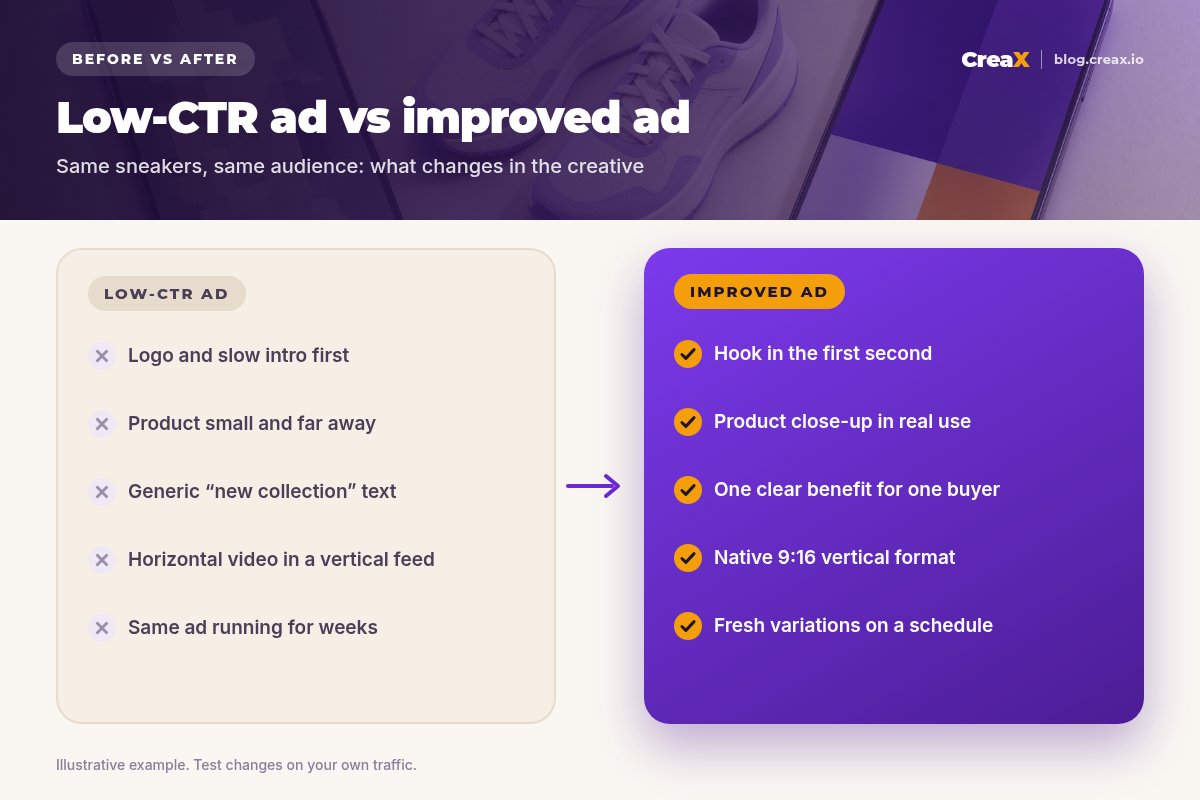
- A weak first second. The ad opens with a logo, a slow intro or a vague shot, so people scroll past.
- An unclear product. The product is small, far away or hard to understand.
- A generic message. “High quality, best price” gives nobody a reason to click.
- The wrong format for the placement. A square image in a vertical feed, or text hidden behind interface buttons.
- Creative fatigue. The same people have seen the ad too many times.
- Audience or offer mismatch. The product is shown to people who don't need it, or the offer isn't interesting.
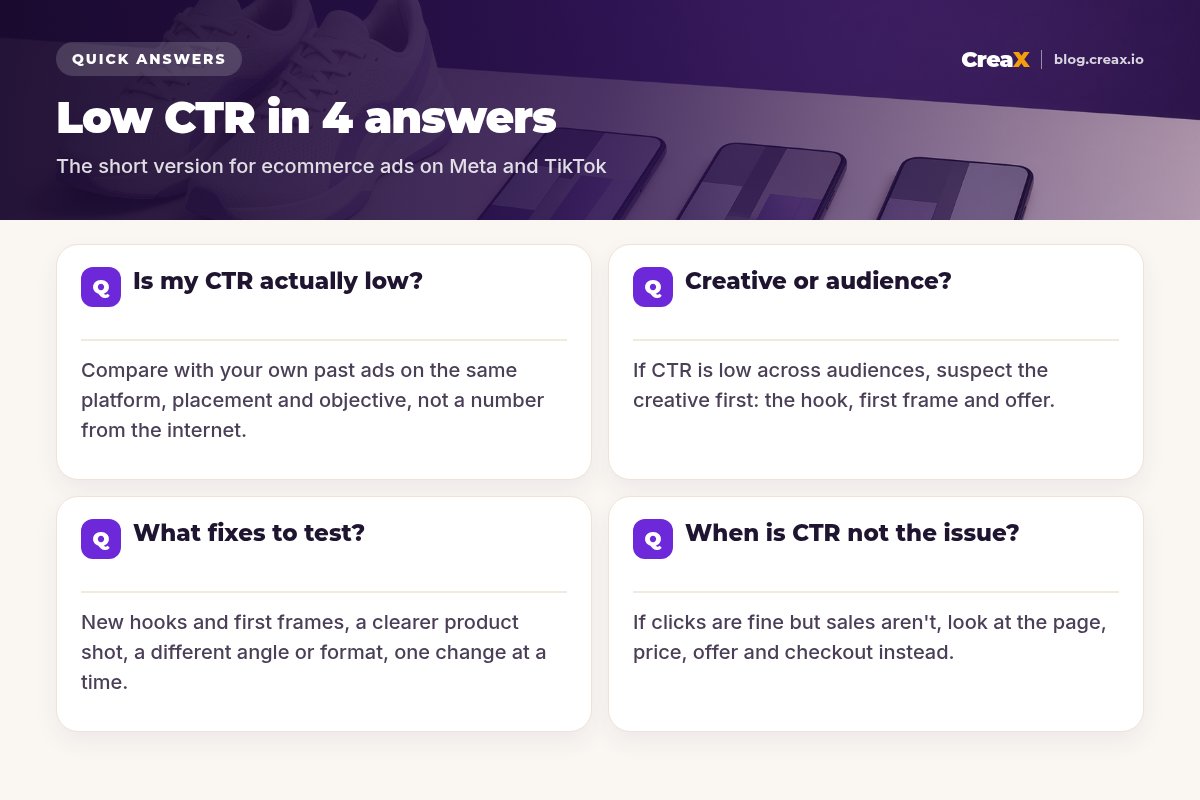
Question 1Is my CTR actually low?
Before you change anything, make sure the number really is a problem. CTR varies a lot by platform, placement, objective, country, product category and even season, so a figure from a forum or a benchmark report may not apply to your account. The most useful comparison is your own history:
- Compare with your past ads on the same platform and placement (Reels vs Feed vs Stories behave differently).
- Compare ads with the same objective. Sales campaigns, traffic campaigns and awareness campaigns are shown to different people.
- Compare like with like: a new product on a cold audience isn't comparable to a retargeting ad.
- Wait for enough impressions before judging. Early numbers swing a lot.
Also check which CTR you're reading. In Meta Ads Manager, “CTR (all)” counts any click on the ad, including likes, profile clicks and expanding the text. “CTR (link click-through rate)” counts clicks that go to your destination, which is the one that matters for a store. On TikTok, look at CTR alongside video watch metrics such as average watch time.
★Make your own baseline
Question 2Is it the creative or the audience?
This is the most common question, and the answer is usually the creative. A quick way to tell:
| What you see | Likely cause | What to try |
|---|---|---|
| CTR low across several audiences | Creative | New hooks, first frames and angles |
| CTR fine in one audience, low in others | Audience fit | Keep the creative, adjust targeting |
| CTR was good, now dropping | Creative fatigue | Refresh with new variations |
| Low CTR with a high hook rate | Middle of the ad or the offer | Clearer benefit, stronger call to action |
| Low CTR and people leave in the first seconds | Opening | Change the first one to three seconds |
A diagnostic guide, not a rule. Look at your own data.
With automated targeting, such as Meta's Advantage+ campaigns, the creative does even more of the targeting work: the platform uses it to find who responds. That's another reason to start with the creative. See creatives for Meta Advantage+.
For video ads, look at the hook rate (the share of impressions that watch the first few seconds) next to CTR. If few people watch past the opening, the hook is the problem. If many watch but few click, the issue is later in the ad. See what hook rate is and how to use it.
Question 3What fixes should I test?
Test fixes that change what people see in the first second and why they should care. Small tweaks like a different button color rarely move CTR on their own. In rough order:
1. A new hook
Change the opening: start with the problem, the result, a bold claim you can back up, or the product in action. Keep the offer the same so you know the hook made the difference.
2. A clearer product shot
Show the product close up, in use, in the first frame. If people can't tell what it is in a second, they won't click to find out.
3. One specific benefit
Replace generic text with one concrete benefit: what changes for the buyer. “Laces that stay tied on long runs” beats “premium quality sneakers”.
4. The right format for the placement
Use vertical video for Reels, Stories and TikTok, and keep text and the product away from the areas covered by buttons and captions. If you're unsure where to begin, see static vs video ads: which to test first and how long a video ad should be.
5. A new angle
Try a different reason to buy: comfort, style, gifting, price, a problem solved. Each angle reaches different people. See how to test ad angles for a new product.
6. Fresh variations
If CTR was good and is fading, the ad may be worn out. Rotate new versions of what worked. See signs of creative fatigue and how to refresh.
Get fresh ad variations for your product
Paste a product link and get studio creatives and UGC-style video ads with new hooks, plus a landing page, in about 60–120 seconds.
Question 4When is CTR not the issue?
CTR measures attention, not sales. Sometimes it's fine and the real problem is somewhere else:
- Good CTR, few sales. People click but don't buy. Look at the landing page, price, shipping costs, trust signals and load speed. See Facebook ads not converting.
- Lots of views, no clicks or sales on TikTok. Entertaining videos can get views without buying intent. See TikTok ads with views but no sales.
- Clickbait CTR. A misleading hook can raise CTR while sales fall, because the page doesn't match the promise.
- Costs too high anyway. Even with a decent CTR, a product may not be profitable. Work out your break-even ROAS before scaling.
⚖A better creative can't fix everything
AvoidCommon mistakes to avoid
- Changing the audience first when CTR is low everywhere.
- Judging too early, after only a few hundred impressions.
- Testing tiny tweaks instead of different hooks and angles.
- Changing several things at once, so you can't tell what worked.
- Reading CTR (all) instead of link CTR.
- Chasing CTR with clickbait that the landing page doesn't deliver on.
ChecklistChecklist you can copy
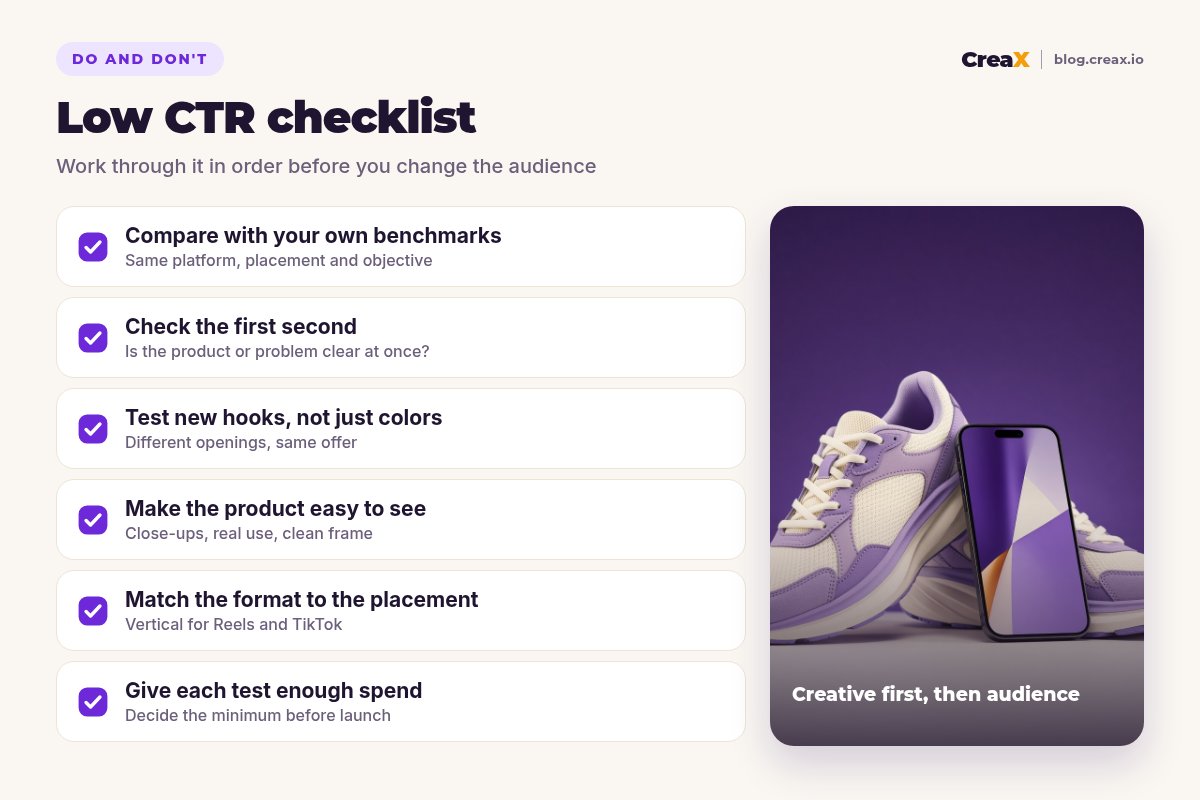
Low CTR: what to check
- ✓Compare link CTR with your own past ads (same platform, placement, objective)
- ✓Check the hook rate or watch time for video ads
- ✓Look at the first second: is the product or problem clear at once?
- ✓Test two or three new hooks with the same offer
- ✓Show the product close up and in use
- ✓Replace generic text with one specific benefit
- ✓Use the right format for each placement
- ✓Give each variation enough spend before judging
- ✓If CTR is fine but sales aren't, check the page and offer
CreaXHow CreaX helps (briefly)
Most CTR fixes come down to testing more, different creatives. CreaX makes that quicker: paste a product link or upload a product image, choose your market and language, and in about 60–120 seconds you get studio ad creatives in multiple sizes for Facebook and Instagram, UGC-style video ads in 15- or 30-second formats for TikTok and Instagram, and a publish-ready landing page for the same product.
That gives you several hooks and formats to test without a photoshoot or creator, and a page that matches the ads, which helps when clicks don't turn into sales. You run the ads in your own ad accounts. See how many ad creatives to test per product.
| CreaX plan | Price / month | Credits |
|---|---|---|
| Free | $0 | 0 |
| Basic | $4.99 | 2,000 |
| Standard | $14.99 | 6,500 |
| Pro | $29.99 | 14,000 |
| Premium | $49.99 | 25,000 |
CreaX plans, October 2026. Top-ups are $1 per 500 credits. Check creax.io/pricing for current details.
Test new hooks this week
One product link gives you studio creatives, UGC-style video ads and a matching landing page.
FAQFrequently asked questions
Q.What's a good CTR for ecommerce ads?
Q.Should I use CTR (all) or link CTR?
Q.How long should I wait before judging CTR?
Q.Does a higher CTR mean more sales?
Q.Can AI-generated ads improve CTR?
Q.Why did my CTR drop after a few days?
Ready to fix your CTR?
Get new ad variations and a matching landing page from one product link in about 60–120 seconds.
This guide is published by CreaX. We describe other tools from their own public websites as of October 2026, avoid invented scores or prices, and recommend checking each vendor's site for current features and plans.