
What Is Creative Strategy in Ecommerce Advertising?
FAQ · Creative strategy
Creative strategy in ecommerce advertising is the plan behind your ads: who you're talking to, which reasons to buy you'll test, how each ad opens, what format it uses, and how you'll decide what worked. This FAQ answers the questions sellers ask most and gives you a one-page framework you can copy today.
Updated October 2026 · By the CreaX team
Key takeaways
- ✓Creative strategy decides what each ad is testing: the buyer, the angle, the hook and the format. Production just makes it.
- ✓An angle is the reason to buy. A hook is the first few seconds that earns attention for that reason.
- ✓Test a few clearly different angles per product, each with a couple of hooks and formats, instead of many near-identical ads.
- ✓Judge on cost per purchase over enough spend, log what you learn, and feed it into the next round.
In this guide
DefinitionThe short answer: what is creative strategy?
Creative strategy is the thinking that happens before anyone writes a script or opens a design tool. It answers four questions:
- Who is this ad for? A specific buyer with a specific situation.
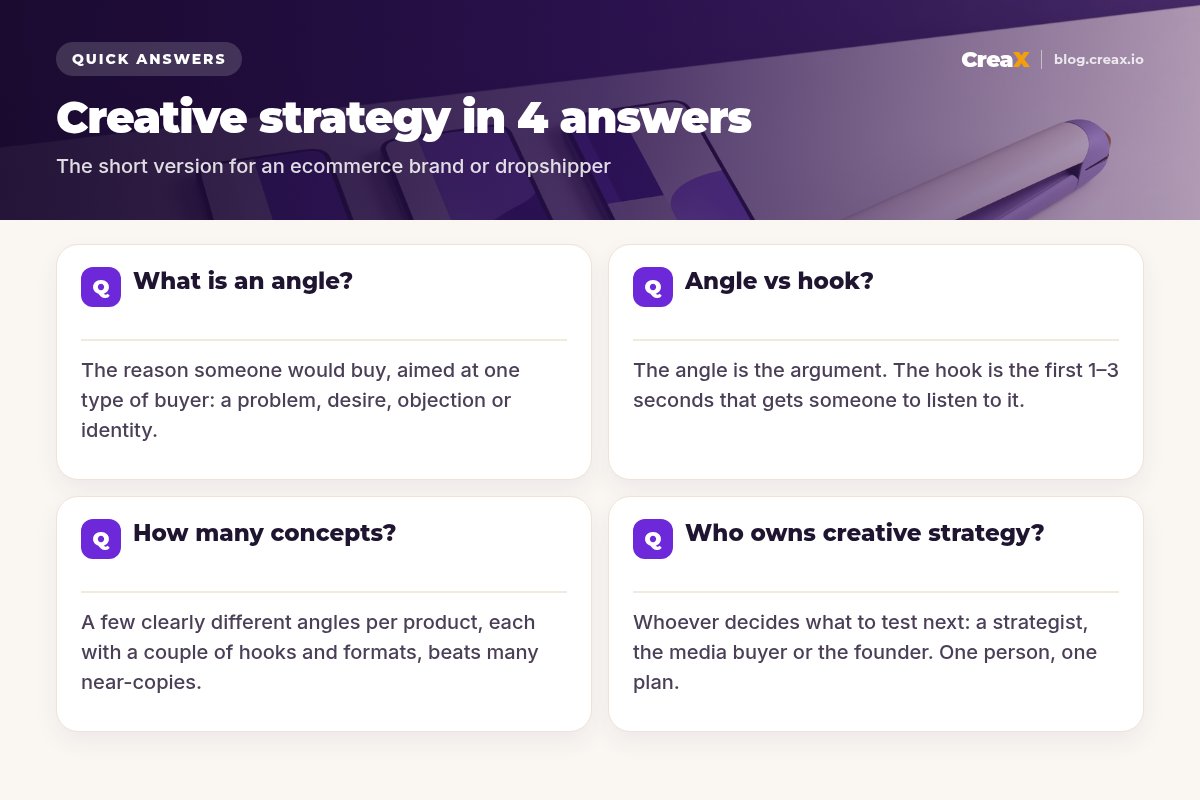
- Why would they buy? The angle: a problem solved, a desire met, an objection removed or an identity confirmed.
- How will the ad open and look? The hook and the format: a UGC-style talking video, a demo, a static comparison, a carousel.
- What will you learn? Which metric decides the winner, and what you'll test next if it wins or loses.
Without a strategy, ad production becomes a stream of ideas that are hard to compare. With one, every ad is a small experiment, and each round makes the next one smarter. It matters even more on platforms where the algorithm handles targeting, because the creative itself is what finds the right people. See our guide to creatives for Meta Advantage+ for why.
iCreative strategy vs media buying
The core ideaWhat is an angle?
An angle is the reason someone would buy, aimed at one type of buyer. The same product can have many angles. Take a ceramic hair straightener:
| Angle type | Example for a hair straightener | Who it speaks to |
|---|---|---|
| Problem | Frizz is back an hour after styling | People fighting humidity or frizz |
| Desire | Salon-smooth hair at home | People who love the salon look |
| Objection | Worried about heat damage? Show the heat settings | Careful buyers with fine or treated hair |
| Speed / convenience | Ready in minutes before work | Busy mornings |
| Identity / gift | The gift for the friend who's always styling | Gift buyers |
Illustrative angles. Every claim in an ad must match the real product.
Good angles come from buyer research, not brainstorming alone: product reviews (yours and competitors'), comments on ads in your niche, customer questions and return reasons. The words buyers use are often better copy than anything you'd invent. Our guide on how to test ad angles for a new product goes deeper.
Don't mix them upAngle vs hook: what's the difference?
The angle is the argument. The hook is the first one to three seconds that gets someone to listen to it. One angle can have many hooks:
| Angle | Hook A | Hook B | Hook C |
|---|---|---|---|
| Frizz is back an hour later | Close-up of frizz returning | “If humidity wins every time, watch this” | Before/after split in the first frame |
One angle, three ways to open the ad.
This matters for testing. If you change the angle and the hook and the format at once, a winning ad tells you little about why it won. A cleaner approach: test angles first with simple hooks, then test new hooks on the winning angle.
VolumeHow many concepts should you test?
There's no universal number, and anyone giving you one without knowing your budget is guessing. The principle is more useful: a few clearly different angles beat many near-copies. A practical starting structure for one product:
- 3–4 angles that are genuinely different, not the same idea reworded.
- 2–3 hooks per angle, so a weak opening doesn't kill a good angle.
- 1–2 formats per angle, such as a UGC-style video and a static image.
Your budget sets the ceiling: each ad needs enough spend to judge it. If you can't fund that many, test fewer angles properly rather than many angles badly. Our guide on how many ad creatives to test per product helps you size it.
Turn your angles into ads in minutes
Paste a product link and CreaX generates a landing page, studio ad creatives and UGC-style video ads, so each angle becomes a test quickly.
ResponsibilityWho owns creative strategy?
Whoever decides what to test next. In a large brand that's often a creative strategist. In an agency it may be the strategist or the media buyer. In a small store or dropshipping business it's usually the founder. What matters is that one person owns the plan, writes it down and reviews results on a fixed schedule.
If you're a media buyer taking on this role, our page on CreaX for media buyers shows how to keep creative volume up without a production team.
Copy thisA one-page creative strategy framework
Write this down for every product before you produce anything:
Buyer
Research notes
Angles
Hooks and formats
Decision rule
Learning log
★Keep the log, even when nothing wins
Worked example: one round for the hair straightener
Here's how the framework looks filled in. Buyer: shoulder-length frizzy hair, busy mornings, lives somewhere humid. Research notes: say reviews in the category mention frizz coming back, worry about heat damage and wanting fewer minutes in front of the mirror. Angles: (1) frizz that stays gone, (2) controllable heat for careful styling, (3) a faster morning routine. Hooks: a before/after first frame, a spoken question, a close-up of the product in use. Formats: one UGC-style video and one static per angle. Decision rule: cost per purchase after the minimum spend you set in advance, decided on a fixed date. Log: which angle won, which hook held attention, and what to try next, for example a new hook on the winning angle.
Notice what's missing: no claims the product can't back up, no copied competitor ads, and no changes to five things at once. That's what makes the result readable.
AvoidCommon creative strategy mistakes
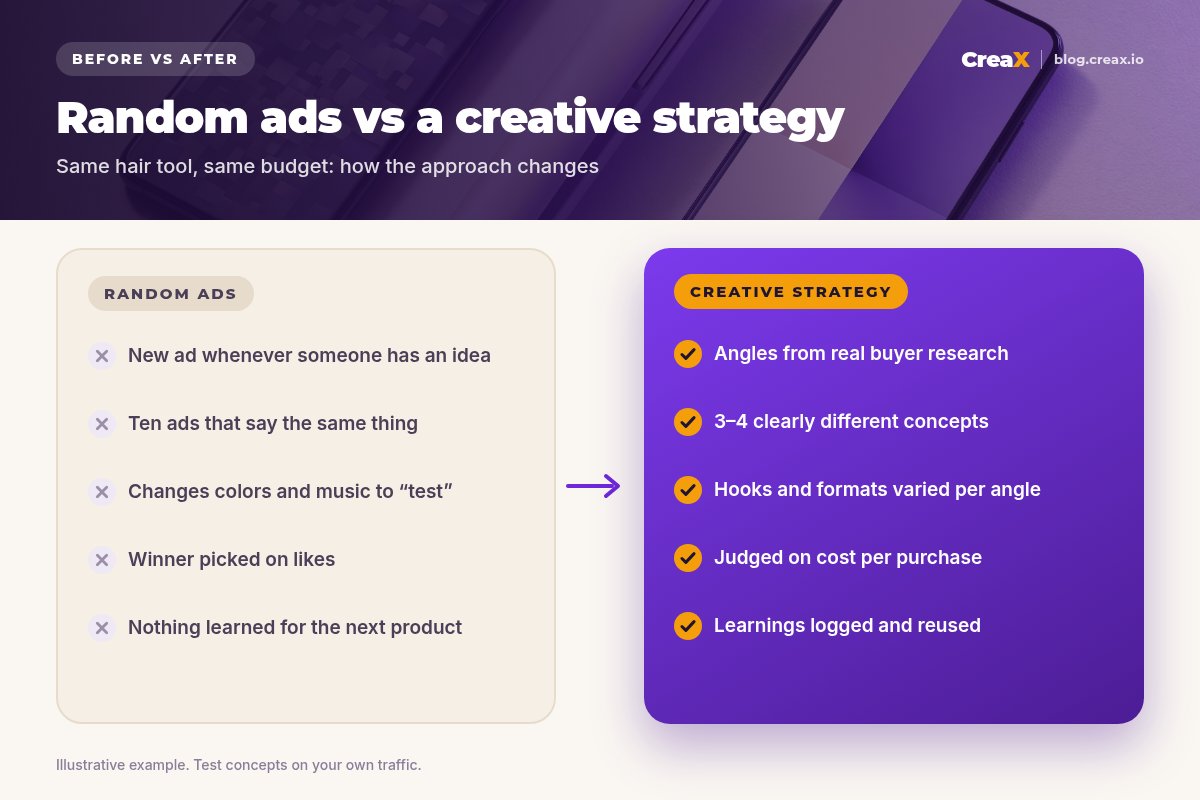
- Testing colors and music instead of ideas. Cosmetic changes rarely teach you anything about why people buy.
- Ten ads, one message. Different visuals with the same angle are one test, not ten.
- Choosing winners on likes or views. Engagement is not purchase intent. Judge on cost per purchase.
- Killing ads too early. Decide the minimum spend before launch and stick to it.
- Ignoring fatigue. Winners decline. Plan the next round before the current winner wears out; see the signs of ad creative fatigue.
- A landing page that tells a different story. If the ad sells “frizz control” and the page leads with “gift idea”, buyers bounce.
Before each roundChecklist you can copy
Creative strategy checklist
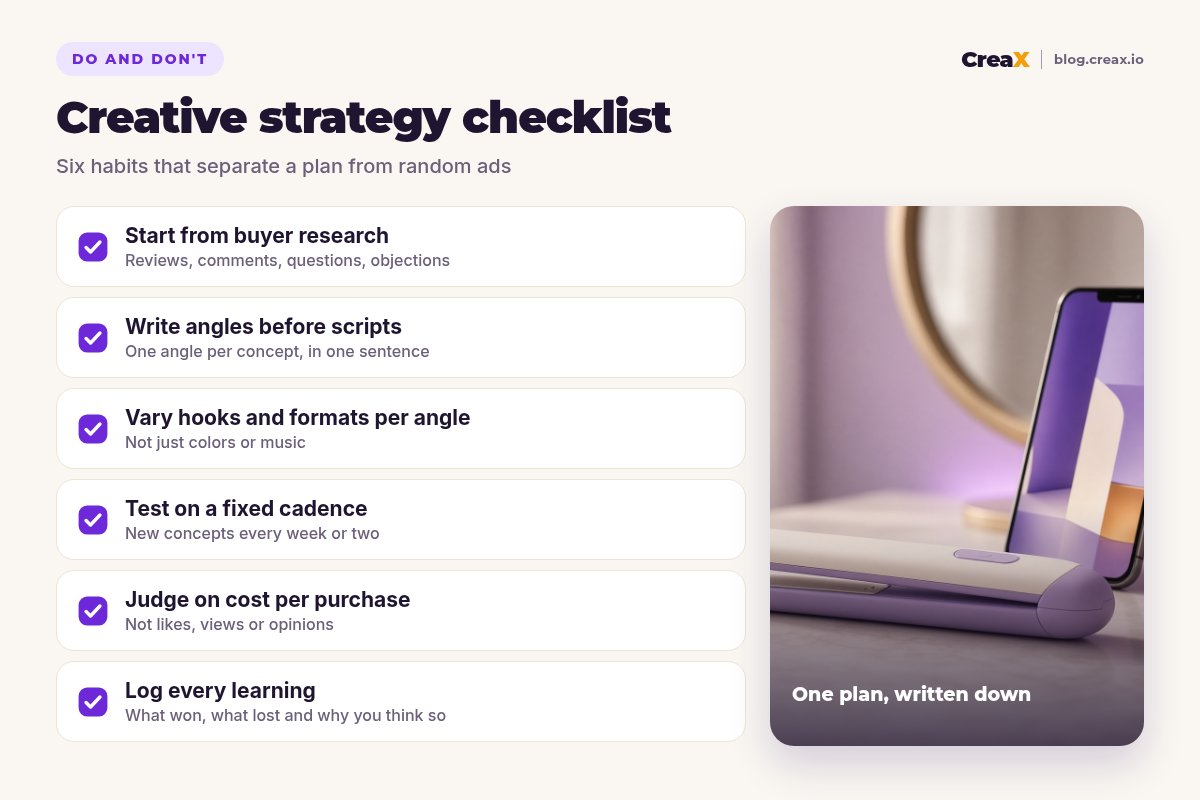
- ✓One buyer written in one sentence
- ✓Angles taken from real reviews, comments or questions
- ✓3–4 angles that are genuinely different
- ✓2–3 hooks per angle, varied in the first seconds
- ✓At least one video and one static format
- ✓Every claim true for the real product
- ✓Landing page that continues the ad's angle
- ✓Metric, minimum spend and decision date set in advance
- ✓Learning log updated after the round
Make the strategy cheap to execute
Once you know the angles, CreaX turns one product link into the page, statics and UGC-style video ads you need to test them.
ExecutionHow CreaX helps (briefly)
CreaX doesn't decide your strategy for you; that part stays with you. What it does is make execution fast and cheap. Paste a product link or upload a product image, and in about 60–120 seconds CreaX generates a publish-ready landing page, studio ad creatives in multiple sizes for Facebook and Instagram, and UGC-style video ads with AI presenters in 15- or 30-second formats for TikTok and Instagram. It also writes the page copy with AI and keeps your brand colors consistent.
Because the page and ads come from the same product, each angle you test has a matching story from ad to page. Plans start at $4.99 a month for 2,000 credits, with top-ups at $1 per 500 credits. Our walkthrough on turning one product image into a week of ad tests shows a full round.
⚖Where a human strategist still wins
FAQFrequently asked questions
Q.Is creative strategy only for big brands?
Q.What's the difference between a concept and a variation?
Q.How often should I test new concepts?
Q.Should I copy competitors' ads?
Q.Do UGC-style videos fit into creative strategy?
Q.Which metric should decide the winner?
This guide is published by CreaX. We describe other tools from their own public websites as of October 2026, avoid invented scores or prices, and recommend checking each vendor's site for current features and plans.