
What Is an Advertorial Landing Page? (And When to Use One)
FAQ · Advertorial landing pages
An advertorial landing page is an ad that reads like an article: it tells a story, explains a problem and then introduces a product as the answer. Used well, it warms up cold traffic that isn't ready for a product page. Used badly, it's a fake news page that gets ads rejected and buyers angry. This guide explains what an advertorial is, when it helps, how long it should be, and how to write one responsibly.
Updated October 2026 · By the CreaX team
Key takeaways
- ✓An advertorial is a long-form, article-style page that sits between your ad and your product page, often called a pre-lander.
- ✓It helps most with cold traffic, products that need explaining, and problems buyers don’t yet see. For people who already want the product, a product page is usually enough.
- ✓It must be honest and clearly an ad: no fake news sites, fake reviews, fake doctors or claims you can't back up.
- ✓The best length is whatever answers the reader’s questions. Structure matters more than word count.
In this guide
TL;DRThe short answer
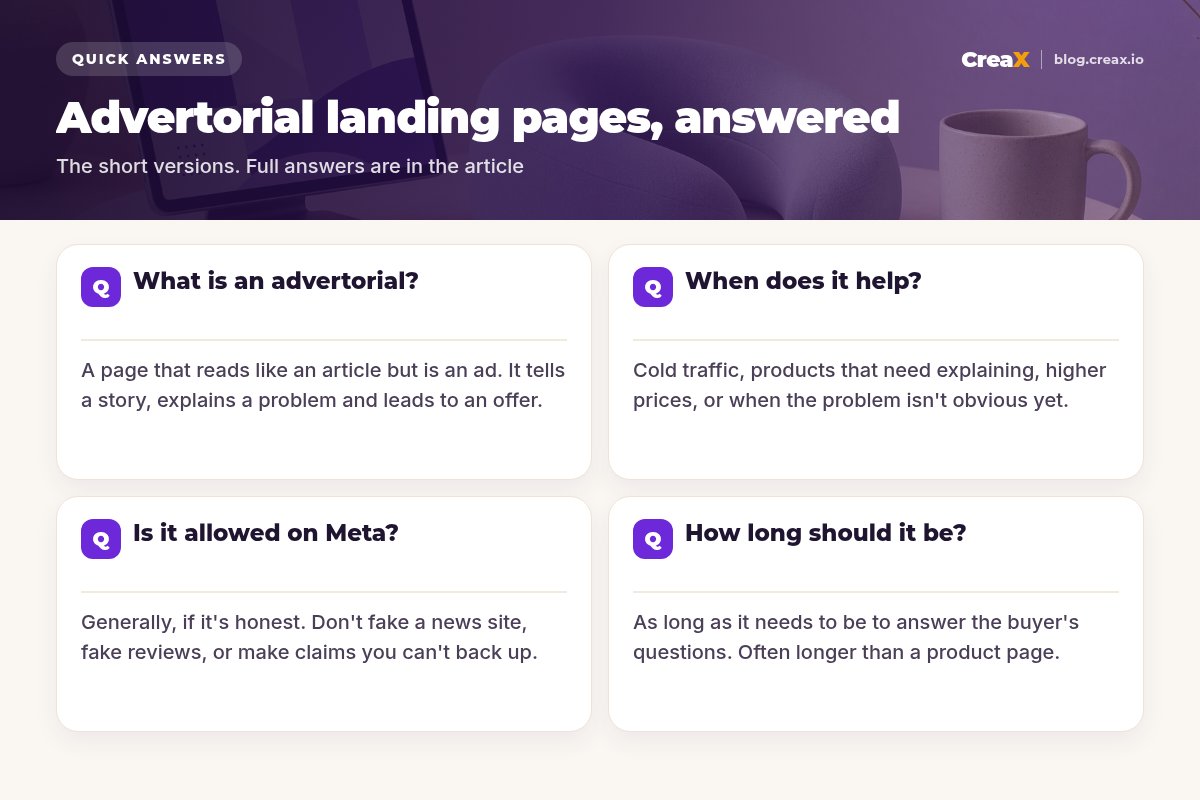
An advertorial landing page is a sales page written in the format of an article. Instead of opening with “Buy now, $39”, it opens with a relatable story or problem, explains why common fixes fail, introduces the product as a better way, and ends with a link to the offer.
It's a tool for cold audiences: people who scrolled past your ad, got curious, but don't know you or the product yet. It gives them the context a short product page can't. It is not a licence to pretend to be a newspaper.
DefinitionWhat is an advertorial?
The word combines “advertisement” and “editorial”. Print magazines have run advertorials for decades, usually marked “Advertisement” or “Sponsored”. Online, the advertorial became a landing page type, often called a pre-lander or pre-sell page, that sits between the ad and the product page:
Ad
Advertorial
Product or offer page
A typical advertorial follows a simple arc:
| Section | What it does | Example (neck pillow) |
|---|---|---|
| Headline | Promises an answer or a story | Why long flights leave your neck sore, and what helps |
| Hook / story | Makes the reader recognise the problem | Waking up mid-flight with your head on your chest |
| Why usual fixes fail | Explains the problem better | Inflatable pillows that push your head forward |
| The better way | Introduces the product's approach | Memory foam that supports the chin and sides |
| Proof | Shows it's real | Clear photos, materials, honest specs, real reviews |
| Offer and CTA | Sends the reader to buy | Link to the product page with the current offer |
An illustrative structure. Every claim must be true for your product.
Affiliates use the same structure as a pre-sell page; see how affiliates build a pre-sell page without code.
Use casesWhen does it help?
Advertorials add a step to your funnel, so use them when that step earns its place:
- Cold traffic. People who don't know your brand need context before a price.
- Products that need explaining. If the benefit isn't obvious from a photo, a story helps.
- A problem buyers don’t see yet. An advertorial can name the problem before selling the fix.
- Higher prices. The more a product costs, the more reassurance buyers want.
- Native ad placements. Content-style ads lead naturally to content-style pages.
And when not to bother:
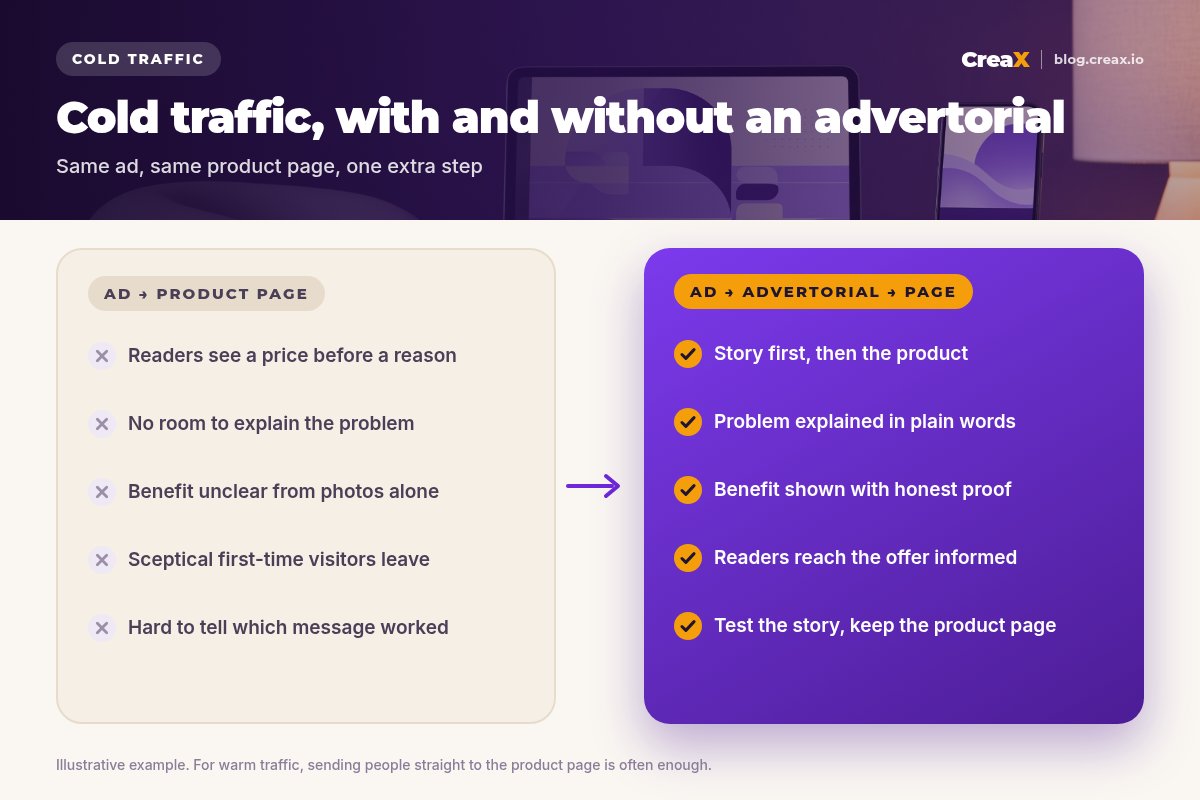
- Warm or retargeting traffic who already know the product. Send them straight to the product page.
- Simple impulse products where a strong product page and a clear photo say everything.
- When you can’t support the claims the story needs. Don't write the advertorial at all.
A simple way to test it
If you're not sure an advertorial will help, test it instead of guessing:
- Keep the ad the same. Change only where it sends people.
- Version A sends traffic straight to the product page. Version B sends it to the advertorial, which links to the same product page.
- Give both versions the same budget and audience, and run them long enough to see purchases, not just clicks.
- Compare cost per purchase, not click-through rate. An advertorial adds a step, so it only wins if more readers end up buying.
If the advertorial wins, keep improving it: test a new headline or story before you test a new product page. If it loses, the product may simply not need the extra explanation.
Whatever page comes after the advertorial still has to convert. See what makes a high-converting product page.
PoliciesIs it allowed on Meta?
Generally, yes, if it’s honest. Meta doesn't ban article-style landing pages, but its Advertising Standards and review process look at the landing page as well as the ad. Advertorials get into trouble when they cross into deception. Common problems include:
- Pretending to be a real news outlet, or copying a known publication's look and name.
- Fake endorsements, including celebrities, doctors or experts who never endorsed the product.
- Fake reviews or testimonials, or “real customer” stories that are invented.
- Exaggerated or unsupported health, weight-loss or income claims.
- Withholding key information, or a page that doesn't match what the ad promised.
!Label it as an ad
If your ads are getting clicks but no sales, the problem may be the ad-to-page match rather than the page type. See why Facebook ads don’t convert.
LengthHow long should it be?
There's no magic number. An advertorial should be long enough to take a cold reader from curious to ready, and not one paragraph longer. In practice, that's usually longer than a product page, because it has to explain the problem as well as the product.
Instead of counting words, check that the page answers these in order:
- Why should I keep reading? (headline and hook)
- Is this my problem? (the story)
- Why haven't other fixes worked? (the explanation)
- What's different here? (the product's approach)
- Can I trust it? (honest proof, clear photos, real specs)
- What do I do now? (one clear call to action)
★Make it skimmable
Watch outCommon mistakes to avoid
- Disguising the ad as news. Fake mastheads, fake bylines and “as seen on” logos you didn't earn.
- Inventing proof. Made-up testimonials, results or expert quotes.
- A headline the ad doesn’t support. If the ad promises one thing and the page another, readers leave.
- Too many links. One offer, one call to action, repeated.
- Slow, cluttered pages. Most traffic is mobile; keep it fast and readable.
- Skipping the product page. The advertorial warms readers up; the product or offer page still has to close the sale.
Before you publishChecklist you can copy
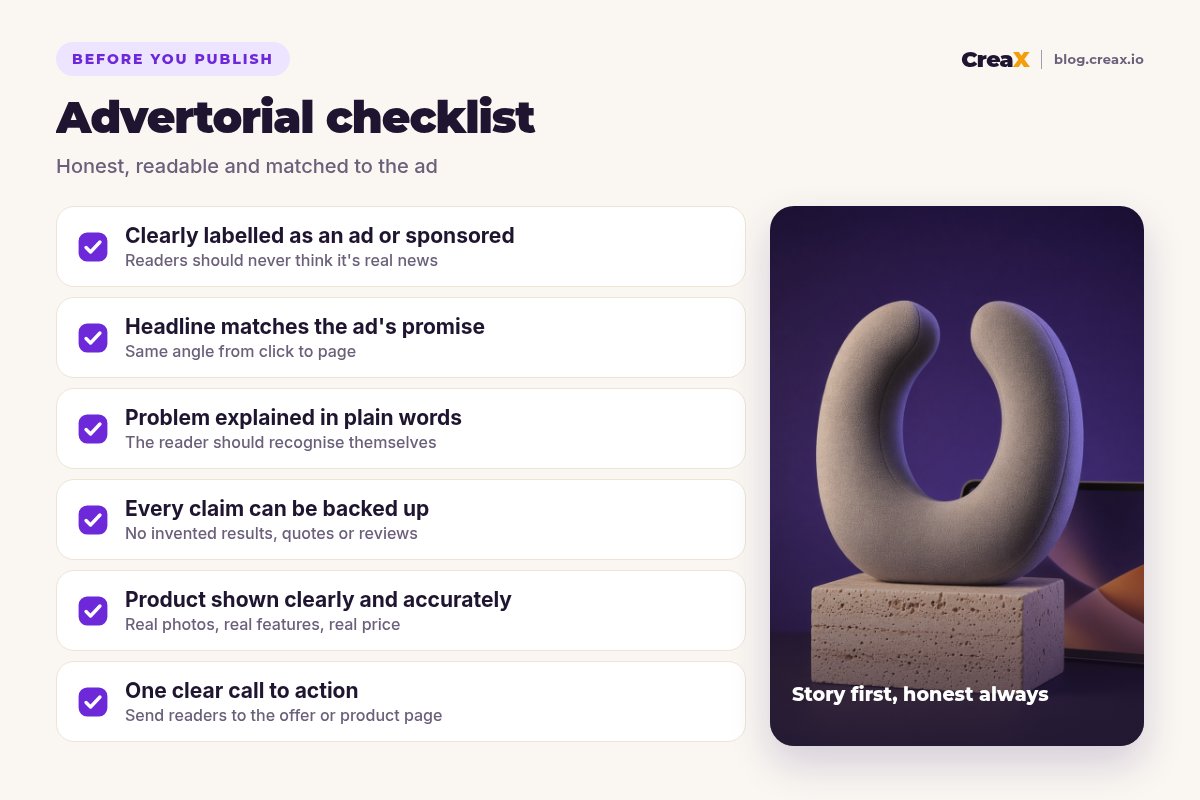
Advertorial checklist
- ✓Clearly labelled as an advertisement or sponsored content.
- ✓No fake news branding, bylines or “as seen on” logos.
- ✓Headline repeats the promise of the ad that sends traffic.
- ✓Problem described in the reader's own words.
- ✓Every claim, number and review is real and can be backed up.
- ✓Real product photos, features and price.
- ✓One clear call to action, repeated, pointing to the offer page.
- ✓Page tested on a phone for speed and readability.
- ✓Meta's current Advertising Standards and local rules checked.
Get the landing page and the ads for your next test
Paste a product link and get a publish-ready landing page, studio ad creatives and UGC-style video ads in about 60–120 seconds.
Where we fitHow CreaX helps (briefly)
CreaX is an all-in-one AI ecommerce creative OS. Paste a product link or upload a product image and, in about 60–120 seconds, it generates a publish-ready landing page, studio ad creatives, UGC-style video ads and a multi-tenant store. In an advertorial funnel, that gives you the page your advertorial points to, plus the ads that send traffic, all built from the same product understanding so the message stays consistent.
It won't write a disguised news article for you, and you shouldn't want it to. Compare page tools in our list of the best AI landing page generators for ecommerce, or see how to turn a product link into a landing page. Plans start at $4.99/month for 2,000 credits.
Build the page and the ads in one pass
One product link, about 60–120 seconds: a landing page, studio creatives and UGC-style video ads that tell the same story.
FAQFrequently asked questions
Q.What's the difference between an advertorial and a landing page?
Q.Is an advertorial the same as a pre-lander?
Q.Do advertorials still work in 2026?
Q.Do I need to label an advertorial as an ad?
Q.Can I use customer reviews in an advertorial?
Q.Can CreaX make my advertorial?
Ready to test your next funnel?
Paste a product link and get the landing page, studio creatives and UGC-style video ads for your next test.
This guide is published by CreaX. We describe other tools from their own public websites as of October 2026, avoid invented scores or prices, and recommend checking each vendor's site for current features and plans.