
Can I Use AliExpress Product Images in My Ads?
FAQ · Image rights
Can you use AliExpress images in your ads? It is one of the first questions every dropshipper asks, and the honest answer is: only if you have permission, and even then it is rarely your best option. This guide explains who usually owns supplier photos, what Meta and TikTok do about ads that use someone else's images or videos, and how to make your own creatives quickly so the question goes away.
Updated October 2026 · By the CreaX team
Key takeaways
- ✓A product listing is not a license. Photos on AliExpress, Alibaba or Amazon usually belong to whoever shot or paid for them, often the manufacturer or another seller, not to everyone who sells the item.
- ✓Platforms act on infringement. Meta and TikTok ad policies do not allow ads that infringe others' intellectual property, and rights holders can report ads. TikTok says accounts can be suspended for copyright and trademark violations.
- ✓Ask, then keep proof. If you want to use supplier images, get written permission and keep it. Never use another brand's photos, logos or video clips.
- ✓Originals are easier than ever. Shoot a sample, or paste the product link into a tool like CreaX to generate new studio ads, UGC-style videos and a landing page.
In this guide
TL;DRThe short answer
You can use AliExpress product images in ads only when the person who owns them has allowed it. Being able to buy and resell a product does not automatically give you the right to copy the photos from its listing. Some suppliers are happy to share their images with resellers; many listings use photos copied from somewhere else, so even the supplier may not own them.
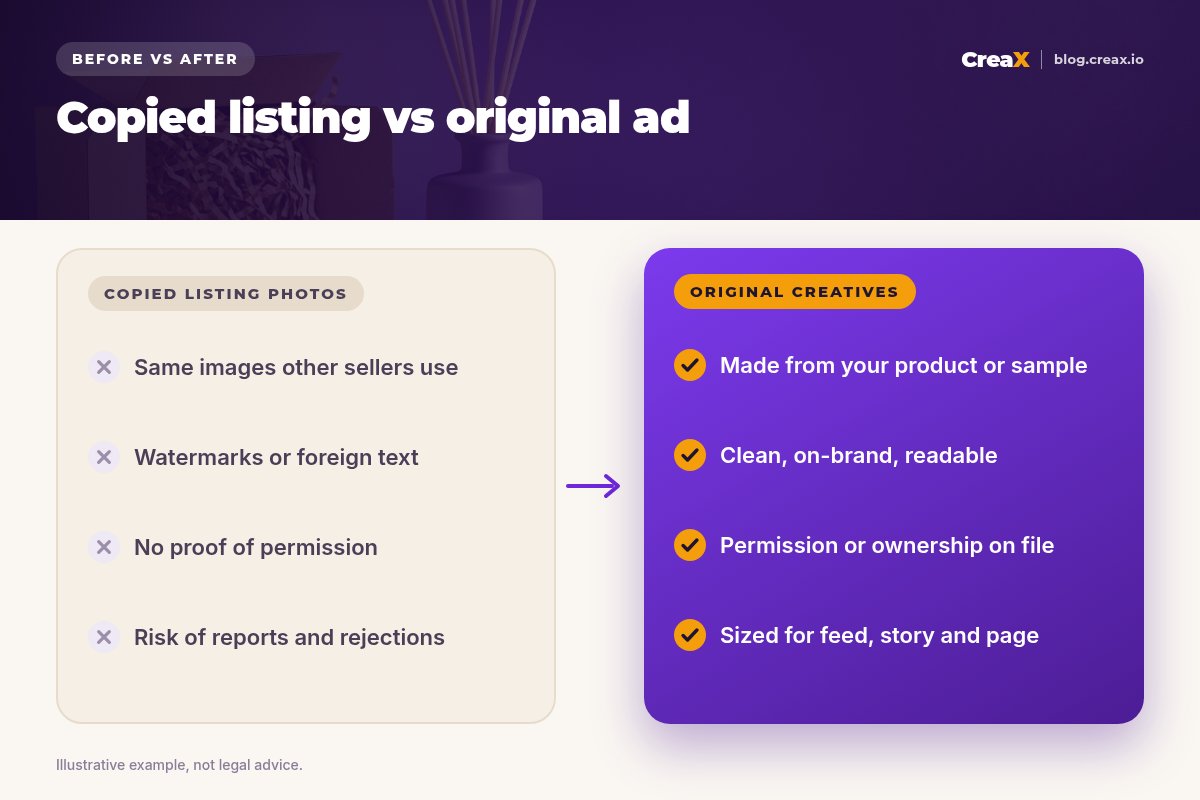
Even with permission, supplier photos have a practical problem: every other store selling the same product uses the same images. Your ad looks like a dozen others, and shoppers who have seen the picture on a marketplace may wonder why your price is different. Original creatives solve both problems.
!This is general information, not legal advice
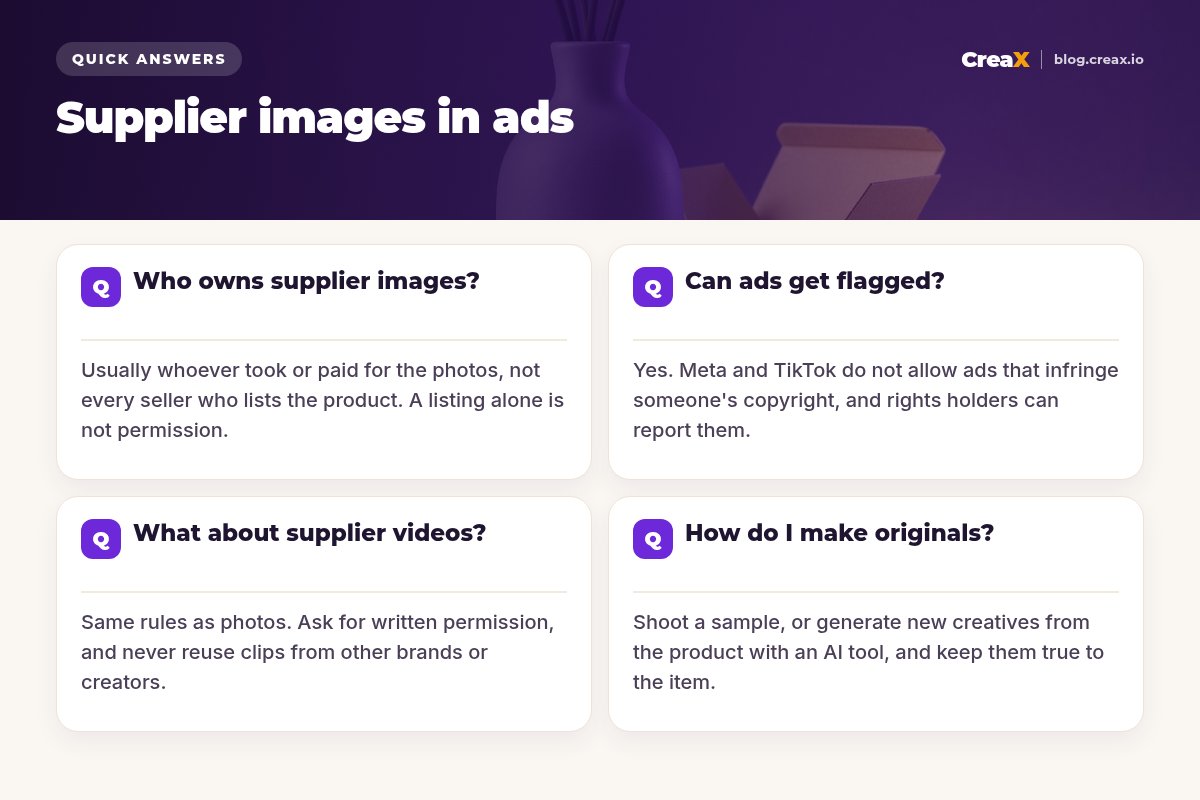
OwnershipWho owns supplier images?
In most places, copyright in a photo starts with the person who created it, or with the company that employed or commissioned them. For a typical AliExpress listing, that could be:
- The factory or brand that shot its own product photos.
- The supplier running the store, if they took or paid for the photos.
- Another seller or brand entirely, whose photos were copied into the listing without permission. This happens more than people think, especially with photos that look like a polished brand shoot.
That is why “I found it on the supplier's page” is not a safe answer. The listing tells you what the product looks like; it does not tell you who owns the picture or whether you may use it.
| Image source | Can you use it in ads? | What to do |
|---|---|---|
| Supplier's own photos | Possibly, with permission | Ask in writing and keep the reply |
| Photos copied from a brand's website | No | Do not use; make your own |
| Images showing another brand's logo | No | Avoid; it can also suggest a fake affiliation |
| Photos you took of your sample | Yes, you own them | Use freely, keep them accurate |
| New creatives you generated from your product | Check the tool's terms for commercial use | Keep them true to the real item |
General guidance only. Rules vary by country and by platform; check each platform's current policies.
Platform rulesCan ads get flagged?
Yes. Both big ad platforms have intellectual property rules for ads:
- Meta lists intellectual property infringement in its Advertising Standards: ads must not infringe third-party copyrights or trademarks, and rights holders can report ads through Meta's IP reporting channels.
- TikTok says in its advertising policies that ads infringing others' copyright or trademarks are not allowed, that ads are reviewed before they go live and may be reviewed again afterwards, and that advertiser accounts can be suspended, temporarily or permanently, for copyright and trademark violations.
In practice, the risk is not only a rejected ad. A rights holder who spots their photos can report the ad or your store, and repeated problems can put the ad account at risk, which hurts much more than one lost creative. If you are already fighting rejections, our guide to whether AI UGC ads are allowed on Meta and TikTok covers the other common policy questions.
★Watch for hidden problems in supplier photos
VideoWhat about supplier videos?
Supplier videos follow the same logic as photos, with a few extra traps:
- Music. A supplier video may include a track that you have no license to use in ads. TikTok, for example, requires promoted content to use original or commercially cleared sounds.
- People. Videos with a person on camera raise questions about who agreed to appear in an ad for your store.
- Clips from other brands or creators. TikTok's policy names using clips from unauthorized media sources to promote your product as an example of what is not allowed.
If you have a written OK from the supplier, use the clip as raw material: trim it, remove any music you cannot license and add your own hook and captions. Better still, make your own short video. Our guide to product demo video ads without filming shows how.
FixHow do I make originals?
You have three practical routes, and most stores use a mix:
Order a sample and shoot it
Generate new creatives from your product
Commission content
Keep everything accurate
Worked example: a reed diffuser
Say you want to test a ceramic reed diffuser you found on AliExpress. The listing has six polished photos, two with a brand name printed on the bottle and one with a model holding it. Instead of copying them, you message the supplier and ask whether you may use the plain product shots in ads; they reply yes in writing, and you save that message. You skip the photos with the printed brand and the model entirely.
While the sample ships, you paste the product link into an AI creative tool to get new studio ads and a short UGC-style video for two angles: a calm bedroom and a gift for a new home. When the sample arrives, you check the color and size against the creatives, take a few phone photos of your own and swap in any image that does not match. Every image in your ads and on your landing page is now either yours or covered by written permission.
Make original ad creatives from a product link
Paste the product link into CreaX and get new studio ads, UGC-style video ads and a landing page in about 60–120 seconds.
AvoidCommon mistakes to avoid
- Treating “everyone uses it” as permission. Other stores using the same photos does not make it safe.
- Cropping out a watermark. Removing a watermark from someone else's image makes the problem worse, not better.
- Using photos from the brand behind a similar product. If your item looks like a branded product, using that brand's photos also suggests a link you do not have.
- Letting AI invent features. Generated creatives must still show the real product, not a nicer version with extras it does not have.
- Forgetting the landing page. The same rules apply to the images on the page your ad sends traffic to; platforms review landing pages too.
Before you launchChecklist you can copy
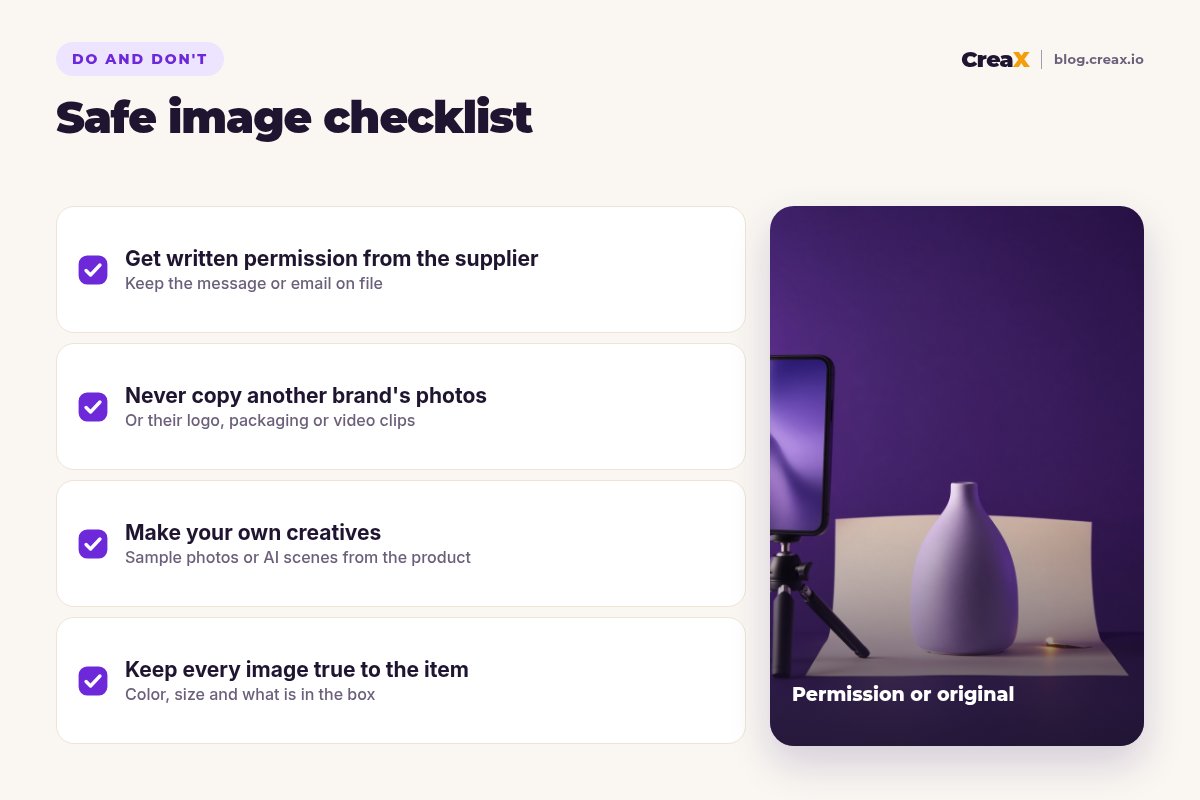
Image rights checklist
- ✓Do I own this image or have written permission? If not, replace it.
- ✓Is there any brand logo, watermark or foreign text? Remove the image, not just the mark.
- ✓Does any video include music I cannot license? Swap it for original or commercially cleared audio.
- ✓Does every image match the real product? Color, size, materials and contents.
- ✓Are my landing page images clean too? Apply the same checks there.
- ✓Do I keep proof? Save permission emails, sample photos and generation history in one folder.
CreaXHow CreaX helps (briefly)
CreaX is an AI ecommerce creative OS. You can paste a link from Alibaba, AliExpress, Amazon, Etsy or any product page, or upload your own product photo, and CreaX extracts the product details and builds a kit from them in about 60–120 seconds: studio ad creatives in five styles and four sizes, UGC-style video ads of 18, 30 or 45 seconds, a publish-ready landing page and a store to sell from.
Instead of reposting the listing photos as they are, you get new creatives built around your product, with your hooks and your page. You are still responsible for what you sell and say: if a product carries another company's brand, or a claim you cannot prove, leave it out. For more on using AI images responsibly, read are AI-generated ads safe to use commercially? and can AI product photos replace a photoshoot?
Stop reusing the same supplier photos
One product link gives you new studio ads, UGC-style videos and a landing page that look like your brand, not everyone else's.
FAQFrequently asked questions
Q.Is it illegal to use AliExpress pictures for my store?
Q.Can I use AliExpress images if I edit them?
Q.Will Facebook reject my ad for using supplier photos?
Q.Can I use supplier images on my product page but not in ads?
Q.Are AI-generated product images safe to use?
Q.Do I need a sample before advertising?
Ready to make creatives you can stand behind?
Paste a product link and get original ads, videos and a landing page for your next test.
This guide is published by CreaX. It summarizes Meta's and TikTok's public advertising policies as of October 2026 and is general information, not legal advice. Check each platform's current policies and ask a lawyer about specific cases.