
UGC vs Influencer Marketing: What's the Difference?
FAQ · UGC vs influencer marketing
UGC vs influencer marketing: they look similar in a feed, but they solve different problems. This guide explains who posts the content, what you actually pay for, which works best in paid ads and where AI UGC fits, with a checklist to plan your next campaign.
Updated October 2026 · By the CreaX team
Key takeaways
- ✓UGC is content made by customers or creators that you publish, mostly in ads and on product pages. Influencer marketing pays a creator to post to their own audience.
- ✓With UGC you pay for the content; with influencers you pay for the content and the reach. That's why UGC is usually cheaper per video.
- ✓For paid ads, UGC is built for the job. Influencer content can run as ads too, but only with usage rights in your agreement.
- ✓AI UGC-style videos let you test many angles quickly. Use them as a format, never as fake customer testimonials.
In this guide
TL;DRThe short answer
User-generated content (UGC) is photos and videos that look like they come from real users: an unboxing, a quick demo, an honest “here's what I like”. Brands either collect it from customers or pay creators to make it, then publish it themselves: in ads, on product pages, in emails.
Influencer marketing is paying, or gifting, a creator with an audience to talk about your product on their own channels. You're buying their content and their followers' attention and trust.
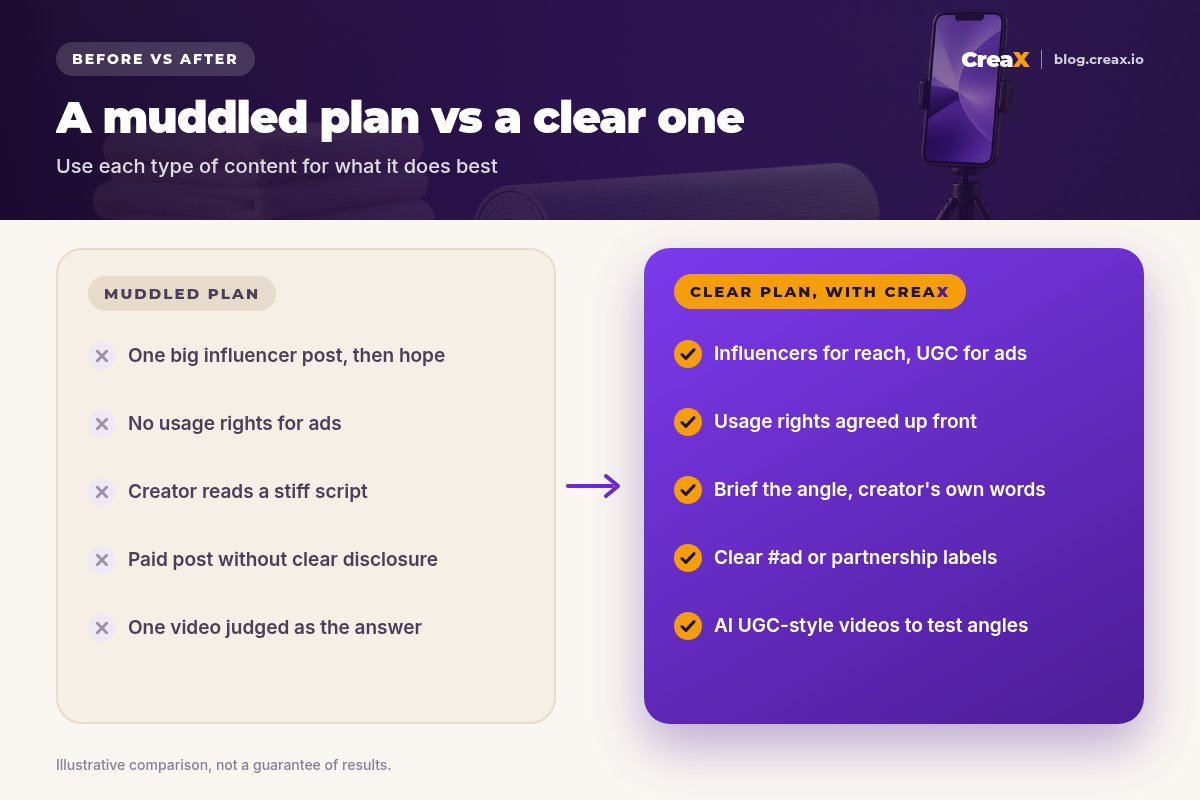
Same look, different deal. UGC is a content supply for your channels. Influencer marketing is distribution through someone else's channel. You can use both: influencers for awareness and social proof, UGC for testing and scaling paid ads.
| UGC | Influencer marketing | |
|---|---|---|
| Who makes it | Customers or UGC creators | Influencers with an audience |
| Who posts it | You: ads, product pages, emails | The influencer, on their channels |
| What you pay for | The content (plus usage rights) | Content, reach and audience trust |
| Main goal | Ad creatives and on-site proof | Awareness and social proof |
| How you measure it | Ad metrics: hook rate, CTR, CPA | Reach, engagement, codes, links |
| Volume | Many videos, many angles | Fewer, bigger posts |
A general comparison; individual deals vary.
The key differenceWho posts the content?
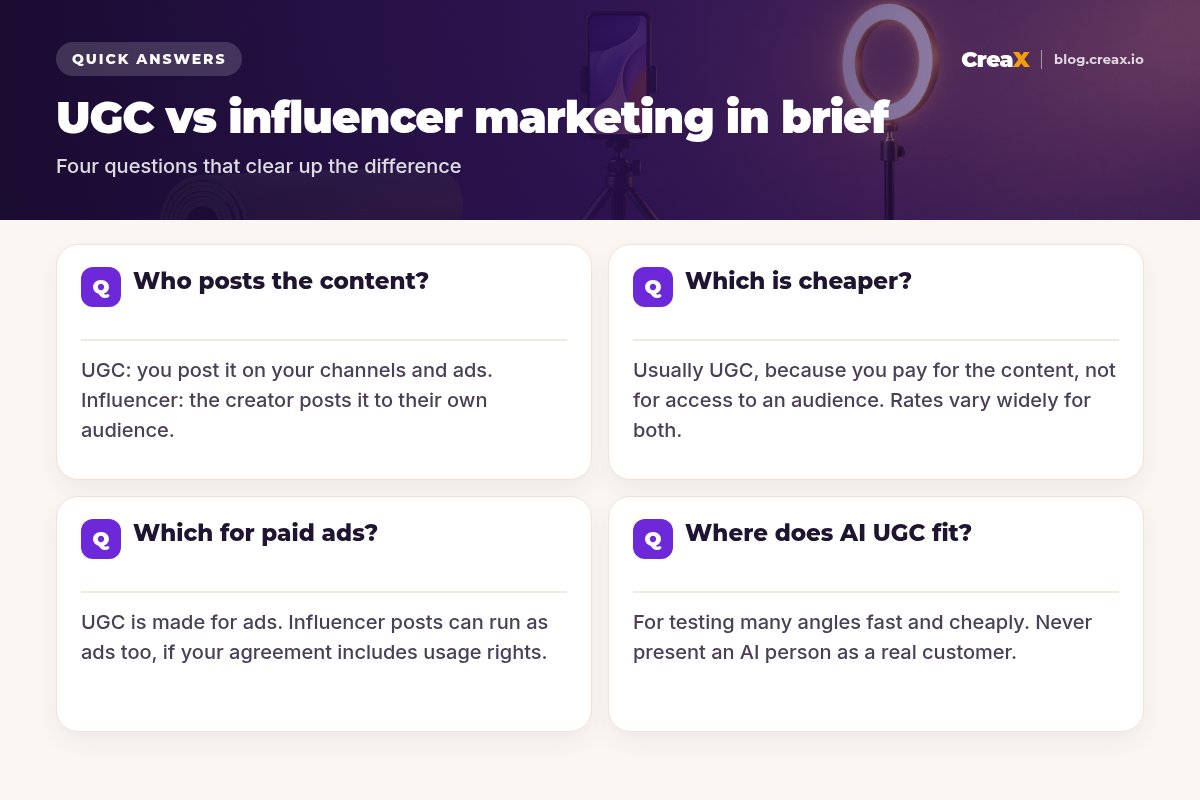
This is the simplest way to tell them apart. With UGC, the creator usually never posts the video on their own profile. They deliver files, and you run them as ads or put them on your page. The creator's follower count barely matters; what matters is whether the video looks natural and sells the product.
With influencer marketing, the post goes up on the creator's account, in front of their followers. That's the point: you're borrowing an audience that already trusts them. Follower quality, engagement and audience fit matter a lot.
★A quick test
CostWhich is cheaper?
Per piece of content, UGC is usually cheaper, because you're not paying for access to an audience. Influencer fees rise with audience size and engagement, and big creators can cost far more than a UGC video. Rates for both vary widely by creator, platform, usage rights and deliverables, so treat any price list you see online as a rough guide. For a breakdown of what drives UGC prices, see how much a UGC video ad costs.
Cheaper isn't the same as better value, though. An influencer post that reaches the right audience can drive sales a UGC ad would need paid spend to reach. Compare cost per sale or cost per qualified visitor, not cost per video.
- UGC costs: creator fee per video, usage rights, revisions, product samples and the ad spend to show it.
- Influencer costs: creator fee or gifted product, usage rights if you want to run the post as an ad, and time to find, vet and manage creators.
AdsWhich for paid ads?
UGC is made for paid social. Brands commission several versions of a video with different hooks, lengths and angles, then let the ad platform find the winners. Because you own the files, you can cut, caption and resize them freely, within the rights you agreed.
Influencer content can work well in ads too, often through formats like partnership ads that run from the creator's handle. But you need written permission covering where, how long and in which ads you can use it. Without usage rights, you may not be allowed to put an influencer's post into paid ads at all.
Get UGC-style ads without waiting on creators
Paste a product link and get UGC-style video ads, studio creatives and a landing page in about 60–120 seconds.
AIWhere does AI UGC fit?
AI tools now generate UGC-style videos from a product link or image. They don't replace real customers or influencers, but they solve one specific problem: testing many angles quickly and cheaply before you invest in creators. If an angle wins with an AI UGC-style video, you can brief a real creator on the proven message.
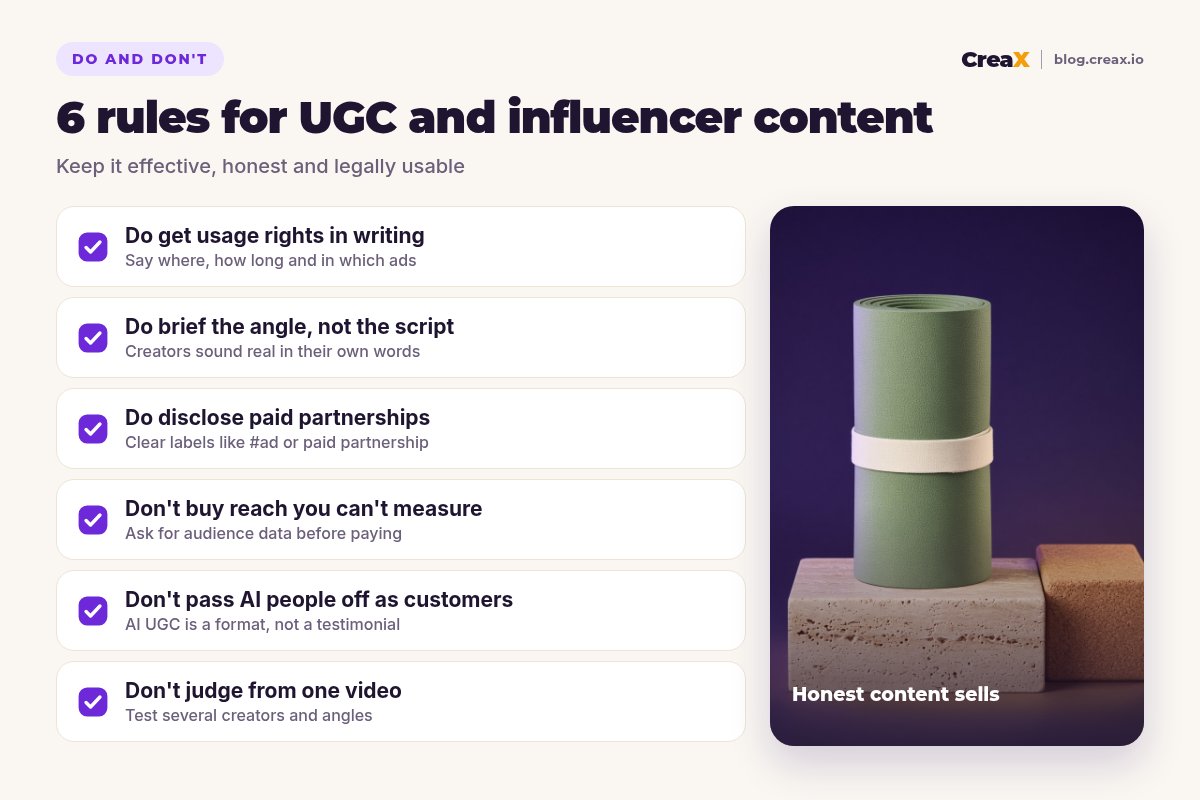
The rule is simple: an AI-generated person is a format, not a customer. Never present one as a real buyer, never put testimonial claims in its mouth, and follow each platform's rules on AI-generated content. Our guide on whether AI UGC ads are allowed on Meta and TikTok covers the details, and what a UGC video ad is covers the basics.
ExampleWorked example: launching a yoga mat
Say you sell a sage green yoga mat with a cotton carry strap. Here's how UGC, AI UGC and influencers could each play a part without wasting budget:
Test angles with AI UGC-style videos
Send all ads to one matching page
Brief real UGC creators on the winner
Add an influencer for reach
Keep refreshing
Each step answers a different question: which message works, who says it best, and who else should hear it. That order keeps the most expensive part, influencer fees, until you know what to say.
Save moneyCommon mistakes to avoid
- Paying influencer rates for UGC. If you only need files for ads, you don't need to pay for an audience.
- Forgetting usage rights. Agree in writing where, how long and in which ads you can use the content.
- Over-scripting creators. Brief the angle, the product facts and what not to claim, then let them speak naturally.
- Skipping disclosure. Paid or gifted posts need clear labels. In the US, the FTC's endorsement guides require disclosing material connections.
- Judging from one video. One creator and one angle tell you little. Test several.
- Choosing influencers by follower count alone. Check audience location, engagement and fit with your product.
!Keep it honest
PlanChecklist you can copy
Before you brief anyone
- ✓Decide the goal first: awareness (influencers) or ad creatives (UGC).
- ✓Write a one-page brief: product facts, the angle, must-show moments and claims to avoid.
- ✓Agree usage rights in writing: channels, duration and paid ads.
- ✓Plan disclosure: #ad, paid partnership labels or platform tools.
- ✓Test several angles: with UGC creators or AI UGC-style videos before scaling.
- ✓Measure the right thing: cost per sale for ads; reach and code redemptions for influencers.
- ✓Send traffic to a matching page: the landing page should repeat the video's promise.
Our roleHow CreaX helps (briefly)
CreaX is an AI ecommerce creative OS. It won't find influencers for you, but it handles the testing side. Paste a product link or upload a product image and, in about 60–120 seconds, you get:
- UGC-style video ads for Reels, Stories and TikTok, to test angles before you brief creators.
- Studio ad creatives: polished product photos and static ads.
- A publish-ready landing page that matches the ads, so creator and AI traffic land on the same message.
- A multi-tenant store for several brands or niches.
Plans start at $4.99/month for 2,000 credits, with top-ups at $1 per 500 credits. For a cost comparison with creator agencies, see CreaX vs UGC agencies.
Test the angle, then brief the creator
One product link, about 60–120 seconds: UGC-style video ads, studio creatives and a landing page.
FAQMore questions sellers ask
Q.Is UGC the same as influencer marketing?
Q.Can an influencer make UGC for me?
Q.Do I need to disclose UGC in ads?
Q.Which is better for a new product?
Q.What are usage rights?
Q.Is AI UGC allowed?
Ready to test your next angle?
Paste a product link and get UGC-style video ads, studio creatives and a landing page for your next test.
This guide is published by CreaX. It's general information, not legal advice; check the advertising and disclosure rules in the countries you sell to.