
How to Test Ad Angles for a New Product
How to · Ad angle testing
When a new product test fails, the product is often fine. The angle was wrong. This guide shows you how to test ad angles properly: where to find five real reasons people would buy, how to turn each into two creatives, how to keep the test fair with one page and an equal budget, how to read CTR and cost per purchase, and how to double down on the one or two angles that win.
Updated October 2026 · By the CreaX team
Key takeaways
- ✓An angle is the reason to buy (save time, fix a problem, look good, a gift). A hook is how the first seconds of one ad express it. Test angles first, hooks second.
- ✓Use five angles × two creatives. Two executions per angle stop one weak ad from killing a good idea.
- ✓Keep everything else equal: same landing page, same offer, same audience, equal budget per angle. Only the angle changes.
- ✓Judge on cost per purchase against your break-even. CTR tells you which angle gets attention, not which one sells.
In this guide
The goalWhat you'll have at the end
By the end you will have a simple angle test for one new product: five distinct angles, ten creatives, one landing page, a budget split, written rules for when to stop or scale, and a way to read the results that tells you what to make next.
Most sellers test creatives, not angles. They make ten ads that all say “this blender is great” in slightly different colors, then pick whichever got the most likes. An angle test asks a better question: which reason to buy makes the right people pay? Once you know that, every future creative, page headline and offer can be built around it.
iAngle vs hook in one sentence
PrepWhat you need before you start
- One product and one landing page. The page should have a neutral headline that doesn't favour any single angle, or you'll tilt the test. If you need a page, see how to turn a product link into a landing page.
- Your break-even cost per purchase. Price minus product cost, shipping and fees. Our guide to break-even ROAS for dropshipping shows the maths.
- A test budget you can afford to lose. Treat it as the price of information.
- Pixel or conversion tracking that works, so purchases are reported back to the ad platform.
- Proof for every claim. If an angle depends on a claim you can't back up, drop the angle.
Step 1Step 1: List 5 angles
Good angles come from what real buyers care about, not from what you find clever. Five reliable sources:
- Reviews of similar products. Read the best and worst reviews on marketplaces. Praise tells you outcomes people value; complaints tell you problems your product can solve.
- Comments on competitor ads. Questions and objections in comments are free research.
- Public ad libraries. The Meta Ad Library and TikTok Creative Center show what others are running. Look for repeated themes, then find your own way to say them.
- The moment of use. Where, when and why does someone reach for this product? Each situation can be an angle.
- Who it’s for and who buys it. The user and the buyer are sometimes different people, which is where gift angles come from.
Then make sure your five angles are genuinely different reasons to buy. A useful set of angle types:
| Angle type | The reason to buy | Example (portable blender) |
|---|---|---|
| Problem → fix | It removes an everyday annoyance | No more washing a big blender for one smoothie |
| Outcome | It gets you a result you want | A fresh smoothie at your desk or after the gym |
| Situation | It fits a specific moment | Breakfast on the commute, shakes while travelling |
| Identity | It fits who you are or want to be | For people who take their mornings seriously |
| Gift | It solves a gift problem for the buyer | The gift for the friend who lives at the gym |
Example angles. Only use claims your product and supplier can back up.
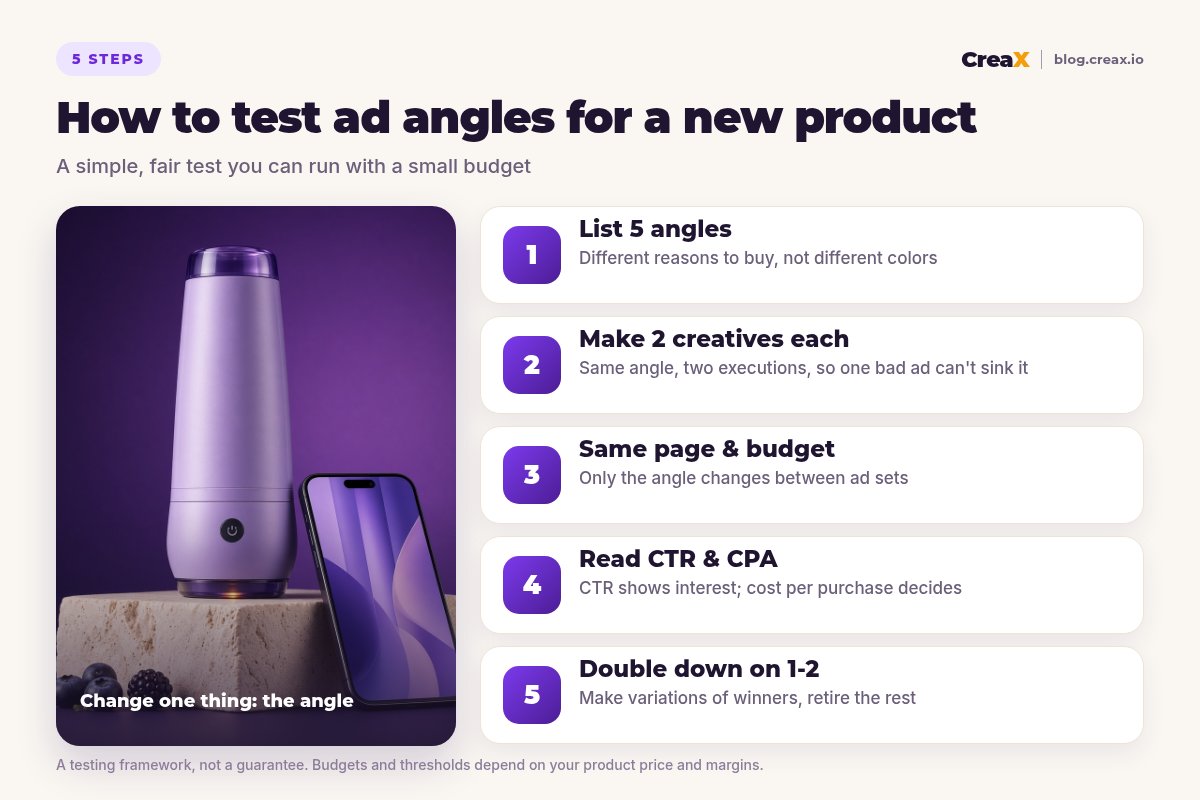
Step 2Step 2: Make 2 creatives each
For each angle, make two creatives that say the same thing in different ways. Why two? Because a single ad can fail for reasons that have nothing to do with the angle: a weak first frame, a bad thumbnail, poor lighting. Two executions give each angle a fair chance.
Keep the angle obvious in the first seconds
Vary the execution, not the message
Use the same product, offer and call to action
Label everything
Ten creatives is a lot to produce by hand. This is where generating creatives from one product link or image saves days; our guide on turning one product image into a week of ad tests shows the approach.
Make ten creatives without a designer
Paste a product link and CreaX generates studio ad creatives, UGC-style video ads and a landing page in about 60–120 seconds, ready to adapt to each angle.
Step 3Step 3: Same page & budget
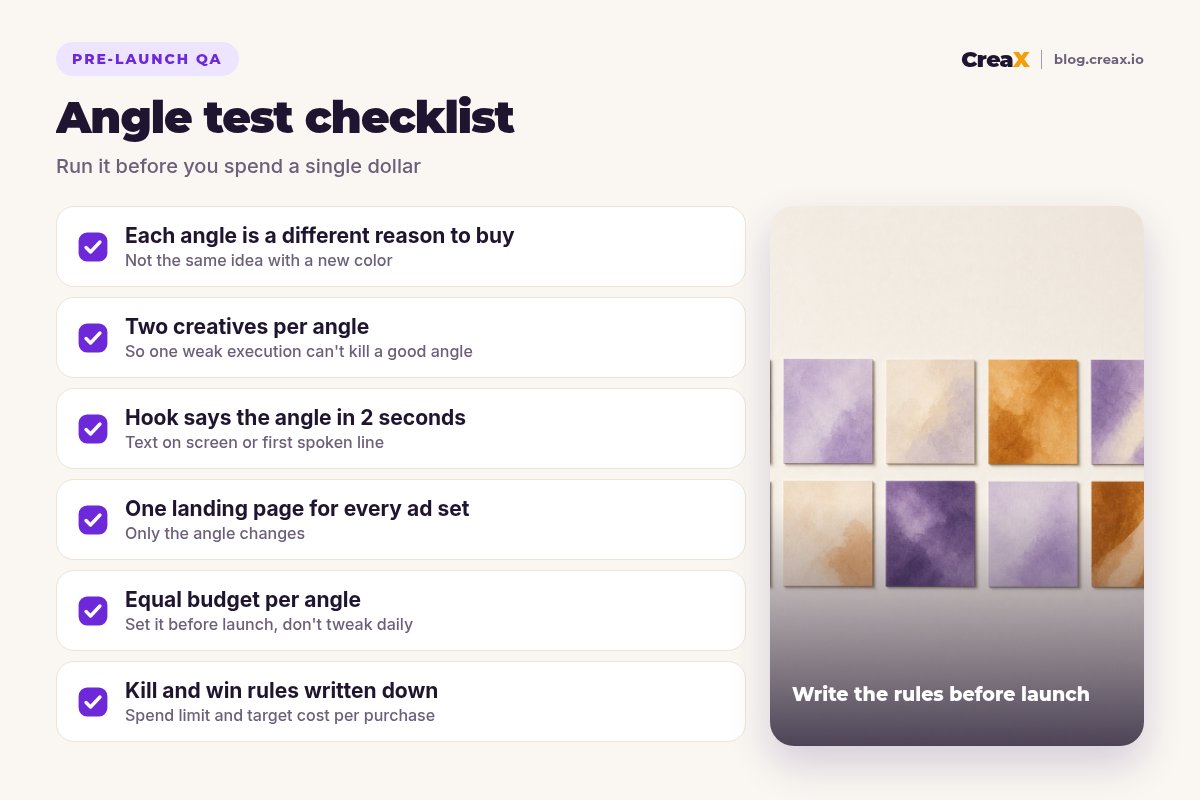
A test is only useful if the angle is the only thing that changes. Lock these down before launch:
- One landing page for every angle. Different pages would mean you are also testing pages.
- One audience setup. Same targeting (or the same broad setup) for every angle.
- Equal budget per angle. Running each angle in its own ad set with its own budget keeps spend even. If you let the platform distribute budget automatically, it may pick a favourite early and starve the others.
- Same schedule. Launch all angles at the same time, so day-of-week effects hit them equally.
- Written rules. Decide in advance how much each angle can spend before you judge it, and what cost per purchase counts as a win.
★A simple stop rule
Step 4Step 4: Read CTR & CPA
Two numbers do most of the work. Click-through rate (CTR) tells you whether the angle earns attention and clicks. Cost per purchase (CPA) tells you whether it earns money. Read them together:
| What you see | What it usually means | What to do |
|---|---|---|
| High CTR, good CPA | The angle attracts and converts | A winner: scale and make variations |
| High CTR, poor CPA | People are curious, but the page or offer doesn't close | Check the page repeats the angle; check price, shipping and proof |
| Low CTR, good CPA | Few clicks, but the right people buy | Keep the angle, test stronger hooks |
| Low CTR, poor CPA | The angle doesn't resonate | Pause it and move budget to better angles |
Patterns to look for, not fixed thresholds. Compare angles against each other and against your break-even.
Also glance at hold rate or thumb-stop rate for video, add-to-cart rate and comments. Comments often tell you why an angle works or fails. If clicks come in but sales don't, read creative fixes for Facebook ads that are not converting or, for TikTok, TikTok ads with views but no sales.
!Don't judge on likes or views
Step 5Step 5: Double down on 1–2
Once one or two angles clearly beat the rest, stop spreading budget thinly:
Move budget to the winners
Make new hooks for the winning angle
Align the page
Watch for fatigue
Turn your winning angle into fresh creatives
Generate new studio ads and UGC-style video ads for the angle that won, plus a page that leads with it, in one pass.
ExampleWorked example: a portable blender
Say you are testing a rechargeable portable blender bottle. You list five angles: no-mess cleanup, smoothies at the desk, gym and protein shakes, travel and commuting, and a gift for a health-minded friend. For each, you make one UGC-style video and one studio static, all pointing to the same landing page with a neutral headline.
| Angle | Creative A | Creative B |
|---|---|---|
| No-mess cleanup | Video: rinse and done in the sink | Static: big blender vs bottle, side by side |
| Smoothies at the desk | Video: fruit in, blend, sip at a laptop | Static: bottle next to a keyboard and fruit |
| Gym and shakes | Video: shake blended in a gym bag moment | Static: bottle with a gym towel and scoop |
| Travel and commute | Video: blend on a train or in a car (parked) | Static: bottle in a backpack pocket |
| Gift | Video: unboxing as a present | Static: gift-wrapped bottle with a tag |
Illustrative plan. Every claim (battery, cleaning, power) must match what your supplier can prove.
You launch five ad sets with equal budgets and agree in advance how much each can spend before judging. Imagine that, by the end, “no-mess cleanup” shows a high CTR and the best cost per purchase, “gift” has a lower CTR but some efficient sales, and the others have clicks with few or no purchases. Your next move: scale cleanup with new hooks, keep gift running at a small budget for the holidays, pause the rest, and rewrite the page headline around easy cleanup.
Common pitfallsMistakes to avoid
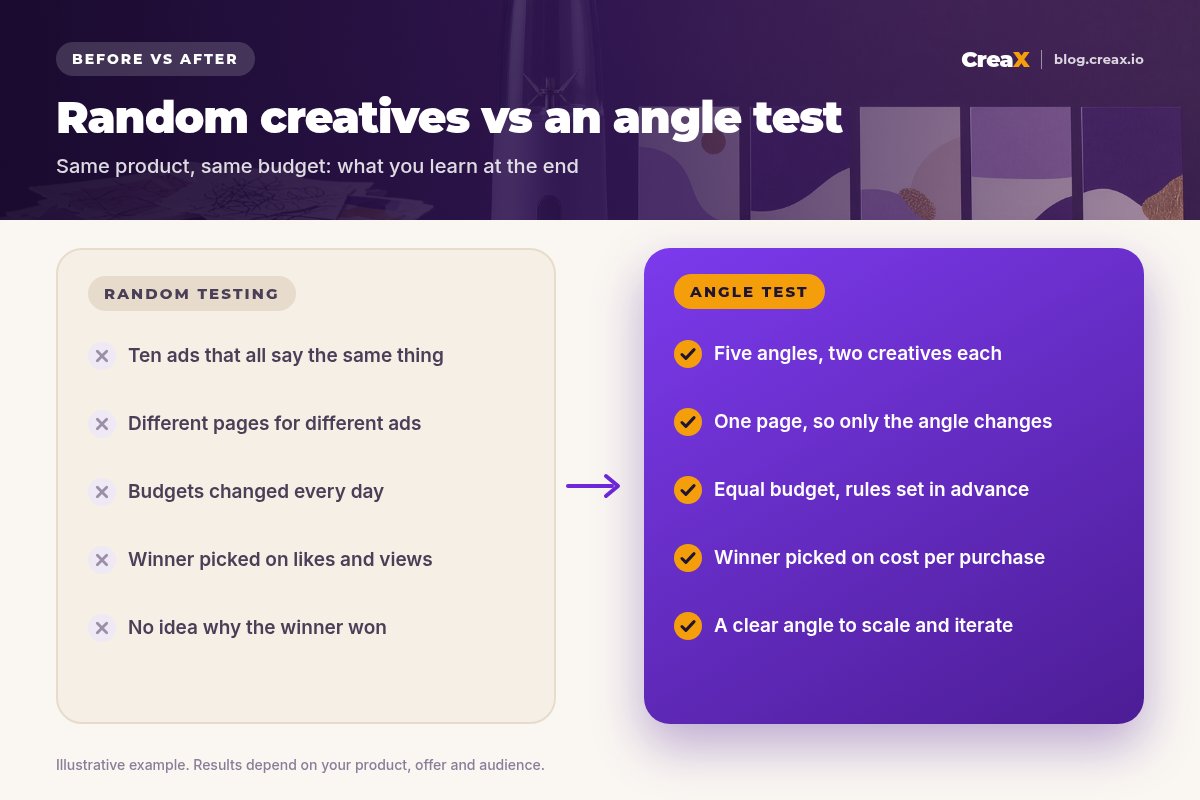
- Testing five versions of one angle. Different colors are not different reasons to buy.
- One creative per angle. A weak execution can bury a strong angle.
- Different pages per ad. You won't know whether the angle or the page made the difference.
- Changing budgets daily. Constant tweaks reset learning and blur results.
- Calling it too early. A few clicks are not a verdict. Stick to your written rules.
- Claims you can’t prove. An angle built on a false promise wins clicks and loses ad accounts.
Before you launchChecklist
Angle test launch checklist
- ✓Five angles written down, each a different reason to buy
- ✓Each angle sourced from reviews, comments, ad libraries or use moments
- ✓Two creatives per angle, the angle clear in the first seconds
- ✓One landing page with a neutral headline for all ad sets
- ✓Same audience, offer and schedule for every angle
- ✓Equal budget per angle, set before launch
- ✓Break-even cost per purchase known; stop and win rules written
- ✓Ads named with product, angle and version
- ✓Every claim backed by product facts
FAQFrequently asked questions
Q.What is an ad angle?
Q.How many angles should I test for a new product?
Q.Should I test angles with video or static ads?
Q.How long should an angle test run?
Q.What if no angle wins?
Q.Can AI help me test more angles?
Ready to find your winning angle?
One product link, about 60–120 seconds: studio creatives, UGC-style video ads and a landing page to test your first five angles.
This guide is published by CreaX. It describes a general testing framework, not guaranteed results, and contains no invented statistics. Budgets and thresholds depend on your product, margins and ad platform.