
Static Ads vs Video Ads: Which Should You Test First?
FAQ · Ad testing
Static ads vs video ads is one of the first decisions you face when you launch a product, and the internet is full of confident answers in both directions. The honest answer is that it depends on your product, your placements and your budget, and that you can find out cheaply. Here's how to decide which format to test first, how to compare them fairly, and when to run both.
Updated October 2026 · By the CreaX team
Key takeaways
- ✓Static ads are usually faster and cheaper to make, which makes them a good way to test several angles quickly.
- ✓Video ads can show the product in use and tell more of the story, and placements like Reels and TikTok are built for them.
- ✓For a fair test, keep the product, angle, offer, page, audience and budget the same, and change only the format.
- ✓Judge on cost per purchase, not likes or views. Many sellers end up running both, each in the placements it suits.
In this guide
TL;DRThe short answer
If you're unsure which angle will work, start with static ads to test angles quickly, then turn the winning angle into video. If your product needs to be seen in motion to make sense (a gadget, a cleaning product, anything with a satisfying demo), or you're mainly advertising in Reels or TikTok, start with video. And if you can make both cheaply, test both from day one.
| Static ads | Video ads | |
|---|---|---|
| Effort to make | Lower: a good image and a clear headline | Higher: footage, editing or AI generation |
| What they do well | One clear message, fast to read | Show the product in use, build trust, tell a story |
| Where they fit | Feeds, Stories, retargeting, catalog-style ads | Reels, TikTok, Stories, and feeds |
| Iteration speed | Fast: swap headline or image in minutes | Slower, unless you can generate variations quickly |
| Common risk | Easy to scroll past without movement | Weak first seconds lose viewers fast |
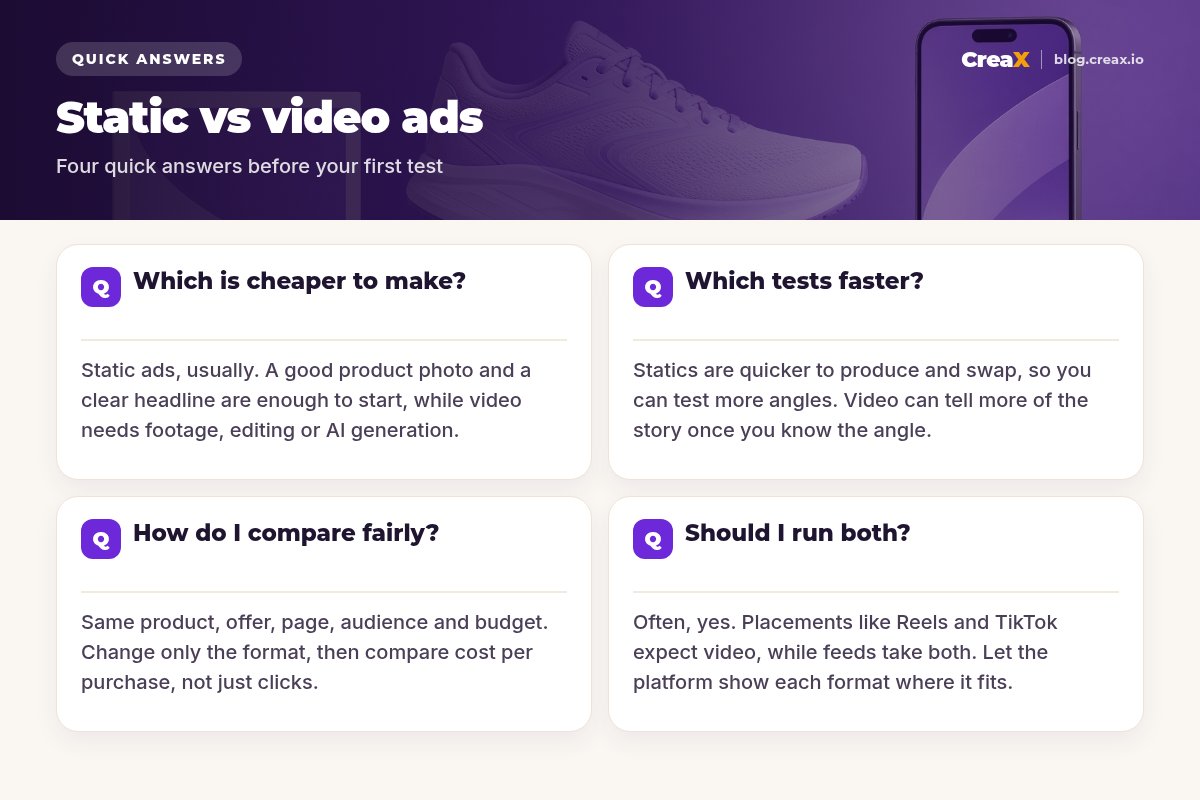
Q1Which is cheaper to make?
Usually static ads. You need one good product image, a headline that states the benefit and maybe a price or offer. With a decent product photo, a designer or an AI tool can produce several variations quickly.
Video costs more because it needs footage. You can film it yourself, pay a creator for UGC-style content or generate it with AI. Creator videos can take days to arrive and cost more per asset, which is why many sellers hold back on video until they know which angle to invest in.
That gap is shrinking. AI tools can now generate UGC-style video ads from a product link or image, so the cost of a first video test is much closer to the cost of a static test than it used to be. Our breakdown of CreaX vs UGC agencies looks at that trade-off in detail.
Q2Which tests faster?
Statics are faster to produce and to change. If you want to test five angles (gift, problem-solver, price, quality, lifestyle), five statics are quick to make, and you can swap a headline within minutes when one underperforms.
Video can be faster to learn from in placements built for it. A video in Reels or TikTok gives you extra signals, such as how many people watched past the first seconds and how long they stayed, which helps you diagnose whether the problem is the hook, the middle or the offer.
★A practical order
Get statics and video ads from one product link
CreaX generates studio ad creatives and UGC-style video ads together, plus a landing page, in about 60–120 seconds.
Q3How do I compare fairly?
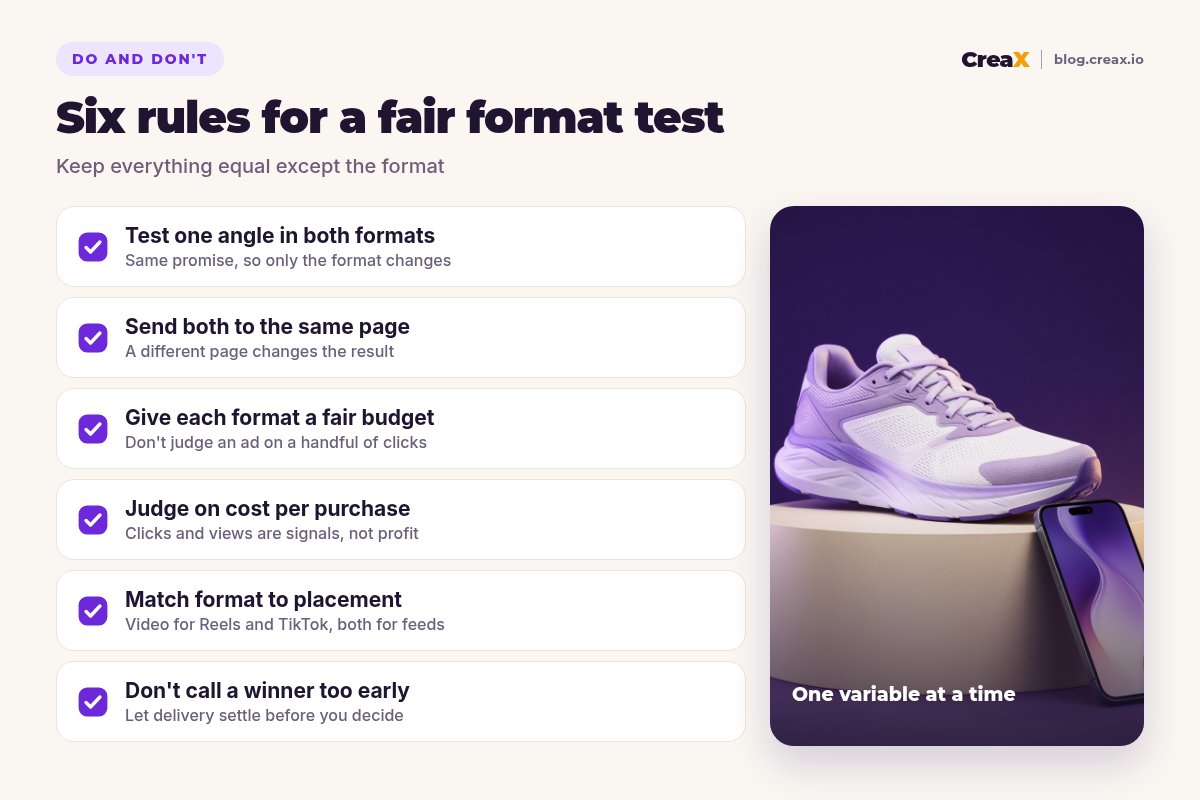
Most “video beats static” or “static beats video” conclusions come from unfair tests. To learn something real, keep everything the same except the format:
Pick one angle
Use the same page and offer
Match audience and budget
Let both get enough spend
Compare cost per purchase
If you use broad campaigns like Advantage+, the platform may favour one format by placement. That's useful information, not a broken test, but it means you should look at results by placement too. See creatives for Meta Advantage+ campaigns for more.
Q4Should I run both?
Often, yes. Different placements reward different formats. Reels and TikTok are built for vertical video; feeds show both; retargeting audiences who already know the product may respond well to a simple static with a clear offer.
Running both also protects you from creative fatigue: when one format tires, you have the other ready. A healthy setup for a product with traction often includes several statics and several videos built around the same winning angles.
Example: a running sneaker
Say you sell a lightweight running sneaker. A static with a clean side view, the headline “Feels broken-in from the first run” and the price is quick to make and easy to read in the feed. A UGC-style video showing someone lacing up, bending the sole and starting a run shows the flexibility that a photo can't. Test the angle with statics first, then make the video version of the winner, and run each where it fits.
MistakesCommon mistakes to avoid
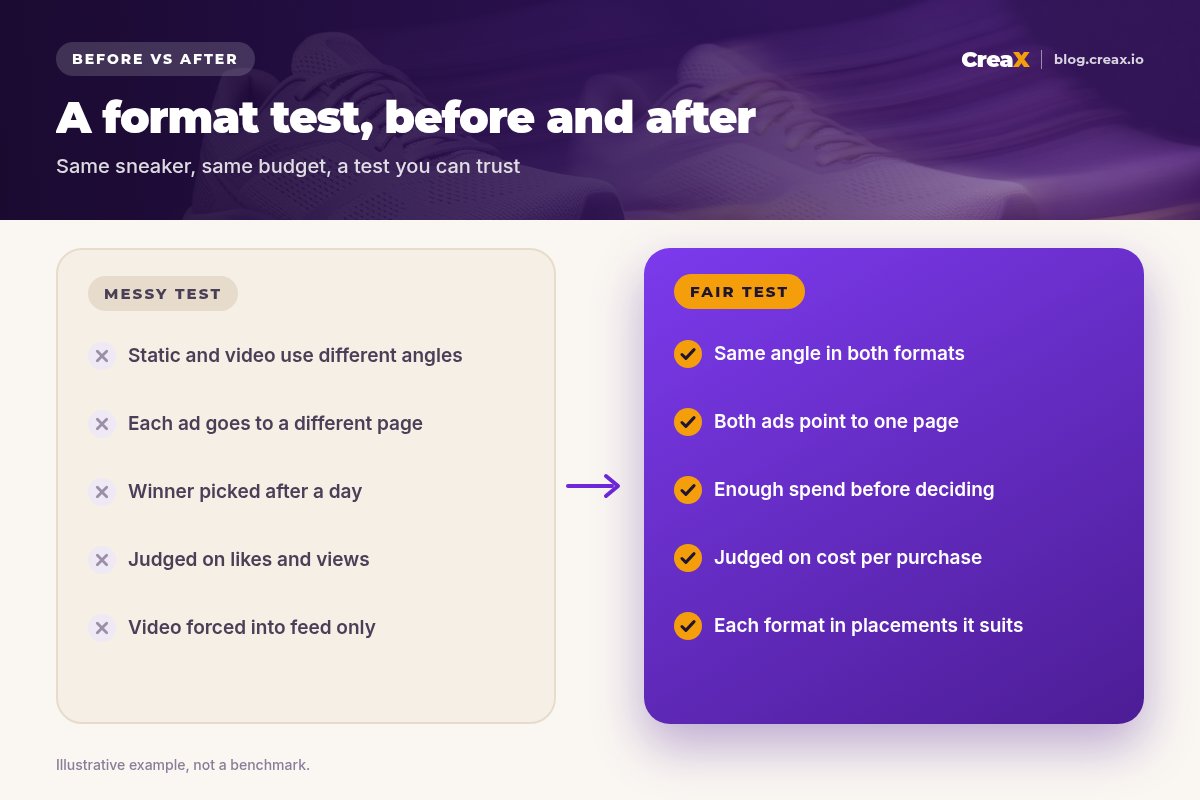
- Different angles in each format. If the static says “gift idea” and the video says “comfort”, you're testing angles, not formats.
- Different pages. Sending one format to the product page and the other to a landing page muddies the result.
- Calling it too early. A winner after one day is often just noise.
- Judging on likes and views. Engagement is nice; purchases pay the bills.
- Resized video. A horizontal clip cropped for Reels rarely looks native. Make vertical video for vertical placements.
- Overloaded statics. Five claims on one image means none of them land. One message per static.
ChecklistChecklist you can copy
Run a fair static vs video test
- ✓Angle: one promise, used in both the static and the video.
- ✓Page: both formats send traffic to the same page and offer.
- ✓Setup: same audience, budget and campaign settings.
- ✓Formats: vertical video for Reels and TikTok; statics sized for feeds and Stories.
- ✓Spend: enough delivery on each ad before deciding.
- ✓Metric: cost per purchase decides; CTR and watch time explain why.
- ✓Next step: turn the winning angle into more variations in both formats.
CreaXHow CreaX helps (briefly)
The main reason sellers test statics first is that video used to be slow and expensive to make. CreaX removes most of that gap: paste a product link or upload a product image and, in about 60–120 seconds, you get studio ad creatives (static ads and product photos), UGC-style video ads and a publish-ready landing page from the same input. That makes a fair test easy, because both formats share the same product understanding and point to the same page.
You still choose the angles, edit the copy and check every claim. For how many variations to make, see how many ad creatives to test per product; for statics specifically, see carousel ads for ecommerce.
Run your first format test this week
One product link gives you static ads, UGC-style video ads and a matching landing page, so the format is the only variable.
MoreMore questions sellers ask
Do carousels count as static? They're usually images, but they behave differently: several cards let you tell a short story or show variants. Treat them as their own format in tests.
What about image ads with motion? Light animation on a static (a moving price tag, a subtle zoom) sits between the two. It can be a cheap way to add movement before you invest in full video.
Should statics and videos share an ad set? You can put both in one ad set and let the platform distribute spend, which shows you what it prefers. For a cleaner comparison, give each format its own ad set with the same audience and budget. Both approaches are valid; just know which question you're answering.
Which numbers should I read for each format? For both, cost per purchase decides. For video, also look at how many people watch past the first few seconds and how long they stay; a weak opening is the most common reason a video loses. For statics, click-through rate tells you whether the headline and image earned the click.
Do I need a person in my video ads? No. Product demos and hands-only videos can work well. If you want a creator feel, see what a UGC video ad is.
FAQFrequently asked questions
Q.Are video ads better than static ads?
Q.Which format should a beginner test first?
Q.How long should I run a static vs video test?
Q.Can I use the same angle in both formats?
Q.Do static ads work on TikTok?
Q.How much does CreaX cost?
Ready to find your winning format?
Paste a product link: static ads, UGC-style video ads and a landing page in about 60–120 seconds.
This guide is published by CreaX. It reflects general ad-testing practice as of October 2026, avoids invented statistics and benchmarks, and recommends testing with your own products and budget.