
Should You Show the Price in Your Ads?
FAQ · Ad creatives
Should you show the price in your ads? There is no single right answer, but there is a right answer for your product. Showing the price can pull in ready buyers and filter out people who would never pay, or it can scare off shoppers before they understand why your product is worth it. Here is how to decide, how to show a discount honestly, and how to test it so your numbers make the call.
Updated October 2026 · By the CreaX team
Key takeaways
- ✓Show the price when it is a reason to buy: a clearly fair price, a real deal, an impulse product or a market where shoppers compare prices fast.
- ✓Hold it back when it needs context first: a premium or unfamiliar product, a bundle, or an offer that changes by size or market. Let the ad build value, then the page shows the price.
- ✓Discounts must be real. Use a reference price you actually charged, show the saving and the end date, and keep the same price on the ad, the page and the checkout.
- ✓Test it, do not guess. Run the same creative with and without the price and judge on cost per purchase, not clicks.
In this guide
TL;DRThe short answer
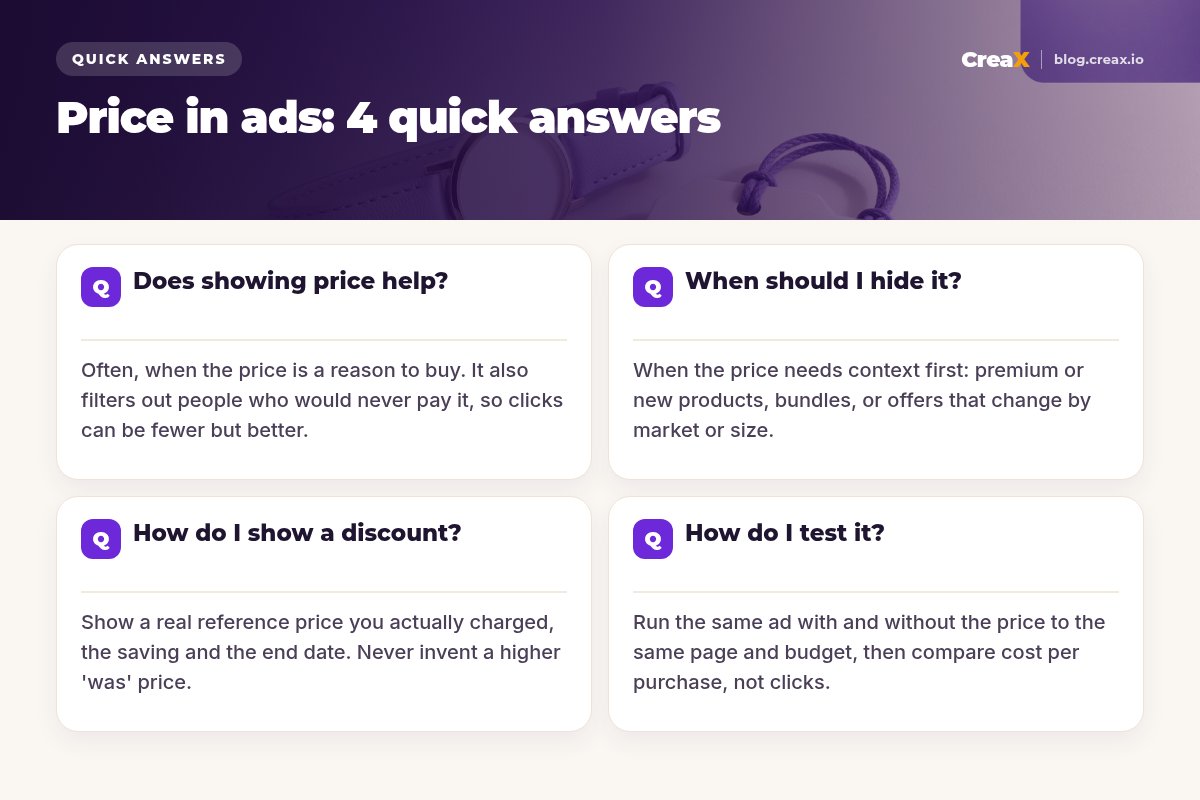
Put the price in the ad when it helps someone decide to buy, and leave it for the landing page when it would make them decide not to look. A price in the ad is a filter: fewer people may click, but the people who do already accept the price. A price held back is an invitation: more people may click, but some will leave when they see it.
Neither is better in general. What matters is whether the filter saves you money (fewer wasted clicks from people who will never buy) or costs you sales (people who would have bought once they understood the product). That depends on your product, your price point and your audience, which is why the honest answer is to test it.
Q1Does showing price help?
Showing the price tends to help when the price itself is part of the pitch. Common situations:
- Impulse and low-ticket products. A phone case, a pair of socks or a kitchen gadget. Shoppers decide fast, and a fair price removes the main question.
- A genuinely good deal. If you are cheaper than the obvious alternative, or running a real sale, the price is your hook.
- Price-sensitive audiences and markets. Where shoppers compare prices quickly, an ad without one can look like you are hiding something.
- Retargeting. People who already visited know the product. Reminding them of the price, or a real offer, can be the nudge they need. See retargeting ads for ecommerce.
- Catalog and shopping ads. Formats that show product listings usually display the price anyway, so your creative should not fight it.
A price in the ad can also lower wasted spend. If your product costs more than people expect, those who click without knowing will often bounce on the page. Putting the price up front means you pay for fewer of those clicks. That is why click-through rate alone can mislead you here: a lower CTR can still mean cheaper purchases.
★Price plus a reason works better than price alone
Q2When should I hide it?
Leaving the price for the landing page makes sense when the number needs a story before it lands well:
- Premium products. If you charge more than the obvious alternatives, lead with what makes the product different: materials, design, results you can prove, a guarantee. Show the price once the shopper sees why.
- New or unfamiliar products. When people do not yet know what the product does, they have nothing to compare the price to. Explain first.
- Bundles and tiered offers. “From $29” can undersell a bundle that most buyers choose at a higher tier. Let the page lay out the options. Our guide to a bundle offer landing page shows how.
- Prices that change by market or variant. If you sell in several countries or sizes, one number in the ad can be wrong for half your audience.
- High-ticket items. For bigger purchases, the ad's job is usually to earn attention and trust, not to close the sale.
Hiding the price is not the same as hiding it forever. The landing page should show the price clearly and early. Making shoppers hunt for it feels like a trick and costs you trust.
Q3How do I show a discount?
Discounts are where price ads go wrong most often. Ad platforms and consumer protection rules in many countries care about misleading price claims, so keep every number true and check the rules for the markets you sell in. A safe way to show a sale:
- Use a real reference price. The “was” price should be a price you actually charged for a meaningful period, not a number invented to make the saving look bigger.
- Show the saving simply. Pick one format: “Save $10”, “20% off” or the old and new price side by side. Do not stack three.
- Give a real end date. “Ends Sunday” only if it truly ends Sunday. Fake countdowns damage trust when people come back and see the same offer.
- Keep it consistent. The ad, the landing page and the checkout must show the same price and the same terms.
- Name the conditions. If the deal needs a code, a minimum order or applies to one size only, say so on the page.
!Never invent a higher “was” price
Free shipping, a bundle or a gift with purchase can work as well as a percentage off, and they protect your margin. Run the numbers first with our guide to pricing a dropshipping product.
Q4How do I test it?
The cleanest test changes only one thing: whether the price appears in the creative.
Pick one strong creative
Make two versions
Send both to the same page
Give both the same budget
Judge on cost per purchase
If you test several angles anyway, add price as one variable inside your normal angle tests rather than as a separate experiment. Our guide to testing ad angles for a new product covers how to structure that.
Make the with-price and without-price versions in one pass
Paste a product link and get studio ads, UGC-style video and a landing page, then edit the copy to test price in the creative.
MistakesCommon mistakes to avoid
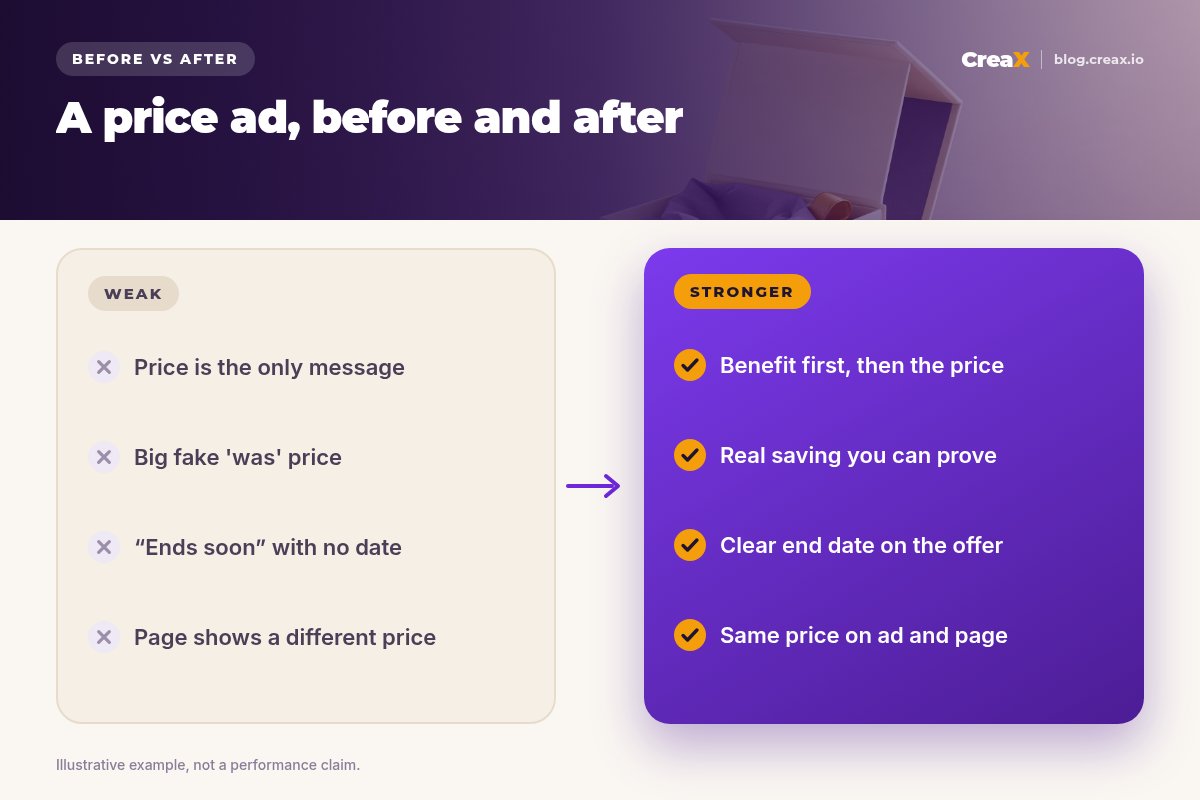
- Making the price the only message. A number with no benefit gives people nothing to want.
- Different prices on the ad and the page. Shoppers notice, and it makes the whole store look careless.
- Fake urgency. “Last chance” on an offer that never ends teaches people to ignore you.
- Judging on CTR. A price in the ad often lowers clicks on purpose. Look at purchases.
- Forgetting currency and market. If you advertise in several countries, show the right currency for each audience, or leave the price for the page.
- Hiding the price on the page too. Holding it back in the ad is fine; making people search for it is not.
ChecklistChecklist you can copy
Before you launch a price ad
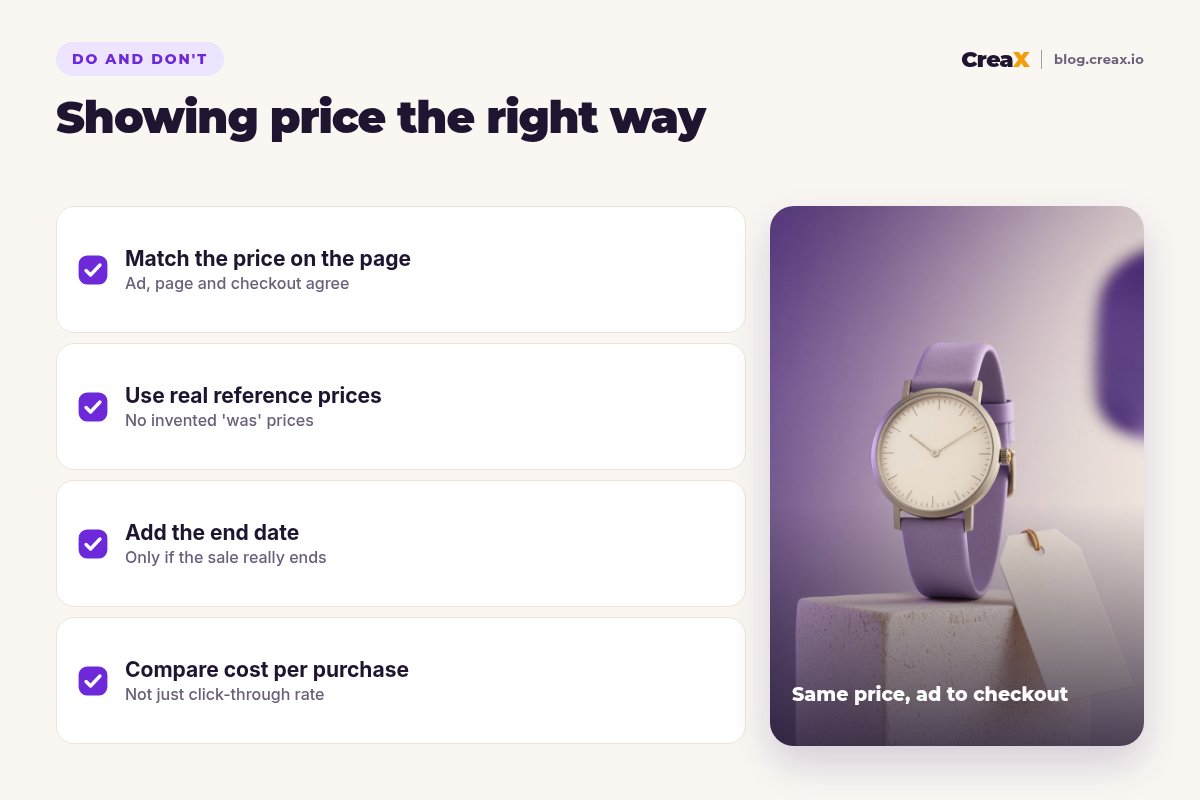
- ✓Is the price a reason to buy? If yes, try it in the ad. If it needs context, start without.
- ✓Does the ad pair the price with a benefit? Number plus outcome, not number alone.
- ✓Is every reference price real? Only prices you actually charged.
- ✓Is there a true end date? Or no date at all.
- ✓Do the ad, page and checkout match? Same price, same terms, same currency.
- ✓Are you testing on cost per purchase? Same creative, with and without the price, same page and budget.
CreaXHow CreaX helps (briefly)
Price tests need two clean versions of the same creative and a landing page that shows the price clearly. CreaX makes that quick: paste a product link or upload a product image, and in about 60–120 seconds you get studio ad creatives in five styles (Classic, Humble Orbit, Punch, Luxe and Meta Feed) and four sizes (1:1, 3:4, 4:5 and 9:16), UGC-style video ads in 18, 30 or 45-second lengths, and a publish-ready landing page. Edit the text to make your with-price and without-price versions, and send both to the same page.
Plans start at $4.99 a month for 2,000 credits, with top-ups at $1 per 500 credits. For layout rules that keep a price readable on a static ad, see our guide to static ad design.
Build your next price test today
One product link, about 60–120 seconds: studio ads, UGC-style video and a landing page that shows the price clearly.
FAQFrequently asked questions
Q.Should I put the price on Facebook and Instagram ads?
Q.Does showing price lower click-through rate?
Q.Is “from $X” pricing a good idea?
Q.Should I show the price in video ads?
Q.What if I sell in several countries?
Q.Can I show a discount without a code?
Ready to test price in your ads?
Paste a product link and get the ads and the landing page for a clean test in about 60–120 seconds.
This guide is published by CreaX. It is general advice, not legal advice: check the advertising and pricing rules of each platform and market you sell in.