
Meta Ads vs TikTok Ads for Ecommerce: Which Should You Start With?
Comparison · Ad platforms
Meta Ads vs TikTok Ads is the first big decision for most new ecommerce stores. Both can sell products, both run on auctions and both reward good creative. They differ in how people use the apps, which ad formats come naturally, and what creatives you need to make. Here is an honest comparison, without invented benchmarks, and a simple way to decide where to start.
Updated October 2026 · By the CreaX team
Key takeaways
- ✓Meta Ads (Facebook and Instagram) handles static images, carousels and video across several apps in one ad buy, with long-established tools for retargeting and catalog ads.
- ✓TikTok Ads is built around full-screen vertical video. Ads that look like native TikToks, often creator-style, tend to fit the feed best.
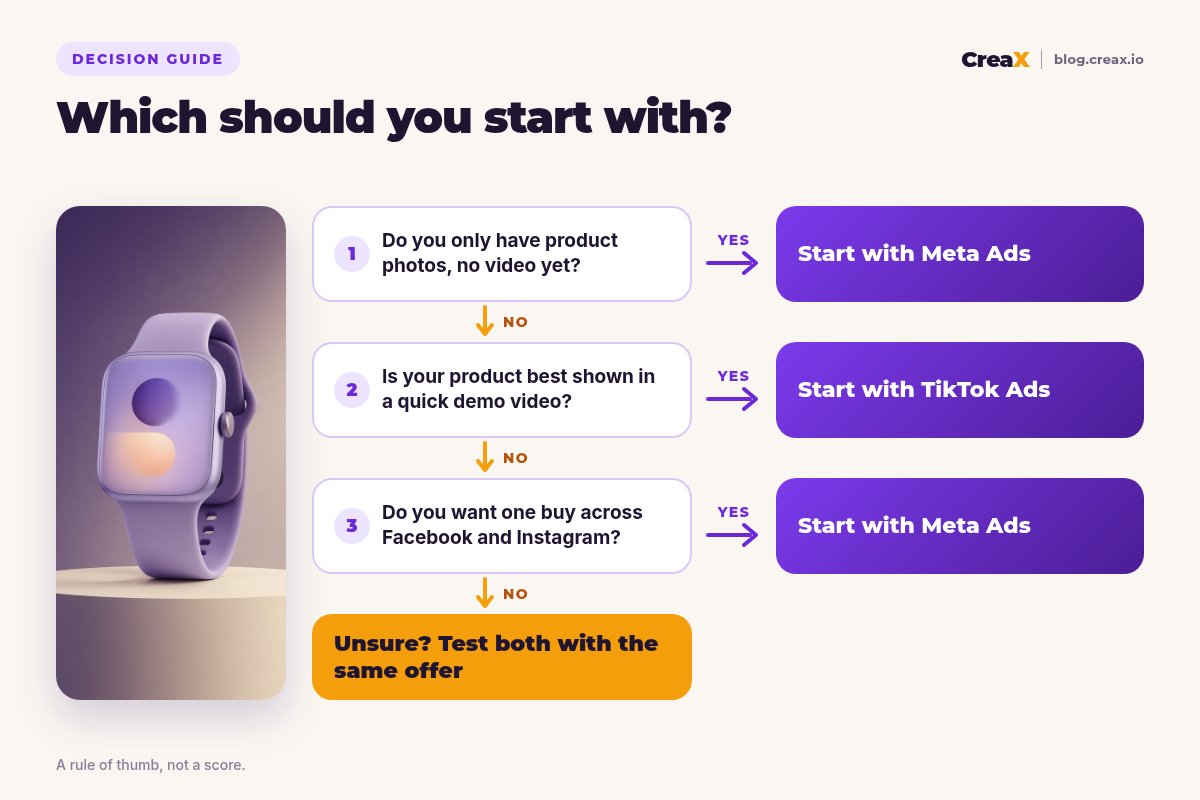
- ✓Start with Meta if you mainly have product photos and want one buy across Facebook and Instagram. Start with TikTok if your product is best shown in a quick demo video.
- ✓Whichever you pick, creative decides the result. CreaX makes static ads and UGC-style videos in the sizes both platforms use, plus the landing page.
In this guide
TL;DRThe short answer: Meta Ads vs TikTok Ads
There is no universal winner. Meta Ads is the more flexible starting point: it accepts almost any creative (photos, carousels, short and long video), reaches people across Facebook, Instagram and other Meta placements in one campaign, and has mature retargeting and catalog features. TikTok Ads is narrower but very strong at one thing: putting a native-looking vertical video in front of people who did not know they wanted your product.
So the practical question is: what creatives can you make well, and how is your product best shown? Photos and a clear offer point to Meta. A product that sells itself in a 15-second demo points to TikTok. If you can make both, test both with the same offer and page.
⚖How we wrote this
Meta AdsWhat Meta Ads is best at
Meta Ads runs ads across Facebook, Instagram, Messenger and other Meta placements from one Ads Manager. For ecommerce, its strengths are:
- Format flexibility. Single images, carousels, collections and video all work, so a store with only product photos can still launch.
- Many placements in one buy. Feed, Stories and Reels across apps, with automatic placement options that let Meta find where your ad does best.
- Retargeting and catalogs. Custom audiences from site visitors and customers, and catalog-based ads that show people the products they viewed.
- Automation. Advantage+ campaigns automate targeting and placements, which puts more weight on giving the system enough good creatives. Our guide to Meta Advantage+ creatives covers how many to give it.
The trade-off: because almost anything can run, it is easy to run something forgettable. Plain supplier photos and generic copy blend into a crowded feed.
TikTok AdsWhat TikTok Ads is best at
TikTok Ads runs mostly in the For You feed, full-screen and vertical, with sound. Its strengths for ecommerce are:
- Discovery through video. People scroll TikTok to be entertained, so a product shown in an interesting way can reach buyers who were not searching for it.
- Native formats. Regular in-feed ads, and Spark Ads that boost real posts from your account or a creator's, keeping likes and comments on the post.
- Creator culture. Creator-style, UGC-style videos fit the feed, and TikTok has its own tools for working with creators.
- Commerce features. In markets where it is available, TikTok Shop lets people buy without leaving the app.
The trade-off: TikTok asks for more video, more often. Ads that look like TV commercials tend to be skipped, and creatives can wear out quickly. If your TikTok ads get views but no sales, see TikTok ads with views but no sales.
ComparisonSide-by-side: audience, formats, creative needs and costs
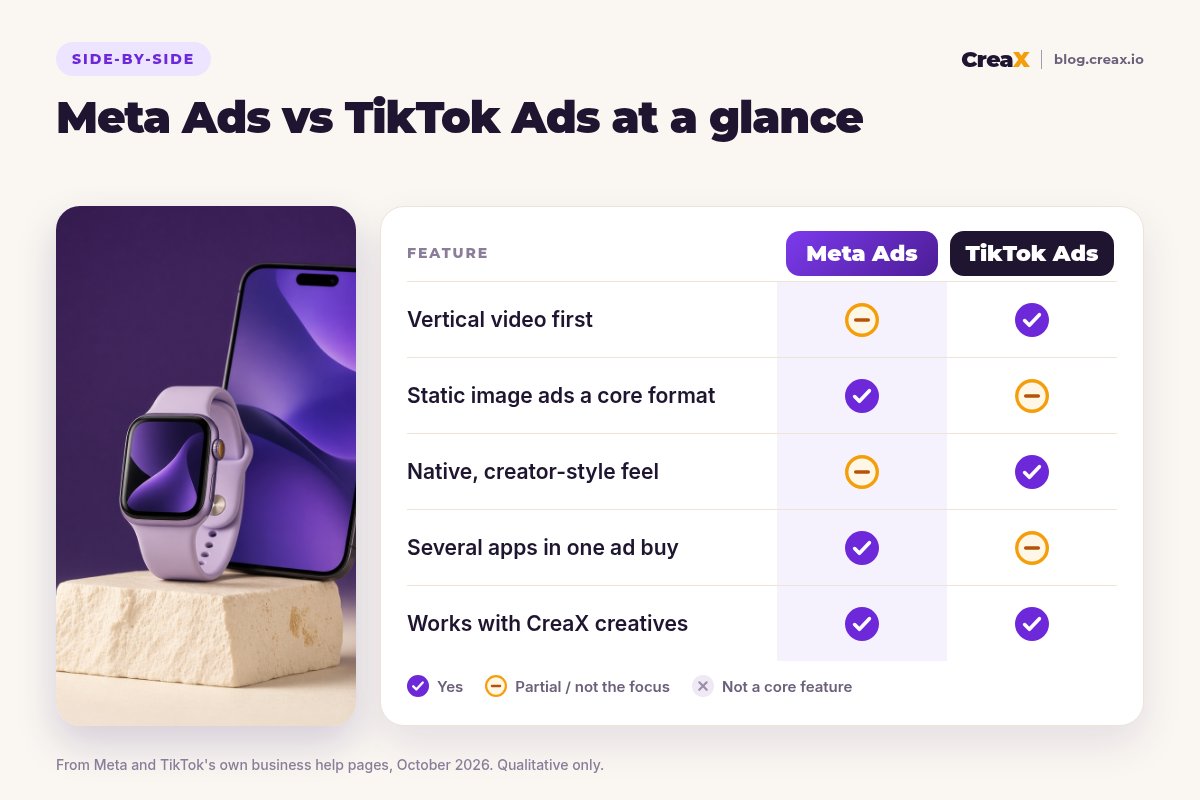
| Meta Ads | TikTok Ads | |
|---|---|---|
| Where ads run | Facebook, Instagram, Messenger and other Meta placements | TikTok (mainly the For You feed), plus TikTok's partner placements |
| Core formats | Image, carousel, collection, video | Vertical video; Spark Ads; image and carousel options |
| Creative that fits | Clear product photos, benefit-led statics, short video | Native-looking vertical video, creator-style, sound on |
| Static-only launch | Works well | Possible, but video is the norm |
| Retargeting and catalogs | Mature custom audiences and catalog ads | Custom audiences and catalog ads available |
| Creative refresh pace | Steady refresh needed | Usually faster refresh needed |
| Costs | Auction-based; varies by market and season | Auction-based; varies by market and season |
From Meta and TikTok's own business help pages, October 2026. Qualitative comparison only; we do not quote CPMs or costs because they vary widely.
Cost is the question everyone asks, and the honest answer is that it depends. Both run auctions, so what you pay depends on your market, the season, your audience and, above all, how much people engage with your ad. Better creative usually lowers cost on both. Work out your own break-even point first with our guide to break-even ROAS.
Meta winsWhere Meta Ads is the better pick
Meta Ads
Strengths
- +Launch with photos and statics, no video required
- +Facebook, Instagram and more in one campaign
- +Mature retargeting and catalog ads
- +Wide range of buyer ages and interests
- +Advantage+ automation for targeting and placements
Trade-offs
- −Crowded feeds punish generic creative
- −Many settings can overwhelm beginners
TikTok Ads
Strengths
- +Strong for video-led discovery
- +Native, creator-style formats
Trade-offs
- −Expects steady video production
- −Static-only launches are harder
Meta is usually the easier first platform if you sell products that people buy considered (home goods, gifts, products for older buyers), if you want to retarget site visitors from day one, or if you can make good statics faster than good videos.
TikTok winsWhere TikTok Ads is the better pick
TikTok Ads
Strengths
- +Products that are fun or surprising to watch
- +Demo-friendly products: gadgets, beauty, kitchen, pets
- +Creator and UGC-style content
- +Discovery for products people are not searching for
- +TikTok Shop in markets where available
Trade-offs
- −Needs more videos, more often
- −Polished TV-style ads tend to underperform
Meta Ads
Strengths
- +Reels placements also take vertical video
- +Retargeting for TikTok-driven visitors
Trade-offs
- −Less of a native culture for creator content
⚖Honest take
Make creatives for Meta and TikTok from one product link
CreaX gives you static ads in 1:1, 3:4, 4:5 and 9:16, UGC-style video ads and a landing page, ready for either platform.
CreativesWhat creatives each one needs (and where CreaX fits)
| Need | Meta Ads | TikTok Ads |
|---|---|---|
| Main sizes | 4:5 and 1:1 for feeds, 9:16 for Stories and Reels | 9:16 full screen |
| Statics | Core: benefit-led product ads | Supporting: image and carousel options |
| Video | Short product videos, Reels | Core: native vertical video with a fast hook |
| How many to start | A few angles, several variations each | Several videos per angle, refreshed often |
Starting points, not platform rules. Check each platform's current specs.
This is where CreaX fits. Paste a product link or upload a product image and, in about 60–120 seconds, you get:
- Studio ad creatives in five styles (Classic, Humble Orbit, Punch, Luxe and Meta Feed) and four sizes (1:1, 3:4, 4:5 and 9:16), for Meta feeds and Stories.
- UGC-style video ads in 18, 30 or 45 seconds for TikTok and Reels.
- A landing page that repeats the same promise, so the click from either platform lands on a matching message.
If you are unsure whether to start with static or video at all, read static vs video ads: which first.
ExampleWorked example: one product on both
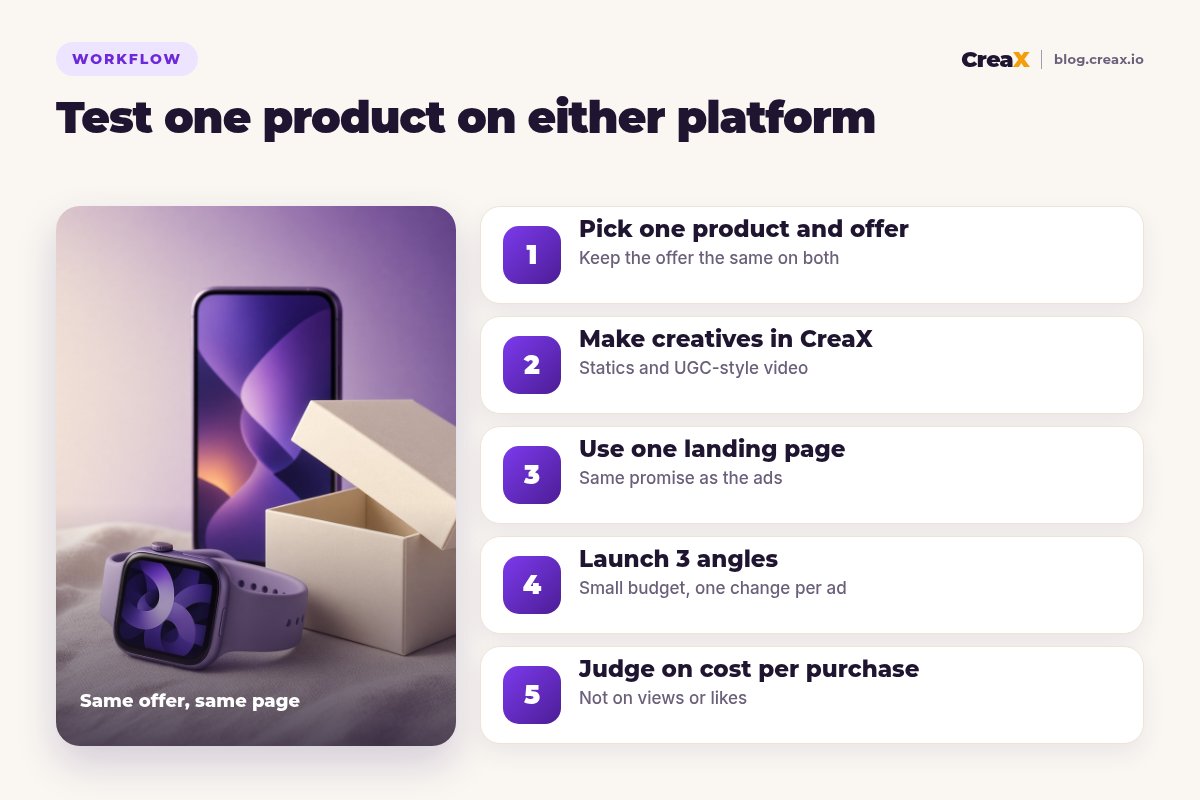
Say you sell a lavender smartwatch with a soft silicone strap at a mid-range price, aimed at people who want a stylish fitness tracker. Here is how the same product could run on each platform:
| Meta Ads | TikTok Ads | |
|---|---|---|
| Angle 1: style | Luxe-style static in 4:5: the watch on a plinth, “a fitness tracker you'd actually wear out” | UGC-style video: putting it on with three different outfits |
| Angle 2: everyday use | Carousel: morning run, desk, dinner | Video: a quick “day with the watch” montage |
| Angle 3: gift | Classic static with the gift box and offer | Video: unboxing the gift box |
| Landing page | One CreaX page for the watch | The same page |
| What to judge | Cost per purchase and ROAS | Cost per purchase and ROAS |
An example test plan, not a result. Use only claims your supplier can prove (battery life, water resistance and so on).
Run each platform with a small, equal budget for long enough to collect purchase data, judge both on cost per purchase rather than views or likes, then put more budget where it pays back. If one creative clearly wins, adapt it for the other platform. Our guide to testing ad angles for a new product explains how to structure the angles.
Get your first test live on Meta, TikTok or both
One product link gives you the statics, the UGC-style videos and the landing page, so the only decision left is where to spend.
Choose with confidenceDecision checklist
Answer these before you spend
- ✓What creatives can you make well right now? Mostly photos: lean Meta. Mostly video: lean TikTok.
- ✓Is your product best shown in motion? A visible before/after or a satisfying demo favours TikTok.
- ✓Who is your buyer? Check where they actually spend time; do not assume by age alone.
- ✓Can you refresh creatives often? TikTok usually asks for more new videos, more often.
- ✓Do you need retargeting from day one? Meta's custom audiences and catalog ads are mature.
- ✓Do you have a landing page that matches the ad? Without it, neither platform will convert well.
Testing both is a fair answer. Many stores use TikTok for discovery and Meta for retargeting and scaling, with the same creative angles adapted to each. See our guide to retargeting ads for ecommerce for the second half of that setup.
FAQFrequently asked questions
Q.Is TikTok or Facebook better for dropshipping?
Q.Are TikTok ads cheaper than Meta ads?
Q.Can I use the same creatives on both platforms?
Q.Which platform should a brand-new store start with?
Q.Do I need a landing page for Meta or TikTok ads?
Q.Are AI-generated ads allowed on Meta and TikTok?
Ready to test your product?
One product link, about 60–120 seconds, and you have static ads, UGC-style video ads and a landing page for Meta, TikTok or both.
This guide is published by CreaX. We describe Meta Ads and TikTok Ads from their own business help pages as of October 2026 and use no invented costs or benchmarks. Platform features and policies change often, so check each platform before you launch.