
How to Localize Ads for Morocco and MENA (Arabic, French, Darija)
How to · Morocco & MENA
To localize ads for Morocco and MENA, you need more than a translation: the right language for each audience, an offer that fits how people buy, copy that sounds native, Arabic layouts that read right-to-left, and a fair test between language versions. This guide walks through all five steps for Arabic, French and Darija, with a worked example and a checklist.
Updated October 2026 · By the CreaX team
Key takeaways
- ✓Language is a targeting decision: Darija, French, Modern Standard Arabic and Gulf or Egyptian dialects reach different people in different moments.
- ✓Localize the offer too: local currency, real delivery times and, where you offer it, cash on delivery stated clearly.
- ✓Rewrite, don’t translate: hooks, idioms and references should be written by or checked with a native speaker.
- ✓Test languages head-to-head: same product, offer and budget, different language. Let cost per order decide.
In this guide
The goalWhat you'll have at the end
By the end you'll have a set of ads and a matching landing page for each language you target, with prices in local currency, delivery and payment terms buyers expect, copy that reads naturally, Arabic layouts checked on a phone, and a test plan that tells you which language version sells best for your product.
PrepWhat you need before you start
- A product you can deliver in the target country, with real delivery times and a returns policy.
- Your offer in local terms: price in the local currency, any bundle, and whether you accept cash on delivery.
- A native speaker for each language you'll run, even if only to review.
- One proven angle if you have one: localize what already works before inventing new angles per language.
- Ad accounts set up for the platforms your buyers use, with tracking on the landing page.
iMorocco is multilingual
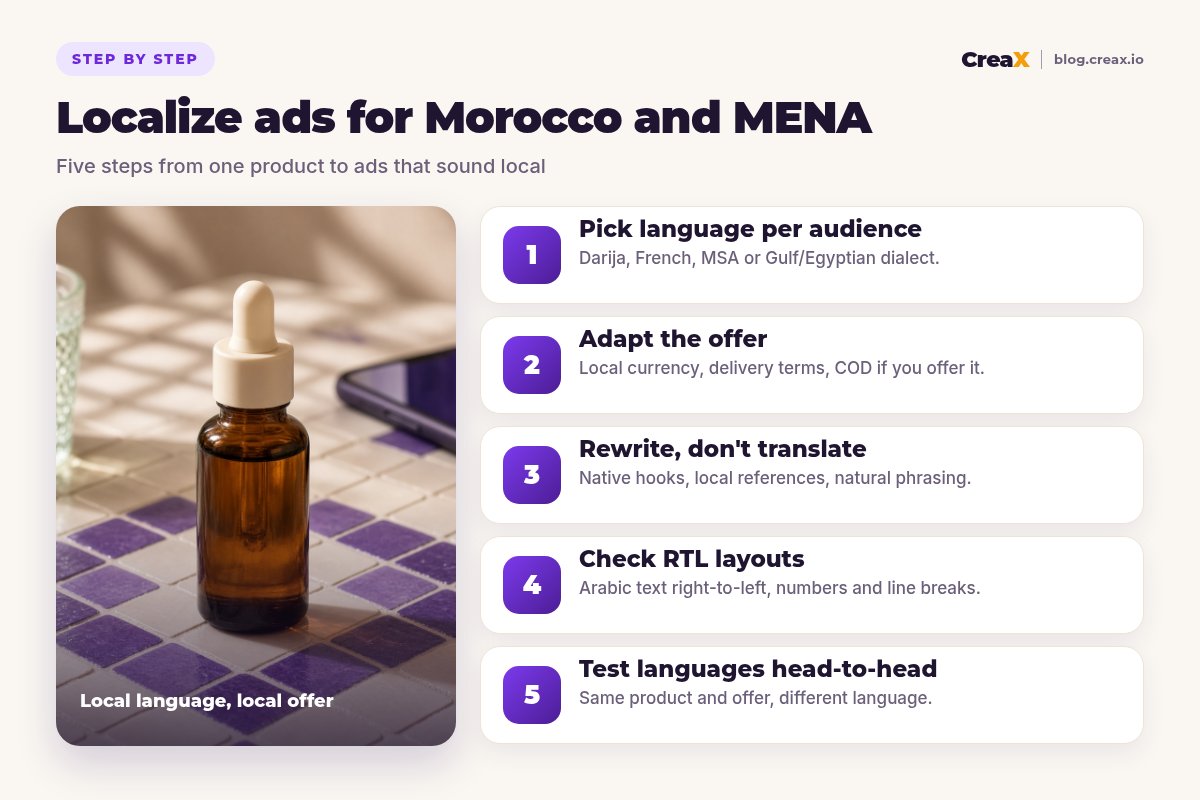
LanguageStep 1: Pick the language per audience
Start from who the buyer is and where they'll see the ad, not from what's easiest to write:
| Language | Often a good fit for | Watch out for |
|---|---|---|
| Darija (Moroccan Arabic) | Short, casual, social-first ads in Morocco; UGC-style videos that should feel local | Spelling varies; Arabic script and Latin-letter Darija both exist, so check what your audience uses |
| French | Morocco and wider Maghreb audiences used to French online, some premium or tech products | Can feel formal for impulse buys; still write natively |
| Modern Standard Arabic | Formal communication across Arab countries, product descriptions, trust content | Can feel stiff in casual social ads |
| Gulf Arabic | Saudi Arabia, UAE and nearby markets | Different vocabulary, tone and currency from the Maghreb |
| Egyptian Arabic | Egypt, and audiences familiar with Egyptian media | Not interchangeable with Darija |
Starting points, not rules. Your own tests decide which language converts for your product.
For Morocco, a practical start is two versions, for example Darija and French, and let results decide. For the Gulf or Egypt, use the local dialect or MSA rather than reusing Moroccan copy: the words, the tone and the currency all change.
OfferStep 2: Adapt the offer
A translated ad with a foreign offer still feels foreign. Localize the parts that affect the buying decision:
- Currency: show prices in the local currency (MAD in Morocco, SAR in Saudi Arabia, AED in the UAE, EGP in Egypt) on both the ad and the page.
- Payment: if you offer cash on delivery, say so clearly; it's a familiar way to pay online in Morocco. If you don't, don't imply it.
- Delivery: state real delivery times and any cities or regions you cover.
- Returns and contact: explain your exchange or returns policy, and how buyers can reach you (for example by phone or WhatsApp, if you support it).
- Timing: shopping habits shift around seasons and holidays such as Ramadan and Eid; plan offers and messaging around your audience's calendar.
!Only promise what you deliver
CopyStep 3: Rewrite, don't translate
Literal translations miss tone, humor and how people really talk. Rewrite each version from the angle, not from the English sentences:
Brief the angle, not the words
Write a local hook
Keep claims identical
Have a native speaker review
Match the page
For video ads, a UGC-style format with a local voice often feels more native than a subtitled foreign ad. Our UGC video ad FAQ explains the format.
Generate localized pages and ads from one product link
CreaX lets you choose your market and language, then generates a landing page, studio creatives and UGC-style video ads in about 60–120 seconds.
LayoutStep 4: Check RTL layouts
Arabic reads right-to-left (RTL). Templates designed for left-to-right languages often break in subtle ways. Check every Arabic ad and page on a real phone:
- Text direction and alignment: Arabic text should be right-aligned and flow right-to-left, with punctuation in the right place.
- Mixed content: prices, product names in Latin letters and phone numbers inside Arabic sentences can jump around; check each line.
- Numbers: Morocco typically uses Western digits (0–9), while some audiences in Egypt and the Gulf often see Eastern Arabic numerals. Match what local ads in your market use.
- Layout mirroring: on pages, arrows, progress bars and image-text order may need to flip.
- Fonts: use a font with good Arabic support so letters connect correctly and stay legible at small sizes.
TestStep 5: Test languages head-to-head
Treat language like any other creative variable and test it fairly:
- Same product, offer and budget for each language version.
- Same angle: only the language and its natural phrasing change.
- Separate ad sets per language so results don't mix; use platform language or location targeting where it helps.
- Judge on cost per order, and for COD offers, also on confirmed and delivered orders, since refused deliveries cost money.
- Keep the winner, then test the next variable: hook, offer or format.
How many variations per language? Our guide to how many ad creatives to test per product gives a practical range, and launching a product test in 24 hours covers the full launch timeline.
Launch your localized test faster
Paste a product link, choose your market and language, and get a landing page, studio creatives and UGC-style video ads to review and launch.
ExampleWorked example: argan oil in Morocco
Say you sell pure argan oil for hair and skin, delivering across Morocco with cash on delivery. Here's how the five steps play out:
| Step | What you do | Result |
|---|---|---|
| 1. Language | Plan two versions: Darija for a casual UGC-style video, French for a cleaner studio ad | Two audiences, two voices |
| 2. Offer | Price in dirhams, a two-bottle bundle, COD and delivery times stated | An offer that feels local |
| 3. Copy | Native hooks per language, identical product facts, native-speaker review | Copy that doesn't sound translated |
| 4. RTL | Check the Darija (Arabic script) ad and page on a phone: alignment, prices, line breaks | Clean RTL layout |
| 5. Test | Same budget per language; judge on cost per confirmed order | A data-backed language choice |
Illustrative example. Use your own verified product facts, prices and delivery terms.
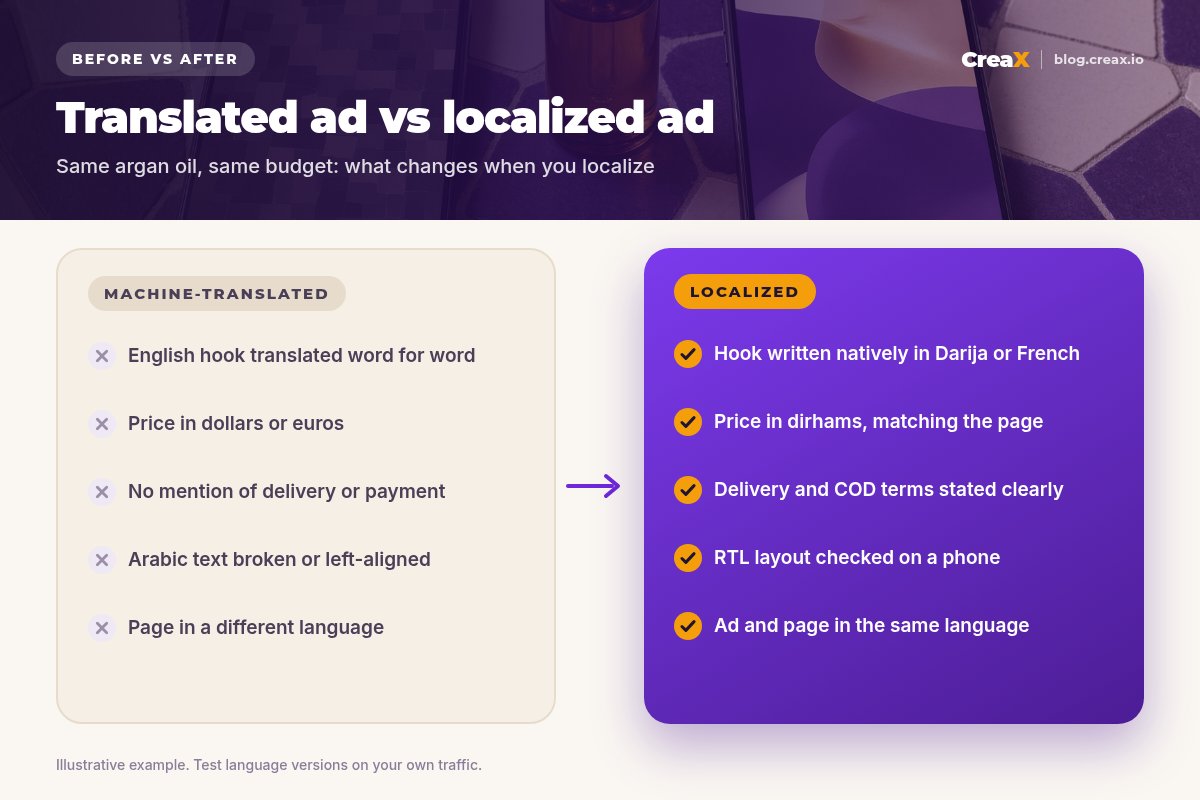
With CreaX, you choose your market and language before generating a landing page, studio creatives and UGC-style video ads. According to creax.io, it supports 40+ languages, from Moroccan Darija to Brazilian Portuguese, and auto-localizes assets to the target country with native dialects and currencies. The checks in this guide still apply to anything AI generates: confirm prices show in dirhams, add your own delivery and payment terms, check Arabic versions on a phone, and have a native speaker review every version before it goes live.
MistakesMistakes to avoid
- Machine translation without review. Errors and unnatural phrasing reduce trust instantly.
- One Arabic version for every market. Darija, Gulf and Egyptian audiences speak differently.
- Foreign prices. Dollars or euros on an ad aimed at Moroccan buyers adds friction.
- Ad and page in different languages. The click feels like a mistake.
- Different claims per language. Keep product facts identical everywhere.
- Judging COD offers on orders alone. Track confirmed and delivered orders too.
Copy thisChecklist
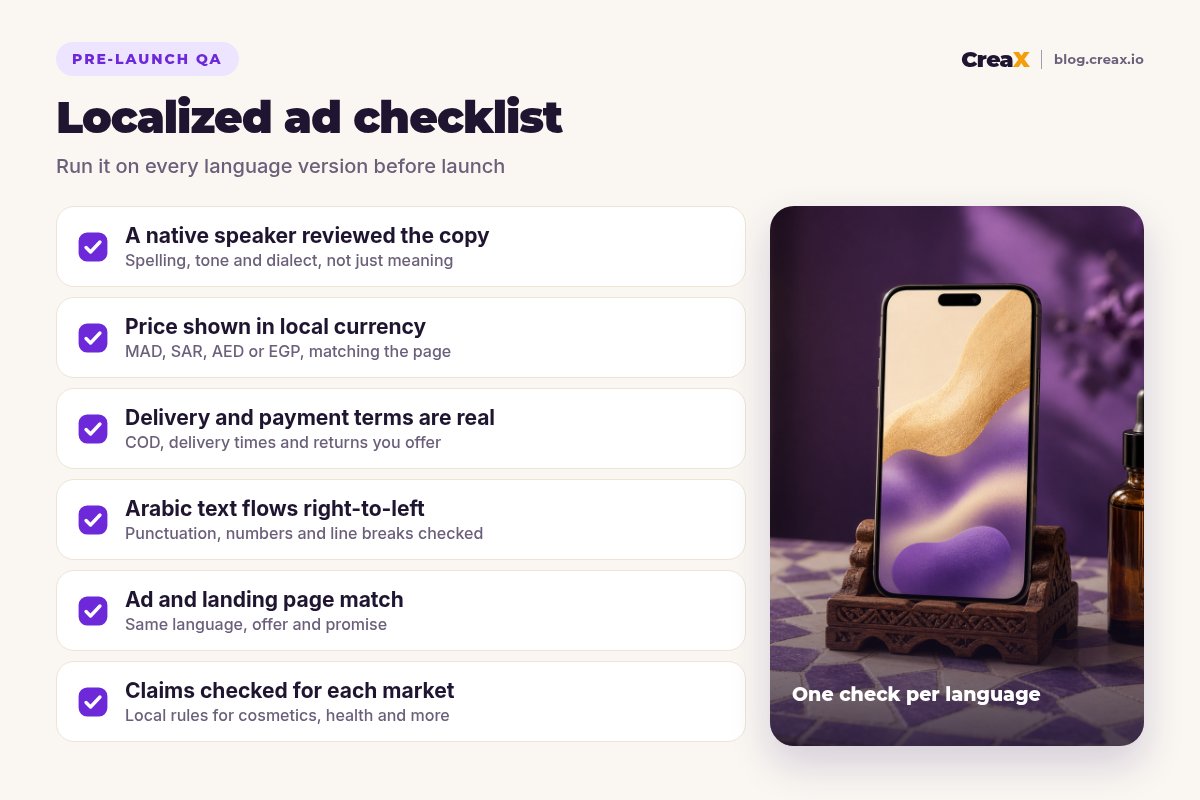
Before you launch each language
- ✓Languages chosen per audience (e.g. Darija and French for Morocco)
- ✓Prices in local currency on ads and page
- ✓Real delivery times, coverage and payment terms (COD only if offered)
- ✓Copy written natively and reviewed by a native speaker
- ✓Product facts and claims identical in every language
- ✓Arabic versions checked on a phone: RTL, numbers, line breaks
- ✓Ad and landing page in the same language
- ✓Separate ad sets per language with equal budgets
- ✓Results judged on cost per confirmed or delivered order
FAQFrequently asked questions
Q.Should I advertise in Darija or French in Morocco?
Q.Can I write Darija in Latin letters?
Q.Is Modern Standard Arabic good for social ads?
Q.Do I need different ads for Saudi Arabia and Morocco?
Q.Can AI localize my ads?
Q.How do I handle refused COD orders in my testing?
Ready to speak your market's language?
One product link, about 60–120 seconds: a landing page, studio creatives and UGC-style video ads, generated for the market and language you choose.
This guide is published by CreaX. It contains general localization practices, not guaranteed results, and no invented statistics. CreaX language features are described from creax.io as of October 2026. Check local advertising and consumer rules for each market.