
Is Dropshipping Still Worth It in 2026? Honest Answers
FAQ · Dropshipping in 2026
Is dropshipping still worth it? For some people, yes, but not in the way most videos promise. This guide gives honest answers: what changed, what it really costs to start, who should skip it, and a checklist to decide whether it fits you right now.
Updated October 2026 · By the CreaX team
Key takeaways
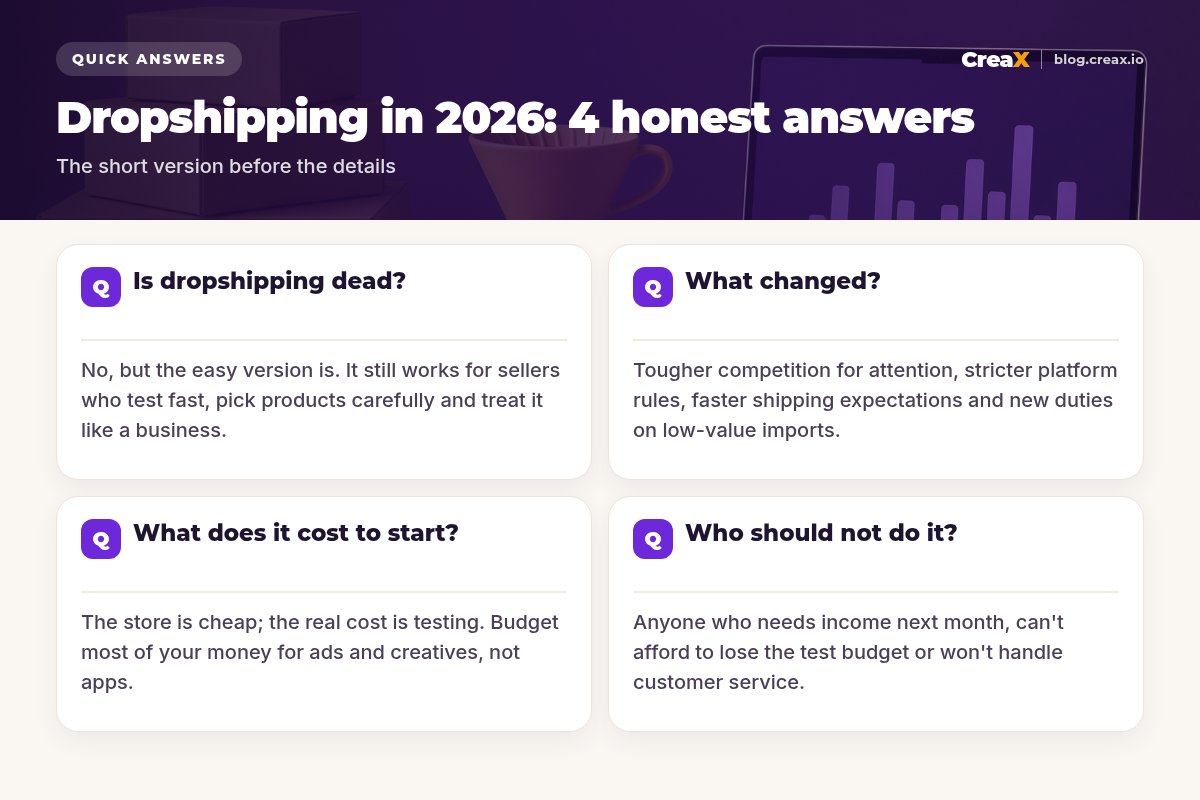
- ✓Dropshipping is not dead, but the easy version is. It still works for sellers who test products quickly, watch their margins and treat it as a real business.
- ✓What changed: more competition for attention, stricter ad and payment rules, higher shipping expectations and new duties on low-value imports in the US and EU.
- ✓The real startup cost is testing, meaning ad spend and creatives, not the store. Plan a budget you can afford to lose.
- ✓Skip it for now if you need income next month, can't absorb a failed test or don't want to handle customer service.
In this guide
TL;DRThe short answer
Dropshipping is still a legitimate way to sell online: you list products, a supplier ships them to your customer, and you never hold stock. What has gone is the idea that it's easy money. Today it rewards the same things any small business needs: a product people actually want, honest delivery promises, margins that survive ad costs and the patience to test.
So the honest answer is: it can be worth it if you treat it as a series of small, cheap experiments and you're prepared for most of them to fail. It's not worth it if you expect one product and one ad to replace a salary within weeks.
The mythIs dropshipping dead?
No. People have called dropshipping dead for years, and stores keep launching, testing and selling. What usually “dies” is a specific playbook: copying the same trending product as everyone else, running one ad and hoping, or hiding long shipping times. Those shortcuts stopped working because shoppers, ad platforms and payment providers all got wiser.
A better question is whether dropshipping is still worth it for you. That depends on your budget, your time, your tolerance for failed tests and whether you enjoy the work: product research, creative testing and customer service. The rest of this guide helps you answer that.
⚖An honest note from us
2026 realityWhat changed?
Five shifts matter most if you're starting now:
| What changed | What it means for you |
|---|---|
| More sellers chase the same products | Winning products get copied fast. Your edge is the angle and the creative, not just the product. |
| Ad platforms automate targeting | Meta and TikTok tools find buyers largely from your creative, so testing several angles matters more. |
| Shoppers expect faster delivery | Long, vague shipping times cause refunds and chargebacks. State honest delivery times. |
| Stricter ad and payment rules | Unsupported claims get ads rejected; payment providers can hold payouts for new or risky stores. |
| Duties on low-value imports | The US suspended its de minimis exemption in August 2025; the EU added a per-item duty from July 2026. |
A summary of the main changes. Check current customs and platform rules for your markets.
The customs changes deserve a closer look. In the US, low-value shipments from all countries lost duty-free de minimis treatment in August 2025, so duties and fees now apply. In the EU, the €150 customs duty exemption for low-value imports was removed on 1 July 2026, with a temporary flat €3 duty per item. If you ship from overseas suppliers, add duties and fees to your product cost and check who pays them at delivery. A surprise charge on the doorstep is a fast way to get refund requests.
The creative shift matters just as much. With automated targeting, the ad itself does more of the work of finding buyers. That's why sellers now test several hooks and formats per product. Our guide on Meta Advantage+ creatives for dropshipping explains how.
BudgetWhat does it cost to start?
The store itself is the cheap part. The money goes on finding out whether a product sells. Here's where it goes:
- Store platform and domain: a monthly plan plus a domain. You don't strictly need Shopify; see do you need Shopify to dropship.
- Samples: order the product yourself to check quality, packaging and real delivery time.
- Creatives: videos, static ads and a landing page for each product and angle you test.
- Ad spend: usually the biggest line. Each angle needs enough spend to give you a signal.
- Fees and losses: payment fees, duties, refunds and the occasional lost parcel.
A simple way to size your test budget is to multiply three numbers you choose yourself:
Products to test
Angles per product
Spend per angle
Multiply
Add a buffer
Example numbers only: if you sell a coffee dripper at $34 and it costs you $12 delivered, your margin before ads and fees is $22, so your break-even ROAS is about 34 ÷ 22 ≈ 1.55. Any ad returning less than that loses money. Learn the full method in break-even ROAS for dropshipping.
Make testing cheaper, not riskier
Paste a product link and get UGC-style video ads, studio creatives and a landing page in about 60–120 seconds.
Be honestWho should not do it?
Dropshipping is a poor fit, at least for now, if any of these describe you:
- You need income next month. Testing takes time and money before anything pays you back.
- You can’t afford to lose the test budget. Only spend money you could lose without real harm.
- You want passive income. Customer questions, delays, refunds and supplier problems need daily attention.
- You won’t check claims. If you'd happily promise results a product can't deliver, ads will get rejected and buyers will ask for refunds.
- You dislike testing. The job is mostly running small experiments and acting on the numbers.
If that's not you, and you have a modest budget, a few hours a day and a willingness to learn from failed tests, dropshipping can be a practical way to learn ecommerce and, with good products, build a profitable store.
Save moneyCommon mistakes to avoid
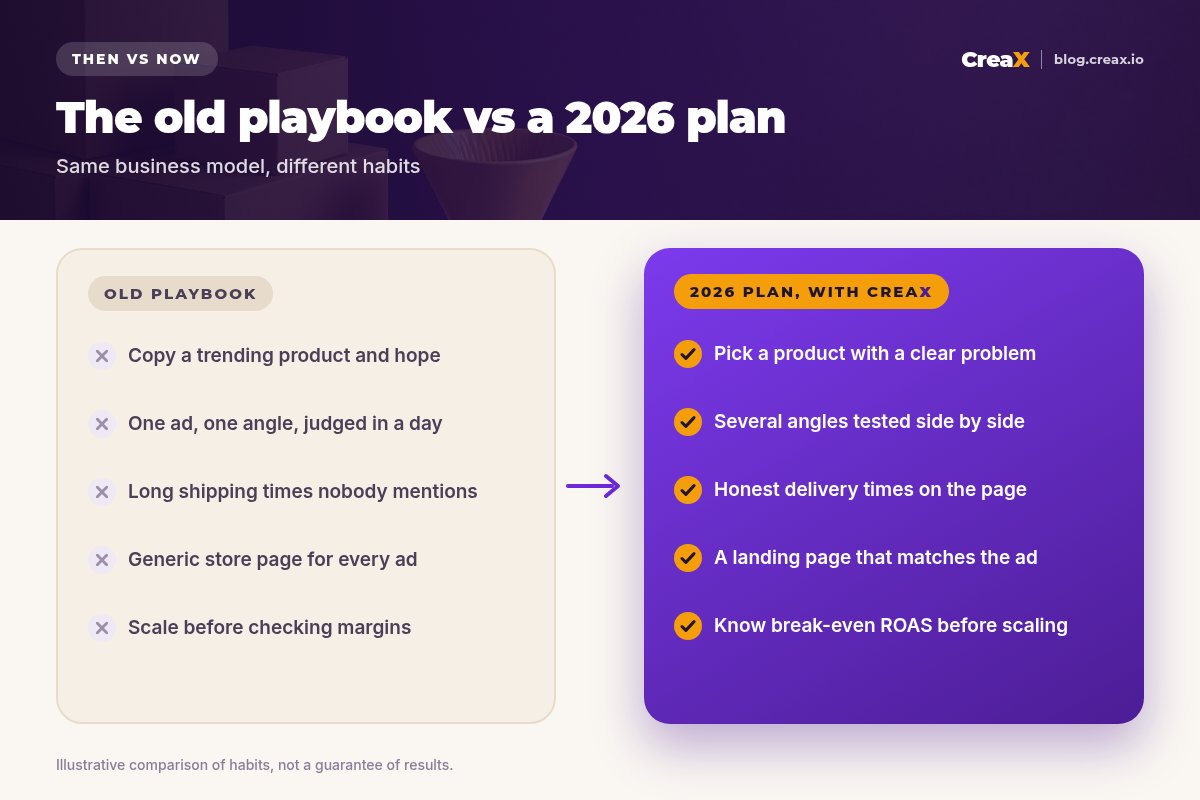
- Judging a product from one ad. One creative tests one angle, not the product. Test several; see how many ad creatives to test per product.
- Sending every ad to a generic store page. A page that repeats the ad's promise gives the click a better chance.
- Hiding shipping times. Customers who expected three days and wait three weeks ask for refunds.
- Ignoring duties and fees. Build them into your cost before you set a price.
- Scaling before knowing the margin. A sale that loses money is not a win, however many you get.
- Skipping the sample. If you haven't held the product, you can't describe it honestly.
!Keep every claim true
DecideChecklist you can copy
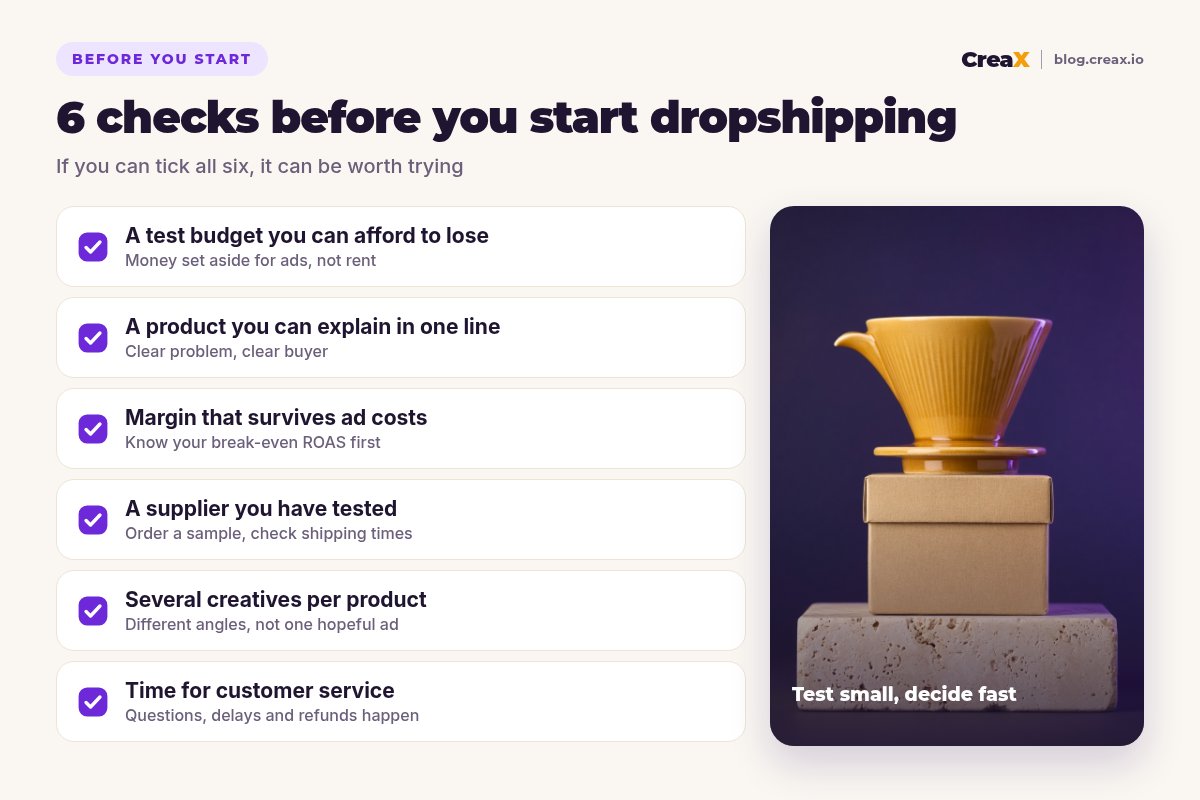
Tick these before you spend on ads
- ✓A test budget you can afford to lose, kept separate from rent and bills.
- ✓A product you can explain in one line: who it's for and what problem it solves.
- ✓Margin that survives ad costs: you know your break-even ROAS before launch.
- ✓A supplier you have tested: sample ordered, quality checked, real delivery time known.
- ✓Several creatives per product: at least two or three angles, each with video and statics.
- ✓Time for customer service: a plan for questions, delays and refunds.
- ✓Honest pages: delivery times, duties and returns stated clearly.
If you can tick all of them, dropshipping is worth a structured test. For a fast, low-cost way to run one, see how to launch a product test in 24 hours.
Our roleHow CreaX helps (briefly)
CreaX won't pick your product or fix your margins, but it removes the slowest part of testing: making the creatives and the page. It's an AI ecommerce creative OS. Paste a product link or upload a product image and, in about 60–120 seconds, you get:
- UGC-style video ads for Reels, Stories and TikTok.
- Studio ad creatives: polished product photos and static ads.
- A publish-ready landing page that repeats the promise of the ads.
- A multi-tenant store if you run several niches or stores.
That makes it practical to test three angles per product instead of one, which is where most of the learning happens. Plans start at $4.99/month for 2,000 credits, with top-ups at $1 per 500 credits. Read more in CreaX for dropshippers.
Test more angles for the same budget
One product link, about 60–120 seconds: video ads, studio creatives and a landing page for your next test.
FAQMore questions sellers ask
Q.Is dropshipping still profitable in 2026?
Q.Is dropshipping legal?
Q.How long does it take to see results?
Q.Do I need a lot of money to start?
Q.Should I sell on Shopify, TikTok Shop or my own site?
Q.Can AI tools make dropshipping easier?
Ready to run your first honest test?
Paste a product link and get UGC-style video ads, studio creatives and a landing page you can launch today.
This guide is published by CreaX. Customs and platform rules change; we summarise them as of October 2026 and recommend checking official sources for the countries you sell to.