

How Should You Price a Dropshipping Product?
FAQ · Dropshipping pricing
How should you price a dropshipping product? Markups alone aren't enough. This guide walks through true landed cost, how much margin you need after ads, when bundling helps, how to test price without guessing and a checklist you can copy before you spend.
Updated October 2026 · By the CreaX team
Key takeaways
- ✓Price from landed cost, not from a random markup. Include product, shipping, payment fees, duties and an allowance for refunds.
- ✓Set break-even ROAS before you launch. Your price only works if ads can hit that number.
- ✓Bundles help when they raise profit per order, not just average order value.
- ✓Test price with the same ads on two pages or two offers, and judge profit per visitor.
In this guide
TL;DRThe short answer
A good dropshipping price covers everything it costs to deliver one order and still leaves room for ads. Start with landed cost, pick a price that hits a break-even ROAS you can live with, then test that price in the market. Guessing a “2× or 3× markup” without ads and fees in the spreadsheet is how stores look busy and lose money.
Landed costWhat goes into cost?
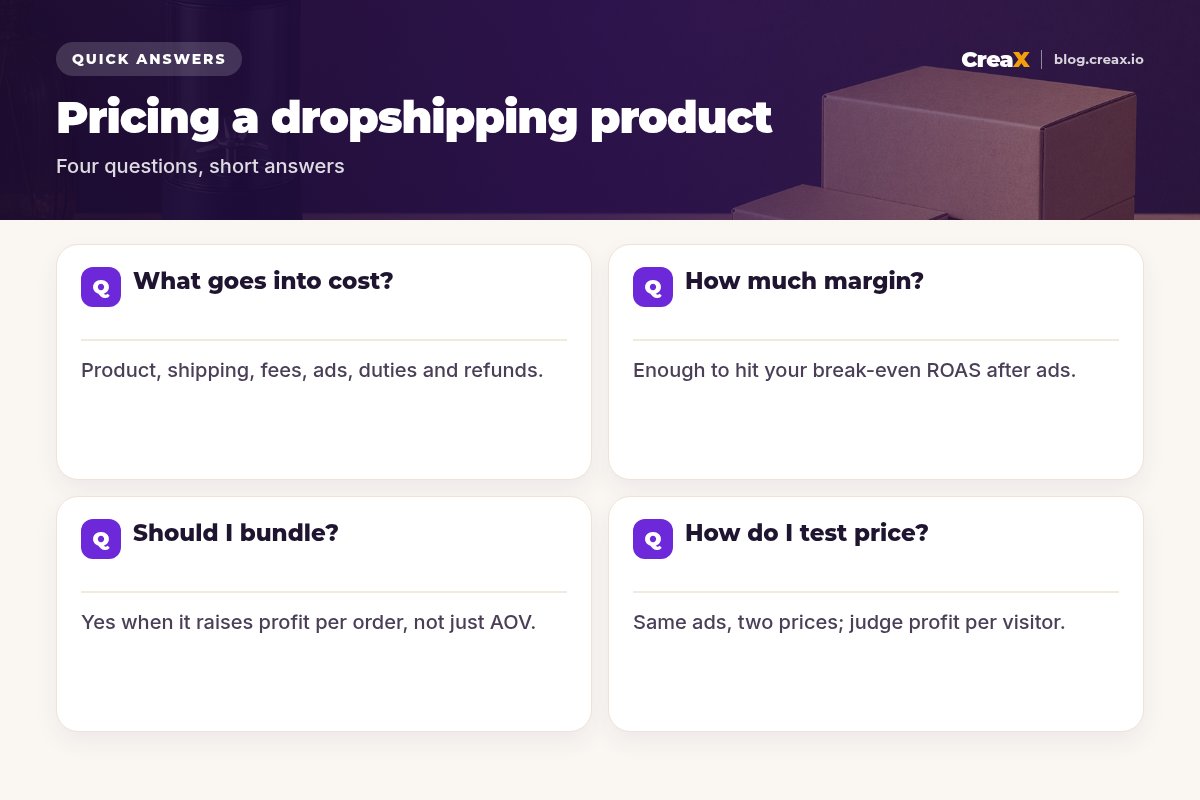
Write down every cost that hits you when one order ships:
- Product cost from the supplier, including any sample or custom packaging fees.
- Shipping to the customer for that product and destination. Multi-unit orders often don't cost 2× or 3× a single ship.
- Payment and platform fees (checkout, currency conversion, chargebacks).
- Duties and taxes you or the customer pay on import. Rules changed in the US and EU; see is dropshipping still worth it for the high-level picture.
- Refunds and lost parcels: a small percentage of revenue, not zero.
- Ad cost: not a product cost, but it must fit inside your margin. That's what break-even ROAS is for.
Add those together for one unit. That total is your landed cost. Your selling price minus landed cost is the cash left for ads and profit. For the ad side of the maths, use break-even ROAS for dropshipping.
A worked mini-example of landed cost (illustrative only): product $9, shipping $6, payment fees about $1.50, a small refund buffer $0.50 → about $17 before ads. If you sell at $34, you have roughly $17 left for ads and profit. At that price, break-even ROAS is about 2.0. Raise the price and you gain ad room; lower it and conversion may rise while ad room shrinks. Either way, write the number down before you launch.
★Check shipping for 1, 2 and 3 units
ROAS firstHow much margin?
There is no universal “good” margin percentage. What matters is whether your price can support the return on ad spend you need. Break-even ROAS is roughly selling price ÷ (selling price − landed cost). If you sell at $40 and landed cost is $18, you have $22 left; break-even ROAS is about 40 ÷ 22 ≈ 1.8. Any campaign returning less than that loses money.
- Higher price usually means more room for ads, but can lower conversion.
- Lower price can convert more but leaves less for ads and mistakes.
- Competitor prices are a reference, not a target. Match them only if your costs allow it.
Pick a price that clears break-even with a cushion for learning costs, then test. Don't lock in a price you can't afford to advertise.
Psychological pricing (for example $29.99 instead of $30) can help on some offers, but it won't fix a margin that can't buy traffic. Anchor prices and “was” prices only work when they're real. If you show a compare-at price, it should be a price you actually charged recently, in line with the rules where you sell.
Also decide what the price includes: shipping, duties paid, a gift or a return promise. Hidden extras at checkout feel like a bait-and-switch and raise refunds. Put the full cost of getting the product to the door in the offer, or say clearly what the customer pays later.
Test the offer, not just the price
Paste a product link and get a landing page, UGC-style video ads and studio creatives in about 60–120 seconds.
BundlesShould I bundle?
Bundle when the set raises profit per order after shipping and ads, not just average order value. A 3-pack that converts slightly fewer people can still win if each order leaves more cash. A bundle that looks generous but wipes your margin is a loss leader you didn't choose.
- Good reasons to bundle: consumables, multi-room use, gift sets, accessories that belong together.
- Bad reasons: clearing slow stock onto a bestseller, or copying a competitor's bundle without checking your costs.
When you do bundle, show the per-item price on every tier and keep two or three options, not five. Highlight the tier you actually want to sell. Then test the bundle page against the single offer with the same ads and compare profit per visitor — the same rule as a price test.
For the page that carries the offer, keep the same structure you would for a single product: headline, price, proof, shipping and FAQ. Only the offer block changes.
TestingHow do I test price?
Treat price like any other offer variable:
Pick two honest prices
Keep creatives identical
Send traffic evenly
Judge profit per visitor
Watch refunds
You can also test price as part of a wider offer test: free shipping threshold, a modest discount or a bundle tier. Keep one change at a time when you can. For structuring creative tests alongside, see how to test ad angles for a new product.
ExampleWorked example: pricing a portable blender
Say you sell a matte navy portable blender for on-the-go shakes. Supplier cost is $11, shipping to your main market is $7 for one unit and $9 for two, payment fees and a small refund buffer (use your real rates).
| Offer | Price | Landed cost (approx.) | Cash left before ads |
|---|---|---|---|
| 1 blender | $39 | $11 + $7 + fees/buffer ≈ $20 | ~$19 |
| 1 blender (promo) | $34 | ~$19.5 | ~$14.5 |
| 2-pack | $69 | $22 + $9 + fees/buffer ≈ $34 | ~$35 |
Illustrative only. Recalculate with your supplier quotes and fee schedule.
At $39, break-even ROAS is roughly 39 ÷ 19 ≈ 2.05. At $34 it rises toward 2.3, so ads must work harder. The 2-pack leaves more cash per order if people buy it. You'd test $39 vs $34 with the same creatives first, then test a 2-pack page against the winner, always on profit per visitor.
Notice what this example does not do: it doesn't chase the cheapest competitor by default, and it doesn't invent a “was $59” tag to make $39 look like a bargain. The price is honest, the cost is written down and the next step is a test — not a hope.
Save moneyCommon mistakes to avoid
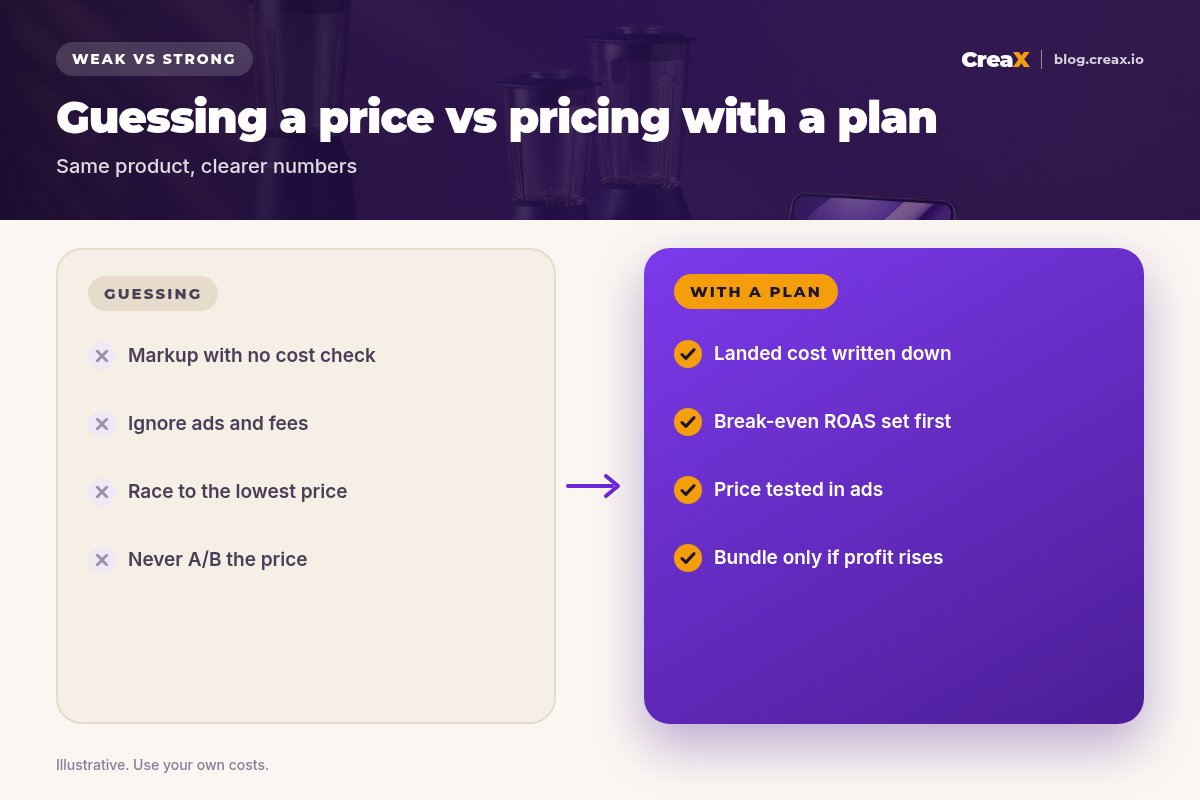
- Markup without landed cost. Shipping and fees often kill a “3×” price.
- Ignoring ads in the spreadsheet. A margin that can't buy traffic isn't a business.
- Racing to the lowest price. Cheap can convert and still lose money.
- Fake “was” prices. Use real reference prices; many regions regulate discounts.
- Never testing. The market tells you what it will pay; your spreadsheet only tells you what you can afford.
- Changing price and creative together. You won't know which moved the result.
!Keep every claim true
Before launchChecklist you can copy
Tick before you spend
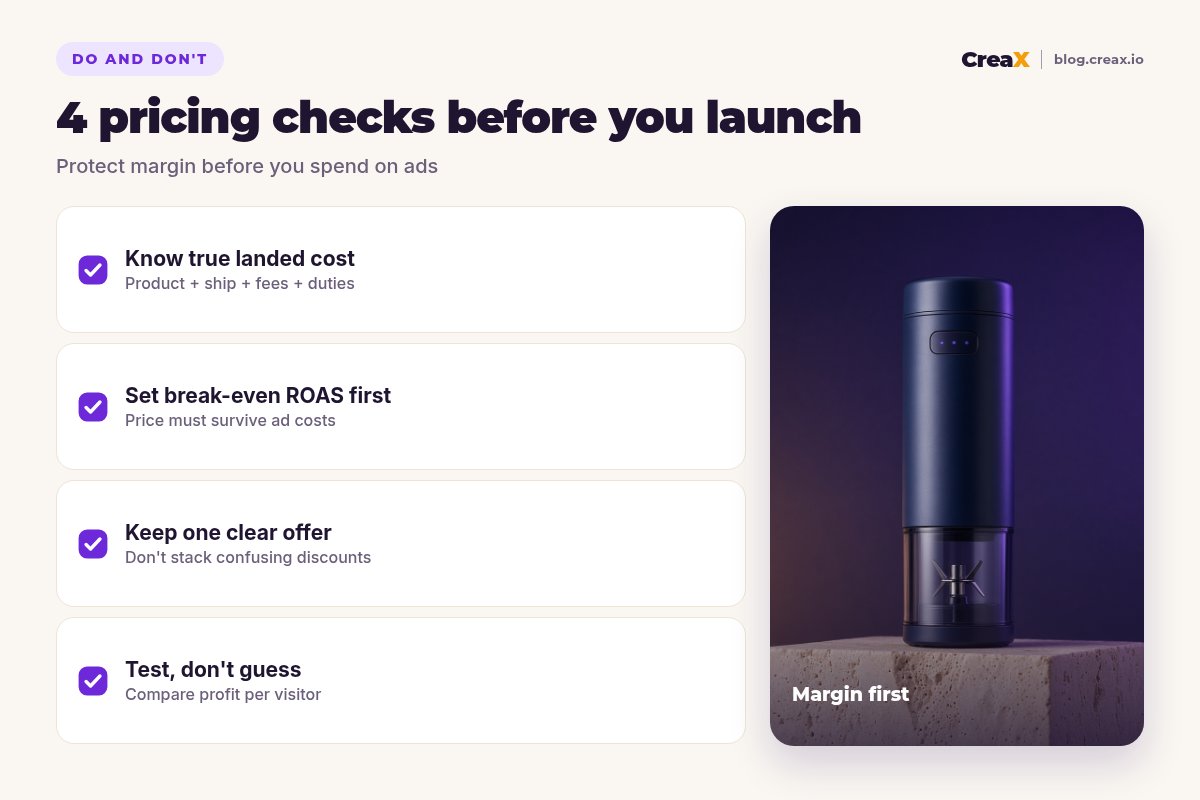
- ✓Landed cost written down for each destination you sell to.
- ✓Break-even ROAS calculated at your chosen price.
- ✓One clear offer on the page — not stacked, confusing discounts.
- ✓Shipping and duties explained for the customer where needed.
- ✓A price test plan with the same ads and a profit-per-visitor metric.
- ✓Refund buffer included so a few returns don't wipe the month.
Our roleHow CreaX helps (briefly)
CreaX doesn't set your price, but it makes testing the offer cheaper. Paste a product link and, in about 60–120 seconds, you get UGC-style video ads, studio creatives, a publish-ready landing page and a multi-tenant store. Use the same creatives across two prices or a single vs bundle page, so you're comparing offers, not production quality.
Plans start at $4.99/month for 2,000 credits, with top-ups at $1 per 500 credits. For a fast first test, see how to launch a product test in 24 hours.
Build the page you'll test the price on
One product link, about 60–120 seconds: landing page, UGC-style video ads and studio creatives.
FAQMore questions sellers ask
Q.What markup should I use for dropshipping?
Q.Should I match the lowest competitor?
Q.Is free shipping worth it?
Q.How often should I change price?
Q.Do duties change my price?
Q.Can AI tools help with pricing?
Ready to test your next product?
Paste a product link and get a landing page, UGC-style video ads and studio creatives for your next price test.
This guide is published by CreaX. Example maths is illustrative; check fees, duties and consumer pricing rules in the countries you sell to.