
How to Create Ads for High-Ticket Products
How-to · High-ticket products
High-ticket product ads fail for a simple reason: they are built like ads for cheap impulse buys. A shopper can grab a phone case on a whim, but nobody spends serious money on an espresso machine, a standing desk or an e-bike after one scroll. This guide shows how to build ads for expensive products step by step: map the doubts, show the detail, reduce the risk, send clicks to a page that answers everything, and follow up over time.
Updated October 2026 · By the CreaX team
Key takeaways
- ✓High-ticket buyers take longer. Expect several touches before a purchase. Plan a sequence of ads, not one winning creative.
- ✓Every ad should answer a doubt. Is it worth the price? Is it well made? Will it fit? What if I do not like it? Map these first, then make creatives for each.
- ✓Detail beats hype. Close-ups, materials, real use and honest specs build trust. Discount-led hooks can cheapen a premium product.
- ✓The page carries the sale. Send ad traffic to a detailed landing page. CreaX builds one from your product link along with studio ads and UGC-style video ads.
In this guide
OutcomeWhat you'll have at the end
By the end of this guide you will have a simple, complete setup for advertising one high-ticket product:
- A doubt map: the five or six questions that stop your buyers, written in their words.
- A creative set: cold ads that hook on the problem, detail ads that prove quality, and risk-reducer ads for people who are close to buying.
- A detailed landing page that answers every doubt before the buyer has to ask.
- A follow-up plan that shows different proof to people who visited but did not buy.
PrepWhat you need before you start
- The real product facts: specs, materials, dimensions, warranty terms, delivery times and return policy, confirmed by your supplier or manufacturer.
- Good product images: your own photos or a sample, or a product link you can turn into studio creatives.
- A clear price and offer: what is included, any bundle, and the payment options you actually offer.
- Realistic expectations: a high-ticket test usually needs more patience and budget per sale than a cheap product. Decide your break-even before you start; our guide to break-even ROAS shows how.
!Never fake proof on expensive products
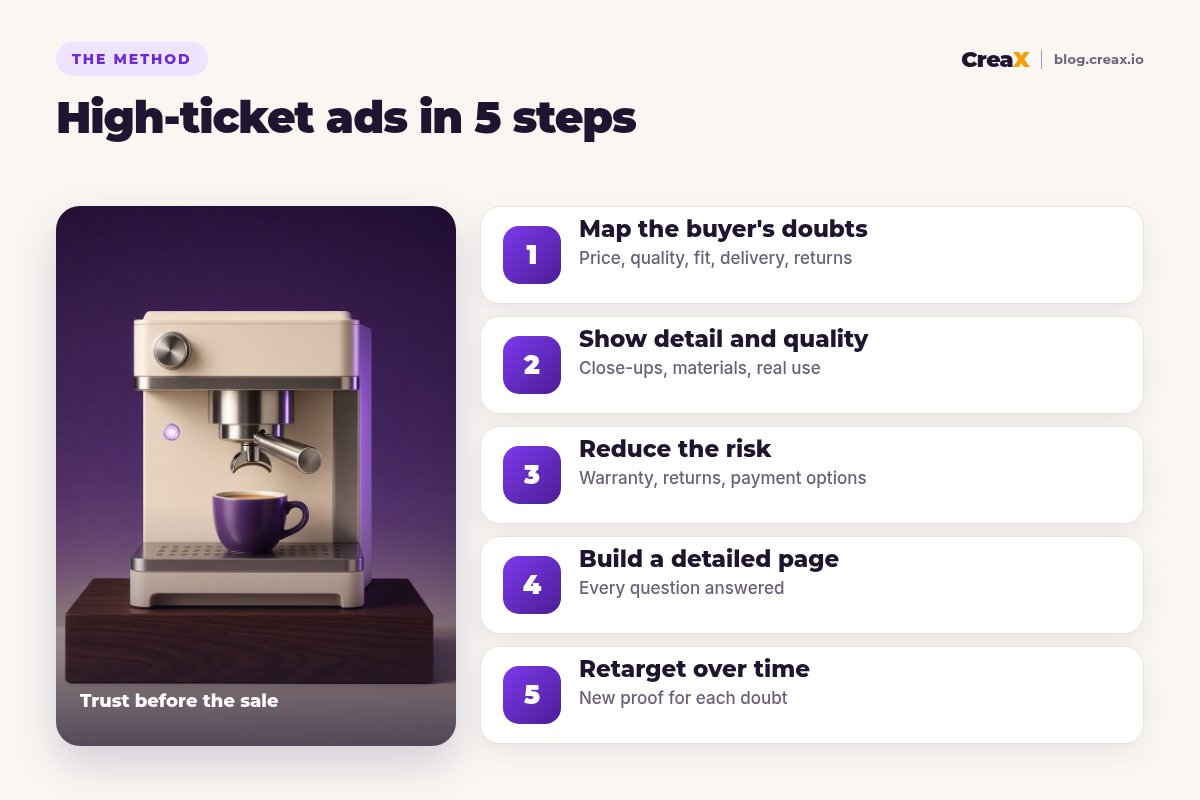
Step 1Step 1: Map the buyer's doubts
Before you make a single creative, write down every reason a buyer might hesitate. For most high-ticket products, the doubts fall into a few groups:
| Doubt | What the buyer is thinking | Creative that answers it |
|---|---|---|
| Value | Is it worth this much? Why not a cheaper one? | Side-by-side with the cheaper option, cost over time, what is included |
| Quality | Will it last? Is it really premium? | Close-ups of materials, joints, finish; build process |
| Fit | Will it work in my space, for my body, with my setup? | Dimensions in context, real-life setting, size guide |
| Risk | What if it breaks or I do not like it? | Warranty, returns, support, delivery details |
| Trust | Is this store real? | Clear brand, contact details, honest reviews where you have them |
A starting doubt map. Replace the examples with the exact words your buyers use in comments, emails and reviews.
Look for the real wording in comments on your ads, questions in your inbox, reviews of similar products and forum threads. Each doubt becomes one ad angle and one section on your page. If you need help turning angles into tests, see how to test ad angles for a new product.
Step 2Step 2: Show detail and quality
A cheap product can sell with one bright photo. An expensive one has to earn its price on screen. Make creatives that show:
- Close-ups: stitching, textures, steel, wood grain, buttons, ports. Quality lives in the details.
- Use in a real setting: the desk in a home office, the machine on a kitchen counter, so the buyer can picture it at home.
- Scale: next to familiar objects, or with dimensions shown clearly.
- The full experience: unboxing, setup, the first use. Longer videos often suit products people research.
Static ads in a calm, premium style usually suit high-ticket products better than loud designs. In CreaX, the Luxe ad style is built for that look, and you can generate UGC-style video ads of 18, 30 or 45 seconds; the longer formats give you room to show detail and answer a question. Our guide to how long a video ad should be helps you pick.
★Use carousels for detail
Step 3Step 3: Reduce the risk
The higher the price, the more the fear of a bad decision matters. Put the things that reduce that fear in your ads, not only in the small print:
State the warranty plainly
Make returns easy to understand
Show delivery and setup
Offer payment options you really have
Give a human contact
Risk-reducer ads work best for people who have already shown interest, such as page visitors or video viewers, which is why they belong in your follow-up sequence.
Step 4Step 4: Build a detailed page
High-ticket buyers read. Sending them to a thin product page with three photos and a buy button wastes the click. A strong page for an expensive product has:
- A headline about the outcome, not the product name.
- Detail images and video matching what the ad promised.
- Specs and dimensions in a clean table.
- A comparison with the cheaper alternative the buyer is considering.
- Warranty, returns and delivery near the buy button.
- An FAQ built from your doubt map.
- Reviews or proof only if they are real.
CreaX generates a publish-ready landing page from your product link, at Simple, Detailed or Advanced level; for a high-ticket product, start with Detailed or Advanced and edit every claim against your real specs. For more on what makes a page convert, read what makes a high-converting product page, and if you want a story-led format, advertorial landing pages often suit products that need explaining.
Build the page and the ads together
Paste your product link into CreaX and get a detailed landing page, premium studio ads and UGC-style videos in about 60–120 seconds.
Step 5Step 5: Retarget over time
Very few people buy an expensive product on the first visit. Plan what each group sees next:
| Audience | What they need | Creative to show |
|---|---|---|
| Watched a video, did not click | A reason to look closer | Detail ad: close-ups, the one feature that matters most |
| Visited the page, did not add to cart | Answers to their doubts | Comparison or FAQ-style ad; warranty and returns |
| Added to cart, did not buy | Less risk, a nudge | Risk-reducer ad: delivery, returns, payment options you offer |
| Bought | Confidence and care | Setup tips, accessories, referral if you have a programme |
An illustrative follow-up sequence. Audience sizes and timing depend on your traffic and platform.
Rotate fresh creatives as people see them repeatedly; our guide to retargeting ads for ecommerce goes deeper on which creative to show each audience.
ExampleWorked example: a premium espresso machine
Say you sell a premium home espresso machine. Your doubt map shows four main worries: “is it worth it versus a pod machine?”, “is it hard to use?”, “will it fit my kitchen?” and “what if it breaks?”.
- Cold ads: a 30-second UGC-style video hooking on café-style coffee at home, and a Luxe-style studio ad showing the machine on a counter.
- Detail ads: a carousel with the portafilter, the steam wand, the dimensions next to a kettle, and the warranty card.
- Page: a Detailed landing page with a cost-over-time comparison against buying coffee out (using your own honest numbers), a specs table, a setup video and a warranty and returns block near the button.
- Follow-up: page visitors see a “first-week guide” video; cart abandoners see delivery, returns and the payment options the store really offers.
Each creative answers one doubt, and the page answers all of them. The seller judges results over a longer window than for a cheap product, because buyers often come back days later.
AvoidMistakes to avoid
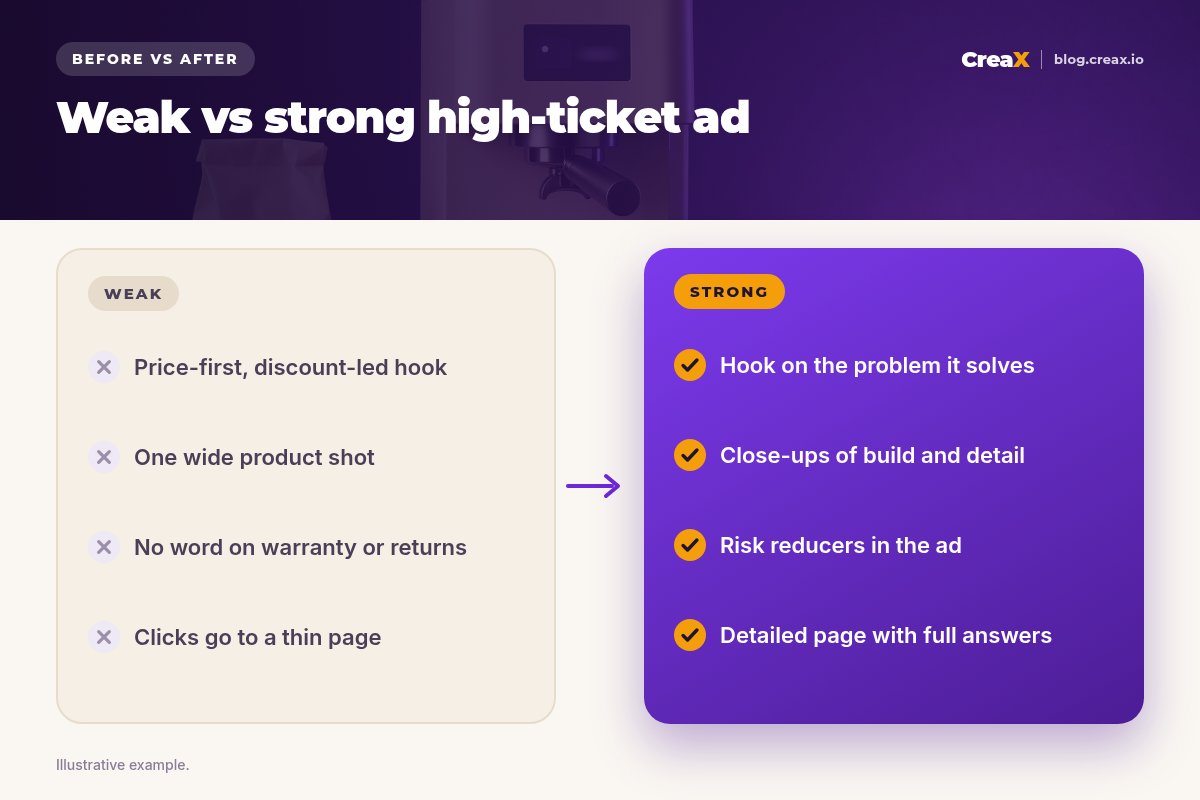
- Leading with a discount. Big percent-off hooks can make a premium product look cheap or suspicious.
- Judging too fast. Turning off ads after a day or two when the buying cycle is longer.
- Hiding the warranty and returns. If they are good, they are selling points. Show them.
- Letting AI add features. Generated images and scripts must match the real product exactly.
- Sending traffic to a thin page. The page has to do the heavy lifting for an expensive purchase.
Before you spendChecklist
High-ticket launch checklist
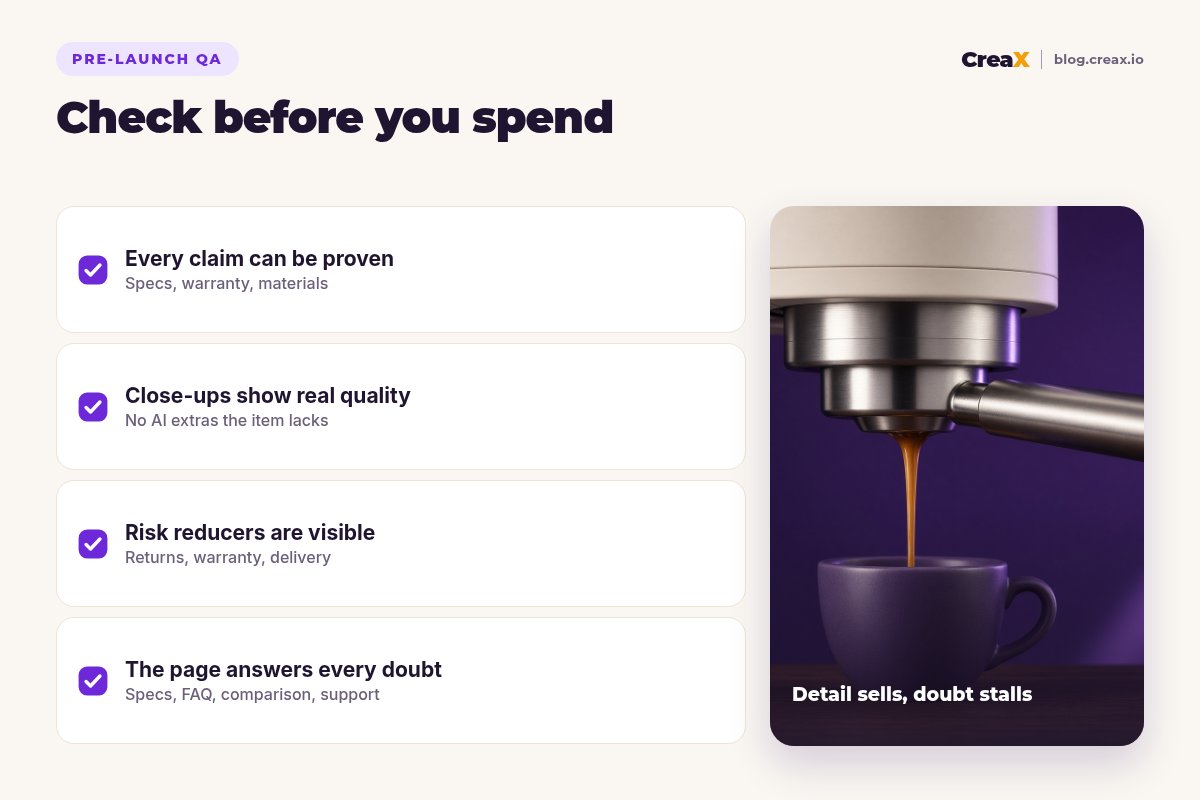
- ✓Doubt map written in the buyer's own words.
- ✓Creatives for each doubt: problem hook, detail, comparison, risk reducer.
- ✓Every claim checked against specs, warranty and policy.
- ✓Detailed page live with specs, comparison, FAQ and risk reducers near the button.
- ✓Follow-up audiences planned for viewers, visitors and cart abandoners.
- ✓Patience budgeted: a test window long enough for a slower buying cycle.
Get your high-ticket ad kit live
One product link gives you premium studio ads, UGC-style videos and a detailed landing page to edit and launch.
FAQFrequently asked questions
Q.What counts as a high-ticket product?
Q.Are video ads better for high-ticket products?
Q.Should I show the price in high-ticket ads?
Q.How long should I test a high-ticket product?
Q.Can CreaX make ads for expensive products?
Q.Can I dropship high-ticket products?
Ready to advertise your premium product?
Paste a product link and get the ads and the detailed page your buyers need before they commit.
This guide is published by CreaX. We describe other tools from their own public websites as of October 2026, avoid invented scores or prices, and recommend checking each vendor's site for current features and plans.