
How to Write Facebook Ad Copy for Ecommerce (With Templates)
How-to · Ad copywriting
Good Facebook ad copy for ecommerce does one job: it gives the right person a reason to stop, care and click. It does not need to be clever or long. This guide walks you through a five-step process for writing primary text, headlines and descriptions, with copy-and-paste templates for the angles that work for physical products and a worked example you can adapt today.
Updated October 2026 · By the CreaX team
Key takeaways
- ✓Pick one angle per ad: one problem, desire or occasion. Mixed messages make weak ads.
- ✓The first line carries most of the weight, because many people only see it before the text is cut off with See more.
- ✓Primary text follows a simple order: hook, benefit, proof, offer, action. Headlines and descriptions back it up in a few words.
- ✓Test copy like creative: change one thing at a time, keep claims provable and make sure the landing page repeats the promise.
In this guide
GoalWhat you'll have at the end
By the end of this guide you will have a set of ad copy for one product: three angles, each with a hook line, a short primary text, a headline and a description, ready to pair with your images or videos in Meta Ads Manager. You will also have a simple way to test which copy works, so the next round is better than the first.
A quick reminder of where each piece appears in a Facebook or Instagram feed ad:
| Field | Where it shows | Its job |
|---|---|---|
| Primary text | Above the image or video | Stop the scroll and make the case |
| Headline | Below the media, in bold | State the offer or main benefit |
| Description | Under the headline, on some placements | Add one supporting detail |
| Call-to-action button | Next to the headline | Tell people what happens next |
Field placement varies by placement and device. Always check the ad preview in Ads Manager.
PrepWhat you need before you start
- The product facts. Materials, sizes, what is in the box, shipping and returns. Only write what you can prove.
- Who buys it and why. The problem it solves, the moment people want it, and the objection that stops them.
- The offer. Price, bundle, free shipping or guarantee, whatever you actually provide.
- The creative. Copy works with the image or video, not instead of it. Know what the first frame shows.
- The landing page. The headline on the page should match the ad. Our guide to product page copy that converts covers that side.
!Keep it honest
Step 1Step 1: Pick the angle
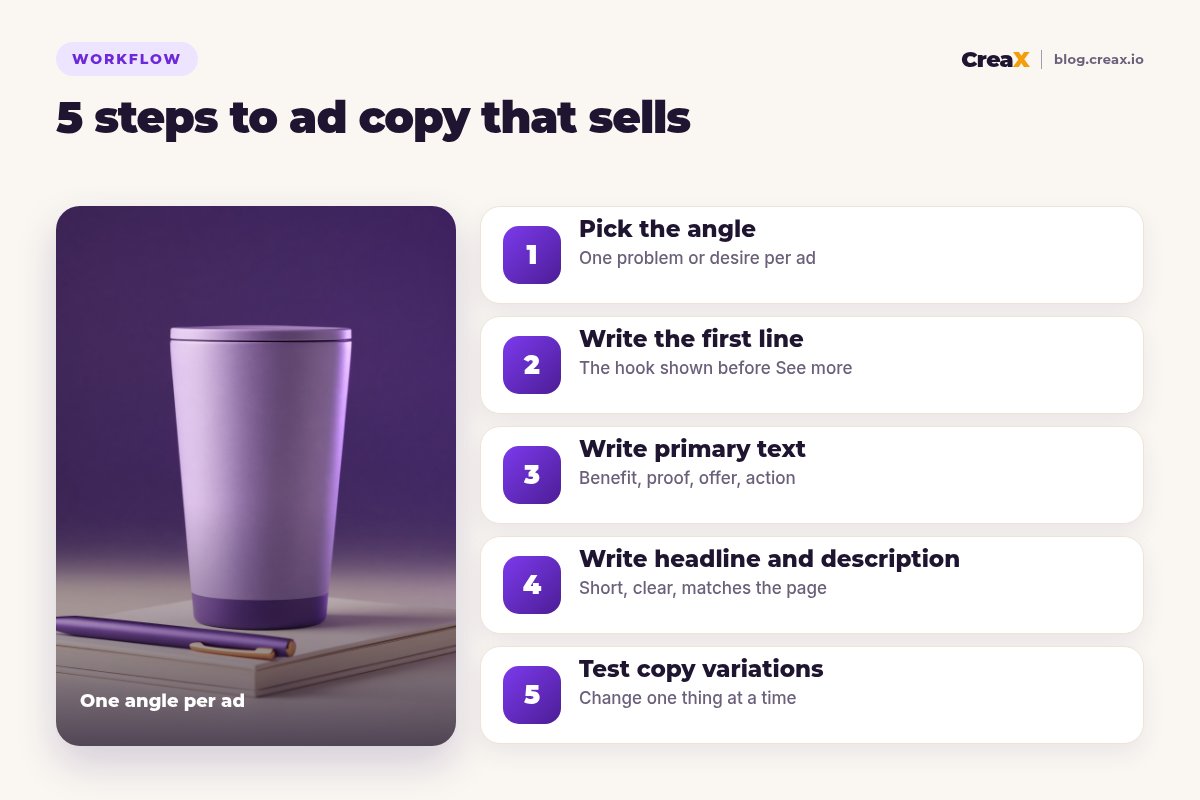
An angle is the reason you give people to care. The same product can be sold on several angles, and each one deserves its own ad. Common angles for physical products:
- Problem. The annoying thing the product fixes. Example: coffee that goes cold before you finish it.
- Desire. The better moment the product creates. Example: a hot drink all the way through your commute.
- Occasion or gift. A season, event or person. Example: a gift for the coworker who lives on coffee.
- Comparison. Why this beats the usual alternative. Example: compared with a paper cup every morning. See our guide to us vs them comparison ads.
- Objection. Answer the doubt directly. Example: will it leak in my bag?
Pick three angles to start. Our guide on testing ad angles for a new product explains how to choose and compare them.
Step 2Step 2: Write the first line
The first line is your hook. On mobile, longer primary text is cut off with a See more link, so the opening line has to work on its own. It should be specific, about the buyer, and connected to what the image or video shows.
First-line formulas that work for products:
- Name the problem: “Your coffee is cold by 9am again.”
- Call out the person: “For anyone who drinks coffee at their desk all day.”
- Ask a real question: “Still buying a paper cup every morning?”
- State the result plainly: “Hot coffee from your first sip to your last.” (only if the product does this)
- Point to the visual: “Watch what happens when we turn it upside down.”
Write five or more first lines per angle and keep the two that feel most like something a person would say. The same thinking applies to video: our guide to UGC ad hooks that stop the scroll has more hook patterns.
Step 3Step 3: Write primary text
After the hook, the rest of the primary text makes the case in a few short lines. A simple order that works for most products:
Hook
Benefit
Proof
Offer
Action
Keep the language simple. Use short lines and line breaks so it scans on a phone. Emojis are fine if they match your brand, but they do not replace a clear message. Long copy can work when the product needs explaining; short copy is usually enough when the video does the work. Test both rather than guessing.
Get ad creatives to pair with your copy
Paste a product link into CreaX and get studio ad creatives and UGC-style video ads in about 60–120 seconds, ready for your new copy.
Step 4Step 4: Write the headline and description
The headline sits under the image or video in bold and is often the last thing people read before clicking. Treat it as the offer line. Good headline patterns:
- The benefit in a few words: “Hot coffee, all morning”
- The product plus the offer: “Lavender tumbler, free shipping”
- The occasion: “The desk gift they will actually use”
- The objection answered: “Leak-proof lid, fits cup holders” (only if true)
The description appears on some placements only, so never put essential information there. Use it for one supporting detail such as the guarantee, a colour choice or delivery information. Then choose a call-to-action button that matches the intent: Shop Now for direct sales, Learn More when the page explains the product first.
★Match the page
Step 5Step 5: Test copy variations
Copy testing works best when each test answers one question. Keep the creative the same and change one element at a time:
- Angle test. Same image, three different angles. This usually teaches you the most.
- Hook test. Same angle, two or three different first lines.
- Length test. Short primary text against a longer version with more proof.
- Headline test. Benefit headline against offer headline.
Meta also lets you add several text options to one ad and mixes them automatically. That is useful for volume, but it makes it harder to see which line won, so for clear learning, use separate ads with clean names. Our guide to naming and tracking ad creatives shows a simple system. If your click-through rate is the problem, read why your CTR is low.
TemplatesTemplates by angle (copy and adapt)
Replace the brackets with your own product facts. Only keep a line if it is true for your product.
iProblem → solution
[Product] [does the one thing that fixes it].
[One proof: material, demo, guarantee].
[Offer]. Tap Shop Now to [next step].
iDesire / better moment
[Product] makes it easy: [main benefit].
[Simple detail that makes it believable].
[Offer, if any]. Get yours today.
iGift / occasion
[Product] is [why it suits them].
[Practical detail: sizes, colours, delivery].
[Gift offer or shipping info]. Shop the [occasion] edit.
iObjection answered
[Product] [fact that answers it].
[Guarantee or returns policy you actually offer].
See the details and pick your [colour/size].
ExampleWorked example: a lavender insulated tumbler
Say you sell an insulated coffee tumbler with a lid, in three colours, with free shipping over a set order value and a 30-day return policy (use your real policy). Here is one angle written out in full.
| Field | Copy |
|---|---|
| First line | Your coffee is cold before your first meeting ends. |
| Primary text | This tumbler is double-wall insulated, so your drink stays warm while you work. Leak-resistant lid, fits most cup holders. Three colours. Free shipping on qualifying orders, 30-day returns. |
| Headline | Warm coffee, all morning |
| Description | Free shipping on qualifying orders |
| Button | Shop Now |
Example copy. Only claim insulation, lid and fit details your supplier can confirm.
For the second and third ads, keep the same image or video and swap only the angle: a gift version (“The desk gift for the coffee person on your team”) and a comparison version (“Still buying a paper cup every morning?”). After a few days, compare cost per click and cost per purchase and keep the winning angle for the next round of creatives.
MistakesMistakes to avoid
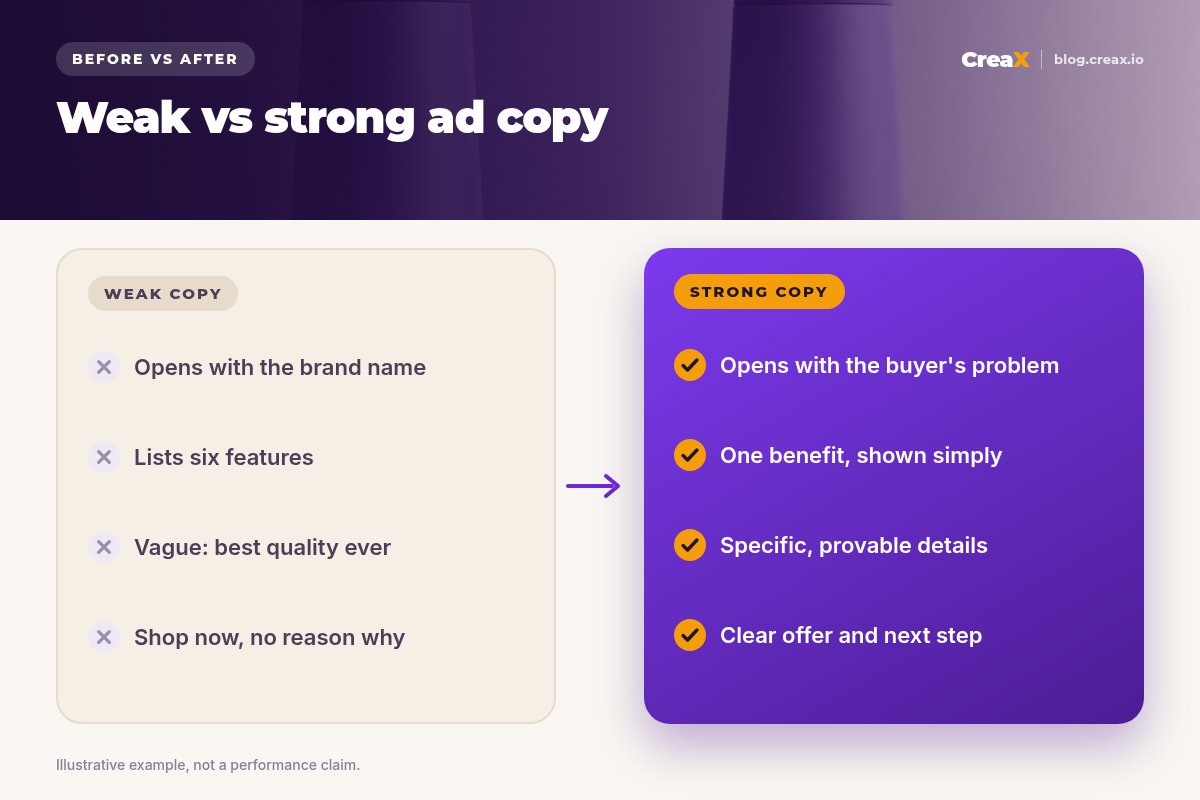
- Starting with the brand name. People care about their problem first. Your name can come later.
- Listing every feature. One clear benefit beats six facts nobody remembers.
- Vague superlatives. “Best quality ever” says nothing. A specific, provable detail does more.
- Fake proof. Invented reviews, star ratings or sales numbers break platform rules and trust.
- Copy that ignores the creative. The text should build on what the image or video shows, not describe something else.
- A page that changes the story. If the ad promises a gift and the page talks about specs, people leave.
ChecklistChecklist before you publish
Ready to launch?
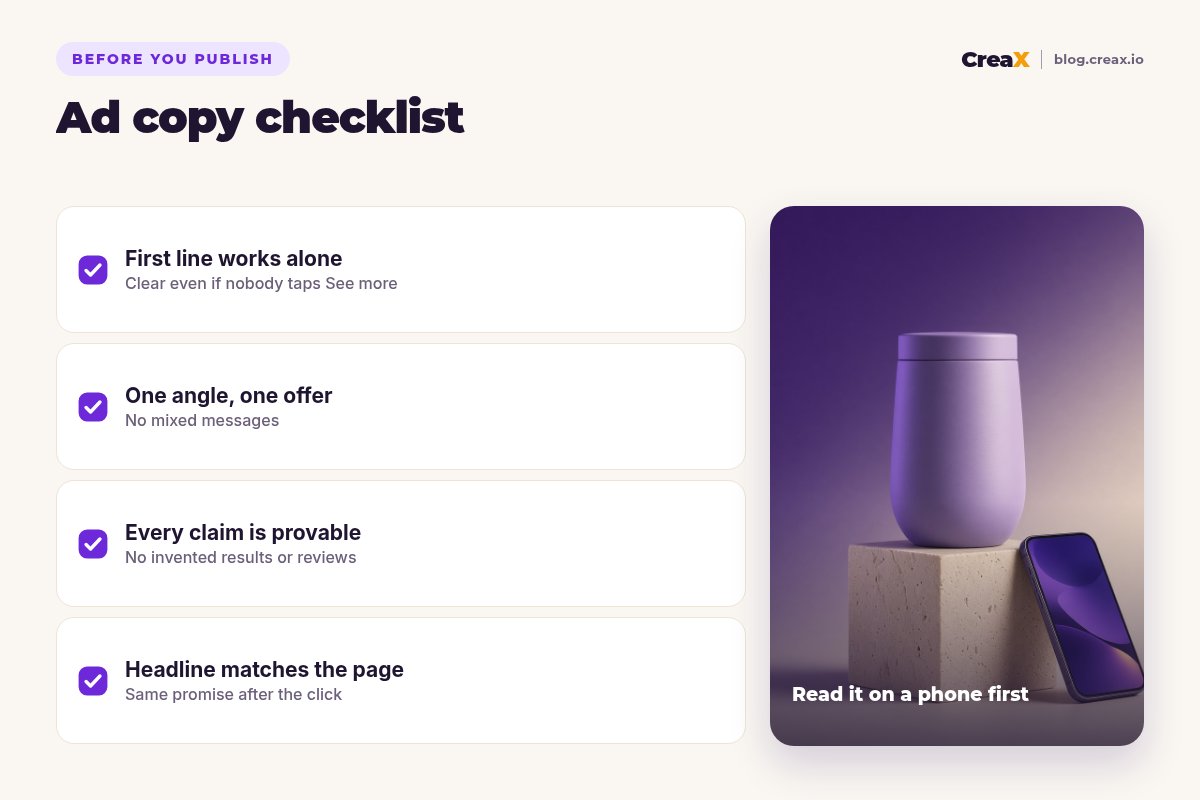
- ✓One angle per ad, written down before you start.
- ✓The first line works on its own, even if nobody taps See more.
- ✓Primary text follows hook, benefit, proof, offer, action.
- ✓Every claim is provable: no invented numbers, reviews or results.
- ✓The headline states the offer or main benefit in a few words.
- ✓The landing page repeats the promise in its first screen.
- ✓You have read the ad preview on a phone for each placement.
Need a hand with the writing itself? Our roundup of the best AI tools for product descriptions and ad copy covers tools that can help you draft, and you still edit for truth and tone.
Pair your new copy with fresh creatives
CreaX turns one product link into studio ads, UGC-style video ads and a matching landing page, so your copy, creative and page tell the same story.
FAQFrequently asked questions
Q.How long should Facebook ad copy be?
Q.Should I use emojis in ecommerce ad copy?
Q.Can I use customer reviews in my ad copy?
Q.Should the headline repeat the primary text?
Q.Can AI write my Facebook ad copy?
Q.How many copy variations should I test?
Ready to launch your next ad?
One product link, about 60–120 seconds, and you have the creatives and landing page your new copy needs.
This guide is published by CreaX. Placement details are based on Meta's Ads Manager as of October 2026 and change often, so always check the ad preview before you publish.