
What Is a Value Proposition in Ecommerce? (With Examples)
FAQ · Ecommerce strategy
An ecommerce value proposition is the short, clear promise that tells a shopper what they get from your product, who it is for and why they should buy it from you instead of anyone else. This guide answers the questions sellers ask most: what it is, how it differs from a USP, where it should appear and how to test it in ads, with examples by niche and a checklist you can copy.
Updated October 2026 · By the CreaX team
Key takeaways
- ✓A value proposition is a promise of a result, for a specific customer, with a reason to choose you. It is not a slogan or a list of features.
- ✓A USP (unique selling proposition) is one specific thing only you offer. It is the proof that backs up your value proposition.
- ✓It belongs in the first screen of your landing page, the hook and headline of every ad and near your product title.
- ✓Don't guess: test two or three versions in separate ads with the same product and budget, and keep the one that sells.
In this guide
TL;DRThe short answer
Your value proposition answers the question every shopper asks in the first few seconds: why should I buy this, from you, now? A good one names who the product is for, the result they get, and what makes your version the better choice. It is written in the customer's words, it can be proven on the page, and it shows up everywhere your customer meets you: ads, landing page, product page and emails.
Q1What is a value proposition?
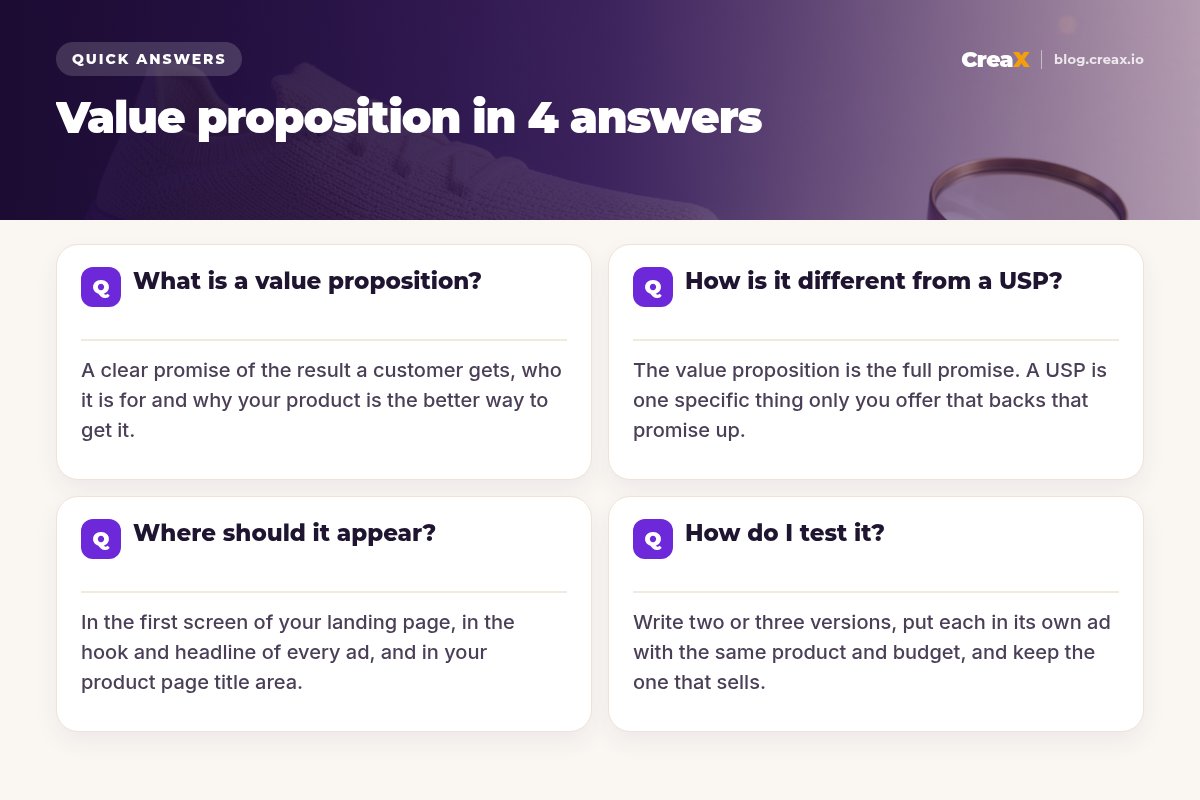
A value proposition is a short statement of the value a customer gets from your product. In ecommerce it usually has three parts:
- The customer. Who the product is for: busy parents, nurses on long shifts, first-time dog owners, home baristas.
- The result. What changes for them: less back pain after a shift, a calmer dog on walks, café-style coffee at home.
- The reason to choose you. Why your product gets them there better than the alternatives: a design detail, a material, a guarantee, a bundle, a service.
A simple template that works for most products:
★Value proposition template
You will rarely publish that sentence word for word. It is a working tool: you turn it into a headline, an ad hook and a few supporting lines. Our guide to product page copy that converts shows how to turn it into a full page.
Q2How is it different from a USP?
People often use the two terms as if they meant the same thing. They are related but not identical:
| Value proposition | USP | |
|---|---|---|
| What it is | The full promise: customer, result, reason to choose you | One specific thing only you offer |
| Question it answers | Why should I buy this? | Why you and not the others? |
| Example (posture corrector) | Stand straighter at your desk without a bulky brace | Fits invisibly under a work shirt |
| Where it lives | Headline, hero, ad hook | Supporting line, comparison, proof section |
Illustrative example of the difference.
Think of the USP as the evidence for your promise. If your value proposition is “comfort for 12-hour shifts”, your USP might be a specific insole design or a fit guarantee. A good us vs them comparison ad is often just your USP made visual.
Q3Where should it appear?
Everywhere a shopper decides whether to keep reading. In order of importance:
- The first screen of your landing page. Headline plus one supporting line, visible without scrolling on a phone. See what makes a high-converting product page.
- The hook and headline of every ad. The first seconds of a video or the main line of a static ad should carry the promise. Our list of UGC ad hooks that stop the scroll has examples.
- Near the product title. A short benefit line under the title helps shoppers who arrive from search.
- Emails and post-purchase pages. Repeating the promise reminds buyers why they chose you.
The most common gap is a mismatch: the ad promises one thing and the page leads with another. Keep the same promise from the first ad to the checkout button.
Q4How do I test it?
You don't need surveys or focus groups to start. Ads are a fast, honest test, because people vote with clicks and purchases:
Write two or three versions
Make one ad set per version
Send each ad to a matching page
Give each version the same budget
Keep the winner and refine it
This is the same logic as testing ad angles; our guide on how to test ad angles for a new product goes deeper into budgets and timing.
Test value propositions without making every ad by hand
Paste a product link and get static ads, UGC-style video and a landing page you can adapt for each promise.
ExamplesExamples by niche
Illustrative value propositions for common ecommerce products. They show the structure, not real brands or results:
| Product | Weak version | Stronger version |
|---|---|---|
| Work sneakers | Premium quality sneakers | Comfort for 12-hour shifts on your feet, with a fit guarantee |
| Dog harness | The best harness for dogs | Calmer walks for dogs that pull, without pressure on the throat |
| Pour-over coffee set | Beautiful coffee gear | Café-style coffee at home in a few minutes, no machine needed |
| Kids' lunch box | Fun lunch boxes | Leak-proof compartments that keep snacks apart in a school bag |
| Skincare serum | Amazing results for your skin | A lightweight serum for dry skin that layers under makeup |
Illustrative examples. Only claim what your product and supplier can prove.
Notice the pattern: the stronger versions name the customer or the situation, describe a concrete result, and include a detail that can be shown on the page.
Worked example: from one sentence to an ad and a page
Take the dog harness. The working sentence might be: for owners of dogs that pull, who want calmer walks, this harness spreads pressure across the chest instead of the throat, unlike a collar and lead. Here is how that one sentence becomes the pieces you actually publish:
- Ad hook (first seconds of a video): “If your dog pulls on every walk, watch this.”
- Static ad headline: “Calmer walks for dogs that pull.”
- Landing page headline and sub-line: “Calmer walks, no pressure on the throat”, followed by one line on how the front clip works.
- Proof section: close-up photos of the chest panel and clip, a sizing guide and your return policy.
Every piece repeats the same promise in a different format, so the shopper who clicked the ad finds exactly what they expected on the page.
MistakesCommon mistakes to avoid
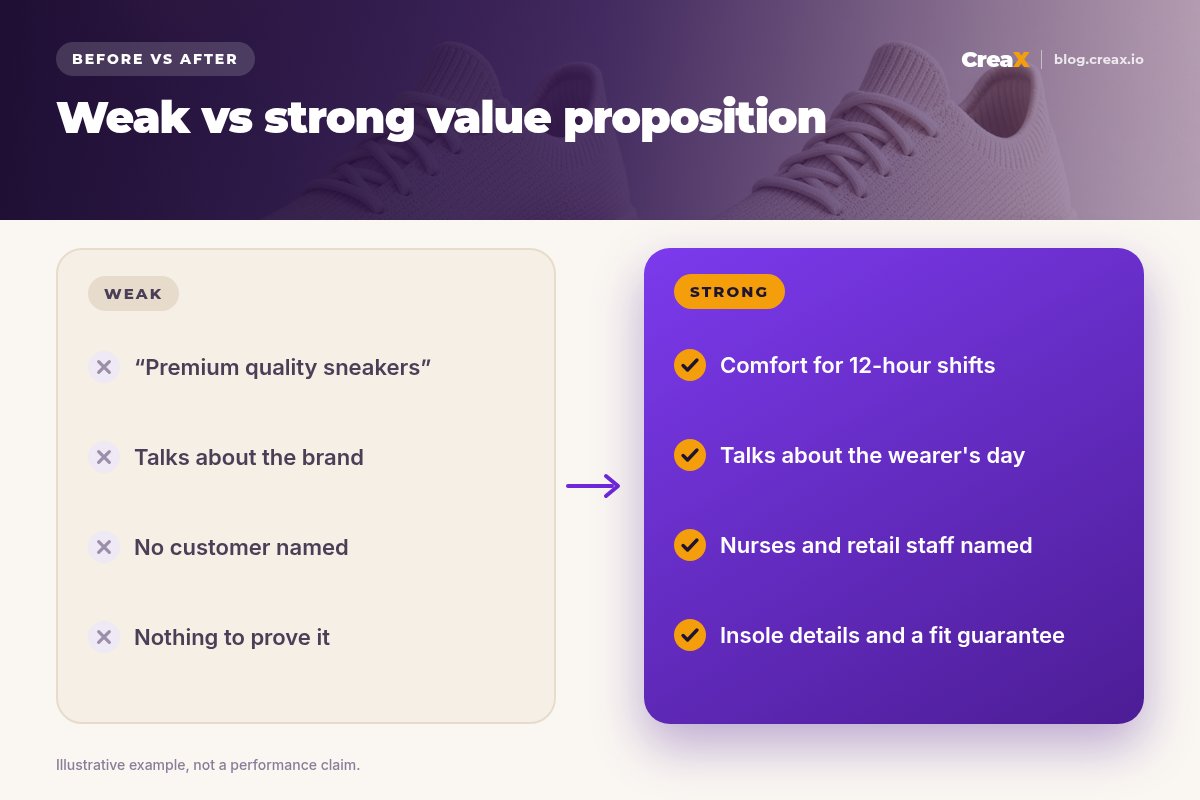
- Talking about yourself. “We are passionate about quality” tells the shopper nothing about their life.
- Being vague. “Premium”, “best” and “amazing” are claims every competitor makes.
- Promising what you cannot prove. Health, income or before-and-after promises can get ads rejected and lose trust.
- Changing the promise between ad and page. The shopper clicked for one reason; keep it.
- Trying to say everything. One clear promise beats five weak ones. Put the rest further down the page.
!Keep claims honest
ChecklistChecklist you can copy
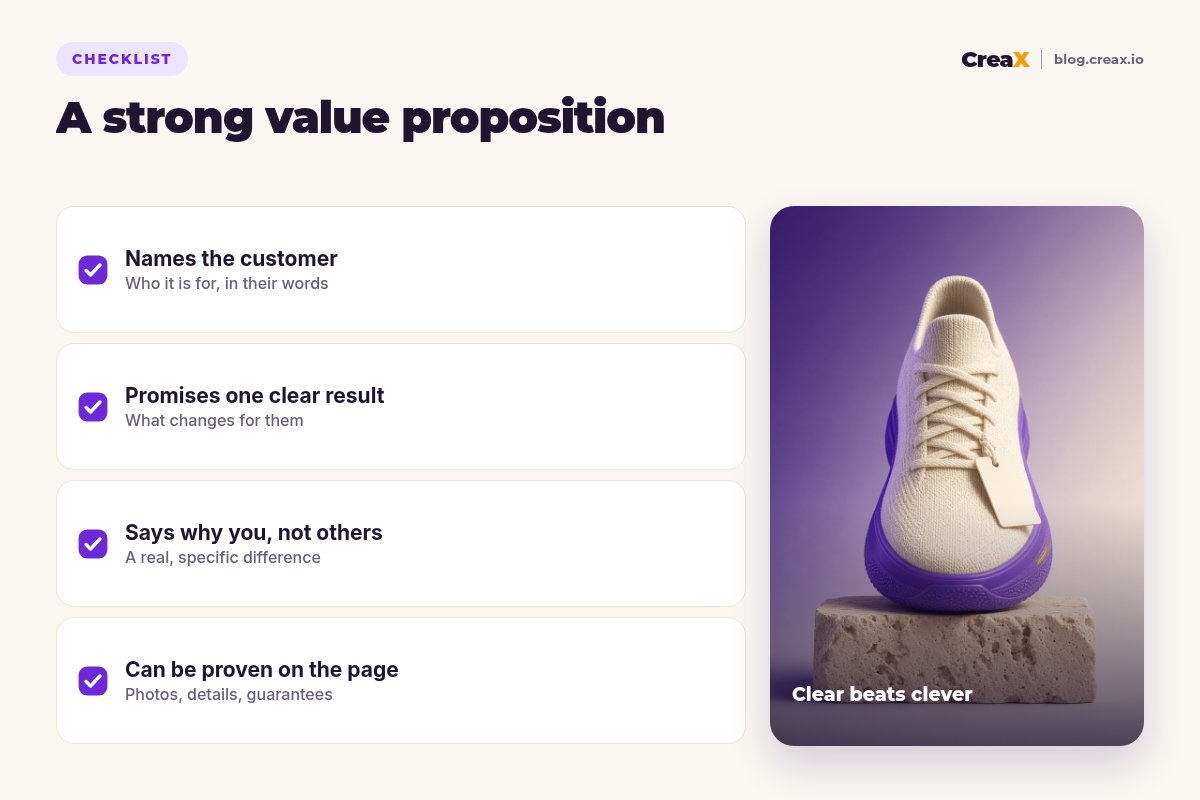
Value proposition checklist
- ✓It names the customer or the situation, in their words.
- ✓It promises one clear, concrete result.
- ✓It says why your product is the better way to get it.
- ✓Every part can be proven with photos, details or a guarantee.
- ✓A stranger understands it in a few seconds on a phone.
- ✓It appears in the ad hook, the page headline and near the product title.
- ✓You have tested at least two versions in ads.
CreaXHow CreaX helps (briefly)
Testing value propositions means making several sets of ads and pages, one per promise. That is the slow part. CreaX is an AI ecommerce creative OS: paste a product link or upload a product image and in about 60–120 seconds you get studio ad creatives, UGC-style video ads (18, 30 or 45 seconds) and a publish-ready landing page. You edit the headline and hook to match each promise, launch them side by side and keep the winner.
Static ads come in five styles and four sizes (1:1, 3:4, 4:5 and 9:16), and plans start at $4.99 a month. For deciding when a product is worth scaling once a promise wins, see how to know a product is a winner.
Turn your best promise into ads and a page
One product link, about 60–120 seconds: static ads, UGC-style video and a landing page you can match to each value proposition.
FAQFrequently asked questions
Q.How long should a value proposition be?
Q.Can a store have more than one value proposition?
Q.Is a slogan the same as a value proposition?
Q.What if my product is the same as competitors'?
Q.Should the price be part of it?
Q.How often should I revisit it?
Ready to find the promise that sells?
Paste a product link and get ads and a landing page to test your value propositions in about 60–120 seconds.
This guide is published by CreaX. Examples are illustrative, not performance claims. CreaX features are described from creax.io as of October 2026.