
Do You Need a Shopify Store to Start Dropshipping?
FAQ · Dropshipping
Do you need Shopify to dropship? No. Shopify is a popular, solid choice, but it is one of several ways to sell. What every dropshipping business actually needs is a product, a reliable supplier, a page that converts, a way to take payment and a source of traffic. This guide answers the questions new sellers ask most, explains the trade-offs, and shows when a landing page or a lighter store gets you testing sooner.
Updated October 2026 · By the CreaX team
Key takeaways
- ✓Shopify is optional. You can dropship with another store builder, a focused landing page with checkout, a marketplace or a social shop, as long as you follow each platform's rules.
- ✓The minimum setup is a product with a clear angle, a tested supplier, a page that repeats the ad, a payment method that works in your country, and ads or another traffic source.
- ✓Shopify earns its fee once you have a winner to scale, a growing catalog, or need its apps, themes and integrations.
- ✓Test first, build later: one product and one page get you real data faster than a full store built before any sales.
In this guide
TL;DRThe short answer
You don't need Shopify to start dropshipping. You need a way for a stranger who clicked an ad to understand the product, trust you and pay. Shopify does that well, which is why it is the default for many sellers. But a well-built landing page with a checkout, another store builder, or a marketplace can do the same job, sometimes with less setup.
The more useful question is what you are trying to do this week. If you are testing whether a product sells at all, the platform matters far less than the product, the ad and the page. If you already have a winner and want to build a brand around it, a full store platform like Shopify starts to pay for itself.
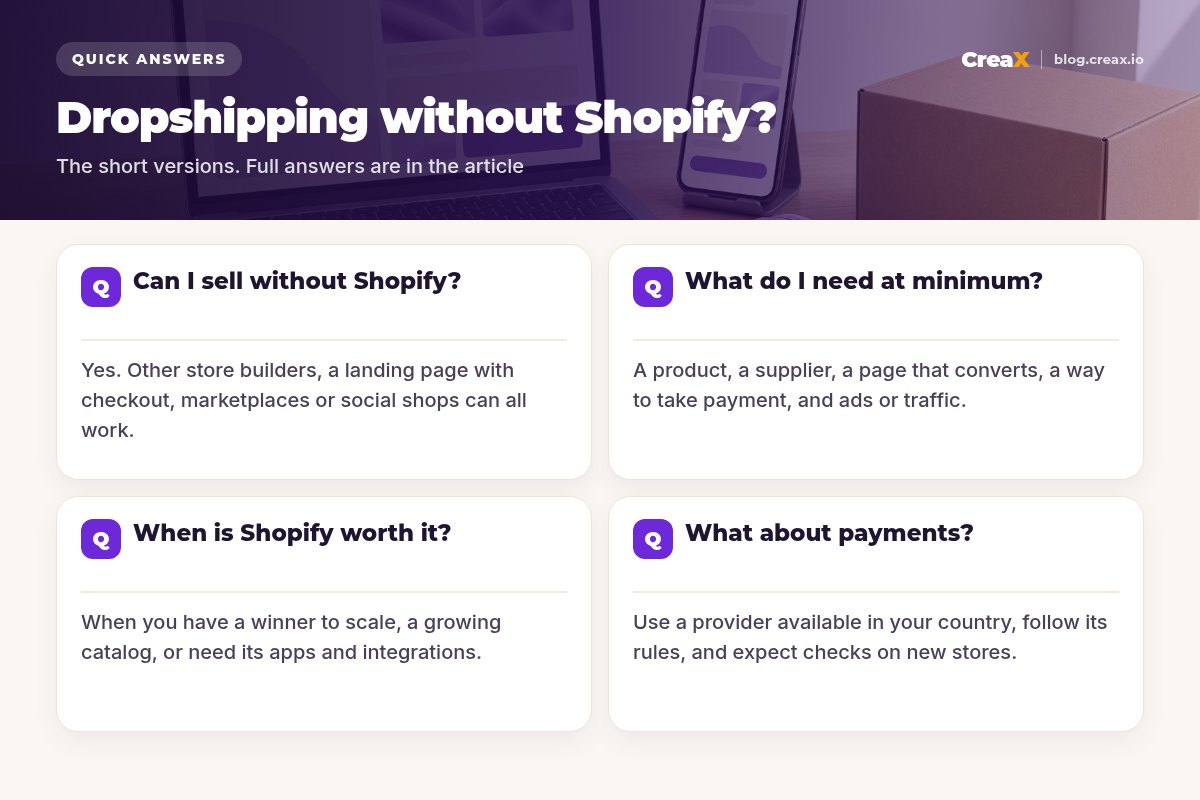
Q1Can I sell without Shopify?
Yes. Here are the main routes, with the honest trade-offs:
| Option | What it is | Good for | Watch out for |
|---|---|---|---|
| Another store builder | WooCommerce, Wix, Squarespace, BigCommerce and similar | Sellers who prefer another ecosystem or already use one | Fewer dropshipping-specific apps on some platforms; setup time is similar |
| Landing page + checkout | One focused page per product with a payment or order form | Fast product tests from paid ads | You still need policies, payment approval and order handling |
| Marketplaces | Amazon, eBay and others | Tapping existing marketplace traffic | Strict dropshipping and seller policies; read them first |
| Social commerce | Shops inside social apps, where available | Sellers whose audience lives on that app | Platform-specific rules, approvals and fees |
| Generated store | A store produced by an AI tool from a product link | Niche or client stores without a theme marathon | Check payment and checkout options for your country |
Platform rules, fees and availability change and vary by country. Read each platform's current seller and dropshipping policies before you start.
For paid-ad product testing, the landing page route is often the fastest: one product, one promise, one button. Our guide to turning a product link into a landing page without a designer walks through it.
Pick your route in three questions
- Are you testing or scaling? Testing favours a focused page per product; scaling favours a full store.
- Where do your buyers already shop? If they buy inside a marketplace or social app, selling there may beat sending them to a new site.
- What can you get paid with? The payment options available in your country often decide the platform for you.
Q2What do I need at minimum?
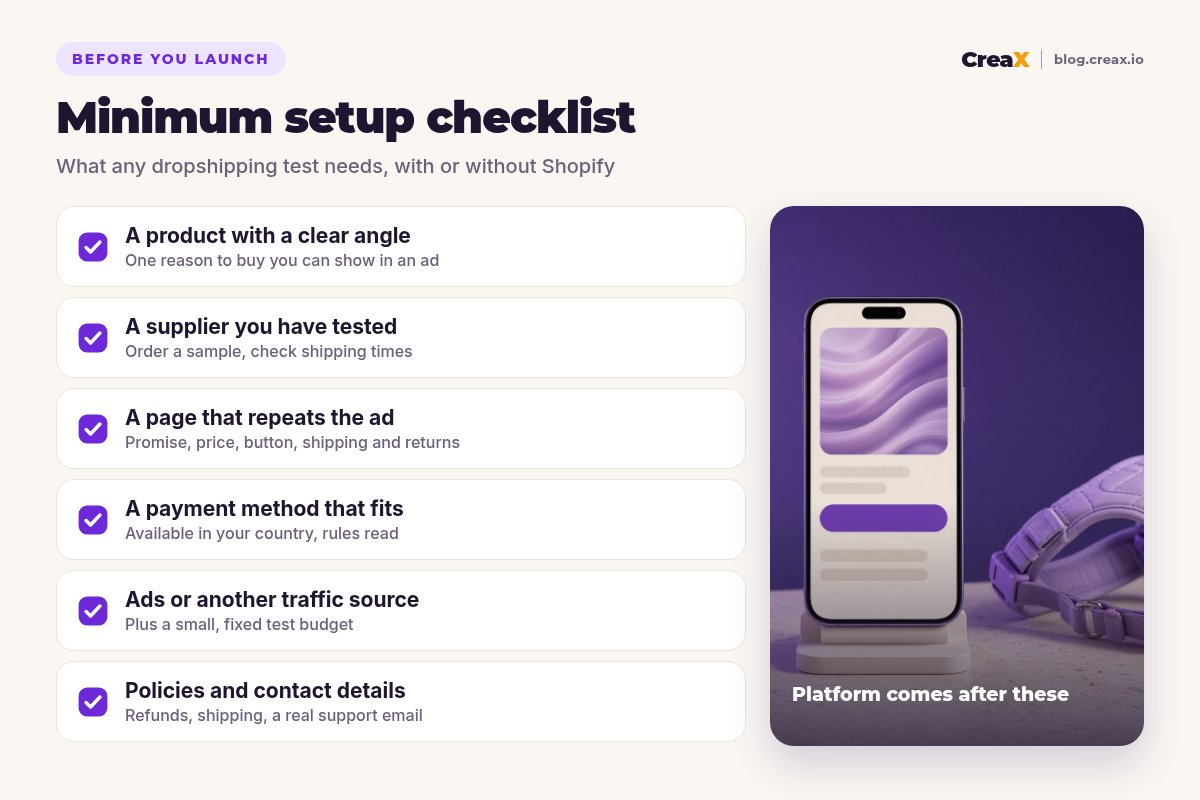
Strip dropshipping down to what actually makes a sale and you get six things. If any one is missing, no platform will save the test:
- A product with a clear angle. One reason to buy that you can show in an ad in a few seconds.
- A supplier you have tested. Order a sample, check quality and real shipping times to your target country.
- A page that repeats the ad. The promise, the price, a clear button, shipping and returns, and honest images. Our FAQ on what makes a high-converting product page covers the details.
- A way to take payment that is available in your country and that you have been approved for.
- Traffic. Usually paid ads on Meta or TikTok, plus a small, fixed test budget.
- Policies and contact details. Shipping, refunds and a real support email, visible before checkout.
Example: a test-first setup
Say you want to test a padded dog harness with Meta ads. A test-first setup could be: order one sample to check the fit and the real delivery time; build one landing page that leads with a single angle (for example “no more pulling on walks”, only if the harness genuinely helps with that); prepare two or three ad creatives for that angle and one alternative; connect a payment method you are approved for; publish shipping, refund and contact pages; then run a small, fixed budget for a few days. If it sells, that is the moment to think about a full branded store, more colors and a bigger catalog.
★Know your numbers before you launch
Get a product page and ads from one link
CreaX turns a product link into a publish-ready landing page, studio creatives, UGC-style video ads and a store in about 60–120 seconds.
Q3When is Shopify worth it?
Shopify is popular for good reasons. It tends to be worth the subscription when:
- You have a winner to scale. A product with consistent sales deserves a proper brand store with collections, upsells and email flows.
- Your catalog is growing. Managing many products, variants and inventory is easier on a full store platform.
- You rely on apps. Supplier integrations, reviews, bundles and subscriptions live in its app ecosystem.
- You want a familiar checkout that many shoppers already recognise, and payment options built into the platform where available.
- You are building a long-term brand rather than testing products week to week.
If you do use Shopify, you can still test new products on focused landing pages and send winners to the main store. Our comparison of CreaX vs PageFly and GemPages covers page options for Shopify sellers, and CreaX vs Shopify Magic explains how AI tools fit alongside a Shopify store.
⚖Shopify is not the problem, or the solution
Q4What about payments?
Payments are where many new dropshippers get stuck, whatever platform they choose. A few principles hold everywhere:
- Use a provider available in your country and for your business type. Popular providers include Stripe and PayPal, and many store platforms have their own payment options in some countries.
- Read the provider’s rules. Payment companies review new businesses and may hold funds or ask for documents, especially when delivery times are long or refunds are high.
- Show shipping times honestly. Late or surprise deliveries cause disputes and chargebacks, which put your payment account at risk.
- Consider cash on delivery where it is normal. In some markets, such as parts of the Middle East and North Africa, cash on delivery is common. It changes your risk (refused parcels) rather than removing it.
- Keep records of orders, tracking numbers and customer messages, so you can answer disputes quickly.
!Not legal or financial advice
MistakesCommon mistakes to avoid
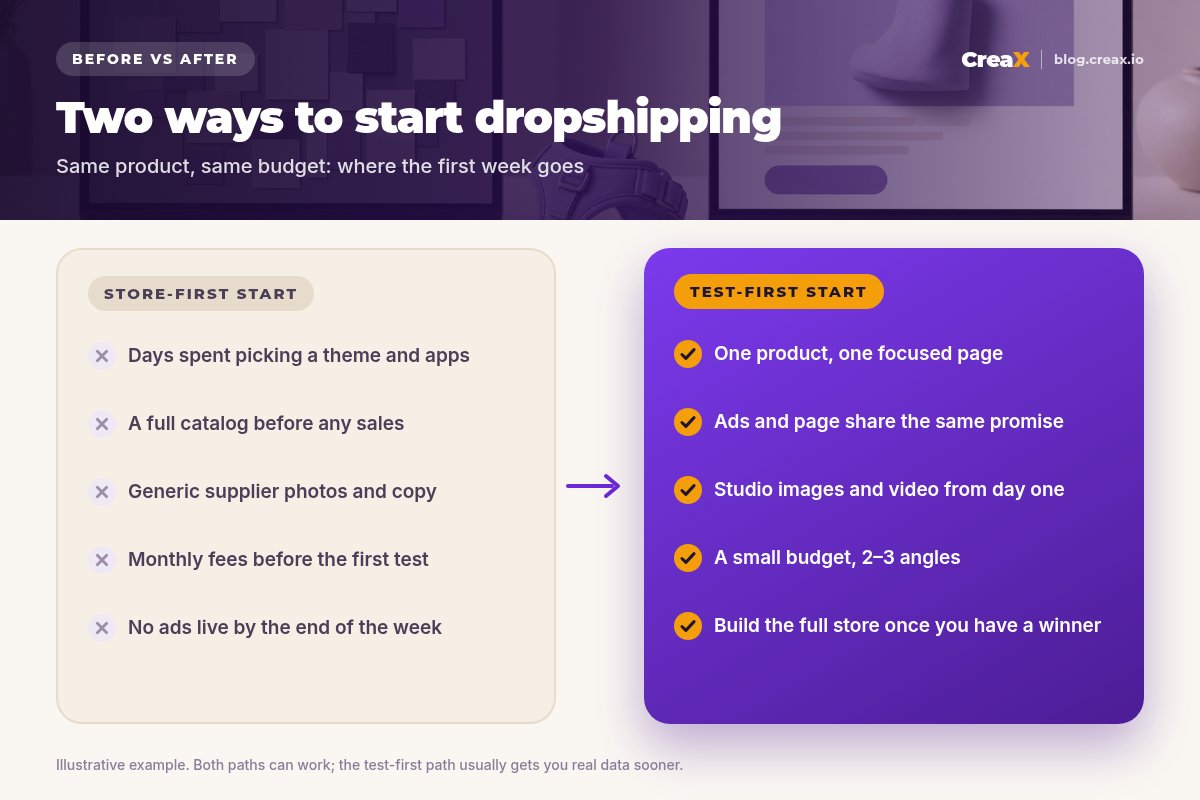
- Building a full store before the first test. Weeks of theme tweaking, zero data.
- Choosing a platform for its hype. Pick what fits your country, payment options and skills.
- Ignoring marketplace rules. Some marketplaces restrict or ban certain dropshipping practices.
- Hiding shipping times. It leads to disputes, chargebacks and payment holds.
- Using supplier photos and copy as-is. Your ad and page look like every other seller's.
- No policies or contact details. Shoppers and payment providers both look for them.
ChecklistChecklist you can copy
Before your first dropshipping test
- ✓Product chosen with one clear angle you can show in an ad
- ✓Supplier sample ordered; real shipping time to your country known
- ✓Break-even cost per sale calculated
- ✓One focused page: promise, price, button, shipping, returns
- ✓Payment method available in your country and approved
- ✓Shipping, refund and contact pages live
- ✓Two or three ad angles ready, plus a fixed test budget
- ✓Platform rules read (store, marketplace, ad network, payment provider)
- ✓Plan for what happens if it wins: full store, more creatives, more stock
CreaXHow CreaX helps (briefly)
CreaX is an all-in-one AI ecommerce creative OS. Paste a product link or upload a product image and, in about 60–120 seconds, it generates a publish-ready landing page, studio ad creatives, UGC-style video ads and a multi-tenant store. That means you can get a focused test page and matching ads without building a store first, then keep using Shopify or another platform when you scale.
The multi-tenant store is useful if you test several niches, because each one can have its own storefront; see the multi-tenant store builder explainer. For a full test plan, read how to launch a dropshipping product test in 24 hours. Plans start at $4.99/month for 2,000 credits. Check in the app which checkout and payment options suit your country.
Start testing without building a store first
One product link, about 60–120 seconds: a landing page, studio creatives, UGC-style video ads and a store for your first test.
FAQMore questions sellers ask
Q.Is Shopify required for dropshipping suppliers?
Q.Can I dropship with just a landing page?
Q.Is Shopify better than WooCommerce for dropshipping?
Q.Can I dropship on Amazon or eBay instead?
Q.How much does it cost to start dropshipping without Shopify?
Q.Do I need a business registered to dropship?
Ready to test your first product?
Paste a product link and get the page, studio ads and UGC-style video ads that tell the same story.
This guide is published by CreaX. It contains general information, not legal, tax or financial advice, and no invented statistics. Platform and payment rules vary by country and change often; check the current rules for your market.