
CreaX vs Hypotenuse AI: Product Content at Scale vs Ad Creatives
Comparison · Product content
CreaX vs Hypotenuse AI looks like a contest between two AI tools for ecommerce, but they solve different problems. Hypotenuse AI is an AI-first product information platform: it enriches catalog data, writes product descriptions in bulk and standardises catalog images for search. CreaX turns one product link or image into ad creatives, UGC-style video ads and a landing page for paid traffic. Here is an honest guide to which one you need, and when a brand uses both.
Updated October 2026 · By the CreaX team
Key takeaways
- ✓Hypotenuse AI is an AI-first PIM for ecommerce: attribute enrichment, bulk SEO titles and descriptions in your brand voice, catalog image standardisation, localisation, rank tracking and retailer guideline checks.
- ✓CreaX is an AI ecommerce creative OS: paste a product link or image and get studio ad creatives, UGC-style video ads, a publish-ready landing page and a multi-tenant store in about 60–120 seconds.
- ✓Pick Hypotenuse AI if your bottleneck is product information across hundreds or thousands of SKUs, on your site and on marketplaces.
- ✓Pick CreaX if your bottleneck is the creatives and pages for the products you push with paid ads. Large catalogs that advertise often use both.
In this guide
TL;DRThe short answer
Hypotenuse AI works on your catalog. It makes sure every product has complete, accurate, well-written information and clean images, so shoppers and search engines (including AI search) understand what you sell. CreaX works on your campaigns. It takes the products you want to sell with ads and gives you the scroll-stopping creatives and a focused page that repeats the ad's promise.
One is organic and operational: fill gaps, standardise, keep thousands of listings tidy. The other is paid and creative: make new angles, launch tests, refresh what tires. If you are a small store with 20 products and paid social is your main channel, catalog tooling is probably not your bottleneck. If you are a retailer onboarding hundreds of products a week, ad creatives may not be the first fire to put out.
⚖Our bias, stated upfront
The competitorWhat Hypotenuse AI is (and who it is built for)
Many sellers know Hypotenuse AI for AI-written product descriptions. Its website now presents it as an AI-first product experience (PXM) and PIM platform, the system behind your product information. Its public website lists four main areas:
- Data enrichment. Fill missing attributes by searching the web, UPCs and spec sheets, extract details like color and specs from images, tag and categorise to Google, Amazon or custom taxonomies, and standardise formats.
- Product content. Bulk-generate SEO-optimised titles and descriptions in a bespoke brand voice, with custom formatting, plus localisation and translation for global audiences.
- Catalog images. Standardise backgrounds and shadows, crop and resize with smart padding, sharpen and upscale, and place products in lifestyle scenes.
- Optimisation. Track product rankings across Google, Amazon, Walmart and more, get keyword suggestions, and check content against retailer guidelines.
It integrates with commerce platforms and marketplaces and highlights enterprise features such as team workflows, granular access control and SOC 2 compliance. The typical user is an ecommerce, merchandising or content team at a brand or retailer with a large, changing catalog.
Our productWhat CreaX is: the AI ecommerce creative OS
CreaX starts from a single product and builds what you need to advertise it. Paste a product link (from Alibaba, AliExpress, Amazon, Etsy or any product page) or upload a product image, and in about 60–120 seconds you get:
- Studio ad creatives. Product photos and static ads in five styles (Classic, Humble Orbit, Punch, Luxe and Meta Feed) and four sizes (1:1, 3:4, 4:5 and 9:16).
- UGC-style video ads. 18, 30 or 45-second videos for TikTok, Reels and Meta feeds.
- A publish-ready landing page. Simple, Detailed or Advanced levels, written from the same product understanding as the ads.
- A multi-tenant store. Keep niches or client brands apart.
CreaX supports 40+ languages and 160+ target countries, and its pages support right-to-left languages like Arabic. It is built for dropshippers, media buyers, affiliates, coaches, ecommerce brands and agencies who sell with paid traffic. It is not a PIM and does not manage catalog attributes or marketplace feeds.
CompareSide-by-side: features, outputs and workflow
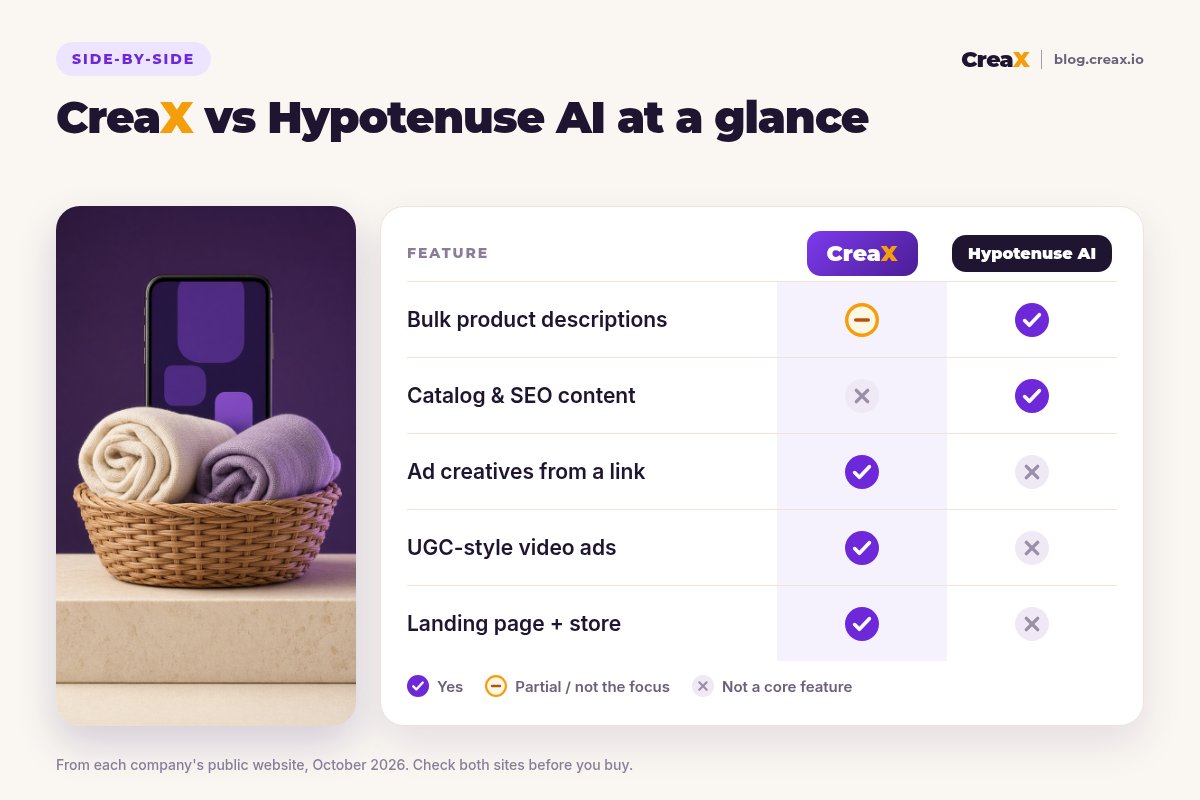
| Hypotenuse AI | CreaX | |
|---|---|---|
| Main job | Complete, accurate product information at scale | Ads and a landing page for a product |
| Unit of work | The whole catalog | One product or campaign |
| Text output | SEO titles, descriptions, attributes, tags | Ad copy and landing page copy |
| Image output | Standardised catalog images, lifestyle scenes | Studio ad creatives in 5 styles, 4 sizes |
| Video ads | Not a core feature | UGC-style video in 18s, 30s or 45s |
| Landing page or store | Not a core feature | Yes, plus a multi-tenant store |
| Search and marketplace tools | Rank tracking, keywords, guideline checks | Not the focus |
| Best fit | Ecommerce and merchandising teams | Sellers testing products with paid ads |
From each company's public website, October 2026. A summary of focus, not a full feature list.
The workflows reflect that. A Hypotenuse AI project usually means connecting your store or product feed, setting your brand voice and rules, then enriching and rewriting many products at once. A CreaX session means pasting one link, reviewing the generated kit, picking the angles to test and launching the same day.
Need ads and a page for a product you want to push?
Paste a product link and get studio ads, UGC-style video and a landing page you can review in minutes.
BudgetPricing: CreaX plans vs Hypotenuse AI
CreaX uses monthly credit plans. Credits are spent when you generate, and you can top up any time:
| CreaX plan | Price / month | Credits | Good fit |
|---|---|---|---|
| Free | $0 | 0 | Look around the app before buying credits |
| Basic | $4.99 | 2,000 | Your first product tests |
| Standard | $14.99 | 6,500 | Testing new products every week |
| Pro | $29.99 | 14,000 | Several products or stores at once |
| Premium | $49.99 | 25,000 | Agencies and high-volume media buyers |
| Top-up | $1 | 500 | Extra credits when a test takes off |
Current plans on creax.io/pricing. The app shows the credit cost before you generate.
Hypotenuse AI positions itself for enterprise and growing ecommerce teams, and its plans depend on catalog size and needs. We do not quote its prices; check hypotenuse.ai for current plans or to book a demo.
★Price the outcome you need
Fair playWhere Hypotenuse AI is the better pick
A fair comparison has to say where the other tool is stronger. For catalog-heavy businesses, Hypotenuse AI covers work CreaX does not try to do:
Hypotenuse AI
Strengths
- +Bulk SEO titles and descriptions in your brand voice
- +Attribute enrichment from web, UPC and spec sheets
- +Tagging to Google, Amazon or custom taxonomies
- +Catalog image standardisation at scale
- +Rank tracking and retailer guideline checks
- +Enterprise workflows and access control
Trade-offs
- −Not built to make video ads or ad creative kits
- −No landing pages for campaigns
- −More platform than a small store may need
CreaX
Strengths
- +Studio ads, UGC-style video and a landing page from one link
- +Ad and page share one message
- +About 60–120 seconds per kit
- +Plans from $4.99/month, top-ups $1 per 500 credits
- +Multi-tenant store for niches or clients
Trade-offs
- −Not a PIM: no attribute enrichment or feeds
- −Not built for bulk catalog descriptions
- −No rank tracking or marketplace guideline checks
⚖Honest take
Our recommendationWhere CreaX is the better pick
Perfect product data does not make a cold shopper stop scrolling. When growth depends on paid social, the bottleneck is usually creative: fresh angles, video, statics in every placement size and a page that matches the ad. That is where CreaX fits:
- You sell a focused range with ads. Dropshippers, DTC brands and media buyers usually push a handful of hero products hard.
- You need video and statics, not descriptions. Ads tire; you need new creatives every week, in every placement size.
- You want message match. A landing page built from the same product understanding as the ad keeps the click on one promise. See landing page vs product page.
- You launch new products often. One link gives you the whole first-test kit without a designer or editor.
If product copy is the gap you want to close, our roundup of the best AI tools for product descriptions and ad copy compares more options, and our guide to writing product page copy that converts covers the basics.
Build your next product test in one pass
One product link becomes the landing page, studio ads and UGC-style video ads, so your test can go live today.
ExampleWorked example: one product, both workflows
Say you run a home goods store with a few hundred SKUs, and you want to push a new linen towel set with paid social ads. Only claim materials, sizes or care details your supplier confirms.
With Hypotenuse AI
- Connect your store or product feed and set your brand voice and formatting rules.
- Enrich the towel set's attributes (material, size, color) and generate an SEO title and description, along with the rest of the new collection.
- Standardise the product images so the set matches the rest of the catalog.
- Check the listing against marketplace guidelines and track how it ranks.
With CreaX
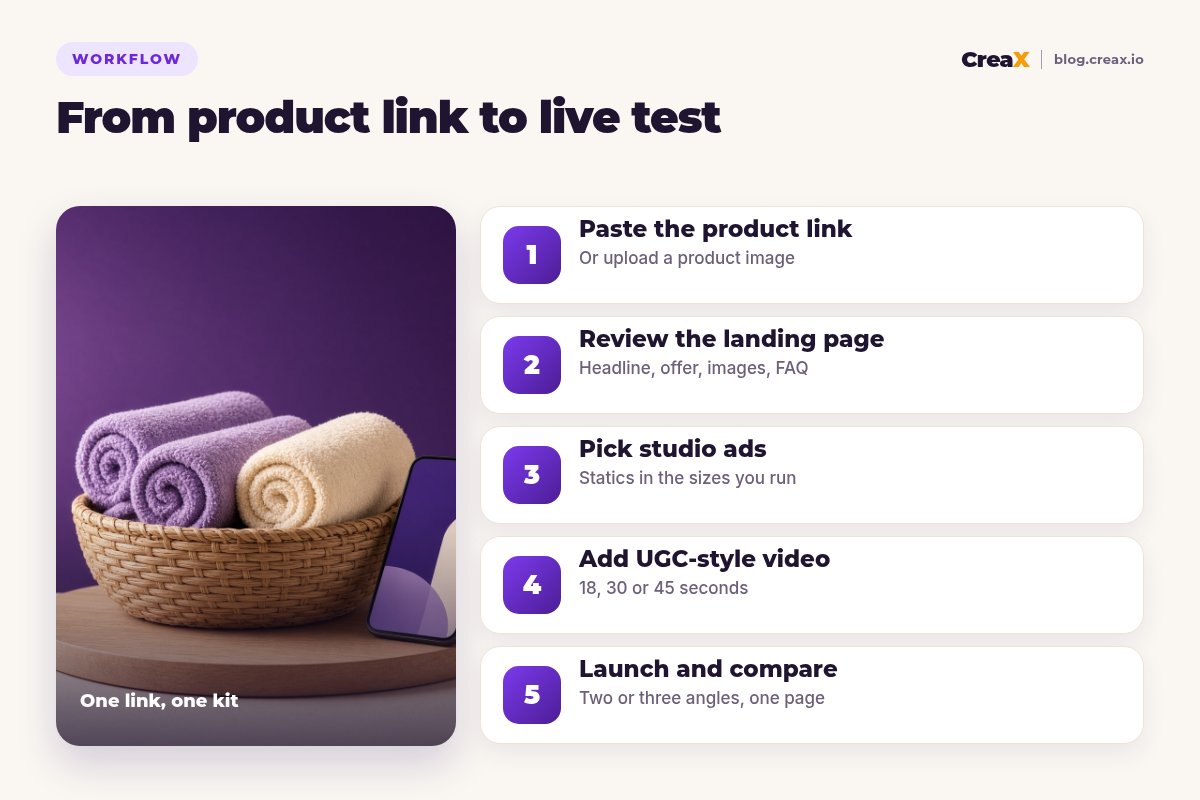
Paste the product link
Review the landing page
Pick studio ads
Add UGC-style video
Launch and compare
| Task | Hypotenuse AI setup | CreaX setup |
|---|---|---|
| Product description and attributes | Strong: enriched, SEO-ready, on brand | Landing page copy for the campaign |
| Catalog images | Standardised to match the store | Studio ad creatives for the campaign |
| Video ads | Made in another tool | UGC-style video from the product link |
| Campaign landing page | Built elsewhere | Generated, then edited |
| Hundreds of other SKUs | Handled in bulk | Not the focus |
A qualitative comparison of the work involved, not a speed or performance benchmark.
In this store, the tools do not compete. Hypotenuse AI keeps the catalog complete and searchable; CreaX makes the ads and the page for the products the store chooses to push.
!Keep claims honest in both tools
Choose with confidenceDecision checklist
Answer these before you pay
- ✓How many SKUs do you manage? Hundreds or thousands point to a catalog platform like Hypotenuse AI.
- ✓Is missing or messy product data hurting you? That is a PIM job. Lean Hypotenuse AI.
- ✓Do you sell on marketplaces with strict listing rules? Guideline checks and taxonomy tagging help.
- ✓Is paid social your main growth channel? Ads and pages are the bottleneck. Lean CreaX.
- ✓Do you need video ads? CreaX makes UGC-style video from the product link.
- ✓Do you launch new products every week? A kit-per-product tool saves the most time.
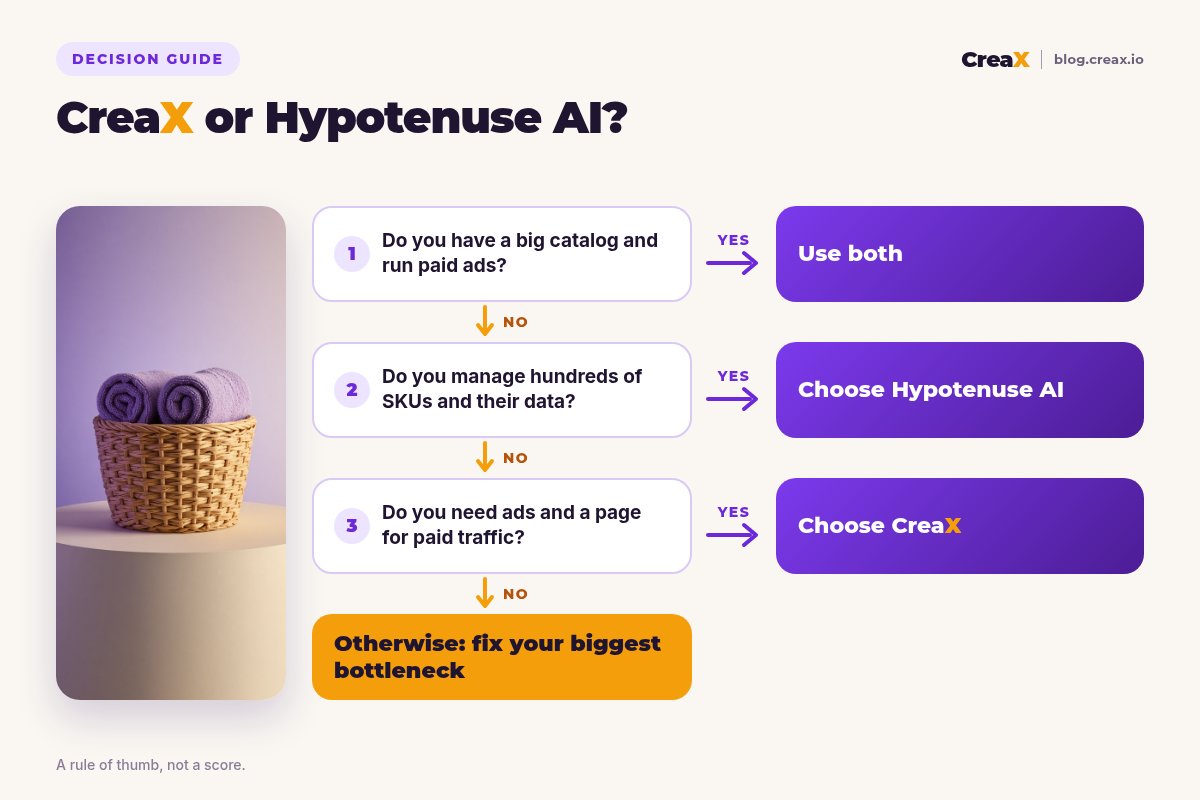
Using both is a fair answer. A larger brand might run its catalog through Hypotenuse AI and use CreaX for the hero products it advertises.
FAQFrequently asked questions
Q.Is CreaX a Hypotenuse AI alternative?
Q.Can Hypotenuse AI make video ads?
Q.Is Hypotenuse AI still an AI writer?
Q.Which is cheaper, CreaX or Hypotenuse AI?
Q.Can I use both tools together?
Q.Does CreaX support other languages?
Ready to test your next product?
One product link, about 60–120 seconds, and you have the studio ads, UGC-style video and landing page for your first test.
This guide is published by CreaX. We describe other tools from their own public websites as of October 2026, avoid invented scores or prices, and recommend checking each vendor's site for current features and plans.