
CreaX vs Foreplay: Ad Inspiration vs Ad Production (Use Both?)
Comparison · CreaX vs Foreplay
CreaX vs Foreplay is less a head-to-head than a question of where each tool sits in your ad workflow. Foreplay helps teams save, research, track and brief winning ads; CreaX produces the finished creatives and landing page from a product link. This guide explains what each one does, where each is the better pick, and how ecommerce sellers can use both in one loop.
Updated October 2026 · By the CreaX team
Key takeaways
- ✓Foreplay is an ad research and creative-workflow platform: swipe files, an ad search engine, competitor tracking, creative analytics and AI-assisted briefs.
- ✓CreaX is an AI ecommerce creative OS: one product link in, a landing page, studio ad creatives and UGC-style video ads out in about 60–120 seconds.
- ✓They barely overlap. Foreplay answers “what should we make?”; CreaX answers “make it now”.
- ✓For solo sellers and small teams who need ads live this week, we recommend starting with CreaX; teams with a creative strategist can get value from both.
In this guide
SummaryThe short answer: CreaX vs Foreplay
Verdict
Foreplay is for ad inspiration and briefs. CreaX is for ad production.
Picking the wrong tool for your bottleneck is the real risk here. A beautiful swipe file doesn't launch a test if nobody can produce the ads, and fast production doesn't help much if every angle is a guess. Start by naming which problem slows you down today.
CompetitorWhat Foreplay is (and who it's built for)
According to its official site, Foreplay describes itself as “the complete winning ad workflow”. It is made of several connected apps:
- Swipe File: save ads from the Meta, TikTok and LinkedIn ad libraries (and elsewhere) with a Chrome extension or mobile app, then organize them into boards.
- Discovery: an ad search engine for finding ads and trends by filters such as how long an ad has been running.
- Spyder: competitor tracking, to follow the ads a brand launches and study their hooks and landing pages.
- Lens: creative analytics; connect your Meta and TikTok ad accounts to analyze your own creative performance and share reports.
- Briefs: turn inspiration into briefs with AI-assisted scripts and storyboard images, then send them to designers or creators and collect their work in one place.
Foreplay also offers automatic transcription of ads, an API and an MCP connection for AI assistants. It is built for performance creative teams: media buyers, creative strategists, agencies and brands that brief designers and UGC creators. What it doesn't do, by design, is produce the finished ad or landing page; its AI output is a brief, script or storyboard that someone then produces.
CreaXWhat CreaX is: the AI ecommerce creative OS
CreaX is an all-in-one AI creative tool for ecommerce. You paste a product link or upload a product image, and in about 60–120 seconds it generates:
- A publish-ready landing page for the product.
- Studio ad creatives: product photos and static ads.
- UGC-style video ads built around the product.
- A multi-tenant store for testing products and niches.
It is built for dropshippers, media buyers, affiliates, coaches, ecommerce brands and agencies who need assets for a product test quickly, without briefing a designer or booking creators for every variation. You still review every claim before launch, and you run the ads in your own ad accounts.
CompareSide-by-side: features, outputs and workflow
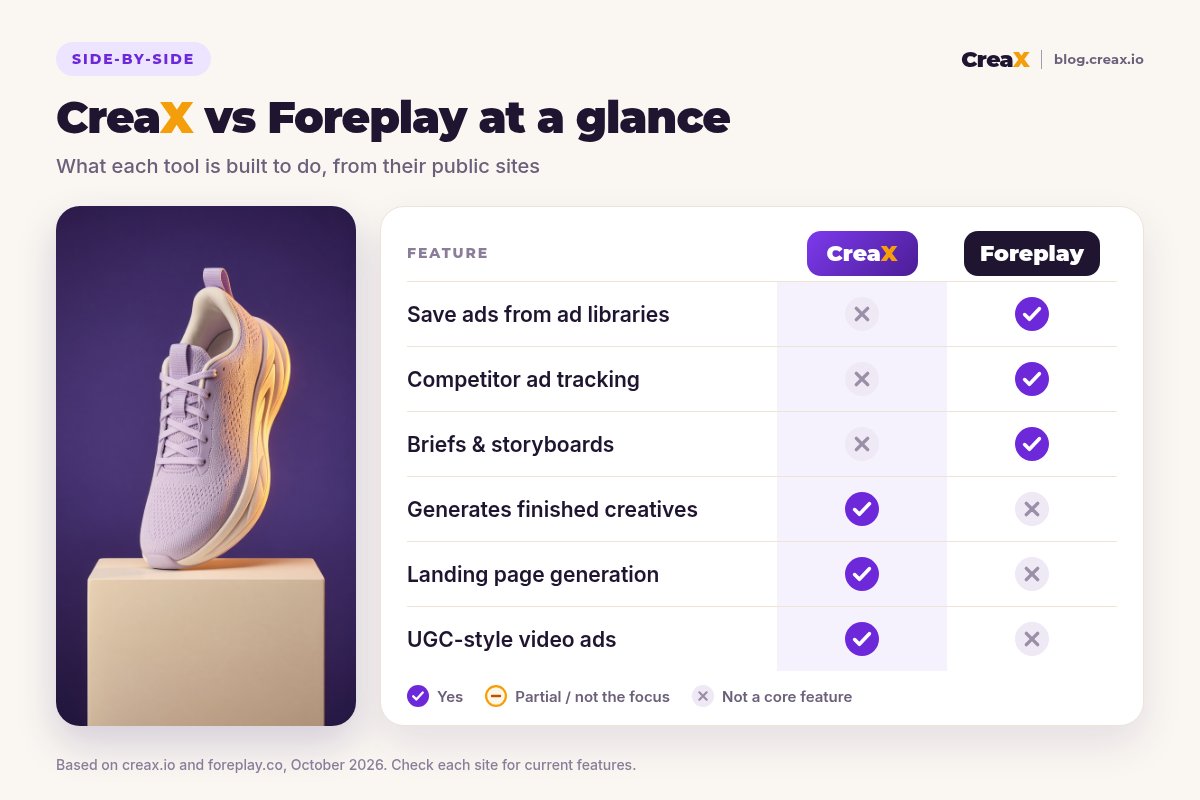
| CreaX | Foreplay | |
|---|---|---|
| Main job | Produce ads and pages for a product | Research, organize and brief ads |
| Input | Product link or product image | Ads you save, search or track; your ad account data |
| Output | Landing page, studio creatives, UGC-style videos, store | Swipe files, boards, reports, briefs, scripts, storyboards |
| Works best for | Sellers and small teams who need assets fast | Creative teams, strategists and agencies |
| Competitor research | Not a core feature | Core feature (Discovery, Spyder) |
| Performance analytics | Not a core feature | Lens, connected to Meta and TikTok |
| Who produces the final ad | CreaX generates it; you review | Your designers, editors or creators |
Based on each company's public website, October 2026. Features change; check both sites.
CreaX
Strengths
- +One product link becomes a page, statics and UGC-style videos
- +Page and ads start from the same product story
- +Fast enough to test new angles every week
- +Transparent credit plans from $4.99/month
Trade-offs
- −No ad library, swipe file or competitor tracking
- −No analytics on your ad accounts
- −You still decide the angles and review every claim
Foreplay
Strengths
- +Save and organize ads from major ad libraries
- +Competitor tracking and an ad search engine
- +AI-assisted briefs, scripts and storyboards
- +Creative analytics connected to Meta and TikTok
Trade-offs
- −Doesn't produce finished ads or landing pages
- −You need designers, editors or creators downstream
- −Most valuable when someone owns creative strategy
CostPricing: CreaX plans vs Foreplay
CreaX uses monthly credit plans; each generation uses credits, and you can top up at $1 per 500 credits:
| CreaX plan | Price / month | Credits |
|---|---|---|
| Free | $0 | 0 |
| Basic | $4.99 | 2,000 |
| Standard | $14.99 | 6,500 |
| Pro | $29.99 | 14,000 |
| Premium | $49.99 | 25,000 |
CreaX prices from creax.io/pricing, October 2026.
Foreplay offers paid plans with different feature sets for research, briefs and analytics. Pricing varies by plan and billing period, so check foreplay.co/pricing for current options. When comparing, remember you are not buying the same thing: with Foreplay you also need a way to produce the ads, whether that's a team, freelancers or a production tool.
Turn your best ad ideas into finished creatives
Paste a product link and get a landing page, studio ad creatives and UGC-style video ads in about 60–120 seconds.
FairWhere Foreplay is the better pick
- You run a creative team or agency and need one place to collect references, share boards with clients and brief designers and creators.
- Competitor research is a daily habit: you want to track what specific brands launch and study their hooks and landing pages over time.
- You want creative analytics on your own Meta and TikTok accounts to see which concepts drive performance.
- You already have production covered by in-house designers, editors or a roster of UGC creators.
⚖Where CreaX doesn't compete
CreaXWhere CreaX is the better pick
- You need assets, not references: a page, static ads and videos for a product you want to test this week.
- You don’t have a designer or creators, or waiting for them is what slows your tests down.
- You test many products or angles and need fresh variations without a new brief and shoot each time.
- You want the page and the ads to match: both are generated from the same product input, which keeps the message consistent.
For most solo dropshippers and small ecommerce teams, production is the tighter bottleneck, which is why we recommend starting with CreaX and adding a research tool once you're testing regularly. Our guide on how many ad creatives to test per product shows why volume of variations matters, and our comparison of CreaX vs AdCreative.ai covers another production-side alternative.
Need ads live this week?
CreaX turns one product link into a landing page, studio creatives and UGC-style video ads so you can launch your next test fast.
ExampleWorked example: one product, both workflows
Say you're launching a lavender running sneaker for casual runners. Here's how each tool contributes, and how they combine:
| Stage | With Foreplay | With CreaX |
|---|---|---|
| Research | Save competitor running-shoe ads, note recurring hooks (comfort, all-day wear, style) | Not a core feature; you bring your angles |
| Brief | Build a brief with references, an AI-drafted script and storyboard | Not needed for a first test; the angle becomes your input |
| Production | Send the brief to a designer or creators and wait for assets | Paste the product link: page, statics and UGC-style videos in about 60–120 seconds |
| Launch | Upload assets to your ad account | Review claims, then launch in your ad account |
| Learn | Analyze results in Lens, update the swipe file | Generate new variations of the winning angle |
Illustrative workflow. Results depend on your product, offer and traffic.
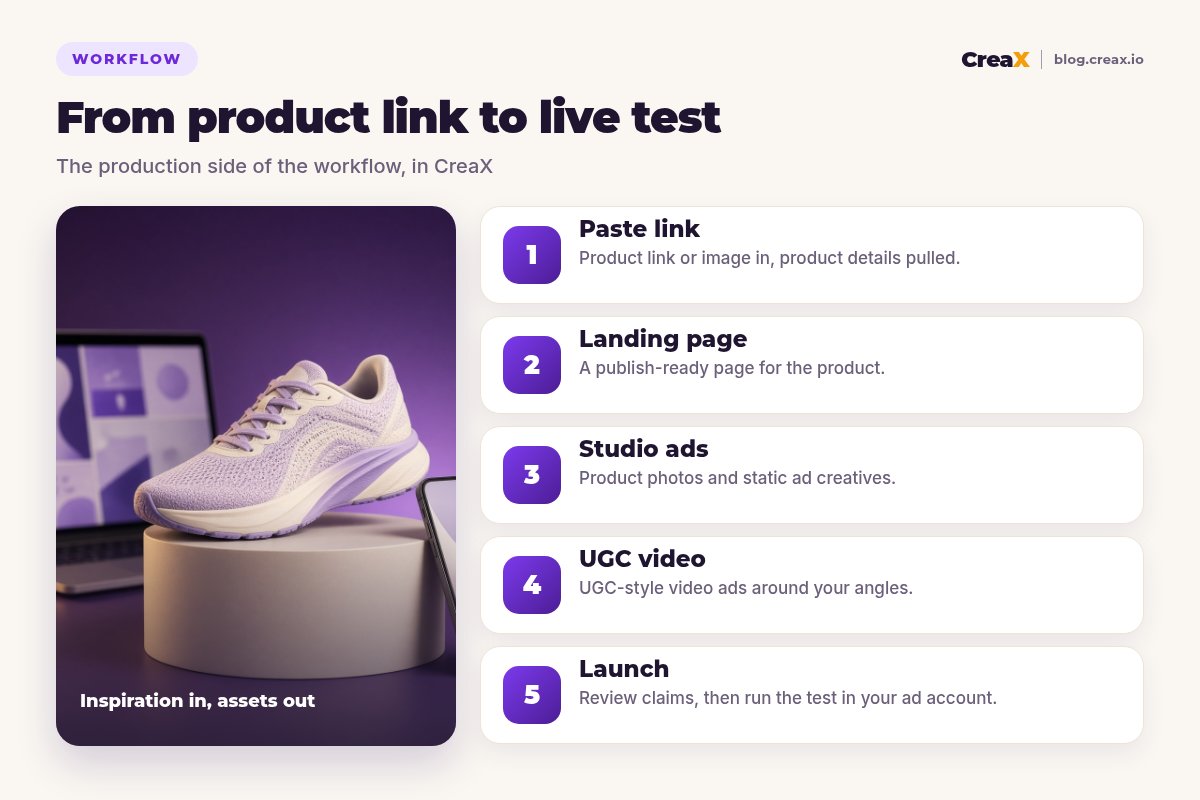
Combined, the loop looks like this: research and save references in Foreplay, pick two or three angles, produce them in CreaX the same day, launch, then feed what you learn back into your swipe file. When creatives start to tire, our guide on signs of ad creative fatigue explains when to refresh, and turning one product image into a week of ad tests shows how to keep variations coming.
DecideDecision checklist
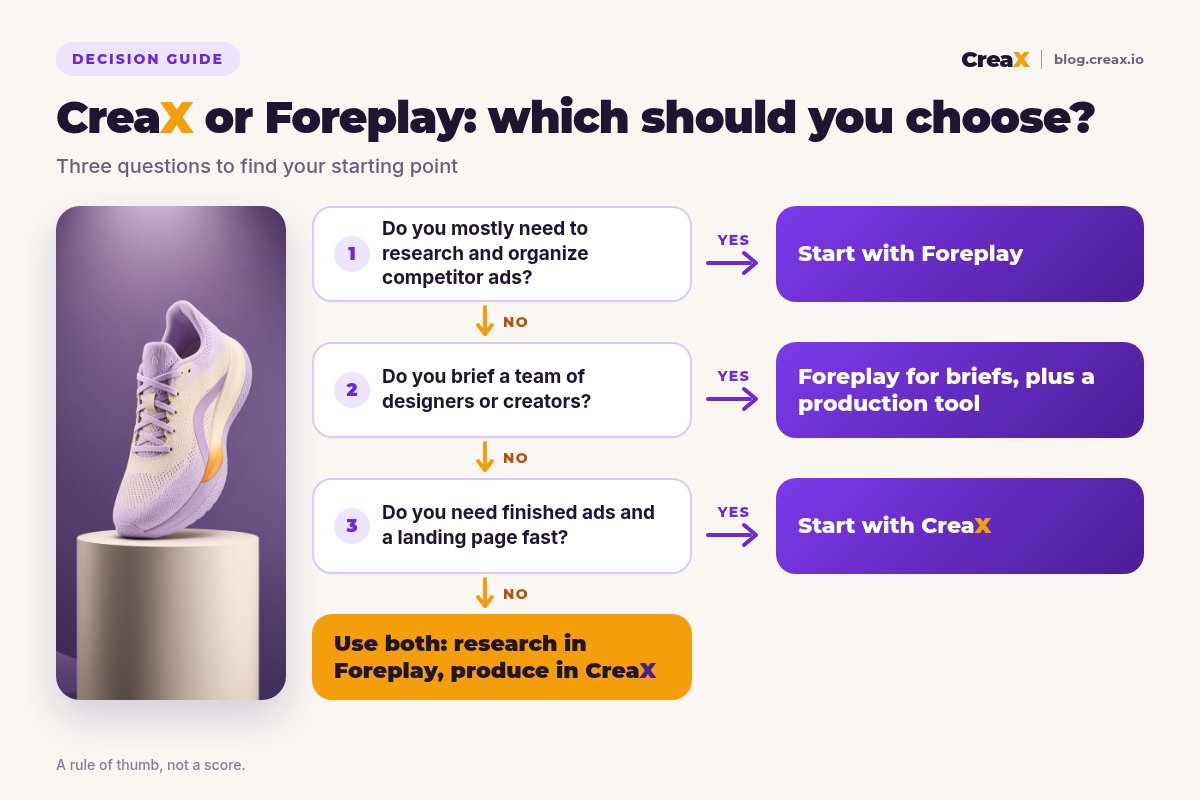
Answer these before you choose
- ✓I know whether my bottleneck is ideas and references, or producing assets
- ✓I have (or don't have) designers, editors or creators to produce briefs
- ✓I need a landing page as well as ads for each product test
- ✓I test new products or angles every week
- ✓I want competitor tracking and analytics on my ad accounts
- ✓I've checked current plans on creax.io/pricing and foreplay.co/pricing
★A simple rule
FAQFrequently asked questions
Q.Is CreaX a Foreplay alternative?
Q.Can Foreplay generate finished ads?
Q.Can CreaX save ads from the Meta Ad Library?
Q.Which is better for a solo dropshipper?
Q.Can I use both together?
Q.How much does Foreplay cost?
Ready to produce your next test?
One product link, about 60–120 seconds: a landing page, studio creatives and UGC-style video ads from the same product story.
This guide is published by CreaX. We describe other tools from their own public websites as of October 2026, avoid invented scores or prices, and recommend checking each vendor's site for current features and plans.