
CreaX for Sustainable and Eco-Friendly Brands: Honest Green Ads
Use case · Sustainable brands
Eco-friendly product ads have two jobs at once: make a good product look desirable, and keep every green claim specific, provable and clear of greenwashing. This guide shows how sustainable and eco-friendly brands use CreaX to turn one product link into calm, clear ads, UGC-style video and a landing page, and how to review the claim wording before anything goes live.
Updated October 2026 · By the CreaX team
Key takeaways
- ✓CreaX turns a product link or image into studio ad creatives, UGC-style video ads and a publish-ready landing page in about 60–120 seconds, so a small sustainable brand can test angles without a shoot.
- ✓Specific beats vague. “Handle made from bamboo” is a claim you can show and prove; “eco-friendly” on its own is a claim regulators increasingly reject.
- ✓Rules are tightening. In the EU, rules applying from 27 September 2026 ban generic environmental claims without proof of recognised excellent performance, and climate-neutral claims based on offsetting.
- ✓Always review AI wording. AI tools write persuasive copy. For green products, every claim about materials, packaging or impact needs a document behind it.
In this guide
AudienceWho this is for: eco-friendly brands
This guide is for small and growing brands that sell products with a genuine sustainability angle, for example:
- Zero-waste and refill products: bamboo toothbrushes, refillable soap and cleaning concentrates, reusable wraps and bags.
- Natural personal care: solid shampoo bars, plastic-free deodorant, minimal-ingredient skincare.
- Durable goods: products built to last or be repaired, such as cast-iron cookware or repairable electronics accessories.
- Recycled and upcycled goods: apparel, accessories and homeware made from recycled or reclaimed materials.
It also fits dropshippers and agencies who sell or promote these products for clients, as long as the claims come from the actual supplier documents. CreaX is built for dropshippers, media buyers, affiliates, coaches, ecommerce brands and agencies.
Why green products are hard to advertiseThe problem this solves
Sustainable brands usually face the same three problems:
- Small budgets for creative. Product shoots, video creators and designers are expensive, and small brands need several angles per product to find what sells.
- A crowded visual language. Leaves, earth tones and the word “eco” are everywhere, so many green ads look the same and say little.
- Claim risk. Vague or exaggerated environmental claims can mislead shoppers, get ads rejected and, in more and more countries, break consumer law.
CreaX helps with the first two directly: it makes the creatives fast and shows the real product clearly. The third is your job, and this guide gives you a simple process for it.
The kitWhat CreaX produces from one product link or image
Paste a product link, from Alibaba, AliExpress, Amazon, Etsy or any product page, or upload a product image. In about 60–120 seconds you get:
- Studio ad creatives: product photos and static ads in five styles (Classic, Humble Orbit, Punch, Luxe and Meta Feed) and four sizes (1:1, 3:4, 4:5 and 9:16). Luxe and Classic suit the calm, premium look many sustainable brands want.
- UGC-style video ads of 18, 30 or 45 seconds, useful for showing how a refill works or how a reusable product fits into a routine.
- A publish-ready landing page at three levels, Simple, Detailed or Advanced, where you can explain materials, care and end-of-life clearly.
- A multi-tenant store if you want to sell from CreaX or keep several brands apart.
CreaX covers 40+ languages and 160+ target countries, and pages support right-to-left languages such as Arabic. See how CreaX UGC-style video ads work for more on the video side.
How to run itStep-by-step workflow
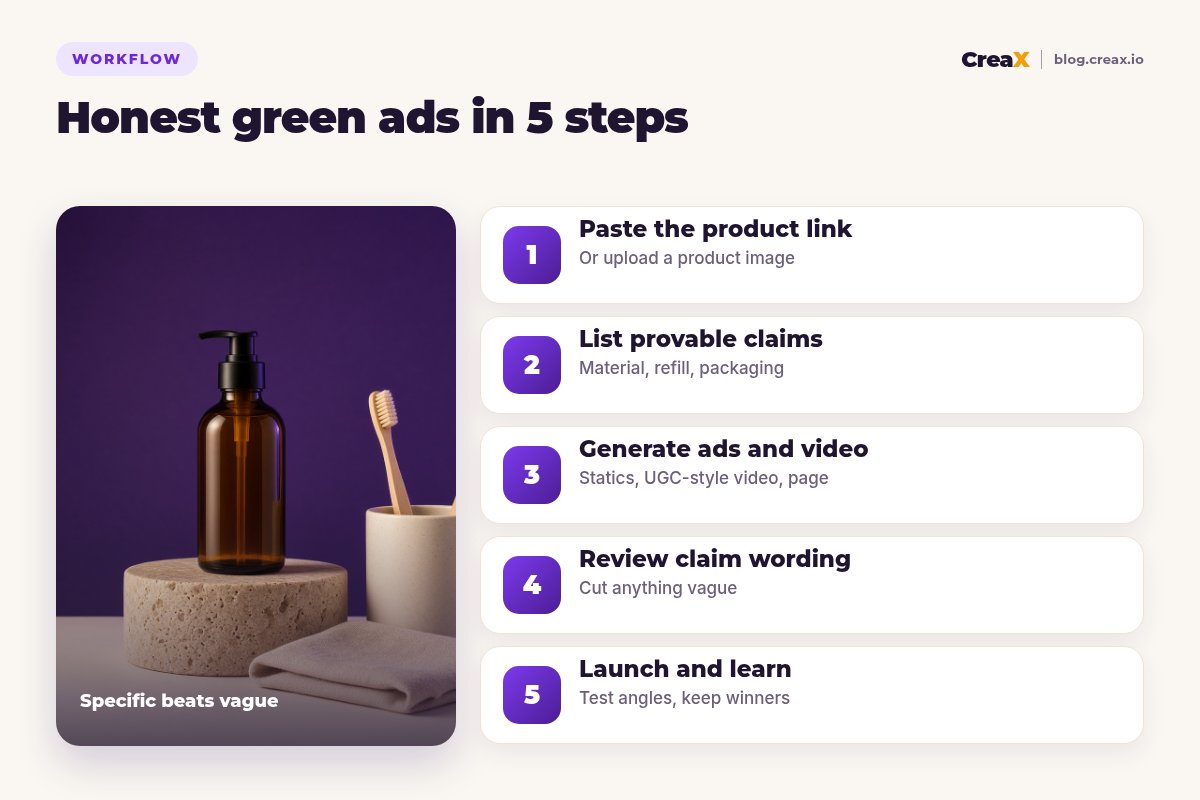
Paste the product link
List provable claims
Generate ads and video
Review claim wording
Launch and learn
★Keep a claims sheet
Stay honestGreen claims: what to say and what to avoid
Regulators in many markets have the same message: environmental claims must be clear, specific and backed by evidence. In the EU, Directive 2024/825 applies from 27 September 2026 and bans generic claims such as “eco-friendly” or “green” unless you can show recognised excellent environmental performance, claims about a whole product when only one part qualifies, and climate-neutral claims based on offsetting. The UK and US have their own guidance (the CMA's Green Claims Code and the FTC's Green Guides). This is not legal advice; check the rules where you sell.
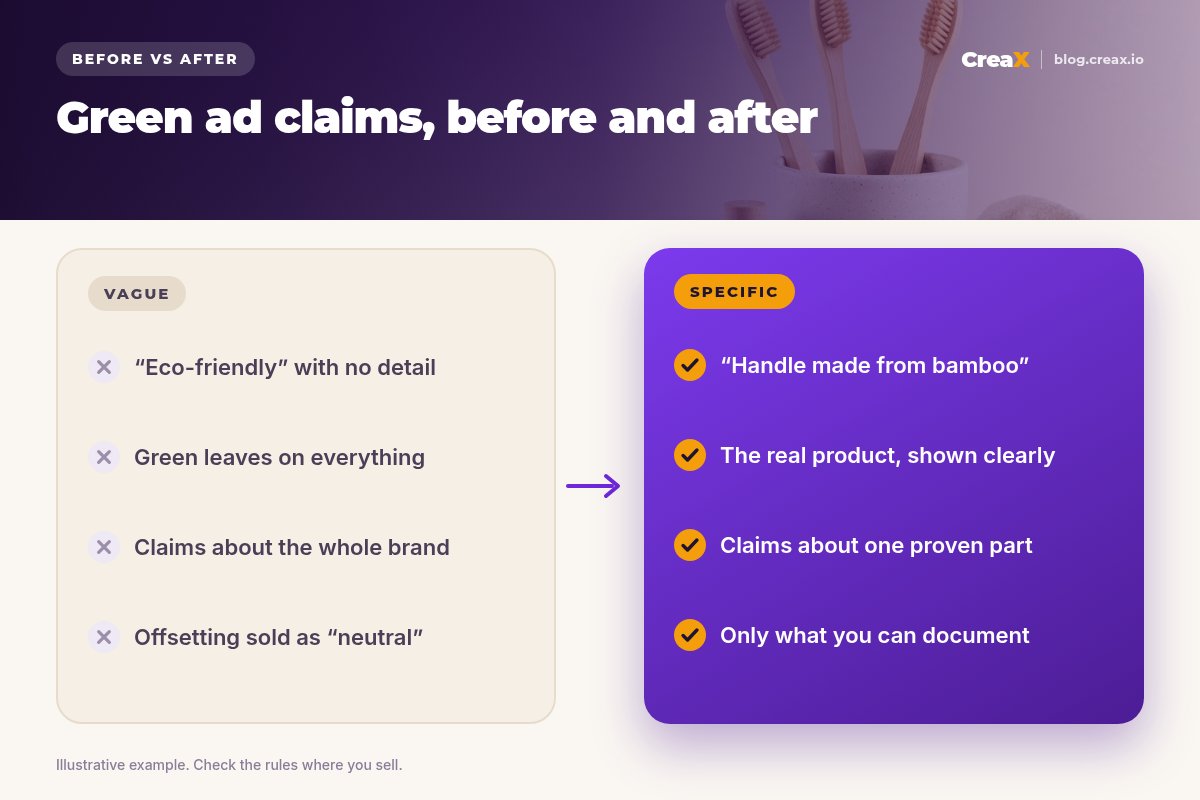
| Instead of… | Say something like… | Why |
|---|---|---|
| Eco-friendly toothbrush | Toothbrush with a bamboo handle | Specific and visible in the photo |
| Sustainable packaging | Shipped in a paper box, no plastic filler | Describes exactly what changed |
| Carbon neutral | (Only with proof that meets the rules where you sell) | Offset-based claims are restricted in the EU |
| Better for the planet | Refill pouch uses less plastic than buying a new bottle | Comparative claims need data you can show |
| 100% natural | List the actual ingredients | Let shoppers judge for themselves |
Illustrative wording. Only use claims your supplier documents support.
!AI will happily write greenwashing
Show your product clearly, then say only what's true
Paste a product link and get studio ads, UGC-style video and a landing page you can edit to match your documented claims.
ExampleWorked example: a bamboo toothbrush set
Say you sell a set of bamboo toothbrushes shipped in a paper box, and your supplier documents confirm the handle material and the packaging. Here is how a first test might look:
- Angle A, the material: a close-up static in Luxe style, headline “A toothbrush with a bamboo handle”, and a short line about the paper box.
- Angle B, the routine: an 18-second UGC-style video showing the set in a bathroom routine, with on-screen text naming the material, not making impact claims.
- Angle C, the gift: a Classic-style static of the boxed set for a family pack angle.
- Landing page: a Detailed page with a materials section, care tips and what to do with the brush at the end of its life, using only wording from your claims sheet.
What you leave out matters as much: no “planet-saving”, no “zero waste” unless the whole product and packaging truly are, and no certification logos you don't hold. For more on writing the page, see product page copy that converts.
PricingWhich plan fits (real CreaX prices)
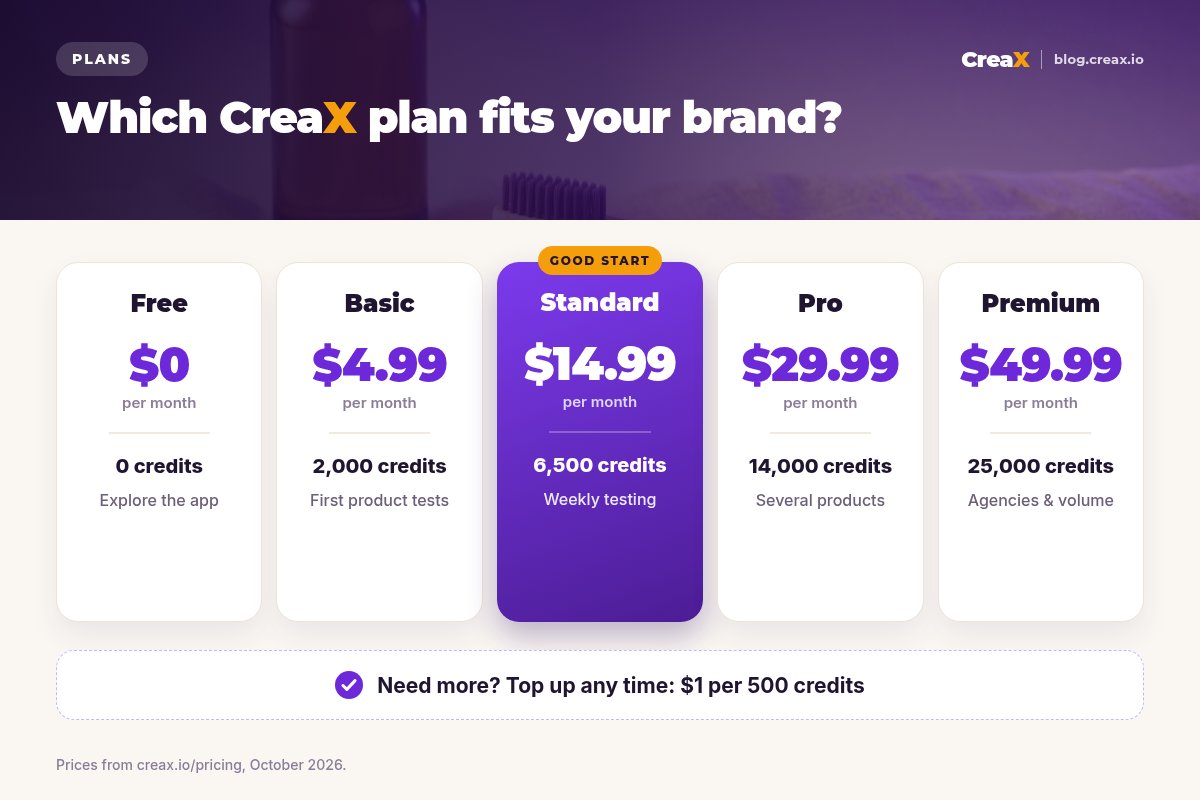
CreaX uses monthly credit plans, and credits are spent when you generate. More in how CreaX credits work.
| Plan | Price / month | Credits | Good fit for an eco-friendly brand |
|---|---|---|---|
| Free | $0 | 0 | Look around the app before buying credits |
| Basic | $4.99 | 2,000 | One hero product and a couple of angle tests |
| Standard | $14.99 | 6,500 | A few products tested each week |
| Pro | $29.99 | 14,000 | A full catalogue or several brands |
| Premium | $49.99 | 25,000 | Agencies running tests for several clients |
| Top-up | $1 | 500 | Extra credits when a product takes off |
Current plans on creax.io/pricing.
Find the green product angle that sells
One product link, about 60–120 seconds: studio ads, UGC-style video and a landing page you can test today.
Do it wellTips for better results
- Show the product, not a forest. A clear photo of the bamboo handle or the refill pouch is more convincing than stock nature imagery.
- Use calm styles. Luxe and Classic statics, soft palettes and simple layouts suit most sustainable brands.
- Lead with a benefit, support with the material. “Feels good in the hand” plus “bamboo handle” works better than a lecture.
- Explain how to use, refill or dispose of it. Practical details build trust and reduce returns.
- Keep the page and the ad consistent. The same claim, in the same words, from ad to checkout.
- Label AI content where required. Follow each platform's rules on AI-generated images and video.
Honest limitsLimits and when to use other tools
CreaX makes creatives and pages. It does not verify your environmental claims, calculate a carbon footprint or issue certifications. For those, you need your supplier's documentation, a recognised certification body or a specialist adviser. CreaX also does not run your ad campaigns or your email marketing; you launch ads in your ad platforms and use your own email tool for repeat buyers.
If your product needs a real-world shoot, for example to show it in nature or in use outdoors, a photographer may still be the right call for hero images. CreaX is strongest when you need many clean variations fast. Read more in are AI-generated ads safe to use commercially.
FAQFrequently asked questions
Q.Can CreaX make green claims for me?
Q.Is “eco-friendly” banned in ads?
Q.Which CreaX ad style suits sustainable brands?
Q.Can I use certification logos in my ads?
Q.Does CreaX work for dropshipped eco products?
Q.What does CreaX cost?
Ready to launch honest green ads?
Paste a product link and get studio ads, UGC-style video and a landing page in about 60–120 seconds.
This guide is published by CreaX. It is general information, not legal advice; green-claim rules differ by country. Examples are illustrative. CreaX features are described from creax.io as of October 2026.