
10 Best Dropshipping Tools in 2026 (The Complete Stack)
Buyer's guide · Dropshipping stack
The best dropshipping tools in 2026 aren't one magic app; they're a small stack where each tool does one job well: find products, source and fulfill them, make the ads, run the store, read the numbers and bring buyers back. We picked 10 tools from their official websites, explain the job each one does, and show which ones you actually need at each stage so you don't pay for tools you won't use.
Updated October 2026 · By the CreaX team
Key takeaways
- ✓A dropshipping stack has six jobs: research, sourcing and fulfillment, creatives, store, data and retention. You don't need a tool for every job on day one.
- ✓CreaX is our top pick for the creative job: one product link gives you video ads, static ads, a landing page and a store for every test.
- ✓Shopify plus a fulfillment app like AutoDS, Zendrop or CJ Dropshipping covers the operational core for many stores.
- ✓Add analytics and email (Triple Whale, Klaviyo) once you have winners to scale, not before.
In this guide
TL;DRQuick picks: the best tool for each job
| If you need… | Start with | Why |
|---|---|---|
| Video ads, static ads and a landing page for every product test | CreaX | One product link produces the whole creative kit |
| A store with checkout and an app ecosystem | Shopify | A widely used store platform with a big app store |
| Product import and automated fulfillment | AutoDS | Import, order automation and price/stock monitoring |
| Sourcing, fulfillment and US warehousing | Zendrop | Sourcing plus US and China 3PL options |
| Finding products through competitors' ads | Minea | Ad spy and shop tracking for product research |
| Organizing ad inspiration and competitor ads | Foreplay | Swipe files, discovery and competitor tracking |
| A large supplier catalog and sourcing | CJ Dropshipping | Catalog, sourcing, fulfillment and print-on-demand |
| Knowing which ads drive profit | Triple Whale | Attribution and analytics for ecommerce |
| Email and SMS that bring buyers back | Klaviyo | Flows, campaigns and segmentation |
MethodHow we chose (and what we didn't do)
We looked at tools dropshippers actually use and judged them on five practical questions:
- Job clarity: does the tool do one job in the stack clearly and well?
- Stage fit: is it useful for a store testing its first products, or only once you're scaling?
- Time saved: does it remove a task you'd otherwise repeat every week?
- Integrations: does it work with the store platforms dropshippers use?
- Overlap: does it duplicate something another tool in the stack already does?
⚖No fake scores
Comparison tableAll 10 at a glance
| Tool | Job in the stack | Best stage | Main output |
|---|---|---|---|
| CreaX | Creatives and landing pages | Testing and scaling | Video ads, static ads, landing page, store |
| Shopify | Store and checkout | All stages | Online store, checkout, apps |
| AutoDS | Import and fulfillment | Testing and scaling | Imported products, automated orders |
| Zendrop | Sourcing and fulfillment | Testing and scaling | Sourced products, 3PL fulfillment |
| Minea | Product research | Finding products | Ad and shop data |
| Foreplay | Creative research | Testing and scaling | Saved ads, competitor tracking, briefs |
| CJ Dropshipping | Sourcing and fulfillment | All stages | Catalog, sourcing, fulfillment |
| Triple Whale | Analytics and attribution | Scaling | Attribution, profit dashboards |
| Klaviyo | Email and SMS | Scaling | Flows, campaigns, segments |
| Canva | Manual design | All stages | Edited graphics and templates |
Summarised from each tool's public website, October 2026.
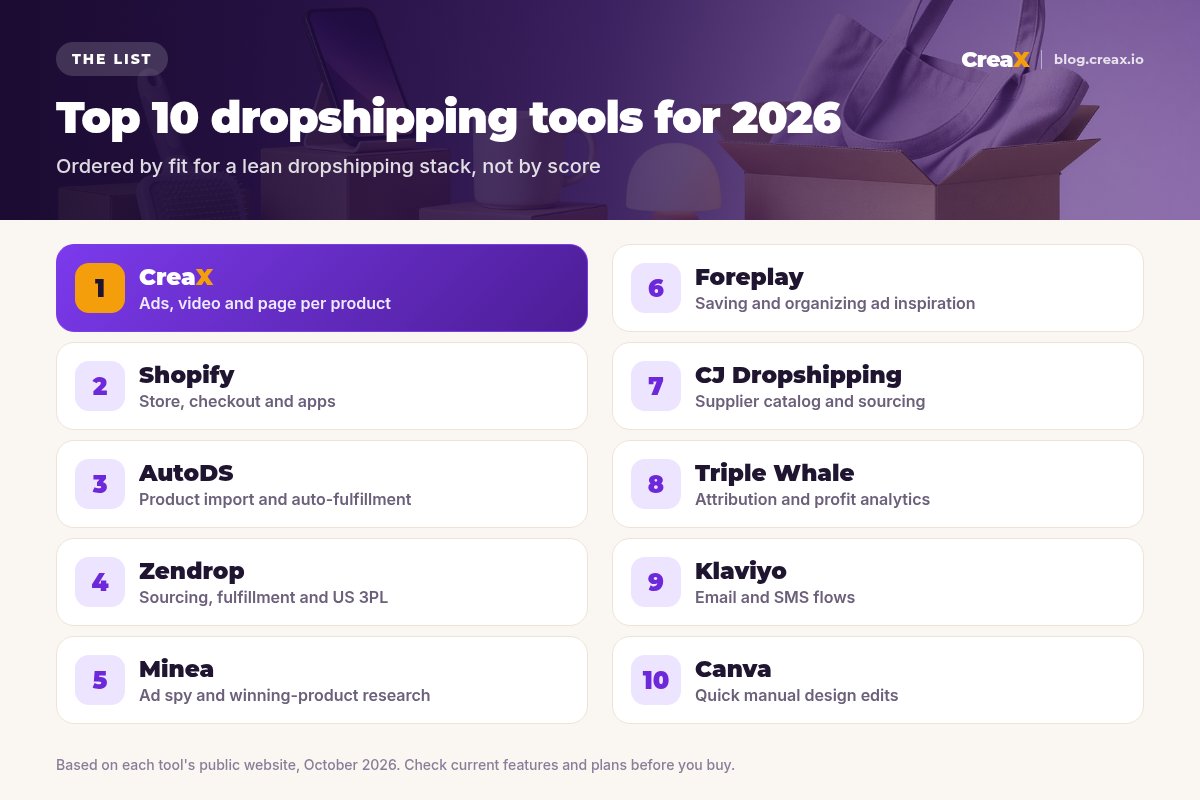
The listThe 10 best dropshipping tools for 2026
CreaX
Best for: ads, video and a page for every product test
CreaX is an all-in-one AI ecommerce creative OS. Paste a product link or upload a product image and, in about 60–120 seconds, it generates UGC-style video ads, studio ad creatives (static ads), a publish-ready landing page and a multi-tenant store. In a dropshipping stack it owns the creative job, which is where tests often stall: the product is imported, but there's no video, the ads look like supplier photos, and the page doesn't repeat the ad's promise.
Plans start at $4.99 a month (2,000 credits), with top-ups at $1 per 500 credits. Our guide to launching a dropshipping product test in 24 hours shows it in a full workflow.
Good for
- Video, statics, landing page and store from one input
- Fresh angles per product without briefing creators
- Low entry price, credit-based
Keep in mind
- Doesn't source or fulfill products
- No attribution or email features
Give every product test real creatives
Paste a product link and get UGC-style video ads, studio creatives and a landing page that tell the same story.
Shopify
Best for: store, checkout and apps
Shopify is the store platform many dropshippers start on: hosted storefront, checkout, payments, themes and a large app store, with built-in AI features (Shopify Magic and the Sidekick assistant) for copy and image edits. Many of the other tools on this list integrate with it. We compare its AI with ours in CreaX vs Shopify Magic.
Good for
- Reliable checkout and hosting
- Huge app ecosystem
- Integrates with many tools here
Keep in mind
- Apps add up in monthly cost
- Ads and video creative are separate work
Website: www.shopify.com
AutoDS
Best for: product import and auto-fulfillment
AutoDS is an all-in-one dropshipping automation platform. According to its site, it covers product finding, one-click import, automated order fulfillment, price and stock monitoring and research tools, with integrations for stores such as Shopify and TikTok Shop. It removes much of the manual order work once you start getting sales.
Good for
- Automates repetitive order tasks
- Price and stock monitoring
- Integrates with major platforms
Keep in mind
- Another monthly subscription
- Creative and pages are separate
Website: www.autods.com
Zendrop
Best for: sourcing, fulfillment and US 3PL
Zendrop is a dropshipping platform focused on sourcing and fulfillment, with product discovery, sourcing and quoting, US and China 3PL warehousing, print-on-demand, and integrations with Shopify, Wix, TikTok Shop and ClickFunnels. Its site also lists AI-built stores and an AI ad generator for UGC video ads, so it overlaps with creative tools for some sellers.
Good for
- Sourcing plus US warehousing options
- Print-on-demand
- Wide integrations
Keep in mind
- Best value when you use its fulfillment
- Check how its AI ads and stores fit your workflow
Website: www.zendrop.com
Minea
Best for: ad spy and winning-product research
Minea is an ad spy and product research tool for ecommerce and dropshipping. It gives you a database of ads and shops to filter, lets you track trending stores and competitors, and offers a browser extension. It's useful in the research phase, when you're deciding what to test next.
Good for
- Large ad and shop database
- Competitor and trend tracking
- Browser extension
Keep in mind
- Research only: no creative or fulfillment
- Popular products attract many sellers
Website: www.minea.com
Foreplay
Best for: saving and organizing ad inspiration
Foreplay helps marketers save, organize and analyze ads. It offers a swipe file for saving ads from ad libraries, discovery of new ads, competitor tracking (Spyder), creative analytics (Lens) and briefs for creators or designers. It pairs naturally with a generator: inspiration in, new ads out.
Good for
- Organized swipe files
- Competitor ad tracking
- Creative briefs
Keep in mind
- Doesn't make the ads itself
- Most useful once you run ads regularly
Website: www.foreplay.co
CJ Dropshipping
Best for: supplier catalog and sourcing
CJ Dropshipping is a sourcing and fulfillment provider with a large product catalog, sourcing requests, warehousing, fulfillment and print-on-demand, plus integrations with popular store platforms. You can use it directly as a supplier or alongside an automation tool.
Good for
- Large catalog
- Sourcing requests
- Fulfillment and POD
Keep in mind
- Shipping times vary by product and warehouse
- You still need creative and a store
Website: cjdropshipping.com
Triple Whale
Best for: attribution and profit analytics
Triple Whale is an analytics and attribution platform for ecommerce brands, with dashboards, attribution, marketing mix modeling and an AI assistant (Moby). Its site also lists landing page and creative tools. It's most valuable once you have spend and sales worth analyzing.
Good for
- Attribution across channels
- Profit-focused dashboards
- AI assistant for analysis
Keep in mind
- Overkill for a store still testing first products
- Check its site for current plans
Website: www.triplewhale.com
Klaviyo
Best for: email and SMS flows
Klaviyo is a marketing platform for email and SMS, with automated flows (welcome, abandoned cart, post-purchase), campaigns, segmentation and AI features. For stores with repeat-purchase potential, it turns one-time buyers into returning customers.
Good for
- Strong automation flows
- Deep ecommerce integrations
- Segmentation
Keep in mind
- Needs traffic and a list to pay off
- Less useful for one-off impulse products
Website: www.klaviyo.com
Canva
Best for: quick manual design edits
Canva is a general design platform with templates and AI tools. Dropshippers use it for quick graphics, banners and manual tweaks to ads. It's flexible, but you do the design work yourself. See CreaX vs Canva for a detailed comparison.
Good for
- Easy, flexible templates
- Free plan available
- Good for one-off graphics
Keep in mind
- Manual work per creative
- No video ads or pages generated from a product link
Website: www.canva.com
Buyer's checklistHow to choose your dropshipping tools
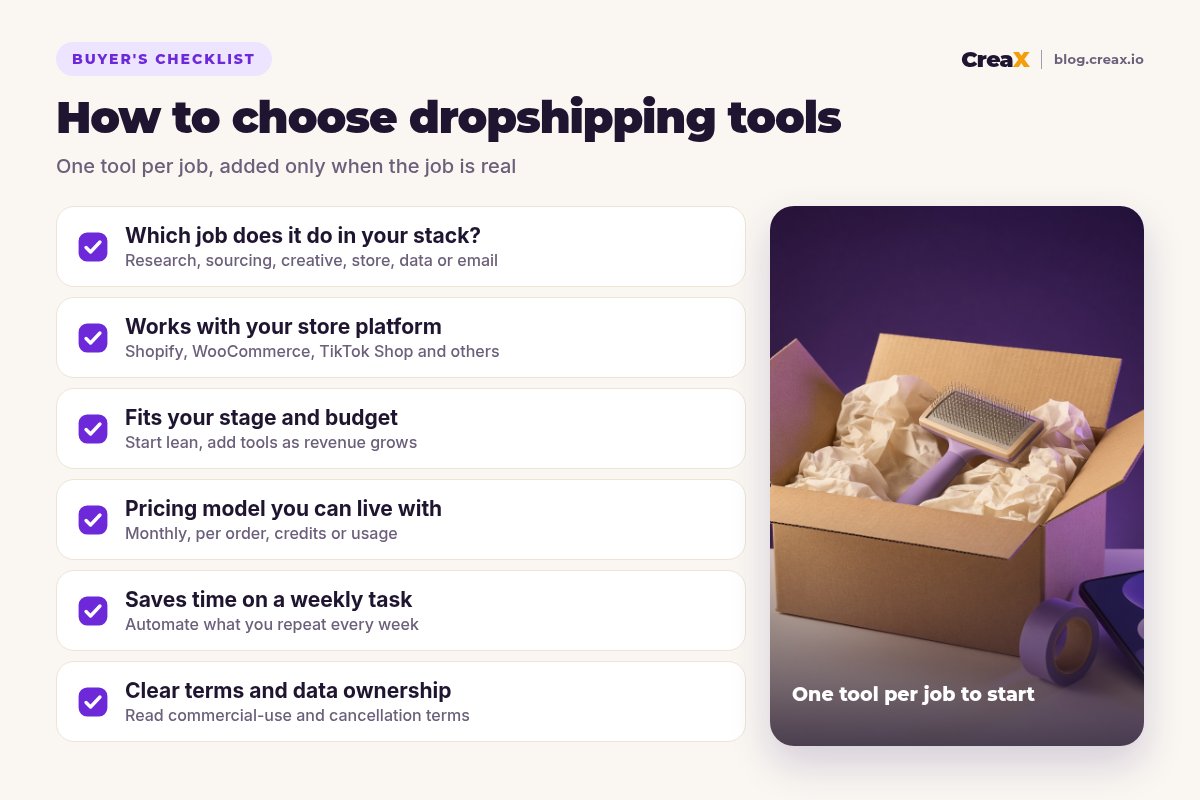
The most expensive stack is the one full of tools you don't use. Start with the jobs you do every week, add a tool only when a job becomes painful, and cancel anything that duplicates another tool.
Before you add a tool
- ✓Names the one job it does in your stack
- ✓Integrates with your store platform
- ✓Useful at your current stage, not just later
- ✓Pricing model you can predict month to month
- ✓Removes a task you repeat every week
- ✓Doesn't duplicate a tool you already pay for
- ✓Clear commercial-use and cancellation terms
- ✓Free trial or low entry plan to test first
★Know your break-even before you buy tools
ExampleWorked example: a small-budget stack
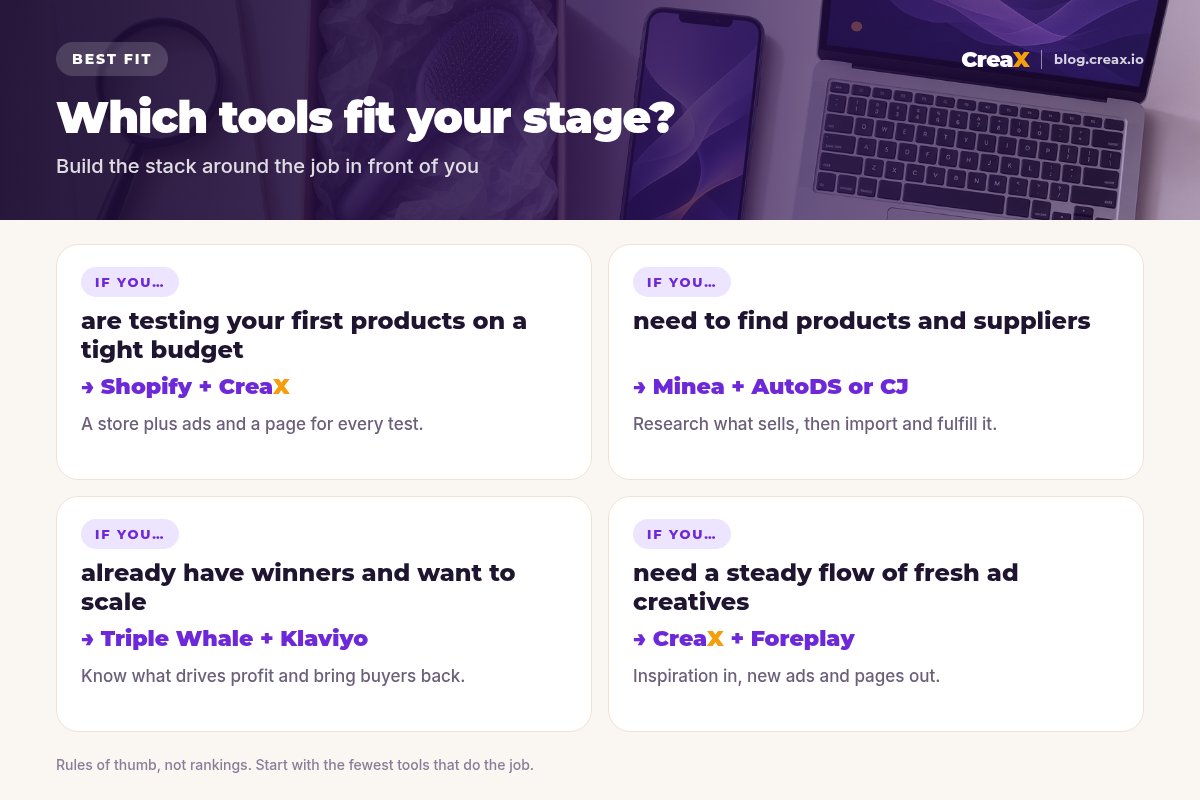
Say you're launching a pet grooming brush as your first dropshipping test, with a small budget and no team. Here's a lean stack that covers every job without paying for scaling tools you don't need yet:
Research (free or low cost)
Store
Sourcing and fulfillment
Creatives and page
Test and read
If your ads get views but no sales, the creative-and-page job is usually where to look first. Our guide to TikTok ads with views but no sales walks through the fixes. Running several niches? See how a multi-tenant store builder keeps them separate.
Build your next product test in about two minutes
Paste a product link and get UGC-style video ads, studio creatives and a matching landing page, ready for your first test.
Save moneyStack mistakes to avoid
- Buying scaling tools before you have a winner. Attribution and email platforms shine with traffic and a list. Before that, they're mostly a monthly bill.
- Three tools doing the same job. Several dropshipping platforms now include AI stores or AI ads. Pick one owner per job.
- Spending on research, skimping on creative. Finding a product is half the job; selling it needs ads and a page that match.
- Ignoring real shipping times. Promise what your supplier actually delivers, on the ad and the page.
- Never cancelling. Review subscriptions monthly and drop anything you didn't open.
!Keep every claim honest
FAQFrequently asked questions
Q.What tools do I need to start dropshipping?
Q.What is the best dropshipping tool in 2026?
Q.Do I need an ad spy tool?
Q.When should I add Triple Whale or Klaviyo?
Q.How much does CreaX cost for dropshipping?
Q.Can CreaX replace Shopify?
Ready to fill the creative gap in your stack?
One product link or image, about 60–120 seconds: UGC-style video ads, studio creatives, a landing page and a store for your next test.
This guide is published by CreaX. We describe other tools from their own public websites as of October 2026, avoid invented scores or prices, and recommend checking each vendor's site for current features and plans.