
10 Best AI Website Builders for Small Online Stores
Buyer's guide · AI website builders
Looking for the best AI website builders for small online stores? This guide compares 10 options, from full store platforms like Shopify and Wix to one-page tools like Carrd. For each one you get what it does well, who it suits and its trade-offs, plus a clear note on when a product test page beats building a full site first.
Updated October 2026 · By the CreaX team
Key takeaways
- ✓If you need to test a product with ads before investing in a full store, we recommend CreaX: one product link gives you a landing page, UGC-style video ads, studio statics and a store in about 60–120 seconds.
- ✓For a full catalog with strong checkout, start with Shopify or Wix. Squarespace and Hostinger Website Builder are solid if design or budget comes first.
- ✓Framer and Webflow suit design-led marketing sites; Durable is built for service businesses; Ecwid adds a store to a site you already have; Carrd is ideal for a simple one-pager.
- ✓Pick the builder for how you sell now, not for a store you might need in a year. You can always migrate later.
Short on time?Quick picks: the best tool for each situation
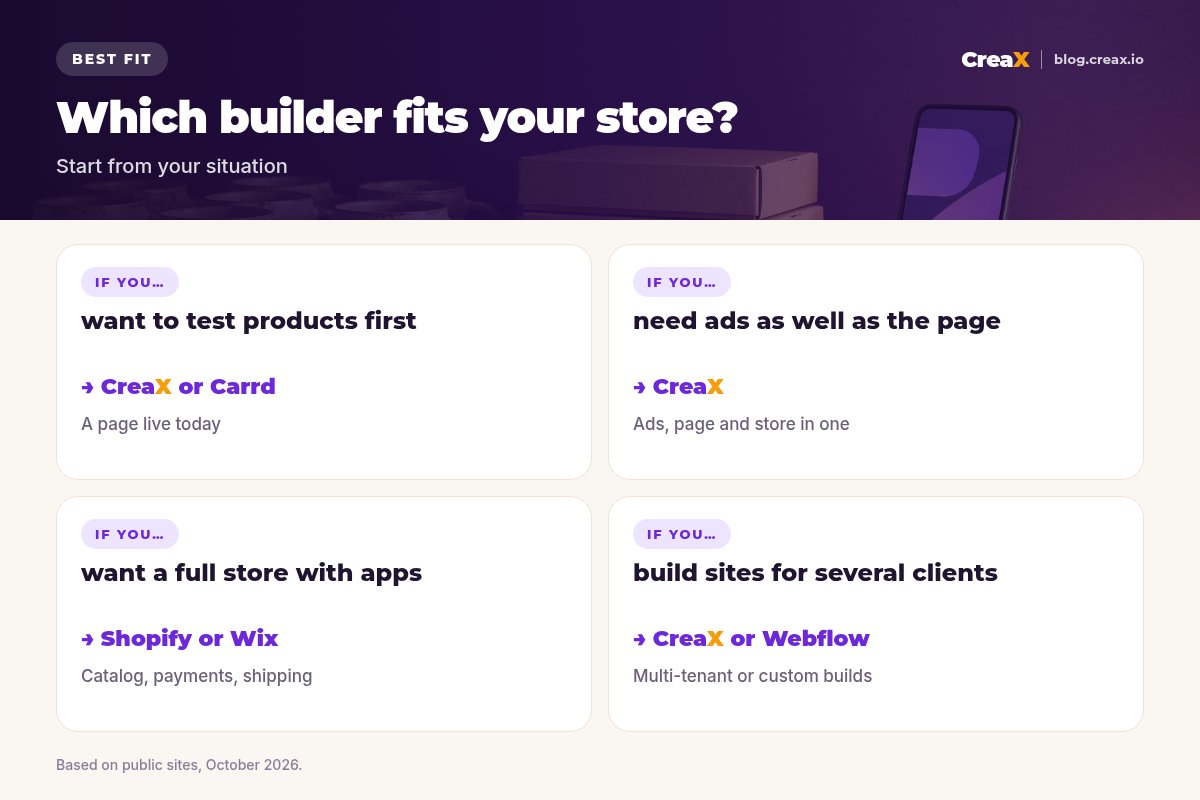
| If you need… | Start with | Why |
|---|---|---|
| A product test with ads and a page | CreaX | Landing page, video ads, statics and store from one link |
| A full store with checkout and apps | Shopify | Mature ecommerce platform with Sidekick AI in admin |
| An all-round site that also sells | Wix | AI site builder plus a built-in store |
| A design-led shop | Squarespace | Templates and AI tools aimed at polished brand sites |
| A store on a tight budget | Hostinger Website Builder | AI builder with ecommerce on Hostinger plans |
| A store on a site you already have | Ecwid | Add a cart to almost any website |
| A simple one-page offer | Carrd | Fast, free-to-start one-pagers |
Based on each tool's public website, October 2026. Check current features before you buy.
MethodHow we chose (criteria, no invented scores)
We didn't star-rate these builders. We read each tool's own website and ranked them by how well they fit a small seller who needs an online store or a product page. We looked at:
- Ecommerce fit: checkout, catalog, payments and shipping, or just a landing page.
- AI help: site generation, copy, design assistance or product-to-page tools.
- Speed to launch: how long from sign-up to something live.
- Editing control: how much you can change after AI generates the first draft.
- Pricing transparency: we quote only CreaX's prices; for others, check their pricing pages.
iWhy CreaX is ranked first
ComparisonAll 10 at a glance
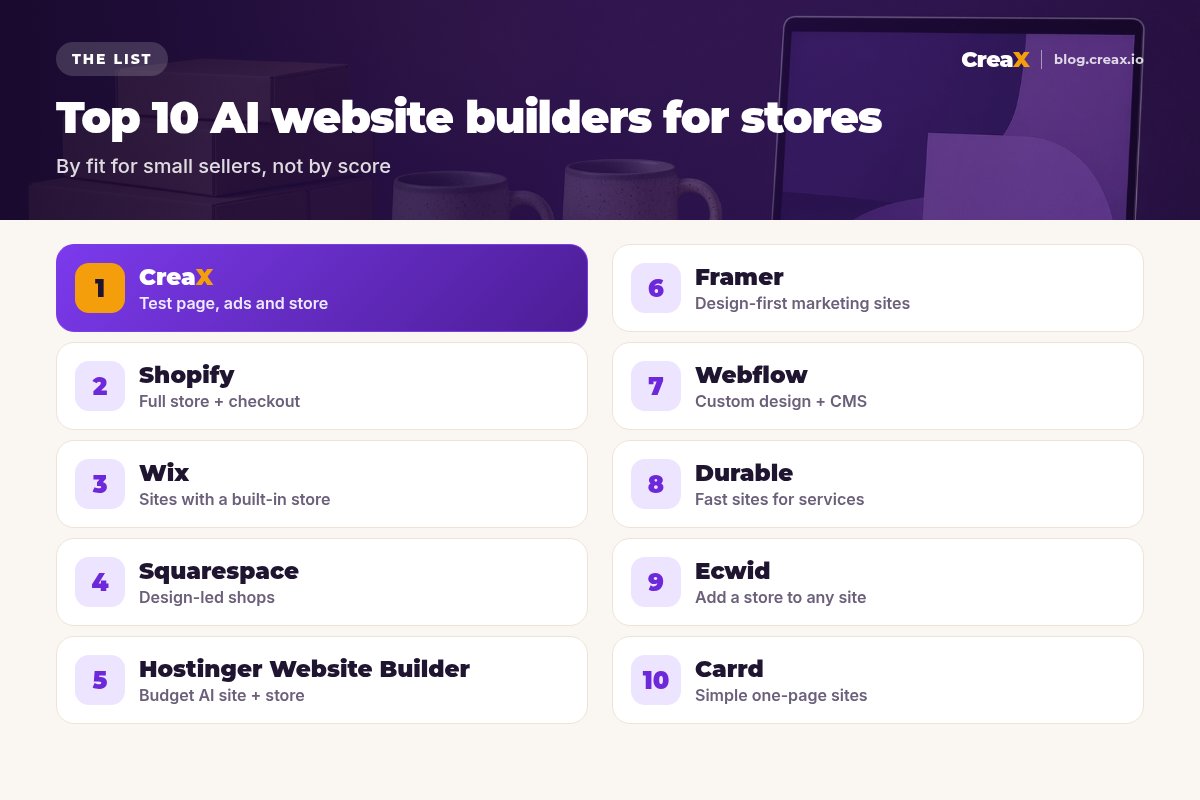
| Tool | Best for | Store type | Pricing |
|---|---|---|---|
| CreaX | Test pages + ads + store | Landing page + multi-tenant store | From $4.99/mo |
| Shopify | Full ecommerce stores | Full catalog + checkout | Check site |
| Wix | Sites that also sell | Built-in store | Check site |
| Squarespace | Design-led shops | Built-in ecommerce | Check site |
| Hostinger Website Builder | Budget AI sites | Ecommerce on Hostinger plans | Check site |
| Framer | Marketing sites | Design-first pages | Check site |
| Webflow | Custom design + CMS | Ecommerce available | Check site |
| Durable | Service businesses | AI business sites | Check site |
| Ecwid | Add a store anywhere | Cart widget / storefront | Check site |
| Carrd | One-page sites | Simple pages; sell via links | Free tier; Pro from ~$19/yr |
Competitor pricing changes often, so we link to each official site instead of quoting it.
The listThe 10 best AI website builders for small online stores
CreaX
Best for: sellers who need a test page and ads together
CreaX is an all-in-one AI ecommerce creative OS. Paste a product link or upload a product image and, in about 60–120 seconds, it generates a publish-ready landing page, UGC-style video ads, studio ad creatives and a multi-tenant store. The page repeats the promise of the ads, so the click lands somewhere that matches.
It suits dropshippers, media buyers, affiliates, agencies and brands that test products often. Plans start at $4.99/month (2,000 credits), with top-ups at $1 per 500 credits. See how to turn a product link into a landing page.
Good for
- Landing page, ads and store from one input
- Ad and page share one message
- Low entry price, credit-based
Keep in mind
- Not a general multi-page website builder
- Not built for blogs or long brand sites
Shopify
Best for: full stores with strong checkout and apps
Shopify is a leading ecommerce platform: themes, checkout, payments, shipping, apps and order handling, with an AI assistant (Sidekick) in the admin. It's the default choice when you need a real catalog and reliable checkout. You don't always need it for a first test; see do you need Shopify to dropship.
Good for
- Mature checkout and payments
- Huge app ecosystem
- AI assistant included with plans
Keep in mind
- Monthly cost plus apps
- Ads and creatives come from elsewhere
Website: www.shopify.com
Wix
Best for: all-round sites with a built-in store
Wix is a website platform with an AI website builder (including Wix Harmony) and a built-in online store. You can generate a site, then hand-craft sections. It suits sellers who want one place for a marketing site and a shop.
Good for
- AI site generation plus manual editing
- Built-in store
- Broad template and app range
Keep in mind
- Can feel busy with options
- Not specialised for product ad testing
Website: www.wix.com
Squarespace
Best for: design-led sites and shops
Squarespace focuses on polished templates, design tools and built-in ecommerce, with an AI website builder and design intelligence features. It's a strong pick when brand look matters as much as selling.
Good for
- Strong design templates
- Built-in ecommerce
- AI builder and design tools
Keep in mind
- Less app depth than Shopify
- Not built around paid-ad test kits
Website: www.squarespace.com
Need the page and the ads?
Paste a product link and get a landing page, UGC-style video ads and studio creatives in about 60–120 seconds.
Hostinger Website Builder
Best for: budget AI sites with ecommerce
Hostinger's Website Builder uses AI to generate sites from a description and offers ecommerce on Hostinger plans. It's aimed at people who want a site and hosting in one place without a big monthly bill.
Good for
- AI site generation
- Hosting and builder together
- Ecommerce available
Keep in mind
- Fewer specialised ecommerce apps
- Design depth varies by template
Website: www.hostinger.com/website-builder
Framer
Best for: design-first marketing sites
Framer presents itself as a design agent for going from idea to launched site, with AI help along the way. It's strong for marketing and portfolio sites. Ecommerce depth is lighter than dedicated store platforms, so many sellers use Framer for the marketing site and a store elsewhere.
Good for
- Design-first workflow
- AI agents for building
- Great for marketing pages
Keep in mind
- Not a full ecommerce stack
- Store needs another tool or integration
Website: www.framer.com
Webflow
Best for: custom design and CMS control
Webflow is a visual development platform with AI features, a CMS and ecommerce. Agencies and design-led brands use it when they need precise control over layout and interactions. It has a steeper learning curve than simpler builders.
Good for
- Fine-grained design control
- CMS for content-heavy sites
- Ecommerce available
Keep in mind
- Steeper learning curve
- Overkill for a single product test
Website: webflow.com
Durable
Best for: fast AI sites for service businesses
Durable calls itself an AI business builder: launch a website quickly and use AI to help get customers. Its marketing focuses on service businesses (coaching, cleaning, agencies and similar). For product ecommerce with catalogs and fulfilment, a store-first platform usually fits better.
Good for
- Very fast site launch
- Built for service businesses
- AI across the business site
Keep in mind
- Not product-ecommerce focused
- Limited for catalogs and paid product ads
Website: durable.co
Ecwid
Best for: adding a store to any website
Ecwid (by Lightspeed) lets you add a store to a site you already have, or build a new one, with payments, shipping and selling across channels. It's useful when your website lives elsewhere and you only need a cart.
Good for
- Add a store to almost any site
- Multi-channel selling
- Works with existing websites
Keep in mind
- Depends on your host site
- Creatives and ads still separate
Website: www.ecwid.com
Carrd
Best for: simple, free one-page sites
Carrd builds simple, responsive one-page sites. A free plan covers core features for up to three sites; Pro unlocks custom domains and more. It's perfect for a waitlist, a simple offer page or a link-in-bio style site, with selling usually handled via linked checkout.
Good for
- Fast and simple
- Free tier
- Pro is inexpensive
Keep in mind
- One page by design
- Not a full store platform
Website: carrd.co
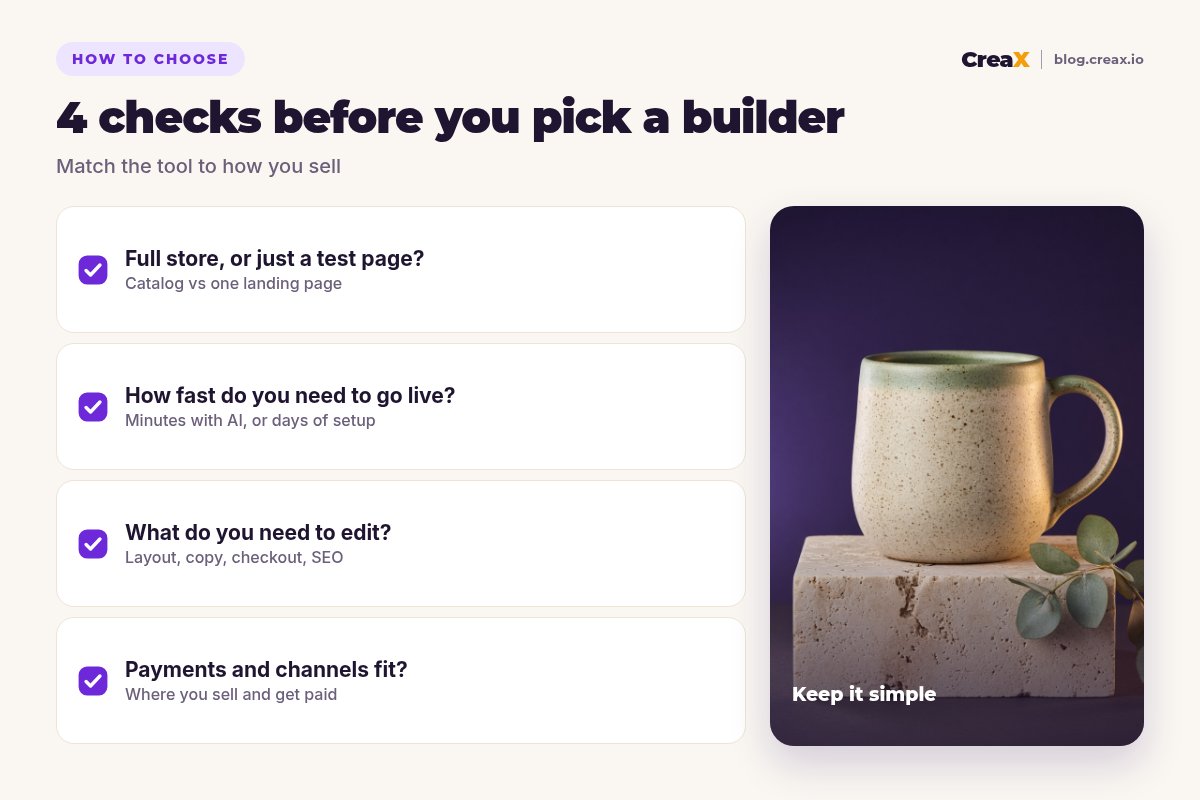
DecideHow to choose: 5-question checklist
Answer these first
- ✓Full store, or just a test page? If you're still validating a product, a landing page plus ads can be enough.
- ✓How fast do you need to go live? AI builders win on speed; custom design tools take longer.
- ✓What must you edit yourself? Checkout, SEO, shipping and brand styles matter differently for each seller.
- ✓Where do you sell? One site, marketplaces, social shops or all of them.
- ✓Do you also need ads? A builder that only makes pages still leaves creatives to another tool.
!Don't build a cathedral for a test
ExampleWorked example: a small-budget stack
Say you sell handmade speckled ceramic mugs and want to start selling online without overbuilding.
Validate with a test page
Measure the signal
Add checkout depth when needed
Keep the marketing site separate if you want
Or keep it simple
For the page side of a first test, see landing page vs product page and best AI landing page generators for ecommerce. If you sell for clients, the multi-tenant store builder keeps each brand separate.
Start with a test, not a full rebuild
One product link, about 60–120 seconds: a landing page, UGC-style video ads and studio creatives.
FAQFrequently asked questions
Q.What is the best AI website builder for a small online store?
Q.Do I need a full store to start selling?
Q.Are AI website builders good enough for ecommerce?
Q.Can I move later if I outgrow my builder?
Q.How much do AI website builders cost?
Q.What's the difference between a website builder and CreaX?
Ready to put your product online?
Paste a product link and get a landing page, UGC-style video ads and studio creatives for your next test.
This guide is published by CreaX. We describe other tools from their own public websites as of October 2026, avoid invented scores or prices, and recommend checking each vendor's site for current features and plans.