
10 Best AI Tools for Product Descriptions and Ad Copy
Buyer's guide · AI copywriting tools
Looking for the best AI tools for product descriptions and ad copy? This guide compares 10 options, from flexible assistants like ChatGPT and Claude to catalog tools and ad-copy scorers. For each one you get what it does well, who it suits and its trade-offs, plus a checklist for picking the right one and a rule that matters more than any tool: every claim must match the real product.
Updated October 2026 · By the CreaX team
Key takeaways
- ✓If you sell through paid ads and need more than words, we recommend CreaX: one product link gives you the copy inside UGC-style video ads, studio statics and a landing page, in about 60–120 seconds.
- ✓For flexible drafting and rewriting, ChatGPT and Claude are hard to beat; give them real product facts and a clear brief.
- ✓For large catalogs, look at Hypotenuse AI; for Shopify stores, Shopify Sidekick writes descriptions inside the admin.
- ✓Marketing teams that need brand governance or copy scoring should compare Jasper, Copy.ai and Anyword. Whatever you use, a human checks every claim.
In this guide
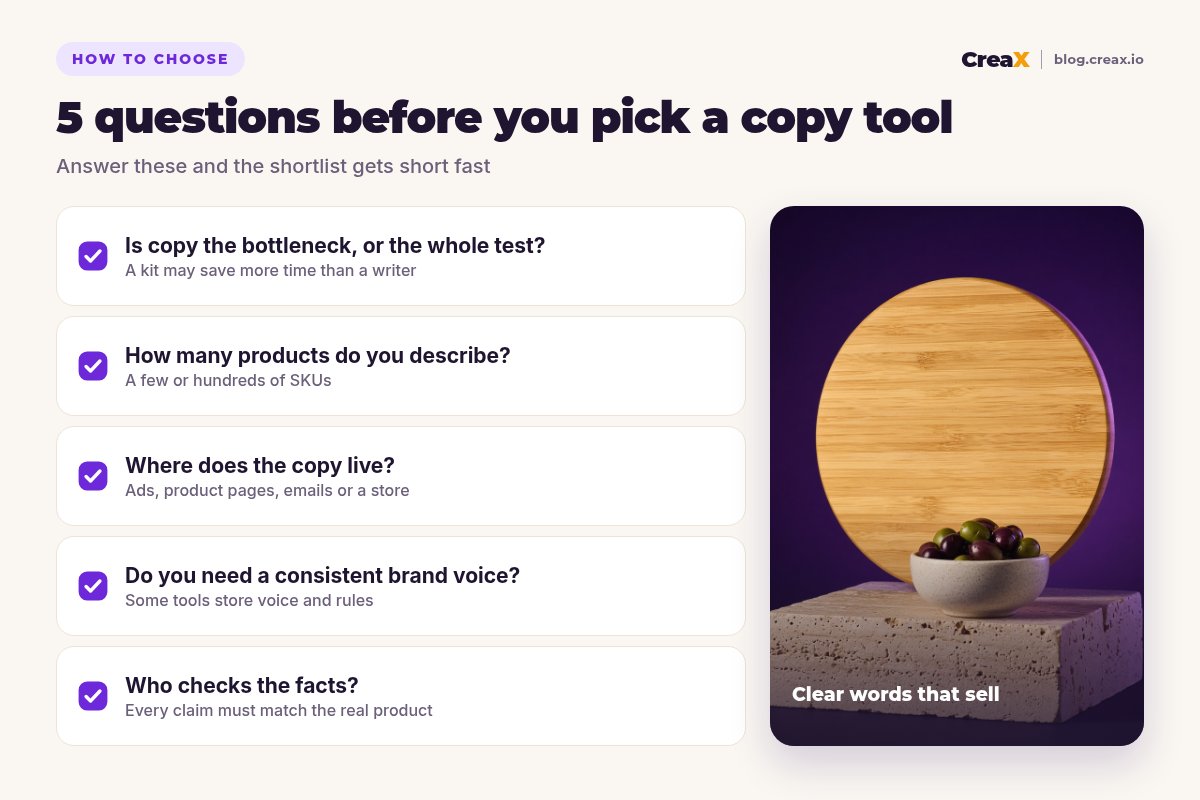
Short on time?Quick picks: the best tool for each situation
| If you need… | Start with | Why |
|---|---|---|
| Copy plus the ads and page it lives in | CreaX | Video ads, statics and a landing page from one link |
| A flexible writing assistant | ChatGPT or Claude | Draft, rewrite and brainstorm any copy |
| Hundreds or thousands of SKUs | Hypotenuse AI | Bulk descriptions with brand rules and integrations |
| Quick drafts inside your store | Shopify Sidekick | Built into the Shopify admin |
| One brand voice across a team | Jasper | Brand IQ, agents and content pipelines |
| A score before you launch ad copy | Anyword | Performance predictions on copy variations |
| Cleaner, clearer final copy | Grammarly | Proofreading, tone and rewrites |
Based on each tool's public website, October 2026. Check current features before you buy.
MethodHow we chose (criteria, no invented scores)
We didn't star-rate these tools or run made-up benchmarks. We read each tool's own website and ranked them by how well they fit one reader: an ecommerce seller who needs product descriptions, ad copy, or both. We looked at:
- Ecommerce fit: does the tool understand products, catalogs, stores or ads, or is it a general writer?
- Where the copy ends up: ads, product pages, landing pages, emails or a whole catalog.
- Brand voice: can you store your tone, rules and product facts so every output stays consistent?
- Speed to a live test: how much work sits between the tool's output and a running ad.
- Pricing transparency: we quote only CreaX's prices; for others, check their pricing pages.
iA note on CreaX's place in this list
ComparisonAll 10 at a glance
| Tool | Best for | Main output | Pricing |
|---|---|---|---|
| CreaX | Copy, creatives and page in one | Ads, statics, landing page, store | From $4.99/mo |
| ChatGPT | Flexible drafting | Any text you prompt for | Check site |
| Claude | Long, careful copy and edits | Any text you prompt for | Check site |
| Jasper | Brand voice for teams | Marketing content via agents | Check site |
| Copy.ai | Copy plus GTM workflows | Content and sales workflows | Check site |
| Shopify Sidekick | Shopify store owners | Descriptions, posts, emails | Included with Shopify |
| Hypotenuse AI | Large catalogs | Bulk descriptions, product data | Check site |
| Writesonic | AI search visibility | GEO and SEO content | Check site |
| Grammarly | Polishing and tone | Edits and rewrites | Check site |
| Anyword | Scoring ad copy | Copy with performance predictions | Check site |
Competitor pricing changes often, so we link to each official site instead of quoting it. Shopify says Sidekick is included with your plan, with limits varying by plan.
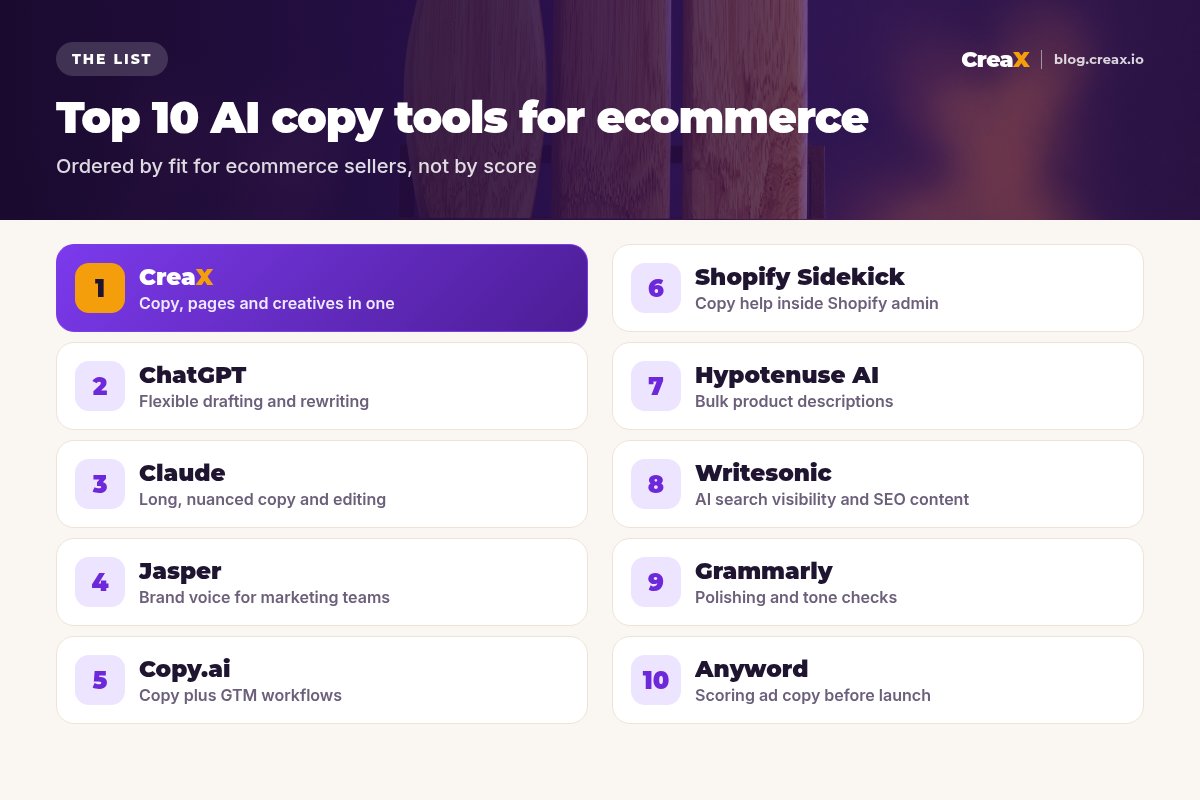
The listThe 10 best AI tools for product descriptions and ad copy
CreaX
Best for: sellers who need the copy and the creatives together
CreaX is an all-in-one AI ecommerce creative OS. Paste a product link or upload a product image and, in about 60–120 seconds, it generates UGC-style video ads, studio ad creatives (polished product photos and static ads), a publish-ready landing page and a multi-tenant store. The words are part of every asset: the page has a headline, benefit sections and an FAQ that repeat the ad's message, so the click lands on copy that matches what the shopper just saw.
It suits dropshippers, media buyers, affiliates, agencies and brands that test products often. Plans start at $4.99/month (2,000 credits), with top-ups at $1 per 500 credits. See how the page side works in turning a product link into a landing page.
Good for
- Copy arrives inside ready-to-launch ads and a page
- Ad and page share one message
- Low entry price, credit-based
Keep in mind
- Not a standalone copywriter for any text task
- Not built for bulk catalog descriptions
ChatGPT
Best for: flexible drafting, rewriting and brainstorming
OpenAI's ChatGPT is the general-purpose assistant most sellers already know. It can draft a product description, rewrite it for a different audience, suggest ten hooks for an ad, shorten copy to fit a headline field or turn a supplier spec sheet into plain benefits. You can upload images and documents, so it can work from your real product details instead of guessing.
Good for
- Handles almost any copy task
- Works from images, files and your notes
- Free tier to start
Keep in mind
- Knows nothing about your brand unless you tell it
- Will invent details if you don't supply facts
Website: chatgpt.com
Claude
Best for: long, nuanced copy and careful editing
Anthropic's Claude is another general assistant, often chosen for longer writing and editing: rewriting a whole product page, tightening a long description, or keeping a consistent tone across many pieces. Like ChatGPT, it accepts documents and images, and it is only as accurate as the product facts you give it.
Good for
- Strong at long-form copy and edits
- Accepts documents and images
- Free tier to start
Keep in mind
- General tool: no store or ad integration
- Needs a clear brief and real facts
Website: claude.ai
Want ads and a page, not just words?
Paste a product link and get UGC-style video ads, studio creatives and a landing page with matching copy in about 60–120 seconds.
Jasper
Best for: marketing teams that need one brand voice
Jasper describes itself as an agent workspace for marketing teams. Its Jasper IQ layer stores brand voice, style guides, audience profiles and product knowledge and applies them to every output, and it offers purpose-built agents, content pipelines and image tools.
Good for
- Brand voice and style rules applied automatically
- Agents and pipelines for repeatable work
- Text and image generation
Keep in mind
- Built for teams; more than a solo seller needs
- No ad creatives or landing pages from a product link
Website: www.jasper.ai
Copy.ai
Best for: copy as part of wider go-to-market workflows
Copy.ai has grown from a copywriting app into a GTM AI platform. Today it focuses on workflows across marketing and sales: content creation, prospecting, lead processing and translation, with a Brand Voice feature and an Infobase that stores company information to inform outputs.
Good for
- Workflows that automate repeat copy tasks
- Brand Voice and Infobase
- Many integrations
Keep in mind
- Aimed at B2B GTM teams more than store owners
- Not ecommerce-specific
Website: www.copy.ai
Shopify Sidekick
Best for: Shopify sellers who want drafts inside the admin
Shopify's AI assistant, Sidekick, sits in the Shopify admin (Shopify's former Magic page now presents Sidekick). Its page lists prompts for SEO product descriptions, social posts and email campaigns, and Shopify says it's included with your plan, with features and limits varying by plan. Because it can see your store data, it's convenient for quick drafts. Compare it in CreaX vs Shopify Magic.
Good for
- Included with Shopify plans
- Works on your store data
- No extra app to learn
Keep in mind
- Shopify-only
- Drafts, not ad creatives or a separate test page
Website: www.shopify.com/magic
Hypotenuse AI
Best for: large catalogs and product data
Hypotenuse AI positions itself as an AI-first product information platform for ecommerce. It enriches missing product attributes, bulk generates SEO titles and descriptions in your brand voice, localises content, cleans up catalog images and integrates with commerce platforms and marketplaces. It's built for teams onboarding many products at once.
Good for
- Bulk descriptions with brand rules
- Attribute enrichment and localisation
- Commerce integrations
Keep in mind
- Enterprise focus; overkill for a few SKUs
- Catalog content, not paid-ad creatives
Website: www.hypotenuse.ai
Writesonic
Best for: visibility in AI search and SEO content
Writesonic has repositioned as an AI search growth engine. It tracks how your brand appears in AI answers across several platforms, recommends fixes and uses agents to create and refresh content designed to be cited. Its site includes an ecommerce track for product-level visibility in AI shopping recommendations.
Good for
- Tracks AI search visibility
- Content and technical fixes in one loop
- Ecommerce product tracking
Keep in mind
- Not a quick ad-copy tool
- More than you need for a few descriptions
Website: writesonic.com
Grammarly
Best for: polishing, clarity and tone
Grammarly is the writing assistant many people already use in their browser and apps. Beyond proofreading, it offers one-click paragraph rewrites, tone suggestions and AI agents. For sellers, it's the last pass: making a description clear, consistent and free of errors before it goes live.
Good for
- Works where you already write
- Proofreading, rewrites and tone
- Free plan available
Keep in mind
- Improves copy more than it creates selling angles
- No ecommerce or ad features
Website: www.grammarly.com
Anyword
Best for: predicting which ad copy will perform
Anyword is built around performance: its data-driven editor scores copy variations and predicts which will perform better for an audience and channel, alongside brand voice, personas and integrations with other AI tools. It's aimed at marketing teams that run a lot of paid and email copy.
Good for
- Performance predictions on variations
- Brand voice and personas
- Works alongside other AI tools
Keep in mind
- Predictions don't replace real tests
- Team-oriented pricing and features
Website: www.anyword.com
DecideHow to choose: 5-question checklist
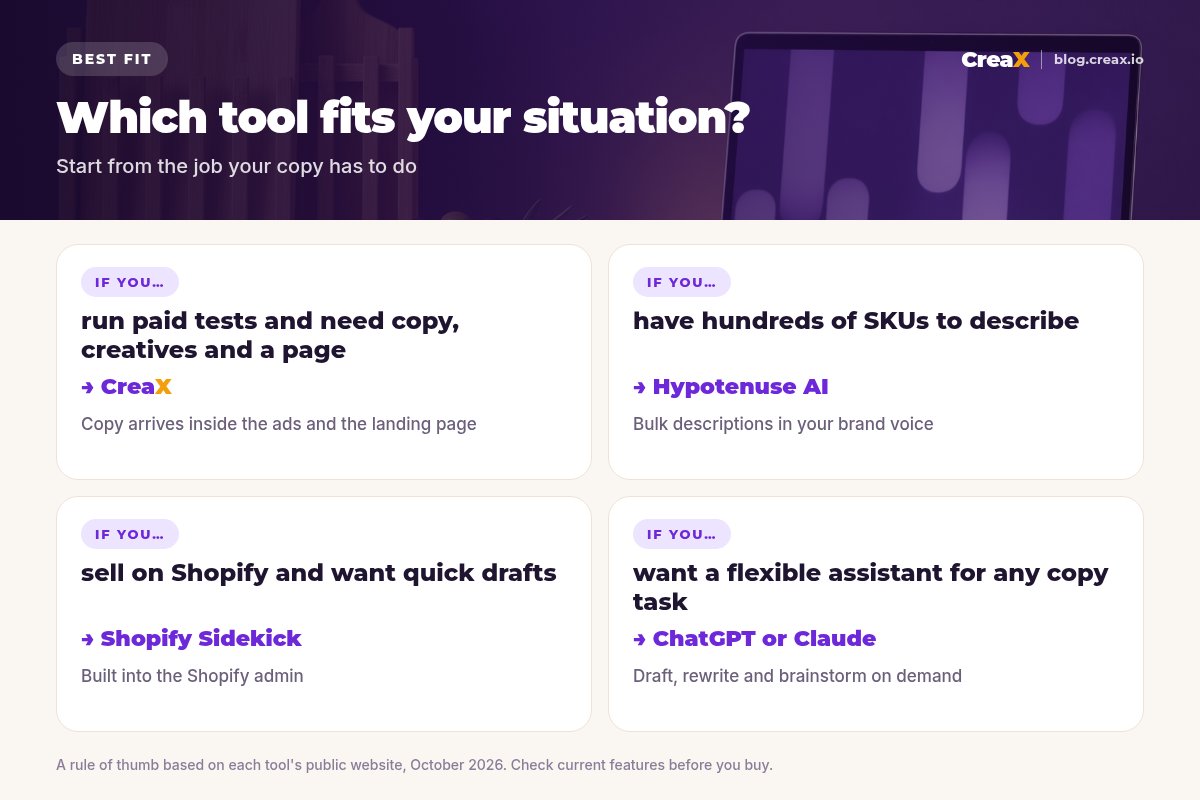
Answer these first
- ✓Is copy the bottleneck, or the whole test? If you also wait on videos, statics and a page, a kit like CreaX saves more time than a better writer.
- ✓How many products do you describe? A handful works fine in ChatGPT or Claude; hundreds of SKUs call for Hypotenuse AI or similar.
- ✓Where does the copy live? Ads, product pages, emails or a store. Pick the tool that writes for that place, ideally inside it.
- ✓Do you need one consistent brand voice? Jasper, Copy.ai and Anyword store voice and rules; general assistants need you to paste them each time.
- ✓Who checks the facts? Every tool can produce a claim your product doesn't support. Someone must check sizes, materials, run times and shipping promises.
Inputs matterWhat good AI copy needs from you
The biggest difference between weak and strong AI copy is rarely the tool. It's the brief. Before you generate anything, collect:
- The real facts: dimensions, materials, care instructions, what's in the box, shipping times. Paste them in; don't let the tool guess.
- One buyer and one problem: “home cooks who hate boards that slide” gives sharper copy than “everyone who cooks”.
- The angle of the ad: the product page should repeat the promise the ad made. Mismatched messages lose clicks you paid for.
- Words to avoid: claims you can't prove (“antibacterial”, “lasts forever”), medical or legal promises, and competitor names.
!Never let AI invent proof
Once the copy is ready, it still has to earn the click and the sale. For the page side, see what makes a high-converting product page; for the ad side, how to test ad angles for a new product.
ExampleWorked example: a small-budget stack
Say you sell a set of three bamboo cutting boards in a slim rack and want to test it on Meta and TikTok without a big budget. A practical stack could be:
Gather the facts
Draft angles with an assistant
Build the test kit
Edit and fact-check
Launch and compare
This keeps costs low: a general assistant for thinking, one kit for the assets, and your own judgement for the facts. For how many variations to run per angle, see how many ad creatives to test per product.
Turn one product link into a full test
UGC-style video ads, studio creatives and a landing page with copy that matches, in about 60–120 seconds.
FAQFrequently asked questions
Q.What is the best AI tool for product descriptions?
Q.Can AI write ad copy that converts?
Q.Is AI-written product copy bad for SEO?
Q.Do I still need to edit AI copy?
Q.How much do AI copywriting tools cost?
Q.Can I use ChatGPT and CreaX together?
Ready to test your next product?
Paste a product link and get UGC-style video ads, studio creatives and a landing page for your next test.
This guide is published by CreaX. We describe other tools from their own public websites as of October 2026, avoid invented scores or prices, and recommend checking each vendor's site for current features and plans.