
Are AI Influencers Worth It for Ecommerce Brands?
FAQ · AI influencers
Are AI influencers worth it for ecommerce brands? Sometimes, for the right job. A computer-generated persona can show products, model looks and post content on schedule, but it cannot honestly say it tried your product. This guide answers what AI influencers are, when they make sense, the disclosure questions and the safer ways to get the same benefits.
Updated October 2026 · By the CreaX team
Key takeaways
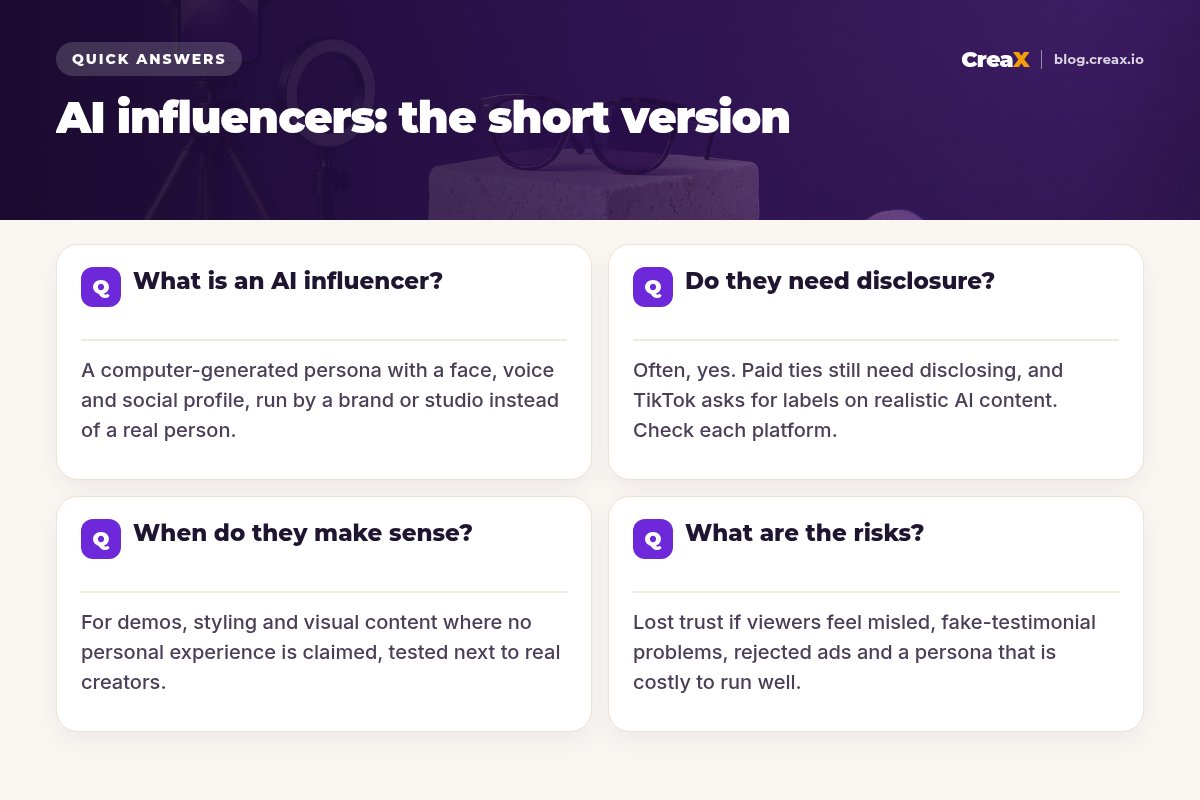
- ✓An AI influencer is a computer-generated persona with a face, voice and social presence, run by a brand or studio rather than a real person.
- ✓They work best for showing a product (demos, styling, visual content), and worst for vouching for it, because a persona has no real experience to share.
- ✓Disclosure matters. Paid relationships still need disclosing, and platforms such as TikTok ask for labels on realistic AI-generated content. Check the rules where you sell.
- ✓Many brands get most of the benefit with less risk by using AI-made product creatives and UGC-style ads for testing, plus real customers and creators for reviews.
In this guide
TL;DRThe short answer
AI influencers can be worth it for ecommerce brands that need a lot of visual content, want full control over a consistent on-brand character, and use that character to show products rather than to review them. They are rarely worth it as a replacement for real customer proof, and they come with real trust and disclosure questions that you need to handle up front.
For most small and mid-size stores, the practical question is not "should we build a virtual celebrity?" but "how do we get more creatives to test without misleading anyone?" That question has simpler answers, which we cover below.
iNot legal advice
DefinitionsWhat is an AI influencer?
An AI influencer (also called a virtual influencer or AI creator) is a digital persona made with computer graphics or generative AI. It has a consistent look, a name, often a voice and personality, and usually a social media account. A real team decides what it posts and says.
In ecommerce marketing you will meet three versions, and it helps to keep them apart:
| Type | What it is | Typical use |
|---|---|---|
| Virtual influencer with a following | A persistent character with its own social accounts and audience | Brand partnerships, much like a human creator |
| Brand-owned AI persona | A character a brand creates as its own face or mascot | Product demos, styling, always-on content |
| AI avatar in ads | A generated presenter or UGC-style actor used inside individual ads | Video ads, explainers and creative tests |
The three formats people usually mean by 'AI influencer'. Each raises slightly different trust and disclosure questions.
The third type overlaps with AI UGC-style video ads, which we cover in our guide to what a UGC video ad is. If you are weighing real creators against other options, see UGC vs influencer marketing.
TransparencyDo they need disclosure?
Often, yes, and in two separate ways that people tend to mix up:
- Disclosing the commercial relationship. If a persona promotes your product because you made it or paid for it, viewers should be able to tell it is advertising. In the US, the FTC's 2023 revised Endorsement Guides updated the definition of endorsements to make clear it can include virtual influencers. Other countries have their own advertising rules.
- Disclosing that the content is AI-generated. Platforms have their own rules here. TikTok, for example, asks creators to label AI-generated content that shows realistic scenes or people, and TikTok Ads Manager has a setting to mark an ad as containing AI-generated content. Meta also labels some AI-generated content and sets its own rules for ads.
Rules differ by country, platform and ad type, and they change. Read the current policy for every platform you advertise on before launch, and treat labelling as a default rather than something to avoid.
★A simple default
Good use casesWhen do AI influencers make sense?
AI personas are a tool, and some jobs suit them better than others:
- Product demonstrations. Showing how a bag opens, how a lamp lights a room or how a jacket layers, where the product itself does the convincing.
- Styling and visual content at volume. Fashion, accessories and home brands that need many looks and settings, posted regularly.
- A consistent brand character. A mascot-like persona that represents the brand, not a fake customer.
- Creative testing. Trying new hooks and angles quickly before spending on real creators for the angles that work.
- Localisation. Versions of the same content for different markets and languages, if the tool supports them.
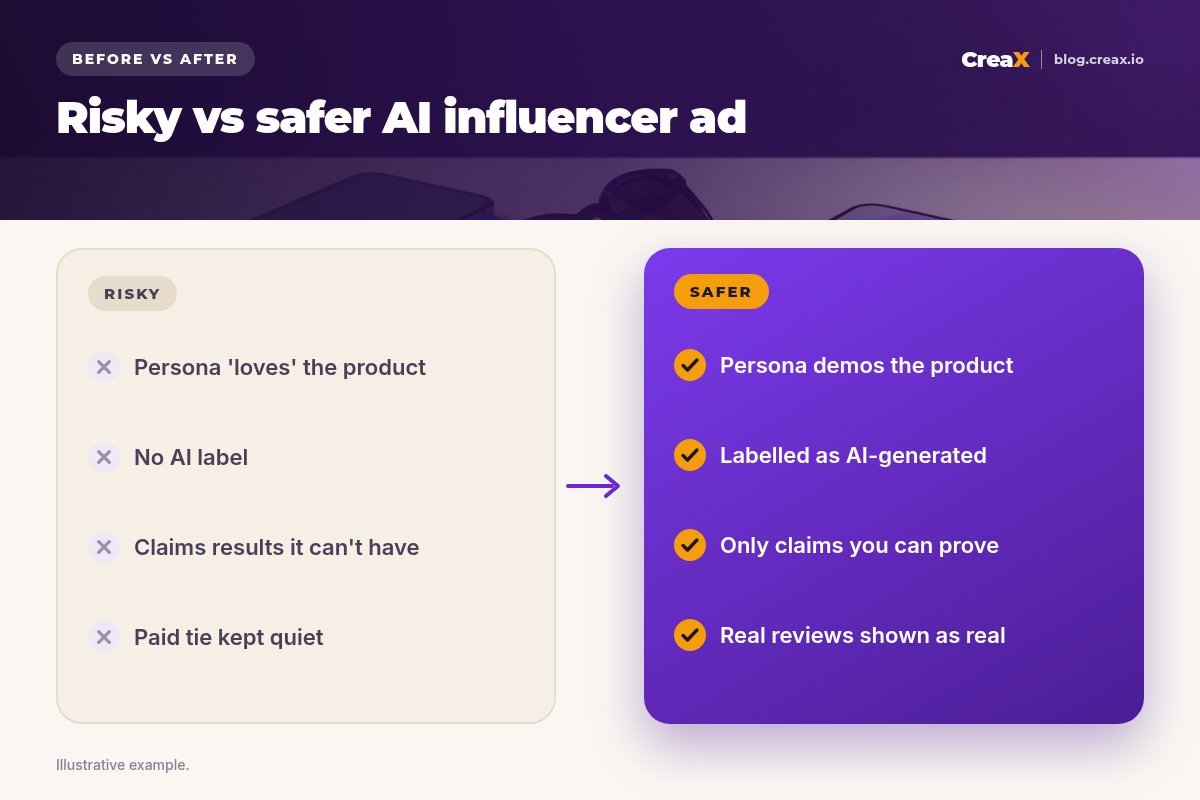
Notice the pattern: in each case, the persona presents the product. It does not claim to have used it, been helped by it or loved it.
Before you commitWhat are the risks?
| Risk | What it looks like | How to reduce it |
|---|---|---|
| Lost trust | Viewers learn later that the 'person' was AI and feel misled | Label AI content clearly from the start |
| Fake-testimonial problem | The persona says it used, loved or was helped by the product | Let the persona demo; keep reviews for real customers |
| Rejected or labelled ads | Platform rules on AI content or claims are not followed | Read each platform's current policy before launch |
| Product mismatch | The AI content shows a color, size or result the product cannot match | Compare every frame with the real product |
| Hidden running costs | A believable persona needs ongoing design, writing and posting | Start with a few ads before building a full persona |
Common risks of AI influencers and practical ways to reduce them. Audience reactions vary by niche, so test before you commit.
For a broader view on the commercial side, our article on whether AI-generated ads are safe to use commercially answers more questions about using AI creatives in paid ads.
Learn from othersCommon mistakes to avoid
- Making the persona a fake customer. "I've used this every day for a month" is a personal experience claim an AI cannot have.
- Hiding the AI or the ad. Viewers who find out later tend to remember the hiding more than the product.
- Showing results the product cannot deliver. AI makes it easy to show perfect outcomes. If your real product cannot match them, you are setting up refunds and rejections.
- Changing the product in the image. Colors, sizes, materials and included items in the AI content must match what ships.
- Going all in before testing. Start with a few ads next to your existing creatives and compare, instead of rebuilding your whole brand around a persona.
- Ignoring your audience. Some audiences enjoy virtual characters; others want real people. Watch comments and results, not just reach.
Before you launchChecklist you can copy
AI influencer launch checklist
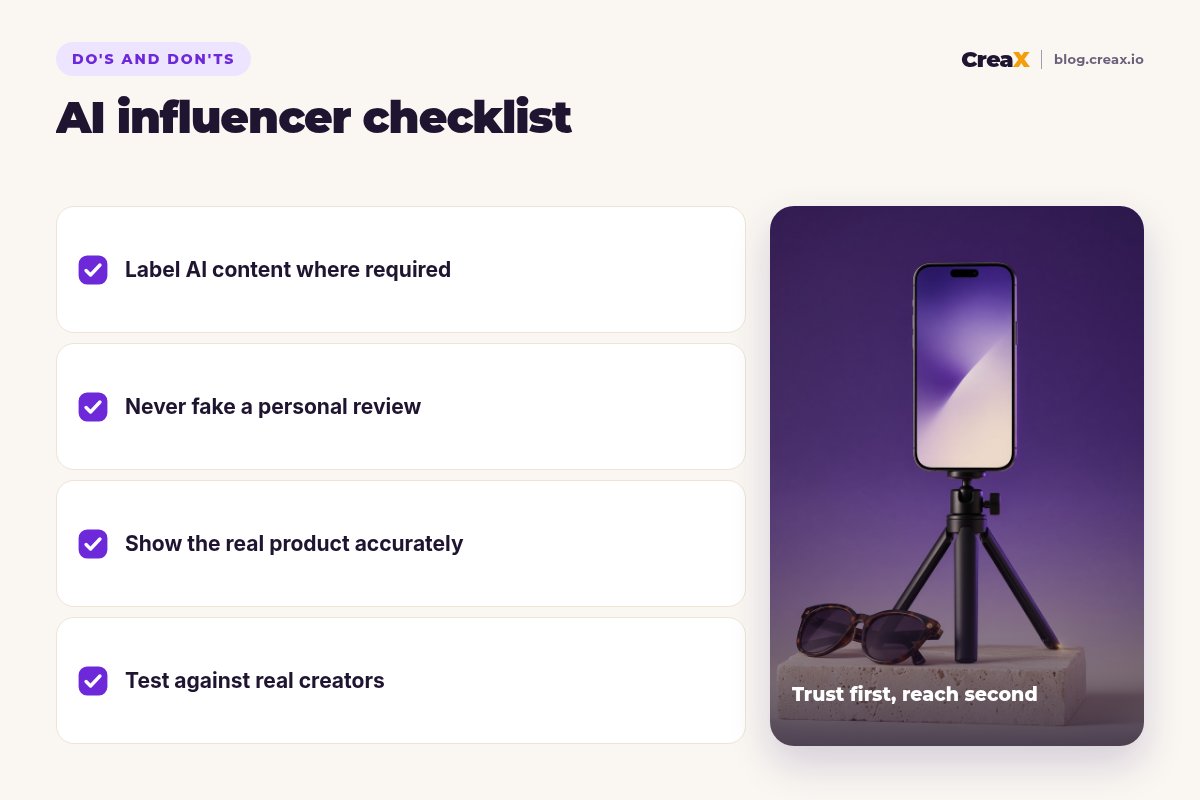
- ✓Job defined: the persona will show, demo or style the product, not review it.
- ✓Labels on: AI-generated content and paid relationships are disclosed according to each platform's rules.
- ✓Claims checked: every claim in the script is something you can prove about the real product.
- ✓Product accurate: color, size, material and contents match what the customer receives.
- ✓Real proof kept real: reviews and testimonials come only from real customers, shown as real.
- ✓Test planned: AI persona ads run next to your current creatives, with a clear success metric.
- ✓Exit plan: you know what you will change if comments or results turn negative.
Want more creatives to test, without building a persona?
CreaX turns one product link or image into studio ads, UGC-style video ads and a landing page, so you can test angles quickly and keep real reviews real.
Our approachHow CreaX helps (briefly)
Many brands looking at AI influencers really want two things: more creative variety and faster testing. CreaX is built for that, without asking you to run a virtual personality:
Paste a product link or upload an image
Get studio ad creatives
Get UGC-style video ads
Get a landing page
Test, then invest
The same honesty rules apply to any AI video, including CreaX's: check claims, keep the product accurate, label AI content where platforms require it, and never present a generated presenter as a real customer review. For hooks that work without fake testimonials, see UGC ad hooks that stop the scroll.
Test new angles today, honestly
One product link, about 60–120 seconds: studio ads, UGC-style video ads and a matching landing page for your next test.
FAQFrequently asked questions
Q.Are AI influencers cheaper than real influencers?
Q.Do AI influencers work for small ecommerce brands?
Q.Can an AI influencer review my product?
Q.Do I have to label AI-generated ads?
Q.Is CreaX an AI influencer tool?
Q.What should I test first?
Ready to make your next ad test?
Paste a product link or upload an image and get the creatives and the page for your first test, from $4.99 a month.
This guide is published by CreaX. It is general information, not legal advice. Platform and advertising rules change, so check the current policies for every platform and country you sell in.