
Are AI-Generated Ads Safe to Use Commercially?
FAQ · AI ads and the rules
AI can now produce product photos, ad images and presenter videos in minutes, and many sellers wonder whether they're allowed to run them. The short answer: usually yes, as long as you follow the tool's terms, the ad platforms' rules and the law where you sell. Most problems come from what an ad says or shows, not from the fact that AI made it. This FAQ explains ownership, brand names, AI faces and voices, risky claims and platform rules in plain language, with a checklist you can copy.
Updated October 2026 · By the CreaX team
!General information, not legal advice
Key takeaways
- ✓Usually yes: AI-generated ads are widely used commercially, but you're responsible for what they say and show.
- ✓Ownership depends on the tool and the law: read each tool's terms for commercial use; purely AI-generated material may get limited copyright protection in some countries.
- ✓Avoid real people and other brands: no celebrity lookalikes, cloned voices or logos that suggest a link you don't have.
- ✓Claims are the biggest risk: AI can invent benefits, so check every claim against evidence before you publish.
In this guide
TL;DRThe short answer
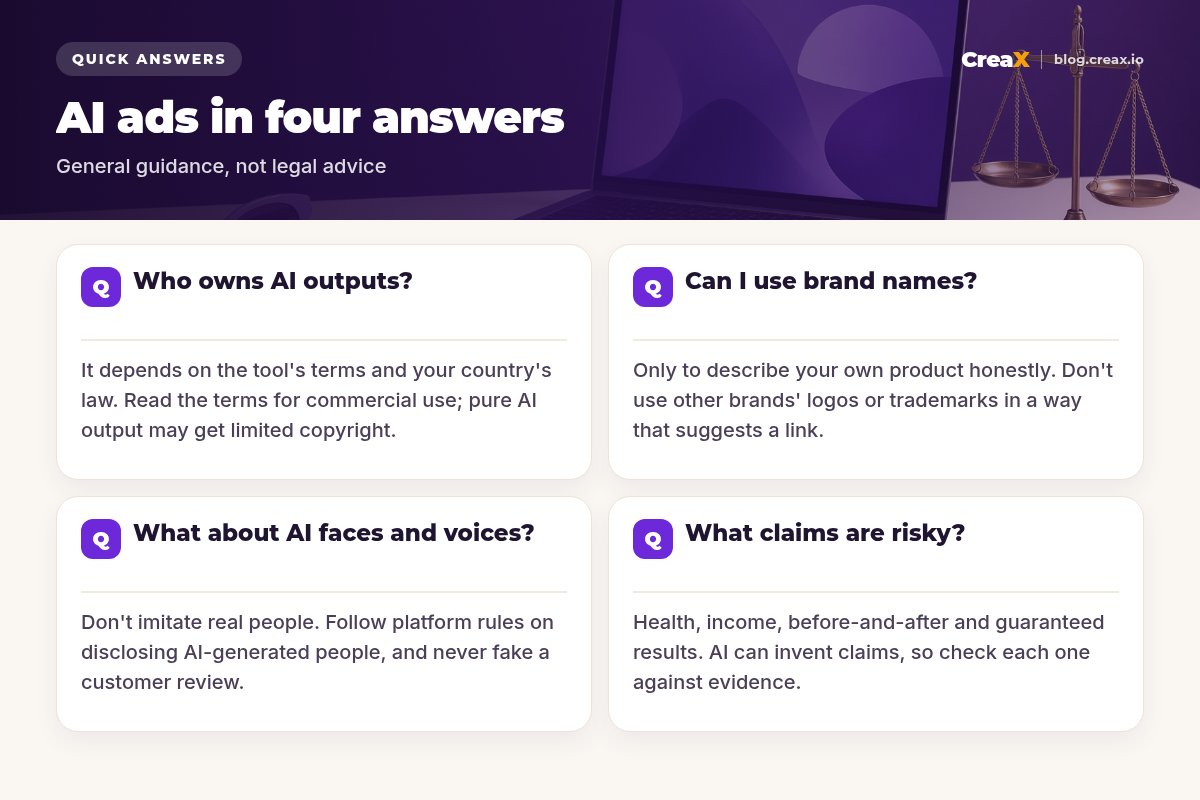
AI-generated ads are used by brands of every size, and ad platforms accept them. Using AI isn't the problem. The risks are the same ones that apply to any ad, plus a few that AI makes easier to stumble into: content you may not fully own, lookalikes of real people, other brands showing up in generated images, and claims the AI invented. Manage those four and AI ads are about as safe as any other creative.
| Question | Short answer | What to do |
|---|---|---|
| Can I use AI ads commercially? | Usually, if the tool's terms allow it | Read the terms for commercial use |
| Do I own the outputs? | Depends on the terms and your country's law | Add your own creative input and keep records |
| Can I mention other brands? | Only to describe honestly | No logos or implied partnerships |
| Can I use AI people? | Yes, if they don't imitate real people | No lookalikes, cloned voices or fake reviews |
| Which claims are risky? | Health, income, results, comparisons | Back every claim with evidence |
OwnershipWho owns AI outputs?
Two separate questions hide in here: what the tool lets you do with outputs, and whether the law protects them as yours.
What the tool's terms say
Every AI tool has terms of service that say whether you can use outputs commercially, who owns them, and what you may not generate. Terms vary between tools and plans, so read them for each tool you use, including any third-party models a tool relies on. Look for commercial-use permission, any restrictions, and who is responsible if something goes wrong.
What the law protects
Copyright law in many countries protects human creativity. In the US, for example, the Copyright Office has said copyright requires human authorship, so material generated entirely by AI may get little or no protection, while human contributions such as selection, arrangement and editing can be protected. Other countries take different approaches. In practice this means a competitor might be able to reuse a purely AI-generated image, even if you're allowed to use it.
★Make your ads more yours
TrademarksCan I use brand names?
Mentioning another brand to describe your product honestly is often acceptable, such as saying a case fits a specific phone model. What gets sellers in trouble is using another brand's name or logo in a way that suggests a connection, endorsement or origin that doesn't exist.
- Watch generated images closely. Image models sometimes add logos, brand-like marks or famous designs. Remove them or regenerate.
- No look-alike branding. Don't style your ad to look like a famous brand's campaign.
- Careful with comparisons. Comparing your product to a named competitor needs to be accurate and fair, and some countries have specific rules on comparative advertising.
- Platforms enforce this too. Meta and TikTok accept intellectual property complaints and can remove ads that infringe.
LikenessWhat about AI faces and voices?
AI presenters and voiceovers are common in UGC-style ads. Using a generated person is generally fine. The problems start when the AI person resembles, sounds like or is presented as someone real.
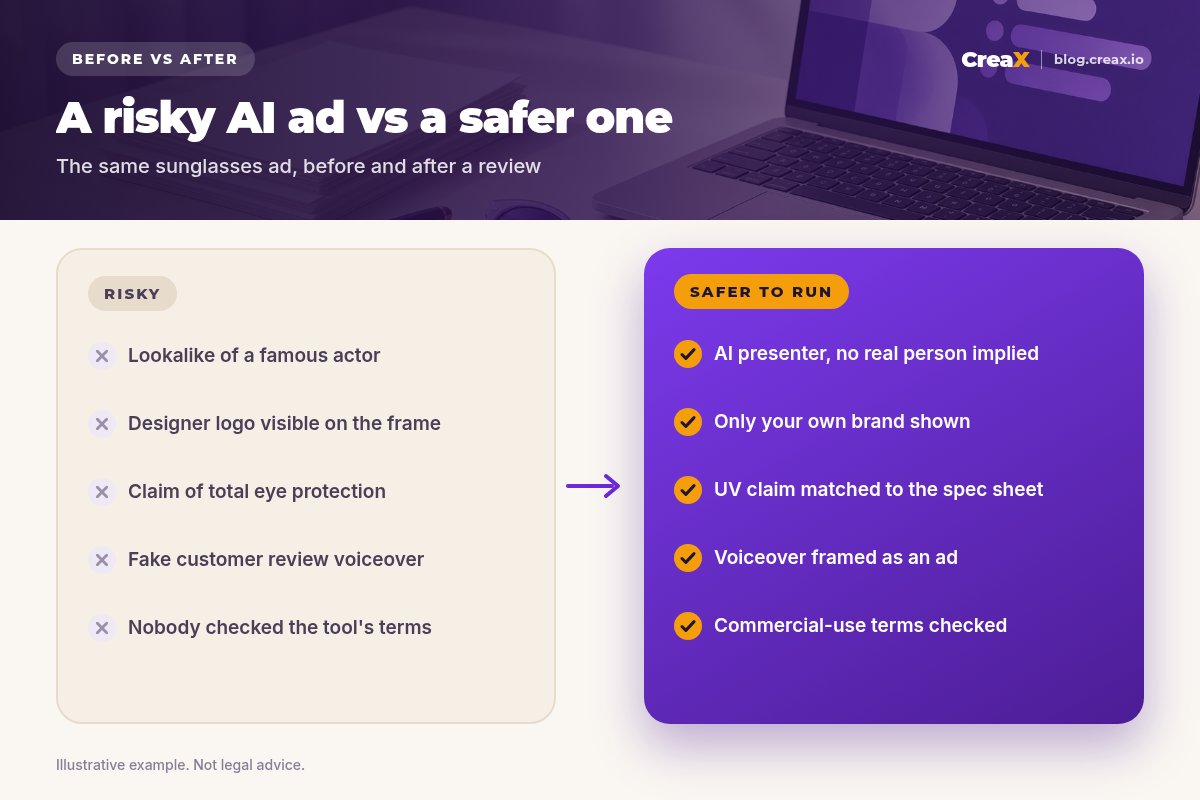
- No celebrity or influencer lookalikes and no cloned voices of real people without their permission. Many countries protect a person's likeness and voice, and platforms ban misleading use of public figures.
- No fake testimonials. An AI presenter saying "I've used this for months" as if they were a real customer is a fake review. In the US, the FTC has rules against fake reviews and testimonials, and other regulators take similar positions.
- Frame AI presenters as ads. Present the content as your brand speaking, not as an independent customer's experience.
- Follow disclosure rules. Some platforms and laws require labels for realistic AI-generated people or scenes. The EU's AI Act, for example, includes transparency rules for AI-generated content such as deepfakes.
For platform-specific detail, see are AI UGC ads allowed on Meta and TikTok? and our explainer on what a UGC video ad is.
ClaimsWhat claims are risky?
This is where most AI ad problems actually happen. AI writes persuasive copy, and persuasive copy drifts toward claims you can't prove: "clinically proven", "lose 10 kg", "100% UV protection" or "earn from home". Advertising law in most countries requires claims to be truthful and backed by evidence, whoever wrote them.
| Claim type | Why it's risky | Safer approach |
|---|---|---|
| Health and medical | Strict rules; platforms restrict many categories | Describe features, not cures; follow category rules |
| Income and results | Often banned or restricted by platforms | No promised earnings or guaranteed results |
| Before-and-after | Restricted for some categories on Meta and TikTok | Show the product, not body transformations |
| Specs and materials | AI may invent numbers or materials | Match every spec to the supplier's sheet |
| Comparisons | Must be accurate and fair | Compare only what you can prove |
⚖AI doesn't know your product
PlatformsAd platform rules
Meta, TikTok and Google all allow AI-generated ads, and all apply their normal advertising policies to them: no misleading claims, no prohibited products, no impersonation, and restrictions on sensitive categories. They also have policies on labeling realistic AI-generated content in some situations, and they update them often. Check the current advertising policies for each platform you run on, and keep an eye on ad rejections as an early warning.
If an ad is rejected, the cause is usually a claim, a restricted category or a misleading visual, the same as for non-AI ads. Our guide to fixing Facebook ad creatives covers creative issues that also affect performance.
MistakesCommon mistakes to avoid
- Publishing without reading the output. A logo in the background or an invented spec slips through.
- Letting AI write the claims. Use AI for wording, not facts.
- Celebrity-style prompts. Prompting for someone who looks like a famous person creates a lookalike problem.
- Fake customer framing. AI presenters pretending to be real buyers.
- Ignoring the terms. Assuming every plan of every tool allows commercial use.
- No records. Being unable to show what you generated and when.
ChecklistChecklist you can copy
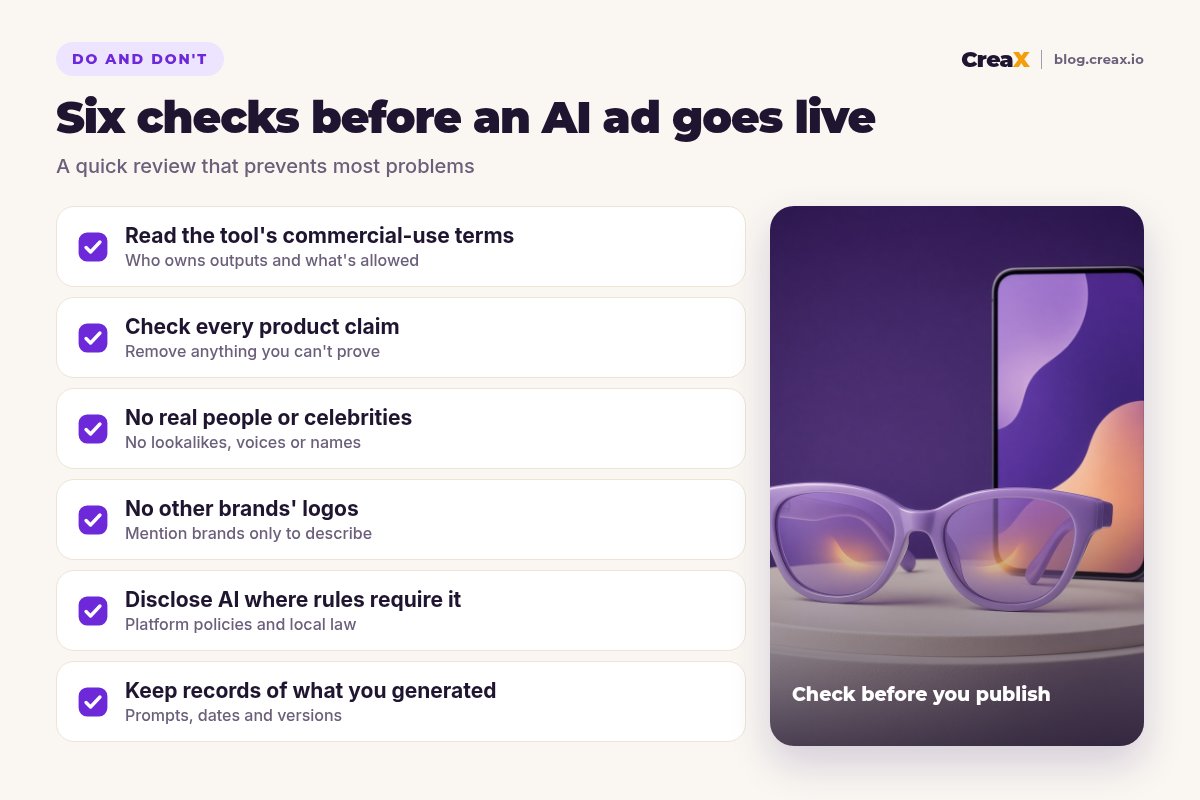
Run these checks on every AI-generated ad before it goes live:
Before you publish
- ✓I've read the commercial-use terms of every AI tool I used
- ✓Every claim is true and I can back it with evidence
- ✓No real person, celebrity lookalike or cloned voice
- ✓No other brand's logo, packaging or trademark style
- ✓AI presenters are framed as ads, not customer reviews
- ✓AI disclosure added where the platform or law requires it
- ✓I've saved prompts, inputs and dates for this ad
Make ads from your own product
CreaX starts from your product link or image, so your ads show your product and brand.
CreaXHow CreaX fits (briefly)
CreaX is an all-in-one AI ecommerce creative OS: paste a product link or upload a product image and it generates a landing page, studio ad creatives, UGC-style video ads and a store. Its UGC video ads use AI-generated presenters with native voiceover in 40+ languages, and its brand consistency feature applies your brand colors. Because you start from your own product, your ads show your product rather than someone else's.
The same rules in this guide still apply. Read the Terms of Service, Acceptable Use Policy and Third Party Terms linked in the creax.io footer before using outputs commercially, review every claim before publishing, and frame presenter videos as ads. Plans start free, with paid credit plans from $4.99 a month. To see what AI video ads can do, read do AI video ads work for ecommerce?
Ready to create ads you can review and run?
One product link: a landing page, studio creatives and UGC-style video ads in about 60–120 seconds.
FAQFrequently asked questions
Q.Are AI-generated ads legal?
Q.Can I copyright AI-generated ad images?
Q.Do I need to label AI-generated ads?
Q.Can AI presenters give testimonials?
Q.What if the AI adds a logo to my image?
Q.Is CreaX safe for commercial ads?
This guide is published by CreaX. We describe other tools from their own public websites as of October 2026, avoid invented scores or prices, and recommend checking each vendor's site for current features and plans.